PUBLISHER: Mordor Intelligence | PRODUCT CODE: 2061905

PUBLISHER: Mordor Intelligence | PRODUCT CODE: 2061905
Printed Films - Market Share Analysis, Industry Trends & Statistics, Growth Forecasts (2026 - 2031)
According to Mordor Intelligence, the printed films market size is projected to expand from USD 7.21 billion in 2025 and USD 7.47 billion in 2026 to USD 8.91 billion by 2031, registering a CAGR of 3.59% during the forecast period (2026 to 2031).
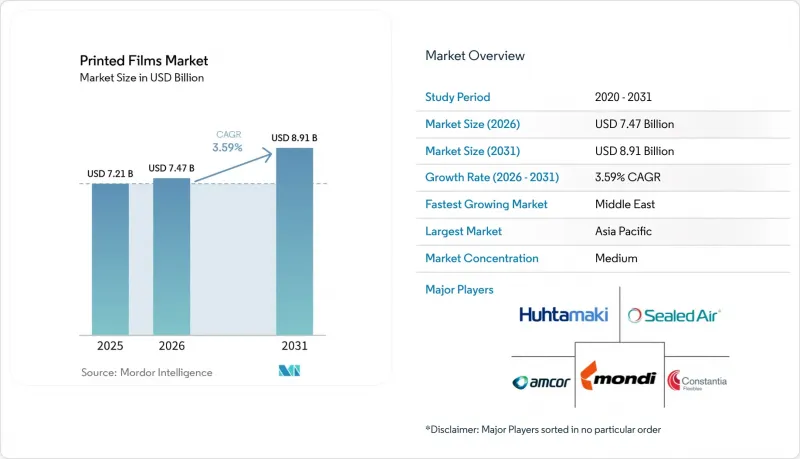
This report is Segmented by Film Material (Polyethylene Films, Polypropylene Films, and More), Printing Technology (Flexographic Printing, and More), Printing Ink Type (Solvent-Based Inks, Water-Based Inks, and More), End-User Industry (Food and Beverage, Personal Care and Cosmetics, and More), Film Thickness (Up To 25 Mm, and More), and Geography. The Market Forecasts are Provided in Terms of Value (USD).
Global Printed Films Market Trends and Insights
Rising Demand for Sustainable Packaging Solutions
Brand procurement contracts now embed circularity clauses that oblige converters to certify bio-based content and recyclability. CARBIOS secured US food-contact clearance in 2025 for enzymatically recycled polylactic-acid films, enabling closed-loop recovery without downcycling. Metalvuoto's bio-based barrier coating on PLA substrates delivers oxygen transmission below 5 cc/m2/day and extends produce shelf life by 40%. The EU Packaging and Packaging Waste Regulation, effective in 2026, introduces monetary penalties for non-compliant flexibles, prompting rapid substrate reformulation and boosting the adoption of sustainable printed films.
Growth of E-Commerce Boosting Protective Printed Films
Global parcel volumes reached 150 billion in 2025, each typically wrapped in 1.8 layers of film. Converters answered with high-impact polyethylene mailers that withstand >400 g-force puncture tests yet accept water-based flexo inks. Automated fulfillment centers favor coextruded slip layers with a 0.18 coefficient of friction to enable sortation belts to move 8,000 parcels per hour. Digital presses that swap graphics within 10 minutes support small promotional batches, aligning with same-day-delivery demands and sustaining market penetration of printed films in logistics packaging.
Volatility in Raw Material Prices for Printing Inks and Films
Polyethylene swung from USD 950/t to USD 1,320/t in 2025 on Middle East outages and China cracker shutdowns, slashing converter margins. Titanium dioxide climbed 18% YoY to USD 3,200/t in early 2026, inflating white-ink costs. Converters with captive resin or pigment facilities, such as Uflex, enjoy a 200-250 bp margin cushion, yet many independents are forced into quarterly repricing, limiting predictable investment in the printed films market.
Other drivers and restraints analyzed in the detailed report include:
- Advancements in High-Resolution Digital Printing Technologies
- Increasing Adoption of Smart and Interactive Packaging
- Environmental Concerns Regarding Plastic Waste Management
For complete list of drivers and restraints, kindly check the Table Of Contents.
Segment Analysis
Polyethylene accounted for 37.22% of 2025 revenue, yet polyester is on track to outpace the printed films market at a 3.61% CAGR, buoyed by pharmaceutical and high-barrier food formats that demand oxygen levels below 3 cc/m2/day. Toray's aluminum-oxide-coated PET delivers 0.8 cc/m2/day at 12 µm yet remains transparent, a specification low-density polyethylene cannot match without multilayer complexity. Polypropylene remains essential wherever heat-seal strength above 2.5 N/15 mm is required, while PVC's share continues to erode in food-contact applications due to phthalate bans. Emerging biopolymers currently have only mid-single-digit value but serve as a testbed for circularity pilots and keep the printed films market narrative around sustainability alive.
Cost-effective downgauging strategies are reinforcing polyester uptake. Innovia's nano-porous BOPP allows lettuce and berries to breathe without laser perforation, and Cosmo First's anti-fog PET keeps refrigerated pouches clear for a three-week shelf life. With regulators capping overall migration at 10 mg/dm2 in the EU, demand for food-grade resins with full traceability is increasing, positioning specialty PET grades as credible challengers to incumbent polyolefins within the printed films industry.
Flexo accounted for 41.82% share of 2025 revenue, but inkjet's 3.75% CAGR signals an inflection. Digital presses eliminate plate-mount downtime and run 500-meter jobs profitably, making them perfect for regional promotions and SKU proliferation. Windmoeller and Hoelscher's hybrid unit integrates flexo stations for static branding and inkjet heads for serialized QR codes, reducing cost per thousand impressions across mixed portfolios. Rotogravure remains relevant for snack and tobacco films exceeding 1 million meters, where cylinder costs amortize efficiently, and color variation must remain within +-1 ΔE.
Ongoing innovation keeps flexo competitive. Bobst's M6 line automatically registers plates and curtails setup scrap by 40%, narrowing waste differentials versus digital. Meanwhile, the printed films market for screen and pad technologies remains niche, focusing on conductive tracks and specialized tamper seals. Across print platforms, converters are weighing capital outlay against run-length flexibility, a trade-off that shapes future equipment purchases throughout the printed films industry.
Geography Analysis
Asia-Pacific accounted for 34.17% of the printed films market, anchored by India's 81,200 tpa line from Cosmo First and Jindal Poly Films' INR 700 crore (USD 84 million) expansion, which together reinforce regional leadership in BOPP and BOPET supply. China's domestic demand for e-commerce mailers grew at mid-single-digit rates despite resin shortages, while Japan's converters focused on export-oriented pharmaceutical applications that require stringent migration controls. Southeast Asian nations captured follow-on investment in specialty laminates, adding to the depth of the printed films market across the region.
North America and Europe jointly captured nearly one-half of global value, driven by higher selling prices for low-migration and recyclability-compliant films. Amcor's USD 24 billion revenue base after merging with Berry Global accentuates consolidation, and Mondi's EUR 1.2 billion (USD 1.34 billion) capex program increases mono-material stand-up pouch output. The EU Packaging Regulation, taking effect in 2026, spurs redesigns toward recyclable structures, an imperative that sustains the printed films market size in mature economies.
The Middle East is expected to post the fastest CAGR of 3.96% through 2031, as GulfPack's 135,000 tpa BOPP line positions Saudi Arabia as a re-export platform to Africa and South Asia. South America holds high potential but faces currency volatility that tempers capital spending, while Africa remains largely import-dependent, with South Africa and Egypt hosting regional hubs that serve basic flexible packaging needs.
- Sealed Air Corporation
- Amcor plc
- Huhtamaki Oyj
- Mondi plc
- Constantia Flexibles Group GmbH
- CCL Industries Inc.
- Sonoco Products Company
- Avery Dennison Corporation
- Uflex Limited
- Cosmo First Limited
- Klockner Pentaplast GmbH & Co. KG
- Toppan Inc.
- Dai Nippon Printing Co., Ltd.
- Taghleef Industries LLC
- POLIFILM GmbH
- FlexFilms Limited
- Jindal Poly Films Limited
- Innovia Films Limited
- Toray Industries, Inc.
- Bemis Company, Inc.
Additional Benefits:
- The market estimate (ME) sheet in Excel format
- 3 months of analyst support
TABLE OF CONTENTS
1 INTRODUCTION
- 1.1 Study Assumptions and Market Definition
- 1.2 Scope of the Study
2 RESEARCH METHODOLOGY
3 EXECUTIVE SUMMARY
4 MARKET LANDSCAPE
- 4.1 Market Overview
- 4.2 Market Drivers
- 4.2.1 Rising Demand for Sustainable Packaging Solutions
- 4.2.2 Growth of E-Commerce Boosting Protective Printed Films
- 4.2.3 Advancements in High-Resolution Digital Printing Technologies
- 4.2.4 Increasing Adoption of Smart and Interactive Packaging
- 4.2.5 Rapid Expansion of Printed Electronics on Flexible Substrates
- 4.2.6 Stringent Regulations Driving Biodegradable Printed Film Usage
- 4.3 Market Restraints
- 4.3.1 Volatility in Raw Material Prices for Printing Inks and Films
- 4.3.2 Environmental Concerns Regarding Plastic Waste Management
- 4.3.3 High Initial Capital Investment in Advanced Printing Presses
- 4.3.4 Supply Chain Disruptions Affecting Specialty Substrates
- 4.4 Industry Value-Chain Analysis
- 4.5 Regulatory Landscape
- 4.6 Technological Outlook
- 4.7 Impact of Macroeconomic Factors on the Market
- 4.8 Porter's Five Forces Analysis
- 4.8.1 Threat of New Entrants
- 4.8.2 Bargaining Power of Suppliers
- 4.8.3 Bargaining Power of Buyers
- 4.8.4 Threat of Substitutes
- 4.8.5 Competitive Rivalry
5 MARKET SIZE AND GROWTH FORECASTS (VALUE)
- 5.1 By Film Material
- 5.1.1 Polyethylene (PE) Films
- 5.1.2 Polypropylene (PP) Films
- 5.1.3 Polyester (PET) Films
- 5.1.4 Polyvinyl Chloride (PVC) Films
- 5.1.5 Other Film Materials
- 5.2 By Printing Technology
- 5.2.1 Flexographic Printing
- 5.2.2 Rotogravure Printing
- 5.2.3 Digital Inkjet Printing
- 5.2.4 Other Printing Technologies
- 5.3 By Printing Ink Type
- 5.3.1 Solvent-based Inks
- 5.3.2 Water-based Inks
- 5.3.3 UV/EB-curable Inks
- 5.3.4 Other Printing Ink Types
- 5.4 By End-user Industry
- 5.4.1 Food and Beverage
- 5.4.2 Personal Care and Cosmetics
- 5.4.3 Pharmaceuticals
- 5.4.4 Homecare and Cleaning
- 5.4.5 Other End-user Industries
- 5.5 By Film Thickness
- 5.5.1 Up to 25 µm
- 5.5.2 25 - 50 µm
- 5.5.3 50 -100 µm
- 5.5.4 Above 100 µm
- 5.6 By Geography
- 5.6.1 North America
- 5.6.1.1 United States
- 5.6.1.2 Canada
- 5.6.1.3 Mexico
- 5.6.2 South America
- 5.6.2.1 Brazil
- 5.6.2.2 Argentina
- 5.6.2.3 Rest of South America
- 5.6.3 Europe
- 5.6.3.1 United Kingdom
- 5.6.3.2 Germany
- 5.6.3.3 France
- 5.6.3.4 Italy
- 5.6.3.5 Rest of Europe
- 5.6.4 Asia-Pacific
- 5.6.4.1 China
- 5.6.4.2 Japan
- 5.6.4.3 India
- 5.6.4.4 South Korea
- 5.6.4.5 Rest of Asia-Pacific
- 5.6.5 Middle East
- 5.6.5.1 United Arab Emirates
- 5.6.5.2 Saudi Arabia
- 5.6.5.3 Turkey
- 5.6.5.4 Israel
- 5.6.5.5 Rest of Middle East
- 5.6.6 Africa
- 5.6.6.1 South Africa
- 5.6.6.2 Egypt
- 5.6.6.3 Rest of Africa
- 5.6.1 North America
6 COMPETITIVE LANDSCAPE
- 6.1 Market Concentration
- 6.2 Strategic Moves
- 6.3 Market Share Analysis
- 6.4 Company Profiles (includes Global Level Overview, Market Level Overview, Core Segments, Financials as available, Strategic Information, Market Rank/Share, Products and Services, Recent Developments)
- 6.4.1 Sealed Air Corporation
- 6.4.2 Amcor plc
- 6.4.3 Huhtamaki Oyj
- 6.4.4 Mondi plc
- 6.4.5 Constantia Flexibles Group GmbH
- 6.4.6 CCL Industries Inc.
- 6.4.7 Sonoco Products Company
- 6.4.8 Avery Dennison Corporation
- 6.4.9 Uflex Limited
- 6.4.10 Cosmo First Limited
- 6.4.11 Klockner Pentaplast GmbH & Co. KG
- 6.4.12 Toppan Inc.
- 6.4.13 Dai Nippon Printing Co., Ltd.
- 6.4.14 Taghleef Industries LLC
- 6.4.15 POLIFILM GmbH
- 6.4.16 FlexFilms Limited
- 6.4.17 Jindal Poly Films Limited
- 6.4.18 Innovia Films Limited
- 6.4.19 Toray Industries, Inc.
- 6.4.20 Bemis Company, Inc.
7 MARKET OPPORTUNITIES AND FUTURE OUTLOOK
- 7.1 White-Space and Unmet-Need Assessment

