
PUBLISHER: Mordor Intelligence | PRODUCT CODE: 2061916

PUBLISHER: Mordor Intelligence | PRODUCT CODE: 2061916
Aquatic Herbicides - Market Share Analysis, Industry Trends & Statistics, Growth Forecasts (2026 - 2031)
According to Mordor Intelligence, the aquatic herbicides market is projected to grow from USD 0.98 billion in 2025 to USD 1.05 billion in 2026, and is forecast to reach USD 1.62 billion by 2031, marking a 9% CAGR from 2026 to 2031.
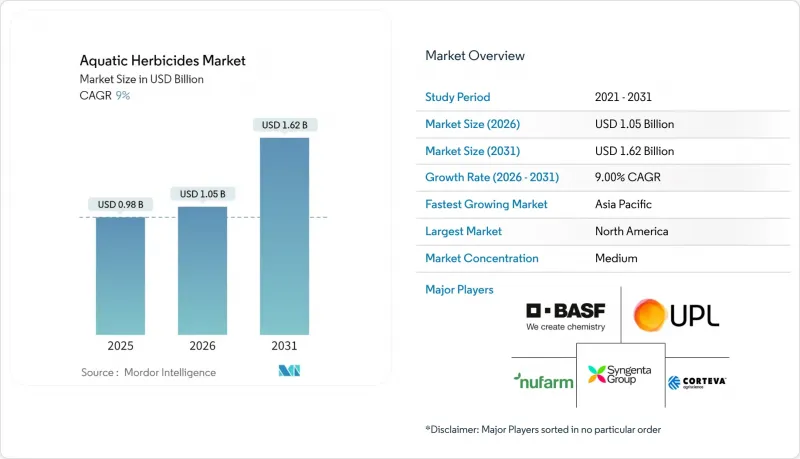
This report is Segmented by Product Type (Glyphosate, 2, 4-D, and More), by Mode of Action (Selective Herbicides, and More), by Application Method (Foliar Application, and More), by End-User Industry (Agricultural Water Bodies, and More), by Formulation (Liquid Concentrates, and More), and by Geography (North America, South America, and More). The Market Forecasts are Provided in Terms of Value (USD).
Global Aquatic Herbicides Market Trends and Insights
Invasive-Weed Outbreaks In Hydropower Reservoirs
Invasive macrophytes are obstructing turbine intakes and reducing capacity at hydropower assets in emerging regions. For instance, water-hyacinth mats have caused significant operational challenges, prompting the adoption of continuous herbicide programs and mechanical removal. Federal funding initiatives highlight the growing recognition of the threat invasive species pose to power generation and recreation. Operators are shifting from reactive measures to proactive strategies, such as basin-wide mapping, early-detection surveillance, and whole-lake herbicide treatments. This shift is driving demand for efficient chemical solutions and precision delivery systems.
Faster Permitting Of Reduced-Risk Actives
In 2024, the United States Environmental Protection Agency (EPA) approved glufosinate-P for aquatic use, marking the first phosphinic-acid option for submersed treatments . FMC Corporation intends to introduce Dodhylex in 2026. Harmonized exposure modeling and toxicology endpoints in Europe and North America are expediting approvals, benefiting molecules with selective toxicity and rapid degradation. These advancements are fostering innovation while also increasing competition in premium, compliance-sensitive market segments, where adherence to stringent regulations is critical for market entry and sustainability.
Stringent Toxicological Re-Registration
In 2025, the United States Environmental Protection Agency (EPA) updated its Aquatic Life Benchmarks, incorporating revised toxicity thresholds for numerous pesticide active ingredients based on updated ecological risk assessments. Concurrently, the European Food Safety Authority (EFSA) continues to enforce stringent requirements for endocrine disruption and ecotoxicological data under European Union pesticide regulations. These regulations often mandate higher-tier and long-term studies on aquatic species. The evolving regulatory standards have increased data requirements, extended approval timelines, and raised compliance costs for manufacturers, creating significant entry barriers and contributing to supply constraints.
Other drivers and restraints analyzed in the detailed report include:
- Eco-Tourism And Blue-Economy Funding For Lake Restoration
- Aquaculture Acreage Expansion Driving Demand
- Price Compression From Generic Glyphosate And Diquat Oversupply
For complete list of drivers and restraints, kindly check the Table Of Contents.
Segment Analysis
Glyphosate generated the largest 42.5% market share for aquatic herbicides in 2025, while imazamox is projected to log the fastest 11.2% CAGR from 2026 to 2031, pointing to progressive portfolio realignment. Data shows that imazamox can effectively control aquatic weeds at submerged rates of 500 parts per billion and foliar rates of 32 fluid ounces per acre . Investors in aquaculture are gravitating towards imazamox, willing to pay a 30%-50% premium over traditional actives to protect their high-value fish and crustaceans. While triclopyr and 2,4-D cater to specific woody shoreline needs, diquat is facing margin pressures due to an influx of generic alternatives.
Looking ahead, formulators are increasingly combining reduced-risk actives with adjuvants, enhancing uptake efficiency and extending environmental application windows. As the demand for selective molecules rises, distributors are reshaping their inventories to meet tightening residue tolerances. FMC Corporation's upcoming launch of Dodhylex in 2026, a new mode-of-action chemistry, is poised to challenge glyphosate's market dominance. In summary, the aquatic herbicides market is gradually shifting its focus from volume to value, emphasizing high-selectivity actives.
Non-selective herbicides maintained the largest 55.1% market share for the aquatic herbicides in 2025, yet selective formulas will advance at the fastest 9.4% CAGR from 2026 to 2031. Selective options suit integrated rice-fish-vegetable wetlands in Bangladesh, where farmers need to protect both rice seedlings and stock. Regulatory regimes in North America reward selectivity with Reduced Risk designations, accelerating label clearance and shortening market entry.
Conversely, in South America, hydropower and irrigation districts continue to favor non-selective herbicides. Their goal is to optimize conveyance capacity while minimizing costs per hectare. To address the evolving market dynamics, vendors are introducing split-application programs. These combine a lower-rate non-selective knockdown with a subsequent selective application, striking a balance between efficacy, cost, and ecological considerations. Such innovative hybrid strategies ensure that while the market for aquatic herbicides expands its selective offerings, non-selective chemistry remains pertinent.
Geography Analysis
In 2025, North America held the largest market share of 35% in the aquatic herbicides market, driven by robust regulatory frameworks and public funding initiatives. The Great Lakes Restoration Initiative has seen cumulative investments exceeding USD 4 billion, with additional funding provided under the Bipartisan Infrastructure Law for ecosystem restoration. State-level programs further bolster demand. Additionally, the approval of newer herbicide actives, such as florpyrauxifen-benzyl, by the United States Environmental Protection Agency reflects a shift toward more selective and environmentally compliant chemistries.
From 2026 to 2031, the Asia-Pacific region is projected to experience the fastest growth in the aquatic herbicides market, with a CAGR of 9.5%. This growth is attributed to the expansion of aquaculture and water infrastructure. According to the Food and Agriculture Organization, Asia accounts for over 85% of global aquaculture production, with significant contributions from China, India, Indonesia, and Vietnam. The prevalence of invasive aquatic weeds, such as water hyacinth, negatively impacts productivity, increasing the reliance on herbicides. Furthermore, China's strong domestic production of glyphosate and diquat enhances cost competitiveness, although regulatory fragmentation across the region poses challenges for smaller market players.
Europe, South America, the Middle East, and Africa exhibit diverse market dynamics influenced by regulatory and investment trends. In Europe, the European Food Safety Authority enforces stringent pesticide approval protocols, including assessments for endocrine disruption, which can delay the commercialization of new active ingredients. In Brazil, aquatic weed management practices vary by application. Chemical herbicides are commonly used in irrigation canals, while mechanical removal is preferred in environmentally sensitive areas. In Africa and the Middle East, increasing investments in hydropower and water infrastructure, supported by institutions such as the World Bank, are driving the adoption of integrated aquatic vegetation management approaches that combine herbicides with monitoring systems.
- Syngenta AG
- BASF SE
- Corteva, Inc.
- UPL Limited
- Nufarm Limited
- SePRO Corporation
- Sumitomo Chemical Company, Limited (Valent USA)
- Arxada AG
- Nippon Soda Co., Ltd.
- Alligare, LLC
- Albaugh, LLC
- FMC Corporation
- Hangzhou Tianlong Biotechnology Co., Ltd.
- Aquatic Technologies
Additional Benefits:
- The market estimate (ME) sheet in Excel format
- 3 months of analyst support
TABLE OF CONTENTS
1 Introduction
- 1.1 Study Assumptions and Market Definition
- 1.2 Scope of the Study
2 Research Methodology
3 Executive Summary
4 Market Landscape
- 4.1 Market Overview
- 4.2 Market Drivers
- 4.2.1 Invasive-weed outbreaks in hydropower reservoirs
- 4.2.2 Faster permitting of reduced-risk actives
- 4.2.3 Eco-tourism and blue-economy funding for lake restoration
- 4.2.4 Aquaculture acreage expansion driving demand
- 4.2.5 Digital bathymetry and drone spraying cutting costs
- 4.2.6 Bio-based chelation carriers improving copper-herbicide efficacy
- 4.3 Market Restraints
- 4.3.1 Stringent toxicological re-registration
- 4.3.2 Price compression from generic glyphosate and diquat oversupply
- 4.3.3 Preference for mechanical harvesting in recreation lakes
- 4.3.4 Activist litigation delaying permits
- 4.4 Regulatory Landscape
- 4.5 Technological Outlook
- 4.6 Porter's Five Forces Analysis
- 4.6.1 Threat of New Entrants
- 4.6.2 Bargaining Power of Suppliers
- 4.6.3 Bargaining Power of Buyers
- 4.6.4 Threat of Substitutes Products
- 4.6.5 Intensity of Competitive Rivalry
5 Market Size and Growth Forecasts (Value)
- 5.1 By Product Type
- 5.1.1 Glyphosate
- 5.1.2 2,4-D
- 5.1.3 Imazamox
- 5.1.4 Imazapyr
- 5.1.5 Triclopyr
- 5.1.6 Diquat
- 5.2 By Mode of Action
- 5.2.1 Selective Herbicides
- 5.2.2 Non-Selective Herbicides
- 5.3 By Application Method
- 5.3.1 Foliar Application
- 5.3.2 Submersed Injection
- 5.4 By End-User Industry
- 5.4.1 Agricultural Water Bodies
- 5.4.2 Recreational Water Bodies
- 5.4.3 Fisheries and Aquaculture
- 5.5 By Formulation
- 5.5.1 Liquid Concentrates
- 5.5.2 Granular/Pelletized
- 5.5.3 Tablet/Compressed Briquettes
- 5.5.4 Water Soluble Concentrates
- 5.5.5 Emulsifiable Concentrates
- 5.6 By Geography (Value)
- 5.6.1 North America
- 5.6.1.1 United States
- 5.6.1.2 Canada
- 5.6.1.3 Mexico
- 5.6.1.4 Rest of North America
- 5.6.2 South America
- 5.6.2.1 Brazil
- 5.6.2.2 Argentina
- 5.6.2.3 Rest of South America
- 5.6.3 Europe
- 5.6.3.1 Germany
- 5.6.3.2 France
- 5.6.3.3 United Kingdom
- 5.6.3.4 Russia
- 5.6.3.5 Rest of Europe
- 5.6.4 Asia-Pacific
- 5.6.4.1 China
- 5.6.4.2 India
- 5.6.4.3 Japan
- 5.6.4.4 Australia
- 5.6.4.5 Rest of Asia-Pacific
- 5.6.5 Middle East
- 5.6.5.1 Saudi Arabia
- 5.6.5.2 United Arab Emirates
- 5.6.5.3 Rest of Middle East
- 5.6.6 Africa
- 5.6.6.1 South Africa
- 5.6.6.2 Egypt
- 5.6.6.3 Rest of Africa
- 5.6.1 North America
6 Competitive Landscape
- 6.1 Market Concentration
- 6.2 Strategic Moves
- 6.3 Market Share Analysis
- 6.4 Company Profiles (Includes Global level Overview, Market level overview, Core Segments, Financials as available, Strategic Information, Market Rank/Share for key companies, Products and Services, and Recent Developments)
- 6.4.1 Syngenta AG
- 6.4.2 BASF SE
- 6.4.3 Corteva, Inc.
- 6.4.4 UPL Limited
- 6.4.5 Nufarm Limited
- 6.4.6 SePRO Corporation
- 6.4.7 Sumitomo Chemical Company, Limited (Valent USA)
- 6.4.8 Arxada AG
- 6.4.9 Nippon Soda Co., Ltd.
- 6.4.10 Alligare, LLC
- 6.4.11 Albaugh, LLC
- 6.4.12 FMC Corporation
- 6.4.13 Hangzhou Tianlong Biotechnology Co., Ltd.
- 6.4.14 Aquatic Technologies
7 Market Opportunities and Future Outlook

