
PUBLISHER: Mordor Intelligence | PRODUCT CODE: 2061926

PUBLISHER: Mordor Intelligence | PRODUCT CODE: 2061926
Ultrafiltration - Market Share Analysis, Industry Trends & Statistics, Growth Forecasts (2026 - 2031)
According to Mordor Intelligence, the ultrafiltration market size is expected to grow from USD 56.63 billion in 2025 to USD 61.59 billion in 2026 and is forecast to reach USD 95.09 billion by 2031 at 9.07% CAGR over 2026-2031.
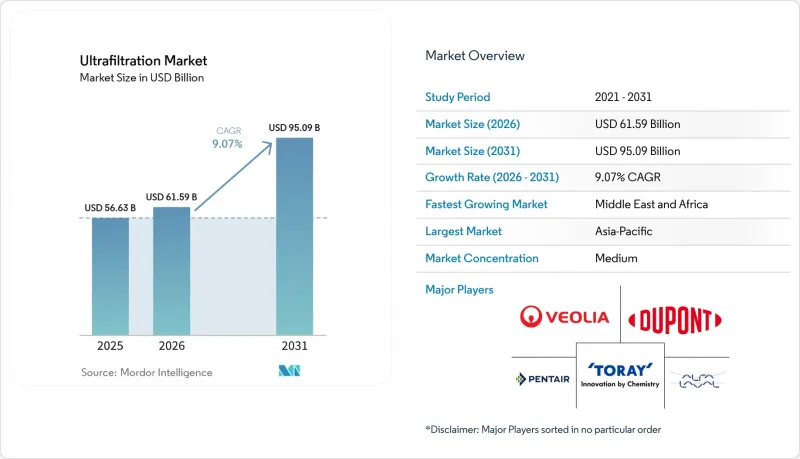
This report is Segmented by Membrane Type (Polymeric, Ceramic, and More), Module Type (Hollow Fiber, Spiral Wound, and More), Application (Water and Wastewater Treatment, Micro-Electronics and More), End-User Industry (Municipal, Industrial, and More), and Geography (Asia-Pacific, North America, Europe, South America, and Middle-East and Africa). The Market Forecasts are Provided in Terms of Value (USD).
Global Ultrafiltration Market Trends and Insights
Growing Demand for Water and Wastewater Treatment
Utilities, facing challenges of water scarcity, are moving away from traditional sand filtration methods, opting instead for advanced membrane clarification. This transition not only enables them to adhere to strict turbidity standards but also sidesteps the significant expenses tied to reservoirs. In China, the Yiwu Third Water Plant is at the forefront, utilizing ceramic modules for extensive water processing. Their research indicates that, even accounting for fouling downtimes, ceramic systems are economically comparable to polymeric systems. Meanwhile, in Qingdao Dongjiakou, another facility is combining ultrafiltration with reverse osmosis, resulting in reduced maintenance needs and improved operational cost efficiency. The Middle-East is also advancing, with plans to expand desalination capacities in the coming years. Interestingly, a large portion of these tenders is leaning toward ultrafiltration pretreatment. This trend of ultrafiltration isn't confined to desalination; it's gaining traction in industrial reuse too. For example, Veolia's Vitoria station in Brazil is supplying process water to major steel manufacturers. This achievement not only emphasizes the station's operational efficiency but also signifies a marked decrease in freshwater consumption for a region already grappling with drought challenges.
Integration of Ultrafiltration as Pretreatment for Reverse Osmosis and Desalination
Seawater plants now standardize dual-membrane trains, as reverse-osmosis warranties mandate ultrafiltration feedwater. Toray's 2025 high-removal hollow fiber cuts downstream fouling by a third and reduces carbon output from chemical cleaning by 30%. DuPont's 2026 ultra-high-pressure element, aiming for minimal liquid discharge, depends on ultrafiltration to avert irreversible compaction. Bahrain's USD 2 billion expansions at Sitra and Hidd set turbidity limits under 0.1 nephelometric turbidity units and a silt density index below 3.0, ensuring ultrafiltration is in place before major operations commence. Energy modeling reveals that implementing 0.5-2 bar ultrafiltration boosts reverse-osmosis flux by 10%-15%. This enhancement can prolong the lifespan of the elements by as much as two years, leading to a favorable net-present-value payback. As a testament to its efficacy, industry associations have incorporated these designs into their best-practice manuals, paving the way for a swift global adoption.
Membrane Fouling and Cleaning Costs
Surface-water plants grappling with high turbidity and elevated dissolved organics face a significant financial drain due to fouling. Regular treatments using bleach, acid, and surface-active agents oxidize polymeric fibers, consequently shortening their effective lifespan. While ceramic modules can withstand rigorous cleaning, their elevated price confines them to upscale markets. Pall's Gradient Permeability Integrated Cartridge design, boasting graduated permeability, has notably cut down cleaning frequency in dairy trials, yet it is just now entering wider markets. Research on graphene-oxide coatings indicates potential in curbing flux decline in laboratory feeds; however, the absence of timely pilot data hampers field adoption. In the Middle East, operators are experimenting with ultraviolet pre-oxidation and dissolved-air flotation to lessen organic loads, though this comes with increased capital complexity.
Other drivers and restraints analyzed in the detailed report include:
- Rising Adoption in Food and Beverage Product-Recovery Loops
- Decentralized Ultrafiltration Skids for Smart-City and Remote Installations
- Competition From Membrane Bioreactor and Next-Generation Low-Pressure Membranes
For complete list of drivers and restraints, kindly check the Table Of Contents.
Segment Analysis
In 2025, polymeric membranes secured 67.20% of the revenue, capitalizing on their cost advantages. However, ceramic alternatives are set to outpace the competition, boasting a projected CAGR of 10.56% in the ultrafiltration market from 2026 to 2031. Hollow fiber polymeric units are strategically priced to align with standard municipal budget depreciation schedules. On the other hand, food and pharmaceutical processors opt for the pricier ceramic units. This choice stems from ceramics' enhanced heat and chemical tolerance, which markedly prolongs their service life. Pall's new GP-IC ceramic has addressed previous yield loss concerns, now boasting a high recovery rate for dairy proteins. Furthermore, China's Yiwu plant illustrates that when factoring in long-term pricing for fouling downtime, ceramics can rival the economic viability of polymeric options.
Metallic and other inorganic membranes command a modest market share, predominantly catering to semiconductor ultrapure water loops. In this specialized arena, the capability to eliminate minuscule particles can markedly boost chip yield. Asahi Kasei's OAT series rises to meet these exacting standards, albeit for a select fabrication node. Concurrently, heightened scrutiny on per- and polyfluoroalkyl substances in Europe has pivoted the industry's attention towards ceramics devoid of these compounds. Emphasizing this shift, Nanostone's Ceramic Ultrafiltration Flow, boasting an augmented surface area per module, is swaying procurement choices towards ceramics, especially among utilities with rigorous compliance mandates.
In 2025, hollow fiber modules dominated the landscape, accounting for 51.45% of deployments. These modules boasted the capability to pack up to 1,200 square meters of membrane per cubic meter and effectively managed solids through an outside-in flow. Meanwhile, spiral-wound designs transitioned from reverse osmosis to ultrafiltration, catering to sanitary needs in the food and pharmaceutical sectors. Notably, Alfa Laval's DuroLac spiral, with its innovative envelope geometry tweaks, achieved a 15% boost in permeate. Tubular modules, favored for breweries and high-solids municipal retrofits due to their ability to scour foulants with shear, are projected to grow at a 10.24% CAGR from 2026 to 2031. A testament to this technology's prowess, Yiwu in China showcased a ceramic tubular installation achieving crossflow velocities of 3 meters per second, effectively warding off algae. In the realm of single-use biotech, plate-and-frame capsules are flourishing. Merck's Cork plant, for instance, produces Pellicon devices that not only sidestep cleaning validation but also expedite batch turnover.
Geography Analysis
In 2025, the Asia-Pacific region accounted for 38.31% of global revenue, fueled by China's desalination initiatives, Singapore's NEWater expansion, and India's vaccine manufacturing. Notably, an ultrafiltration pretreatment in Qingdao Dongjiakou has set a new standard for energy efficiency. Singapore's predictive cleaning techniques have yielded impressive energy savings, underscoring the power of data-driven operations. Additionally, pharmaceutical centers in Hyderabad and Bangalore are increasingly opting for imported single-use cassettes, signaling a market opportunity for domestic suppliers.
From 2026 to 2031, the Middle-East and Africa are poised to lead with a robust 10.74% CAGR. The Saudi National Water Company is spearheading a major initiative in Qassim, and Bahrain is heavily investing in its Sitra and Hidd projects. Notably, many recent desalination tenders in the region are now featuring ultrafiltration, highlighting its crucial role in water security. In South Africa, municipalities are exploring containerized skids as a budget-friendly solution to drought challenges.
While Europe and North America command a significant share of global revenue, their growth is tempered by a focus on retrofits and replacements. The European Union's Urban Wastewater Directive emphasizes the removal of nutrients and microplastics. Furthermore, with new per- and polyfluoroalkyl substance limits set to kick in by 2026, there is a surge in membrane technology advancements. Alfa Laval's Sarpsborg plant is on track to meet these regulatory standards by 2027. In North America, even as the capital cycle slows, there is a steady demand driven by bioprocessing expansions. A case in point is Meissner's new plant in Georgia, which not only produces single-use systems but also generates significant employment. Meanwhile, in South America, despite a smaller market presence, Veolia's Vitoria station in Brazil underscores the region's potential for industrial water reuse.
- 3M
- Alfa Laval
- Aquatech
- Asahi Kasei Corporation
- DuPont
- GEA Group Aktiengesellschaft
- Hydranautics (Nitto Group)
- Kovalus Separation Solutions
- Kubota Corporation
- LG Chem Ltd.
- MANN+HUMMEL
- Membranium
- Mitsubishi Chemical Aqua Solutions
- Nanostone
- Ovivo Inc.
- Pall Corporation (Danaher)
- Pentair
- Sartorius AG
- Toray Industries, Inc.
- Toyobo Co., Ltd.
- Veolia
- Xylem
Additional Benefits:
- The market estimate (ME) sheet in Excel format
- 3 months of analyst support
TABLE OF CONTENTS
1 Introduction
- 1.1 Study Assumptions and Market Definition
- 1.2 Scope of the Study
2 Research Methodology
3 Executive Summary
4 Market Landscape
- 4.1 Market Overview
- 4.2 Market Drivers
- 4.2.1 Growing demand for water and wastewater treatment
- 4.2.2 Integration of UF as pretreatment for RO and desalination
- 4.2.3 Rising adoption in food and beverage product-recovery loops
- 4.2.4 Decentralised UF skids for smart-city and remote installations
- 4.2.5 Regulatory push for micro-plastics removal in drinking water
- 4.3 Market Restraints
- 4.3.1 Membrane fouling and cleaning costs
- 4.3.2 Competition from MBR and next-gen low-pressure membranes
- 4.3.3 End-of-life polymer-membrane disposal uncertainty
- 4.4 Value Chain Analysis
- 4.5 Regulatory Landscape
- 4.6 Technological Outlook
- 4.7 Porter's Five Forces
- 4.7.1 Bargaining Power of Suppliers
- 4.7.2 Bargaining Power of Buyers
- 4.7.3 Threat of New Entrants
- 4.7.4 Threat of Substitutes
- 4.7.5 Competitive Rivalry
5 Market Size and Growth Forecasts (Value)
- 5.1 By Membrane Type
- 5.1.1 Polymeric Membranes
- 5.1.2 Ceramic Membranes
- 5.1.3 Metallic and Other Inorganic Membranes
- 5.2 By Module Type
- 5.2.1 Hollow Fiber
- 5.2.2 Spiral Wound
- 5.2.3 Tubular
- 5.2.4 Plate and Frame
- 5.3 By Application
- 5.3.1 Water and Wastewater Treatment
- 5.3.2 Food and Beverage Processing
- 5.3.3 Pharmaceuticals and Biotechnology
- 5.3.4 Chemicals and Petrochemicals
- 5.3.5 Micro-electronics
- 5.4 By End-user Industry
- 5.4.1 Municipal
- 5.4.2 Industrial
- 5.4.3 Healthcare
- 5.4.4 Agriculture
- 5.5 By Geography
- 5.5.1 Asia-Pacific
- 5.5.1.1 China
- 5.5.1.2 India
- 5.5.1.3 Japan
- 5.5.1.4 South Korea
- 5.5.1.5 Southeast Asia
- 5.5.1.6 Rest of Asia-Pacific
- 5.5.2 North America
- 5.5.2.1 United States
- 5.5.2.2 Canada
- 5.5.2.3 Mexico
- 5.5.3 Europe
- 5.5.3.1 Germany
- 5.5.3.2 United Kingdom
- 5.5.3.3 France
- 5.5.3.4 Italy
- 5.5.3.5 Spain
- 5.5.3.6 Russia
- 5.5.3.7 Rest of Europe
- 5.5.4 South America
- 5.5.4.1 Brazil
- 5.5.4.2 Argentina
- 5.5.4.3 Rest of South America
- 5.5.5 Middle-East and Africa
- 5.5.5.1 United Arab Emirates
- 5.5.5.2 Saudi Arabia
- 5.5.5.3 South Africa
- 5.5.5.4 Rest of Middle-East and Africa
- 5.5.1 Asia-Pacific
6 Competitive Landscape
- 6.1 Market Concentration
- 6.2 Key Strategic Moves
- 6.3 Market Share(%)/Ranking Analysis
- 6.4 Company Profiles (includes Global level Overview, Market level overview, Core Segments, Financials as available, Strategic Information, Products and Services, and Recent Developments)
- 6.4.1 3M
- 6.4.2 Alfa Laval
- 6.4.3 Aquatech
- 6.4.4 Asahi Kasei Corporation
- 6.4.5 DuPont
- 6.4.6 GEA Group Aktiengesellschaft
- 6.4.7 Hydranautics (Nitto Group)
- 6.4.8 Kovalus Separation Solutions
- 6.4.9 Kubota Corporation
- 6.4.10 LG Chem Ltd.
- 6.4.11 MANN+HUMMEL
- 6.4.12 Membranium
- 6.4.13 Mitsubishi Chemical Aqua Solutions
- 6.4.14 Nanostone
- 6.4.15 Ovivo Inc.
- 6.4.16 Pall Corporation (Danaher)
- 6.4.17 Pentair
- 6.4.18 Sartorius AG
- 6.4.19 Toray Industries, Inc.
- 6.4.20 Toyobo Co., Ltd.
- 6.4.21 Veolia
- 6.4.22 Xylem
7 Market Opportunities and Future Outlook
- 7.1 White-space and Unmet-need Assessment
- 7.2 Technological Advancements in Membrane Performance
- 7.3 Opportunities in Emerging Water-scarce Markets

