PUBLISHER: Mordor Intelligence | PRODUCT CODE: 2061927

PUBLISHER: Mordor Intelligence | PRODUCT CODE: 2061927
Leggings - Market Share Analysis, Industry Trends & Statistics, Growth Forecasts (2026 - 2031)
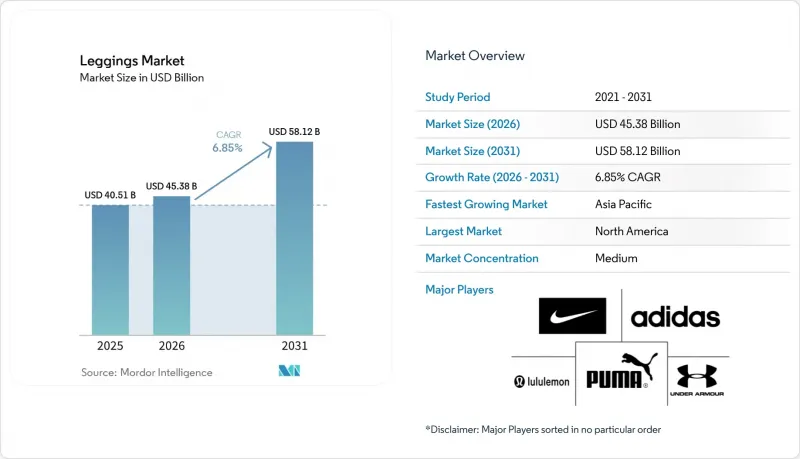
According to Mordor Intelligence, the leggings market size is expected to increase from USD 40.51 billion in 2025 to USD 45.38 billion in 2026 and reach USD 58.12 billion by 2031, growing at a CAGR of 6.85% over 2026-2031.
This report is Segmented by Material (Cotton, Polyester, Blended, and Others), End-User (Women, Men, and Kids), Category (Mass and Premium/Luxury), Distribution Channel (Hypermarkets/Supermarkets, Specialty Stores, Online Retail Stores, and Others), and Geography (North America, Europe, Asia Pacific, South America, and Middle East and Africa). Market Forecasts are Provided in Terms of Value (USD).
Global Leggings Market Trends and Insights
Growing Popularity of Athleisure and Active Lifestyle Trends
Athleisure has evolved from a niche category into a wardrobe staple, with consumers wearing performance fabrics to offices, social events, and travel. BCG research in 2024 found that younger cohorts prioritize versatility and comfort over occasion-specific dressing, a shift that persists even as return-to-office mandates increase. This behavioral change is compressing the distinction between gym wear and casual wear, enabling brands to command higher average selling prices by positioning products as multi-functional. Fast Retailing reported that Uniqlo's sweatshirts, sweatpants, and technical HEATTECH lines drove double-digit revenue growth in North America and Europe during the first half of fiscal 2026, underscoring demand for everyday performance fabrics. The wellness economy, valued at USD 1.5 trillion by McKinsey, is reinforcing leggings adoption as consumers link physical activity to mental health and productivity. Hybrid work schedules have also normalized athleisure in professional contexts, reducing the stigma of wearing moisture-wicking fabrics to video calls or client meetings.
Advancements in Fabric Technologies Enhancing Performance
Technical innovation in yarns and finishes is creating defensible product differentiation and margin expansion opportunities. Teijin Frontier introduced a recyclable stretch polyester yarn in 2024 that eliminates elastane while retaining recovery properties, addressing a critical barrier to textile-to-textile recycling. Under Armour partnered with Celanese to develop NEOLAST, an elastane alternative that reduces reliance on petrochemical-derived spandex and improves end-of-life recyclability. Enzymatic depolymerization is emerging as a scalable pathway for closed-loop nylon and polyester; Lululemon's 10-year offtake with Samsara Eco targets 20% of its fiber portfolio from enzymatically recycled sources by 2030, a volume commitment that signals confidence in commercial viability. PUMA's collaboration with RE&UP scales textile-to-textile recycling of polycotton and polyester-elastane blends, historically difficult feedstocks, into virgin-equivalent fibers, reducing dependence on bottle-derived rPET. These advances are shifting the cost curve for recycled inputs and enabling brands to meet European Union Digital Product Passport requirements, which mandate disclosure of recycled content and recyclability by 2027.
Fluctuating Prices of Synthetic Fibers Impacting Costs
Polyester and nylon prices are tightly correlated with crude oil and natural gas, exposing leggings brands to input-cost volatility that compresses gross margins when retail prices cannot adjust quickly. Reuters reported that geopolitical tensions in the Strait of Hormuz disrupted petrochemical feedstock flows in early 2025, spiking polyester prices by double digits and forcing brands to absorb costs or risk losing market share to competitors with better hedging strategies. Fast Retailing noted in its fiscal 2026 first-half results that weaker yen forward contracts increased the cost of sales, though the company offset this through improved discount control and operational efficiencies. The shift toward recycled polyester introduces new price dynamics; while recycled content reduces carbon footprint, it often trades at a premium to virgin fiber due to limited sorting and reprocessing infrastructure. Brands with long-term offtake agreements, such as Lululemon's 10-year commitment to Samsara Eco, are locking in supply to mitigate spot-market exposure, but smaller players lack the scale to negotiate similar terms.
Other drivers and restraints analyzed in the detailed report include:
- Increasing Consumer Preference for Comfort and Functionality
- Rising Emphasis on Inclusivity and Size Diversity
- Proliferation of Counterfeit and Low-Quality Products
For complete list of drivers and restraints, kindly check the Table Of Contents.
Segment Analysis
Polyester held 40.62% of the material share in 2025, reflecting its cost advantage, moisture-wicking properties, and established supply chains. Blended fabrics, combining polyester with cotton, nylon, or elastane, are forecast to grow at 7.54% annually through 2031, the fastest rate among material segments. This acceleration stems from consumer preference for fabrics that balance performance and comfort; pure polyester can feel synthetic and trap odor, while blends soften hand-feel and improve breathability. Cotton leggings appeal to sustainability-conscious buyers seeking natural fibers, but their moisture retention and slower drying times limit adoption in high-intensity categories. The "Others" segment includes emerging materials such as Tencel, bamboo, and bio-based nylons, which remain niche due to higher costs and limited scale.
Teijin Frontier's launch of a recyclable stretch polyester yarn in 2024 addresses a critical barrier: elastane-blended fabrics are difficult to recycle because separation technologies are not yet commercially viable at scale. PUMA's collaboration with RE&UP to recycle polycotton and polyester-elastane blends into virgin-equivalent fibers signals that textile-to-textile pathways are maturing, though infrastructure investment remains concentrated in Europe and North America PUMA. Regulatory frameworks such as the European Union's Ecodesign for Sustainable Products Regulation, which mandates digital product passports by 2027, are pressuring brands to shift toward mono-materials or recyclable blends to meet minimum recycled-content thresholds Adidas Group. Cotton sourcing is also under scrutiny; PUMA reported that 99.5% of its cotton came from Better Cotton Initiative, organic, or recycled sources in 2024, reflecting industry-wide adoption of certification standards, according to PUMA Annual report 2025.
Women accounted for 70.26% of leggings demand in 2025, a dominance rooted in decades of product innovation, celebrity endorsements, and retail prioritization. Men's leggings is expanding at 8.21% annually through 2031, the fastest end-user growth rate, driven by rising gym memberships, the normalization of athleisure in professional settings, and brand investments in men 's-specific fits and colorways. Kids' leggings benefits from school sports programs and parental willingness to invest in performance fabrics, though growth is tempered by shorter product lifecycles due to rapid size changes.
The men's acceleration reflects a behavioral shift. BCG research in 2024 found that younger male cohorts prioritize comfort and versatility over occasion-specific dressing, a pattern that mirrors the athleisure adoption curve among women a decade earlier. Fast Retailing reported strong demand for men's sweatshirts, sweatpants, and technical HEATTECH ranges in North America and Europe during the first half of fiscal 2026, underscoring that functional fabrics are gaining traction beyond traditional gym wear. Under Armour's "Pulse" regenerative sportswear capsule, launched in December 2025, targets environmentally conscious male consumers with plant-based, plastic-free designs and a composting program. Nike's emphasis on recovery and wellness, positioning leggings as essential to mental health and productivity, resonates with male consumers who historically viewed performance apparel as gym-specific.
Geography Analysis
North America commanded 35.27% of leggings revenue in 2025, underpinned by high per-capita spending, mature athleisure adoption, and established specialty-retail infrastructure. Asia Pacific is forecast to grow at 7.95% annually through 2031, the fastest regional rate, as manufacturing shifts to India and Vietnam compresses lead times and landed costs while rising middle-class incomes in China and Southeast Asia expand the consumer base. Europe balances strong demand for sustainable products with regulatory frameworks such as the Ecodesign for Sustainable Products Regulation, which mandates digital product passports by 2027 and pressures brands to adopt traceable, recycled materials Adidas Group. South America and the Middle East & Africa remain smaller but are attracting investment as brands seek geographic diversification and tap into nascent fitness cultures.
Hong Fu's Rs 1,500 crore (approximately USD 180 million) facility in India, operational in January 2026 and employing 25,000 workers, signals that Nike and Adidas suppliers are reducing dependence on China and Vietnam to mitigate geopolitical and labor-cost risks. Uniqlo targets 30% local sourcing in India, up from 15-20%, while growing its domestic retail footprint to 18 stores and achieving 44% year-over-year revenue growth in fiscal 2026 Business Standard. Fast Retailing's Uniqlo brand reported double-digit revenue and profit growth in North America and Europe during the first half of fiscal 2026, driven by flagship-store openings in Chicago, San Francisco, and New York, as well as strong demand for HEATTECH and year-round sweatshirt ranges. PUMA opened a 1.2 million square-foot distribution center in Arizona in June 2024 and a 440,000 square-foot logistics facility in France in November 2025, investments that reduce delivery times and support omnichannel fulfillment.
Keppel Corporation and Fast Retailing signed a memorandum of understanding to explore retail real estate opportunities across Asia Pacific, with Uniqlo confirmed as a tenant in Hanoi's forthcoming largest shopping destination Retail News Asia. Brazil, Argentina, and Chile are seeing increased leggings adoption tied to urbanization and rising gym memberships, though economic volatility and currency fluctuations constrain purchasing power. The Middle East, particularly the United Arab Emirates and Saudi Arabia, is investing in sports infrastructure and wellness tourism, creating demand for premium leggings aligned with luxury retail ecosystems.
- Nike, Inc.
- Adidas AG
- Lululemon Athletica Inc.
- Under Armour, Inc.
- Puma SE
- Gap Inc.
- Spanx, LLC
- Levi Strauss & Co. (Beyond Yoga)
- Gymshark Ltd.
- Calzedonia Group
- Hanesbrands Inc.
- Fast Retailing Co., Ltd. (Uniqlo)
- Swaty Betty Ltd.
- PVH Corp. (Calvin Klein)
- Decathlon SA
- Columbia Sportswear Company
- Outdoor Voices Inc.
- Jockey International, Inc
- Paragon Fitwear
- Lands' End Inc.
Additional Benefits:
- The market estimate (ME) sheet in Excel format
- 3 months of analyst support
TABLE OF CONTENTS
1 INTRODUCTION
- 1.1 Study Assumptions and Market Definition
- 1.2 Scope of the Study
2 RESEARCH METHODOLOGY
3 EXECUTIVE SUMMARY
4 MARKET LANDSCAPE
- 4.1 Market Overview
- 4.2 Market Drivers
- 4.2.1 Growing Popularity Of Athleisure And Active Lifestyle Trends
- 4.2.2 Advancements In Fabric Technologies Enhancing Performance
- 4.2.3 Increasing Consumer Preference For Comfort And Functionality
- 4.2.4 Rising Emphasis On Inclusivity And Size Diversity
- 4.2.5 Expansion Of Customization And Personalization Options
- 4.2.6 Surging Demand For Sustainable And Eco-Friendly Materials
- 4.3 Market Restraints
- 4.3.1 Fluctuating Prices Of Synthetic Fibers Impacting Costs
- 4.3.2 Proliferation Of Counterfeit And Low-Quality Products
- 4.3.3 Concerns Related To Fabric Durability And Quality
- 4.3.4 Intense Competition From Alternative Substitute Products
- 4.4 Consumer Behavior Analysis
- 4.5 Regulatory Landscape
- 4.6 Technological Outlook
- 4.7 Porter's Five Forces
- 4.7.1 Bargaining Power of Suppliers
- 4.7.2 Bargaining Power of Buyers
- 4.7.3 Threat of New Entrants
- 4.7.4 Threat of Substitutes
- 4.7.5 Competitive Rivalry
5 MARKET SIZE AND GROWTH FORECASTS (VALUE)
- 5.1 By Material
- 5.1.1 Cotton
- 5.1.2 Polyester
- 5.1.3 Blended
- 5.1.4 Others
- 5.2 By End-User
- 5.2.1 Women
- 5.2.2 Men
- 5.2.3 Kids
- 5.3 By Category
- 5.3.1 Mass
- 5.3.2 Premium/Luxury
- 5.4 By Distribution Channel
- 5.4.1 Hypermarkets/Supermarkets
- 5.4.2 Specialty Stores
- 5.4.3 Online Retail Stores
- 5.4.4 Others
- 5.5 By Geography
- 5.5.1 North America
- 5.5.1.1 United States
- 5.5.1.2 Canada
- 5.5.1.3 Mexico
- 5.5.1.4 Rest of North America
- 5.5.2 Europe
- 5.5.2.1 Germany
- 5.5.2.2 United Kingdom
- 5.5.2.3 France
- 5.5.2.4 Italy
- 5.5.2.5 Spain
- 5.5.2.6 Netherlands
- 5.5.2.7 Sweden
- 5.5.2.8 Poland
- 5.5.2.9 Belgium
- 5.5.2.10 Rest of Europe
- 5.5.3 Asia Pacific
- 5.5.3.1 China
- 5.5.3.2 India
- 5.5.3.3 Japan
- 5.5.3.4 Australia
- 5.5.3.5 South Korea
- 5.5.3.6 Vietnam
- 5.5.3.7 Indonesia
- 5.5.3.8 Rest of Asia Pacific
- 5.5.4 South America
- 5.5.4.1 Brazil
- 5.5.4.2 Argentina
- 5.5.4.3 Chile
- 5.5.4.4 Peru
- 5.5.4.5 Colombia
- 5.5.4.6 Rest of South America
- 5.5.5 Middle East and Africa
- 5.5.5.1 United Arab Emirates
- 5.5.5.2 Saudi Arabia
- 5.5.5.3 South Africa
- 5.5.5.4 Nigeria
- 5.5.5.5 Rest of Middle East and Africa
- 5.5.1 North America
6 COMPETITIVE LANDSCAPE
- 6.1 Market Concentration
- 6.2 Strategic Moves
- 6.3 Market Ranking Analysis
- 6.4 Company Profiles (Includes Global-level Overview, Market-level Overview, Core Segments, Financials, Strategic Info, Market Rank/Share, Products & Services, Recent Developments)
- 6.4.1 Nike, Inc.
- 6.4.2 Adidas AG
- 6.4.3 Lululemon Athletica Inc.
- 6.4.4 Under Armour, Inc.
- 6.4.5 Puma SE
- 6.4.6 Gap Inc.
- 6.4.7 Spanx, LLC
- 6.4.8 Levi Strauss & Co. (Beyond Yoga)
- 6.4.9 Gymshark Ltd.
- 6.4.10 Calzedonia Group
- 6.4.11 Hanesbrands Inc.
- 6.4.12 Fast Retailing Co., Ltd. (Uniqlo)
- 6.4.13 Swaty Betty Ltd.
- 6.4.14 PVH Corp. (Calvin Klein)
- 6.4.15 Decathlon SA
- 6.4.16 Columbia Sportswear Company
- 6.4.17 Outdoor Voices Inc.
- 6.4.18 Jockey International, Inc
- 6.4.19 Paragon Fitwear
- 6.4.20 Lands' End Inc.
7 MARKET OPPORTUNITIES AND FUTURE OUTLOOK

