
PUBLISHER: Mordor Intelligence | PRODUCT CODE: 2061932

PUBLISHER: Mordor Intelligence | PRODUCT CODE: 2061932
Hair Mask - Market Share Analysis, Industry Trends & Statistics, Growth Forecasts (2026 - 2031)
According to Mordor Intelligence, the global Hair Mask market is projected to expand from USD 702.1 million in 2025 to USD 741.31 million in 2026, reaching approximately USD 915.12 million by 2031, reflecting a CAGR of 5.6% over 2026-2031.
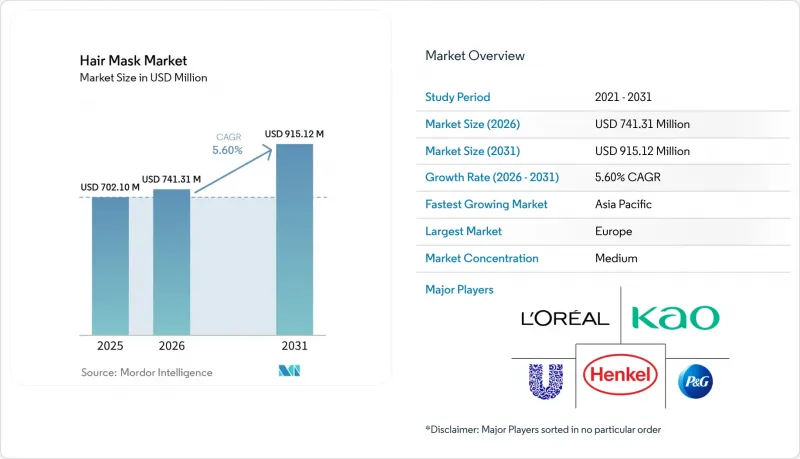
This report is Segmented by Product Type (Steam Free Masks, Thermal/Steam Masks), Packaging Type (Pouch, Jar, Tubes), Category (Mass, Premium), Distribution Channel (Health and Beauty Stores, Online Retail Stores, Supermarkets/Hypermarkets, Others), and Geography (North America, Europe, Asia-Pacific, South America, Middle East and Africa). The Market Forecasts are Provided in Terms of Value (USD).
Global Hair Mask Market Trends and Insights
Growing Demand for Advanced Post-Damage Hair Repair Solutions
Rising incidence of hair damage from coloring, bleaching, and heat styling has made breakage the leading concern for approximately 36-37% of consumers in the U.S. and U.K., according to a May 2025 survey. Similarly, conversations around hair loss, particularly among Generation Z, have surged across social platforms, signaling a shift in concern beyond traditional aging demographics. This heightened awareness is reshaping consumer priorities, with repair-focused solutions increasingly favored over preventive care. In response, demand is accelerating for high-performance hair masks formulated with proteins, ceramides, and bond-building actives that penetrate the cortex rather than merely coating the cuticle. This behavioral shift has been amplified by dermatologists and influencers who frame intensive repair as a non-negotiable step in hair care routines. As a result, purchase frequency is rising, the addressable consumer base is expanding, and expectations for efficacy are increasing.
Ingredient-Led Skinification Trend Shaping Premium Hair Mask Adoption
The convergence of skincare and hair care continues to redefine the hair mask category, with consumers increasingly applying skincare-level standards to hair treatments. Ingredients such as peptides, niacinamide, and hyaluronic acid have transitioned from facial serums into hair formulations, enabling brands to substantiate performance claims with clinical and lab-backed data. Scientific validation, such as findings confirming peptide-keratin interactions that restore mechanical strength, is reinforcing the efficacy narrative and supporting premium pricing, with some masks reaching USD 50 for 50 ml formats. Peptide-based and bioactive formulations are emerging as key growth drivers, targeting structural repair, scalp health, and overall hair resilience at a molecular level. This shift is evident across both prestige and mass segments: premium launches like Kerastase's Symbiose range incorporate microbiome-balancing prebiotics, while mass-market players such as Dove's Damage Therapy line leverage bio-protein technology to broaden access to high-performance actives.
Availability of Substitute Products (Conditioners and Leave-Ins)
As product functionalities converge, hair masks face increasing substitution pressure from rinse-out conditioners and leave-in serums that deliver similar moisturizing and repair benefits at lower price points and with greater convenience. The emergence of hybrid formats that combine the benefits of masks and conditioners into quick-use solutions is blurring category boundaries. These multi-functional products appeal to time-constrained and value-conscious consumers, particularly in the mass market, reducing the need for multi-step routines. This dynamic is forcing dedicated mask brands to clearly articulate and demonstrate differentiated value, such as deeper repair, longer-lasting results, or advanced ingredient delivery systems. Without a compelling efficacy narrative, pure-play mask products risk losing shelf space in increasingly rationalized retail assortments
Other drivers and restraints analyzed in the detailed report include:
- Rapid Expansion of E-Commerce and Direct-to-Consumer Channels
- Rising Disposable Incomes in Emerging Markets Driving Salon-Grade Product Uptake
- High Price Sensitivity in Mass-Market Segments
For complete list of drivers and restraints, kindly check the Table Of Contents.
Segment Analysis
Steam-free masks continue to dominate the category, accounting for 53.18% of total revenue in 2025, driven by strong consumer preference for convenient, no-heat application formats that integrate into everyday routines. Their accessibility, ease of use, and compatibility with time-constrained lifestyles make them particularly attractive in the mass market. However, as private-label players increasingly replicate core formulations, steam-free variants face rising commoditization risk, intensifying price competition and limiting differentiation.
In contrast, thermal or steam-activated masks are emerging as the fastest-growing segment, projected to expand at a 6.4% CAGR through 2031, outpacing the broader market. Growth is fueled by sustained consumer demand for salon-quality results at home, a behavior that accelerated during the pandemic and has since become entrenched. Innovations such as self-heating sachets and USB-powered caps are enhancing convenience, while advancements like graphene film heating technology, capable of reaching optimal temperatures in under 90 seconds, are addressing historical barriers related to safety and usability. Brands are further strengthening adoption by bundling masks with affordable heating accessories, encouraging system-based purchases and fostering customer loyalty.
Pouch packaging continues to dominate the hair mask market, accounting for 50.12% of the total share in 2025, driven by its cost efficiency, portability, and suitability for single-use applications. This format aligns well with mass-market demand for convenience and affordability, particularly among on-the-go consumers. However, despite ongoing innovation such as mono-material designs aimed at improving recyclability, the environmental impact of flexible plastics remains a concern due to low recycling rates and potential regulatory restrictions on laminates, which could increase future costs.
In contrast, jar packaging is emerging as the fastest-growing segment, projected to expand at a CAGR of 5.85% through 2031. Growth is being driven by rising sustainability expectations and evolving regulatory frameworks, including Extended Producer Responsibility (EPR) policies in Europe. Refillable glass and aluminum jar systems can reduce packaging waste by up to 80%, strengthening their appeal among environmentally conscious consumers and supporting premium brand positioning. Meanwhile, tubes occupy a middle ground but lack strong differentiation, offering neither the sustainability advantages of jars nor the convenience of pouches. As a result, retailers are increasingly prioritizing shelf space for high-performing jar-based products in premium segments.
Geography Analysis
Europe remains the largest regional market, accounting for 35.10% of global share in 2025, supported by strong consumption in countries such as Germany, France, and the United Kingdom. The region benefits from a well-established salon culture and mature premium retail channels, reinforcing demand for high-quality hair treatments. At the same time, stringent regulatory frameworks, including restrictions on microplastics and cyclic silicones, are accelerating product reformulation cycles. While these regulations increase compliance costs, they also create a competitive advantage for brands that can position themselves as leaders in sustainable and "clean" formulations. With GDP growth hovering around 2%, the market is relatively mature, and competition is increasingly centered on capturing wallet share rather than expanding the consumer base.
Asia-Pacific is the fastest-growing region, projected to register a CAGR of 5.9% through 2031, driven by rising incomes, rapid urbanization, and strong digital adoption. China stands out as a digital-first market, where online channels dominate hair-care sales, making e-commerce the primary route to market. India, while still at an earlier stage in per-capita beauty spending, is experiencing rapid growth, expanding the addressable premium segment.
North America continues to represent a high-value but slower-growth market, with overall hair-care growth remaining modest. However, the region's regulatory landscape, highlighted by the December 2023 rollout of the Modernization of Cosmetics Regulation Act (MoCRA), poses compliance challenges. Canada, with its emphasis on natural products and bilingual labeling requirements, presents niche opportunities for eco-certified and clean-label brands.
Latin America is expected to grow at a moderate pace, supported primarily by Brazil, though relatively low e-commerce penetration limits the scalability of direct-to-consumer strategies. In contrast, the Middle East and Africa region is expanding steadily, driven by urbanization, rising incomes, and an expanding middle class. However, operational challenges such as high logistics costs and import duties continue to constrain margins.
- L'Oreal S.A. (Kerastase, Garnier, Matrix)
- Unilever PLC (Dove, TRESemme)
- The Procter & Gamble Company (Pantene)
- Henkel Ag & Co. KGaA (Schwarzkopf, Syoss)
- Kao Corporation (Oribe, John Frieda)
- The Estee Lauder Companies (Aveda)
- Shiseido Company
- Coty Inc. (Wella Professionals)
- Kenvue Inc. (OGX)
- Davines Group
- Olaplex Inc.
- Briogeo Hair Care
- Moroccanoil Inc.
- Amika
- Lush Cosmetics
- The Body Shop
- Hask Beauty
- Mielle Organics
- Virtue Labs
- K18 Hair
Additional Benefits:
- The market estimate (ME) sheet in Excel format
- 3 months of analyst support
TABLE OF CONTENTS
1 INTRODUCTION
- 1.1 Study Assumptions and Market Definition
- 1.2 Scope of the Study
2 RESEARCH METHODOLOGY
3 EXECUTIVE SUMMARY
4 MARKET LANDSCAPE
- 4.1 Market Overview
- 4.2 Market Drivers
- 4.2.1 Growing demand for advanced post-damage hair repair solutions
- 4.2.2 Ingredient-led "skinification" trend shaping premium hair mask adoption
- 4.2.3 Rapid expansion of e-commerce and direct-to-consumer (DTC) channels
- 4.2.4 Rising disposable incomes in emerging markets driving salon-grade product uptake
- 4.2.5 Increasing adoption of structured "hair-cycling" care routines
- 4.2.6 Advancements in time-release and encapsulation technologies
- 4.3 Market Restraints
- 4.3.1 Availability of substitute products (conditioners and leave-ins)
- 4.3.2 High price sensitivity in mass-market segments
- 4.3.3 Regulatory pressure on silicones and microplastic-based formulations
- 4.3.4 Supply chain volatility for premium natural oil ingredients
- 4.4 Consumer Behavior Analysis
- 4.5 Regulatory Landscape
- 4.6 Technological Outlook
- 4.7 Porter's Five Forces
- 4.7.1 Bargaining Power of Suppliers
- 4.7.2 Bargaining Power of Buyers
- 4.7.3 Threat of New Entrants
- 4.7.4 Threat of Substitutes
- 4.7.5 Competitive Rivalry
5 MARKET SIZE AND GROWTH FORECASTS (VALUE)
- 5.1 By Product Type
- 5.1.1 Steam Free Masks
- 5.1.2 Thermal/Steam Masks
- 5.2 By Packaging Type
- 5.2.1 Pouch
- 5.2.2 Jar
- 5.2.3 Tubes
- 5.3 By Category
- 5.3.1 Mass
- 5.3.2 Premium
- 5.4 By Distribution Channel
- 5.4.1 Health and Beauty Stores
- 5.4.2 Online Retail Stores
- 5.4.3 Supermarkets/Hypermarkets
- 5.4.4 Others
- 5.5 By Geography
- 5.5.1 North America
- 5.5.1.1 United States
- 5.5.1.2 Canada
- 5.5.1.3 Rest of North America
- 5.5.2 Europe
- 5.5.2.1 Germany
- 5.5.2.2 United Kingdom
- 5.5.2.3 France
- 5.5.2.4 Italy
- 5.5.2.5 Spain
- 5.5.2.6 Netherlands
- 5.5.2.7 Rest of Europe
- 5.5.3 Asia-Pacific
- 5.5.3.1 China
- 5.5.3.2 Japan
- 5.5.3.3 South Korea
- 5.5.3.4 Australia
- 5.5.3.5 Rest of Asia-Pacific
- 5.5.4 South America
- 5.5.5 Middle East and Africa
- 5.5.1 North America
6 COMPETITIVE LANDSCAPE
- 6.1 Market Concentration
- 6.2 Strategic Moves
- 6.3 Market Ranking Analysis
- 6.4 Company Profiles (includes Global level Overview, Market level overview, Core Segments, Financials as available, Strategic Information, Market Rank/Share for key companies, Products and Services, and Recent Developments)
- 6.4.1 L'Oreal S.A. (Kerastase, Garnier, Matrix)
- 6.4.2 Unilever PLC (Dove, TRESemme)
- 6.4.3 The Procter & Gamble Company (Pantene)
- 6.4.4 Henkel Ag & Co. KGaA (Schwarzkopf, Syoss)
- 6.4.5 Kao Corporation (Oribe, John Frieda)
- 6.4.6 The Estee Lauder Companies (Aveda)
- 6.4.7 Shiseido Company
- 6.4.8 Coty Inc. (Wella Professionals)
- 6.4.9 Kenvue Inc. (OGX)
- 6.4.10 Davines Group
- 6.4.11 Olaplex Inc.
- 6.4.12 Briogeo Hair Care
- 6.4.13 Moroccanoil Inc.
- 6.4.14 Amika
- 6.4.15 Lush Cosmetics
- 6.4.16 The Body Shop
- 6.4.17 Hask Beauty
- 6.4.18 Mielle Organics
- 6.4.19 Virtue Labs
- 6.4.20 K18 Hair
7 MARKET OPPORTUNITIES AND FUTURE OUTLOOK

