
PUBLISHER: Mordor Intelligence | PRODUCT CODE: 2061981

PUBLISHER: Mordor Intelligence | PRODUCT CODE: 2061981
Legumes - Market Share Analysis, Industry Trends & Statistics, Growth Forecasts (2026 - 2031)
According to Mordor Intelligence, the legumes market size is projected to expand from USD 14.90 billion in 2025 and USD 15.30 billion in 2026 to USD 17.30 billion by 2031, registering a CAGR of 4.60% between 2026 and 2031.
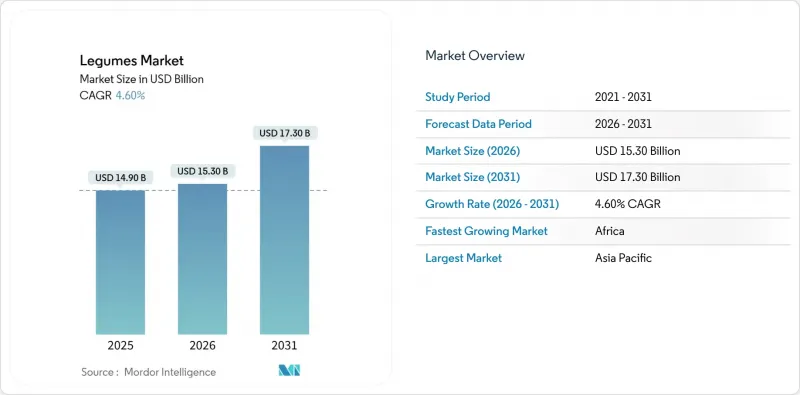
This report is Segmented by Geography (North America, Europe, Asia-Pacific, Africa, and More). The Report Includes Production Analysis (Volume), Consumption Analysis (Value and Volume), Export Analysis (Value and Volume), Import Analysis (Value and Volume), Wholesale Price Trend Analysis and Forecast, List of Key Players, and More. The Market Forecasts are Provided in Terms of Value (USD) and Volume (Metric Tons).
Global Legumes Market Trends and Insights
Rising Demand for Legume-Based Aquafeed Protein Concentrates
Large feed manufacturers are blending 20-30% pea or lupin isolates into rations for shrimp, tilapia, and salmon to counter high fishmeal costs and meet sustainability scorecards. Lupin protein delivers up to 42% crude protein and maintains feed-conversion ratios on par with soybean meal in Atlantic salmon trials. Norway's salmon farms and Chile's trout industry are piloting faba-bean protein, while Asian hatcheries adopt pea concentrate at a commercial scale. As aquaculture output in the Asia-Pacific tops 70 million metric tons annually, incremental pulse demand boosts export values in the legumes market. Medium-term gains are projected as mills retrofit lines for pulse concentrates and regulatory approvals broaden ingredient lists.
Surge in Pulse-Protein Isolates for Alternative Dairy Formulations
More than 40 new chickpea-based yogurts and beverages launched across North America and Europe in 2025, capitalizing on neutral flavor and allergen-free labeling. Faba-bean isolates with 80-85% protein are moving into cream cheese substitutes, and lentil isolates feature in fortified drinks for iron and folate content. Asia-Pacific wet-fractionation plants in China and India are scaling capacity to supply global brands, redirecting export-grade pulses from commodity to ingredient channels. The shift increases value capture for processors and heightens ingredient competition within the legumes market.
Moisture-Driven Mycotoxin Losses in Bulk Storage Chains
Relative humidity above 70% in tropical warehouses allows Aspergillus fungi to produce aflatoxin B1 beyond Codex limits within weeks. European regulations cap aflatoxin at 2 µg/kg for direct consumption, triggering frequent rejections of African and South Asian cargoes in 2025. Sub-Saharan farmers lacking hermetic bags lose up to 15% of volume, undercutting incomes and shortening the legumes market supply pipeline. Short-term mitigation hinges on humidity-controlled silos and affordable moisture barriers.
Other drivers and restraints analyzed in the detailed report include:
- Blockchain Traceability Premiums in Certified Sustainable Trade
- Heat- and Drought-Tolerant Germplasm Unlocking Semi-Arid Acreage
- Fluctuating Trade Policies such as Quotas, Tariffs, and Export Bans
For complete list of drivers and restraints, kindly check the Table Of Contents.
Geography Analysis
Asia-Pacific is projected to dominate the legumes market, with a 50.5% market share in 2025. This dominance is attributed to extensive production capabilities and deeply ingrained dietary habits. The region benefits from large-scale cultivation, diverse crop cycles, and active intra-regional trade. Key producing countries significantly influence global supply balances, while rising domestic demand fueled by income growth and increased protein diversification, sustains strong internal consumption. Additionally, export-oriented activities enhance supply chain resilience, solidifying the region's central role in both production and trade.
Africa is the fastest-growing region in the legumes market, with market size projected to expand at a CAGR of 6.1% through 2031. This growth is driven by rapid population expansion, increased policy support for food security, and the integration of legumes into institutional nutrition programs. Enhanced agricultural extension services and improved post-harvest infrastructure are boosting yield quality and export readiness. Furthermore, the development of regionally competitive supply chains is enabling African producers to access higher-value international markets while meeting growing domestic demand.
North America and Europe contribute distinct yet complementary roles in the legumes market. North America is primarily export-oriented, supported by advanced farming practices and policy incentives promoting sustainable crop rotation. Processors in the region are increasingly targeting international markets to counterbalance stagnating domestic consumption. Europe, on the other hand, is characterized by policy-driven cultivation and a growing consumer preference for plant-based diets. Regulatory support and sustainability initiatives are fostering local production, while reliance on imports for specialty crops ensures continued participation in global trade.
- The market estimate (ME) sheet in Excel format
- 3 months of analyst support
TABLE OF CONTENTS
1 Introduction
- 1.1 Study Assumptions and Market Definition
- 1.2 Scope of the Study
2 Research Methodology
3 Executive Summary
4 Market Landscape
- 4.1 Market Overview
- 4.2 Market Drivers
- 4.2.1 Rising demand for legume-based aquafeed protein concentrates
- 4.2.2 Carbon-farming incentives for nitrogen-fixing pulse rotations
- 4.2.3 Surge in pulse-protein isolates for alternative dairy formulations
- 4.2.4 Near-farm containerized pulse-processing capacity build-outs
- 4.2.5 Blockchain traceability premiums in certified sustainable trade
- 4.2.6 Heat- and drought-tolerant germplasm unlocking semi-arid acreage
- 4.3 Market Restraints
- 4.3.1 Moisture-driven mycotoxin losses in bulk storage chains
- 4.3.2 Fluctuating trade policies, such as quotas, tariffs, and export bans
- 4.3.3 Limited mechanization and threshing efficiency in smallholder systems
- 4.3.4 Phytosanitary import rejections tied to contaminant thresholds
- 4.4 Opportunities
- 4.5 Challenges
- 4.6 Value Chain Analysis
- 4.7 Technologies and usage of AI in the Industry
- 4.8 Input Market Analysis
- 4.8.1 Seeds
- 4.8.2 Fertilizers
- 4.8.3 Crop Protection Chemicals
- 4.9 Distribution Channel Analysis
- 4.10 Market Sentiment Analysis
- 4.11 PESTLE Analysis
5 Market Size and Growth Forecasts (Value and Volume)
- 5.1 By Geography
- 5.1.1 North America
- 5.1.1.1 United States
- 5.1.1.1.1 Production Analysis (Area Harvested, Yield, Production Volume)
- 5.1.1.1.2 Consumption Analysis (Value and Volume)
- 5.1.1.1.3 Import Market Analysis (Value, Volume, Key Supplying Markets)
- 5.1.1.1.4 Export Market Analysis (Value, Volume, Key Destination Markets)
- 5.1.1.1.5 Wholesale Price Trend Analysis and Forecast
- 5.1.1.1.6 Regulatory Framework
- 5.1.1.1.7 List of Key Players
- 5.1.1.1.8 Logistics and Infrastructure
- 5.1.1.1.9 Seasonality Analysis
- 5.1.1.2 Canada
- 5.1.1.2.1 Production Analysis (Area Harvested, Yield, Production Volume)
- 5.1.1.2.2 Consumption Analysis (Value and Volume)
- 5.1.1.2.3 Import Market Analysis (Value, Volume, Key Supplying Markets)
- 5.1.1.2.4 Export Market Analysis (Value, Volume, Key Destination Markets)
- 5.1.1.2.5 Wholesale Price Trend Analysis and Forecast
- 5.1.1.2.6 Regulatory Framework
- 5.1.1.2.7 List of Key Players
- 5.1.1.2.8 Logistics and Infrastructure
- 5.1.1.2.9 Seasonality Analysis
- 5.1.1.3 Mexico
- 5.1.1.3.1 Production Analysis (Area Harvested, Yield, Production Volume)
- 5.1.1.3.2 Consumption Analysis (Value and Volume)
- 5.1.1.3.3 Import Market Analysis (Value, Volume, Key Supplying Markets)
- 5.1.1.3.4 Export Market Analysis (Value, Volume, Key Destination Markets)
- 5.1.1.3.5 Wholesale Price Trend Analysis and Forecast
- 5.1.1.3.6 Regulatory Framework
- 5.1.1.3.7 List of Key Players
- 5.1.1.3.8 Logistics and Infrastructure
- 5.1.1.3.9 Seasonality Analysis
- 5.1.1.1 United States
- 5.1.2 Europe
- 5.1.2.1 Russia
- 5.1.2.1.1 Production Analysis (Area Harvested, Yield, and Production Volume)
- 5.1.2.1.2 Consumption Analysis (Consumption Value and Volume)
- 5.1.2.1.3 Import Market Analysis (Import Value, Volume, and Key Supplying Markets)
- 5.1.2.1.4 Export Market Analysis (Export Value, Volume, and Key Destination Markets)
- 5.1.2.1.5 Wholesale Price Trend Analysis & Forecast
- 5.1.2.1.6 Regulatory Framework
- 5.1.2.1.7 List of Key Players
- 5.1.2.1.8 Logistics and Infrastructure
- 5.1.2.1.9 Seasonality Analysis
- 5.1.2.2 Italy
- 5.1.2.2.1 Production Analysis (Area Harvested, Yield, and Production Volume)
- 5.1.2.2.2 Consumption Analysis (Consumption Value and Volume)
- 5.1.2.2.3 Import Market Analysis (Import Value, Volume, and Key Supplying Markets)
- 5.1.2.2.4 Export Market Analysis (Export Value, Volume, and Key Destination Markets)
- 5.1.2.2.5 Wholesale Price Trend Analysis & Forecast
- 5.1.2.2.6 Regulatory Framework
- 5.1.2.2.7 List of Key Players
- 5.1.2.2.8 Logistic and Infrastructure
- 5.1.2.2.9 Seasonality Analysis
- 5.1.2.3 France
- 5.1.2.3.1 Production Analysis (Area Harvested, Yield, and Production Volume)
- 5.1.2.3.2 Consumption Analysis (Consumption Value and Volume)
- 5.1.2.3.3 Import Market Analysis (Import Value, Volume, and Key Supplying Markets)
- 5.1.2.3.4 Export Market Analysis (Export Value, Volume, and Key Destination Markets)
- 5.1.2.3.5 Wholesale Price Trend Analysis & Forecast
- 5.1.2.3.6 Regulatory Framework
- 5.1.2.3.7 List of Key Players
- 5.1.2.3.8 Logistic and Infrastructure
- 5.1.2.3.9 Seasonality Analysis
- 5.1.2.4 Germany
- 5.1.2.4.1 Production Analysis (Area Harvested, Yield, and Production Volume)
- 5.1.2.4.2 Consumption Analysis (Consumption Value and Volume)
- 5.1.2.4.3 Import Market Analysis (Import Value, Volume, and Key Supplying Markets)
- 5.1.2.4.4 Export Market Analysis (Export Value, Volume, and Key Destination Markets)
- 5.1.2.4.5 Wholesale Price Trend Analysis & Forecast
- 5.1.2.4.6 Regulatory Framework
- 5.1.2.4.7 List of Key Players
- 5.1.2.4.8 Logistic and Infrastructure
- 5.1.2.4.9 Seasonality Analysis
- 5.1.2.5 United Kingdom
- 5.1.2.5.1 Production Analysis (Area Harvested, Yield, and Production Volume)
- 5.1.2.5.2 Consumption Analysis (Consumption Value and Volume)
- 5.1.2.5.3 Import Market Analysis (Import Value, Volume, and Key Supplying Markets)
- 5.1.2.5.4 Export Market Analysis (Export Value, Volume, and Key Destination Markets)
- 5.1.2.5.5 Wholesale Price Trend Analysis & Forecast
- 5.1.2.5.6 Regulatory Framework
- 5.1.2.5.7 List of Key Players
- 5.1.2.5.8 Logistic and Infrastructure
- 5.1.2.5.9 Seasonality Analysis
- 5.1.2.6 Netherlands
- 5.1.2.6.1 Production Analysis (Area Harvested, Yield, and Production Volume)
- 5.1.2.6.2 Consumption Analysis (Consumption Value and Volume)
- 5.1.2.6.3 Import Market Analysis (Import Value, Volume, and Key Supplying Markets)
- 5.1.2.6.4 Export Market Analysis (Export Value, Volume, and Key Destination Markets)
- 5.1.2.6.5 Wholesale Price Trend Analysis & Forecast
- 5.1.2.6.6 Regulatory Framework
- 5.1.2.6.7 List of Key Players
- 5.1.2.6.8 Logistic and Infrastructure
- 5.1.2.6.9 Seasonality Analysis
- 5.1.2.1 Russia
- 5.1.3 Asia-Pacific
- 5.1.3.1 India
- 5.1.3.1.1 Production Analysis (Area Harvested, Yield, and Production Volume)
- 5.1.3.1.2 Consumption Analysis (Consumption Value and Volume)
- 5.1.3.1.3 Import Market Analysis (Import Value, Volume, and Key Supplying Markets)
- 5.1.3.1.4 Export Market Analysis (Export Value, Volume, and Key Destination Markets)
- 5.1.3.1.5 Wholesale Price Trend Analysis & Forecast
- 5.1.3.1.6 Regulatory Framework
- 5.1.3.1.7 List of Key Players
- 5.1.3.1.8 Logistic and Infrastructure
- 5.1.3.1.9 Seasonality Analysis
- 5.1.3.2 China
- 5.1.3.2.1 Production Analysis (Area Harvested, Yield, and Production Volume)
- 5.1.3.2.2 Consumption Analysis (Consumption Value and Volume)
- 5.1.3.2.3 Import Market Analysis (Import Value, Volume, and Key Supplying Markets)
- 5.1.3.2.4 Export Market Analysis (Export Value, Volume, and Key Destination Markets)
- 5.1.3.2.5 Wholesale Price Trend Analysis & Forecast
- 5.1.3.2.6 Regulatory Framework
- 5.1.3.2.7 List of Key Players
- 5.1.3.2.8 Logistic and Infrastructure
- 5.1.3.2.9 Seasonality Analysis
- 5.1.3.3 Australia
- 5.1.3.3.1 Production Analysis (Area Harvested, Yield, and Production Volume)
- 5.1.3.3.2 Consumption Analysis (Consumption Value and Volume)
- 5.1.3.3.3 Import Market Analysis (Import Value, Volume, and Key Supplying Markets)
- 5.1.3.3.4 Export Market Analysis (Export Value, Volume, and Key Destination Markets)
- 5.1.3.3.5 Wholesale Price Trend Analysis & Forecast
- 5.1.3.3.6 Regulatory Framework
- 5.1.3.3.7 List of Key Players
- 5.1.3.3.8 Logistic and Infrastructure
- 5.1.3.3.9 Seasonality Analysis
- 5.1.3.4 Thailand
- 5.1.3.4.1 Production Analysis (Area Harvested, Yield, and Production Volume)
- 5.1.3.4.2 Consumption Analysis (Consumption Value and Volume)
- 5.1.3.4.3 Import Market Analysis (Import Value, Volume, and Key Supplying Markets)
- 5.1.3.4.4 Export Market Analysis (Export Value, Volume, and Key Destination Markets)
- 5.1.3.4.5 Wholesale Price Trend Analysis & Forecast
- 5.1.3.4.6 Regulatory Framework
- 5.1.3.4.7 List of Key Players
- 5.1.3.4.8 Logistic and Infrastructure
- 5.1.3.4.9 Seasonality Analysis
- 5.1.3.5 Vietnam
- 5.1.3.5.1 Production Analysis (Area Harvested, Yield, and Production Volume)
- 5.1.3.5.2 Consumption Analysis (Consumption Value and Volume)
- 5.1.3.5.3 Import Market Analysis (Import Value, Volume, and Key Supplying Markets)
- 5.1.3.5.4 Export Market Analysis (Export Value, Volume, and Key Destination Markets)
- 5.1.3.5.5 Wholesale Price Trend Analysis & Forecast
- 5.1.3.5.6 Regulatory Framework
- 5.1.3.5.7 List of Key Players
- 5.1.3.5.8 Logistic and Infrastructure
- 5.1.3.5.9 Seasonality Analysis
- 5.1.3.1 India
- 5.1.4 South America
- 5.1.4.1 Brazil
- 5.1.4.1.1 Production Analysis (Area Harvested, Yield, and Production Volume)
- 5.1.4.1.2 Consumption Analysis (Consumption Value and Volume)
- 5.1.4.1.3 Import Market Analysis (Import Value, Volume, and Key Supplying Markets)
- 5.1.4.1.4 Export Market Analysis (Export Value, Volume, and Key Destination Markets)
- 5.1.4.1.5 Wholesale Price Trend Analysis & Forecast
- 5.1.4.1.6 Regulatory Framework
- 5.1.4.1.7 List of Key Players
- 5.1.4.1.8 Logistic and Infrastructure
- 5.1.4.1.9 Seasonality Analysis
- 5.1.4.2 Argentina
- 5.1.4.2.1 Production Analysis (Area Harvested, Yield, and Production Volume)
- 5.1.4.2.2 Consumption Analysis (Consumption Value and Volume)
- 5.1.4.2.3 Import Market Analysis (Import Value, Volume, and Key Supplying Markets)
- 5.1.4.2.4 Export Market Analysis (Export Value, Volume, and Key Destination Markets)
- 5.1.4.2.5 Wholesale Price Trend Analysis & Forecast
- 5.1.4.2.6 Regulatory Framework
- 5.1.4.2.7 List of Key Players
- 5.1.4.2.8 Logistic and Infrastructure
- 5.1.4.2.9 Seasonality Analysis
- 5.1.4.1 Brazil
- 5.1.5 Middle East
- 5.1.5.1 United Arab Emirates
- 5.1.5.1.1 Production Analysis (Area Harvested, Yield, and Production Volume)
- 5.1.5.1.2 Consumption Analysis (Consumption Value and Volume)
- 5.1.5.1.3 Import Market Analysis (Import Value, Volume, and Key Supplying Markets)
- 5.1.5.1.4 Export Market Analysis (Export Value, Volume, and Key Destination Markets)
- 5.1.5.1.5 Wholesale Price Trend Analysis & Forecast
- 5.1.5.1.6 Regulatory Framework
- 5.1.5.1.7 List of Key Players
- 5.1.5.1.8 Logistic and Infrastructure
- 5.1.5.1.9 Seasonality Analysis
- 5.1.5.2 Saudi Arabia
- 5.1.5.2.1 Production Analysis (Area Harvested, Yield, and Production Volume)
- 5.1.5.2.2 Consumption Analysis (Consumption Value and Volume)
- 5.1.5.2.3 Import Market Analysis (Import Value, Volume, and Key Supplying Markets)
- 5.1.5.2.4 Export Market Analysis (Export Value, Volume, and Key Destination Markets)
- 5.1.5.2.5 Wholesale Price Trend Analysis & Forecast
- 5.1.5.2.6 Regulatory Framework
- 5.1.5.2.7 List of Key Players
- 5.1.5.2.8 Logistic and Infrastructure
- 5.1.5.2.9 Seasonality Analysis
- 5.1.5.3 Turkey
- 5.1.5.3.1 Production Analysis (Area Harvested, Yield, and Production Volume)
- 5.1.5.3.2 Consumption Analysis (Consumption Value and Volume)
- 5.1.5.3.3 Import Market Analysis (Import Value, Volume, and Key Supplying Markets)
- 5.1.5.3.4 Export Market Analysis (Export Value, Volume, and Key Destination Markets)
- 5.1.5.3.5 Wholesale Price Trend Analysis & Forecast
- 5.1.5.3.6 Regulatory Framework
- 5.1.5.3.7 List of Key Players
- 5.1.5.3.8 Logistic and Infrastructure
- 5.1.5.3.9 Seasonality Analysis
- 5.1.5.1 United Arab Emirates
- 5.1.6 Africa
- 5.1.6.1 Egypt
- 5.1.6.1.1 Production Analysis (Area Harvested, Yield, and Production Volume)
- 5.1.6.1.2 Consumption Analysis (Consumption Value and Volume)
- 5.1.6.1.3 Import Market Analysis (Import Value, Volume, and Key Supplying Markets)
- 5.1.6.1.4 Export Market Analysis (Export Value, Volume, and Key Destination Markets)
- 5.1.6.1.5 Wholesale Price Trend Analysis & Forecast
- 5.1.6.1.6 Regulatory Framework
- 5.1.6.1.7 List of Key Players
- 5.1.6.1.8 Logistic and Infrastructure
- 5.1.6.1.9 Seasonality Analysis
- 5.1.6.2 South Africa
- 5.1.6.2.1 Production Analysis (Area Harvested, Yield, and Production Volume)
- 5.1.6.2.2 Consumption Analysis (Consumption Value and Volume)
- 5.1.6.2.3 Import Market Analysis (Import Value, Volume, and Key Supplying Markets)
- 5.1.6.2.4 Export Market Analysis (Export Value, Volume, and Key Destination Markets)
- 5.1.6.2.5 Wholesale Price Trend Analysis & Forecast
- 5.1.6.2.6 Regulatory Framework
- 5.1.6.2.7 List of Key Players
- 5.1.6.2.8 Logistic and Infrastructure
- 5.1.6.2.9 Seasonality Analysis
- 5.1.6.1 Egypt
- 5.1.1 North America
6 End Use Applications and Industries
- 6.1 Primary Applications and Emerging Applications
- 6.2 Consumption Breakdown by Industries
7 Competitive Landscape
- 7.1 Overview of the Competition
- 7.2 Recent Developments
- 7.3 Market Concentration Analysis
8 Market Opportunities and Future Outlook

