PUBLISHER: Mordor Intelligence | PRODUCT CODE: 2061985

PUBLISHER: Mordor Intelligence | PRODUCT CODE: 2061985
Sulfur Dioxide - Market Share Analysis, Industry Trends & Statistics, Growth Forecasts (2026 - 2031)
According to Mordor Intelligence, the sulfur dioxide market size was valued at 13.71 million tons in 2025 and is estimated to grow from 14.47 million tons in 2026 to reach 18.98 million tons by 2031, at a CAGR of 5.57% during the forecast period (2026-2031).
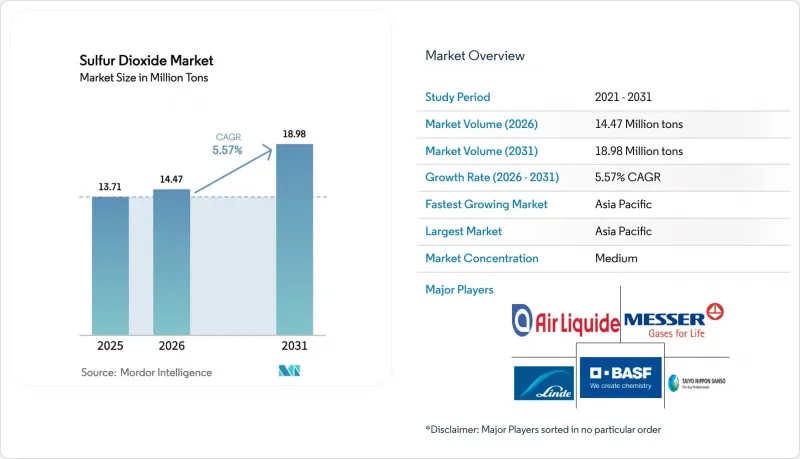
This report is Segmented by Form (Gas, Liquid, and Solid), Purity Grade (Less Than 99%, 99. 0% - 99. 9%, and Greater Than 99. 9%), Application (Chemical Intermediate, Food and Beverage Preservation, Pharmaceutical Synthesis, Pulp and Paper Bleaching, and More), and Geography (Asia-Pacific, North America, Europe, South America, Middle East and Africa). The Market Forecasts are Provided in Terms of Volume (Tons).
Global Sulfur Dioxide Market Trends and Insights
Growing Use in Sulfuric-Acid and Chemicals
Sulfuric-acid manufacturing anchors global SO2 offtake because no substitute exists for phosphate-fertilizer acidulation or copper-ore leaching. India added 1.2 million tons per annum of new acid capacity across Coromandel International, Paradeep Phosphates, and Gujarat State Fertilizers during 2024-2025, each tied to captive rock-phosphate conversion. China's spot sulfuric-acid price rose from CNY 400/ton (USD 54.50/ton) in Q1 2025 to CNY 520/ton (USD 73.78/ton) by December as Middle-East sulfur exports tightened. Hydrometallurgical nickel laterite leaching at Morowali and Weda Bay consumed 800,000 tons of acid in 2025, up 33% on higher EV-grade nickel-sulfate output. Semiconductor-grade acid, derived from more than 99.9% SO2, commands 3 to 5 times technical-grade pricing, prompting BASF to expand ultra-pure capacity at Ludwigshafen in April 2025. The dichotomy of high-volume fertilizer cycles versus high-margin electronics uses is locking the Sulfur dioxide market into a two-track structure that persists through 2031.
Expansion of Pulp and Paper Bleaching Capacity
Pulp mills in Asia and South America are outpacing Western closures, driving incremental SO2 demand. Grasim's 750 tons per day dissolving-pulp line at Vilayat integrates sulfite pulping for viscose fiber, while Shandong Bohui added 500,000 tons per annum bleached-kraft output adopting SO2 sequences in 2025. Norske Skog's Skogn mill cut specific SO2 emissions to 12.3 kg per air-dried ton in 2025 via scrubber upgrades. Nouryon and Arauco are piloting closed-loop bisulfite regeneration in Brazil, targeting a 30% cut in fresh sulfur. Regulatory frameworks such as the EU Industrial Emissions Directive and China's sector rules necessitate flue-gas scrubbers, reinforcing medium-term growth.
Health Hazards and Complex Handling
SO2 is a severe respiratory irritant; OSHA (Occupational Safety and Health Administration) caps 8 hours of exposure at 5 parts per million (ppm), while the National Institute for Occupational Safety and Health (NIOSH) recommends 2 parts per million (ppm). December 2024 EPA rules tightened the 1-hour ambient standard and expanded monitors, adding cost for sulfur-burn facilities. Semiconductor fabs must meet SEMI S2 (Semiconductor Manufacturing Equipment), keeping routine emissions below 1% of occupational limits and installing abatement costing USD 0.5-2 million per tool. These compliance burdens deter small users and consolidate volume with large industrial customers that maintain dedicated EHS (Environment, Health, and Safety) systems.
Other drivers and restraints analyzed in the detailed report include:
- Industrial Disinfectant and Fumigant Adoption
- Surge in Synthetic Gypsum for Green Building
- Phase-Out of Coal Power Curbing Captive Supply
For complete list of drivers and restraints, kindly check the Table Of Contents.
Segment Analysis
Gas-phase SO2 accounted for 56.18% of the Sulfur Dioxide market share in 2025 as sulfuric-acid towers, scrubbers, and fabs require continuous gas feed. The segment benefits from entrenched infrastructure but faces heightened compliance costs under stricter ambient standards. Solid (Bisulfite/Metabisulfite Derivatives), though smaller, are growing at 5.87% CAGR as food-preservers and pharma plants favor low-pressure, transportable inputs that cut insurance premium outlays. The Sulfur Dioxide market size for solids is projected to rise steadily through 2031 on ASEAN demand, while gas retains a majority share in China and India, where large-scale acid plants dominate.
Liquid SO2 occupies a logistic midpoint, serving batch specialty-chemical makers and municipal plants. Chemtrade's Polytec acquisition strengthens its distribution of liquid cylinders and bisulfite blends across North America. Regulatory pressures in Vietnam and Thailand steer small users from gas toward solids, yet high-volume industrial sites will continue ordering bulk gas to maintain process continuity.
Geography Analysis
Asia-Pacific dominated the Sulfur Dioxide market in 2025 with 50.46% share and is projected to log 6.04% CAGR during the forecast period (2026-2031). China's sulfuric-acid spot price escalation signaled tight sulfur availability, while India's 1.2 million tons per annum capacity additions firm fertilizer-sector pull. Taiwan, Japan, and Korea anchor ultra-high-purity uptake for semiconductor nodes, and ASEAN regulations spur demand for point-of-use abatement systems, indirectly boosting bisulfite sales.
North America ranked second on the back of Gulf Coast sulfuric-acid clusters and new fab projects in Arizona and Texas. Linde's USD 400 million Louisiana ASU (Air Separation Unit) will co-produce liquid SO2, and Chemtrade's Polytec buyout broadens turnkey water-treatment offerings. EPA's tighter 1-hour ambient standard raises compliance expenses but also accelerates technology refresh toward closed-loop systems that favor large suppliers.
Europe trails on volume because coal retirements erase captive FGD streams; however, BASF's Ludwigshafen ultra-pure expansion highlights a pivot toward precision chemistry targeting the region's nascent advanced-node fabs. Nordic pulp operations maintain niche bisulfite use, while synthetic-gypsum scarcity is hiking natural-gypsum imports. South America's demand is led by Brazilian eucalyptus mills adopting closed-loop bisulfite regeneration, and Middle East & Africa volumes hinge on refinery sulfur recovery and South African mining.
- AIR LIQUIDE
- Air Products and Chemicals Inc.
- Atul Ltd.
- BASF
- Chemtrade Logistics
- Grillo-Werke AG
- INEOS
- Linde plc
- Messer Group GmbH
- Taiyo Nippon Sanso Corporation
- Tokyo Chemical Industry (India) Pvt. Ltd.
Additional Benefits:
- The market estimate (ME) sheet in Excel format
- 3 months of analyst support
TABLE OF CONTENTS
1 Introduction
- 1.1 Study Assumptions and Market Definition
- 1.2 Scope of the Study
2 Research Methodology
3 Executive Summary
4 Market Landscape
- 4.1 Market Overview
- 4.2 Market Drivers
- 4.2.1 Growing use in sulfuric-acid and chemicals
- 4.2.2 Expansion of pulp and paper bleaching capacity
- 4.2.3 Industrial disinfectant and fumigant adoption
- 4.2.4 Surge in synthetic gypsum for green building
- 4.2.5 Emerging SO2-based battery electrolyte additives
- 4.3 Market Restraints
- 4.3.1 Health hazards and complex handling
- 4.3.2 Phase-out of coal power curbing captive supply
- 4.3.3 Electrochemical substitutes in semiconductor etching
- 4.4 Value Chain Analysis
- 4.5 Porter's Five Forces
- 4.5.1 Threat of New Entrants
- 4.5.2 Bargaining Power of Buyers
- 4.5.3 Bargaining Power of Suppliers
- 4.5.4 Threat of Substitutes
- 4.5.5 Degree of Competition
5 Market Size and Growth Forecasts (Volume)
- 5.1 By Form
- 5.1.1 Gas
- 5.1.2 Liquid
- 5.1.3 Solid (Bisulfite/Metabisulfite Derivatives)
- 5.2 By Purity Grade
- 5.2.1 Less than 99% (Technical Grade)
- 5.2.2 99.0% - 99.9% (Food and Pharma Grade)
- 5.2.3 Greater than 99.9% (Ultra-high purity)
- 5.3 By Application
- 5.3.1 Chemical Intermediate (Sulfuric Acid)
- 5.3.2 Food and Beverage Preservation
- 5.3.3 Wine and Brewing Stabilization
- 5.3.4 Pulp and Paper Bleaching
- 5.3.5 Metal and Mining (Ore Leaching/Processing)
- 5.3.6 Waste- and Wastewater Treatment
- 5.3.7 Semiconductor Cleaning and Etching
- 5.3.8 Pharmaceutical Synthesis
- 5.3.9 Other Applications (Fumigation and Disinfection and Synthetic Gypsum Production)
- 5.4 By Geography
- 5.4.1 Asia-Pacific
- 5.4.1.1 China
- 5.4.1.2 Japan
- 5.4.1.3 India
- 5.4.1.4 South Korea
- 5.4.1.5 ASEAN Countries
- 5.4.1.6 Rest of Asia-Pacific
- 5.4.2 North America
- 5.4.2.1 United States
- 5.4.2.2 Canada
- 5.4.2.3 Mexico
- 5.4.3 Europe
- 5.4.3.1 Germany
- 5.4.3.2 United Kingdom
- 5.4.3.3 France
- 5.4.3.4 Italy
- 5.4.3.5 Spain
- 5.4.3.6 Russia
- 5.4.3.7 NORDIC Countries
- 5.4.3.8 Rest of Europe
- 5.4.4 South America
- 5.4.4.1 Brazil
- 5.4.4.2 Argentina
- 5.4.4.3 Rest of South America
- 5.4.5 Middle-East and Africa
- 5.4.5.1 Saudi Arabia
- 5.4.5.2 South Africa
- 5.4.5.3 Rest of Middle-East and Africa
- 5.4.1 Asia-Pacific
6 Competitive Landscape
- 6.1 Market Concentration
- 6.2 Strategic Moves
- 6.3 Market Share(%)/Ranking Analysis
- 6.4 Company Profiles (includes Global Overview, Market Overview, Core Segments, Financials, Strategic Information, Products and Services, Recent Developments)
- 6.4.1 AIR LIQUIDE
- 6.4.2 Air Products and Chemicals Inc.
- 6.4.3 Atul Ltd.
- 6.4.4 BASF
- 6.4.5 Chemtrade Logistics
- 6.4.6 Grillo-Werke AG
- 6.4.7 INEOS
- 6.4.8 Linde plc
- 6.4.9 Messer Group GmbH
- 6.4.10 Taiyo Nippon Sanso Corporation
- 6.4.11 Tokyo Chemical Industry (India) Pvt. Ltd.
7 Market Opportunities and Future Outlook
- 7.1 White-space and Unmet-need Assessment
8 Key Strategic Questions for CEOs

