PUBLISHER: Mordor Intelligence | PRODUCT CODE: 2061987

PUBLISHER: Mordor Intelligence | PRODUCT CODE: 2061987
Fly Trap - Market Share Analysis, Industry Trends & Statistics, Growth Forecasts (2026 - 2031)
According to Mordor Intelligence, the fly trap market size is projected to grow from USD 333.3 million in 2025 to USD 358.2 million in 2026, reaching USD 478.4 million by 2031, with a CAGR of 7.5% during the period 2026-2031.
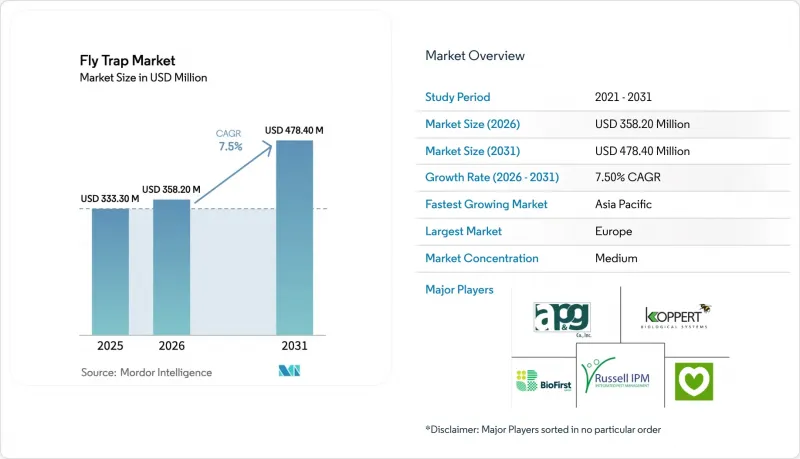
This report is Segmented by Product Type (Sticky Traps, UV Light Traps, and More), by Trap Mechanism (Physical Attraction, Chemical/Pheromone Attraction, and More), by Application (Greenhouses, Crop Fields, and More), and by Geography (North America, South America, Europe, Asia-Pacific, Middle East, and Africa). The Report Offers the Market Size and Forecasts in Terms of Value (USD).
Global Fly Trap Market Trends and Insights
Growing Shift Toward Pesticide-Free Integrated Pest Management
The increasing adoption of pesticide-free integrated pest management (IPM) is a key factor driving the growth of the fly trap market. Industries are progressively implementing non-chemical pest control methods to comply with regulatory requirements and achieve sustainability objectives. IPM focuses on monitoring and mechanical control, resulting in greater utilization of sticky and light-based fly traps across agriculture, food processing, and residential applications. Research indicates that IPM can reduce pesticide usage by up to 30% compared to previous levels, with some systems eliminating chemical inputs. This shift has heightened the dependence on traps for effective pest monitoring and control .
Stricter Chemical-Residue Regulations on Export Crops
Stricter regulations on chemical residues in export crops are driving the adoption of non-chemical pest control methods, such as fly traps, particularly within high-value horticulture and fresh produce supply chains. Export-oriented producers are required to meet stringent maximum residue limits (MRLs), including Japan's Positive List System, which enforces a default limit of 0.01 ppm for unregistered pesticides, and the European Union's pesticide reduction targets under the Farm to Fork Strategy. These regulatory requirements are prompting growers to adopt integrated pest management (IPM) practices, where sticky and light-based fly traps are commonly used for pest monitoring and control without the risk of chemical residues .
Limited Efficacy Against Mixed Pest Populations
Single-color boards are effective against specific pests but are less efficient in environments where thrips, whiteflies, and fungus gnats are present simultaneously. Adhesive saturation can reduce catch rates in greenhouses with high fungus gnat populations, requiring the deployment of additional traps. This increases both labor and material expenses. Hybrid visual-plus-pheromone traps provide broader coverage by combining visual and chemical attractants. However, their higher cost limits their adoption. This is particularly significant for price-sensitive crops, where growers prioritize cost-effectiveness over advanced trapping methods.
Other drivers and restraints analyzed in the detailed report include:
- Subsidy Programs for Greenhouse Biological Controls
- Rapid Expansion of Protected Cultivation Acreage
- Price Sensitivity Among Smallholder Farmers
For complete list of drivers and restraints, kindly check the Table Of Contents.
Segment Analysis
Sticky traps represented the largest 40% of the fly trap product market share in 2025 and remain critical in certified-organic production due to their adherence to residue-free standards. The market size for UV light traps is projected to grow at the fastest CAGR of 10.1% from 2026 to 2031. The adoption of LED modules supports market growth. Disposable bag units remain popular for household use. However, their need for frequent disposal limits their suitability for professional applications. Electric grid devices cater to instant-knockdown requirements in livestock buildings but have faced criticism following the American Veterinary Medical Association's classification of electrocution as a non-preferred method.
Rentokil Initial's recent innovation marks a significant development in the market. Its North American launch features UV-A LEDs combined with high-tack adhesive sheets and a capacitive sensor that records catch counts. Trials demonstrated improved capture rates compared to traditional boards. This success has led to orders from processing plants where minimizing downtime is a priority. The premium segment is dominated by smart IoT-enabled traps, holding a significant market share. Increased deployment among precision-farming operations reflects strong demand, particularly in regions with higher labor costs. These trends underscore the fly trap market's gradual transition toward data-driven solutions that reduce dependence on repetitive manual monitoring.
Geography Analysis
Europe is projected to account for the largest 33% of the fly trap market share in 2025. This dominance is attributed to well-established greenhouse clusters in the Netherlands and Germany, where sticky boards are widely used as primary pest control tools and to optimize the timing of biological releases. The enforcement of Maximum Residue Level (MRL) regulations has significantly limited pesticide options, further integrating traps into pest management protocols. North America ranks second, with specialty crops in California, Washington, and Oregon increasingly adopting smart units connected to digital dashboards.
The Asia-Pacific market size is anticipated to be the fastest-growing market, with a projected CAGR of 9.3% from 2026 to 2031. China's extensive protected cultivation and India's plans to increase greenhouse acreage are driving significant demand for pest control solutions. Furthermore, Japan's stringent Positive List System, which enforces strict residue limits, has made UV units critical for export crops such as strawberries and tomatoes. These factors collectively position the Asia-Pacific region as a key contributor to the global market's growth.
In South America, growth is being driven by Koppert's investment in Brazil, which has localized the production of traps and beneficial organisms. This localization reduces shipping delays and improves the availability of pest control solutions in the region. Meanwhile, the Middle East and Africa are expanding greenhouse capacity to address food security challenges. For instance, a significant percentage of climate-controlled greenhouses in Saudi Arabia now include traps in new constructions. This development is increasing demand for pest control products and supporting sustainable agricultural practices in the region.
- AP&G Co., Inc. (Catchmaster)
- Koppert Biological Systems B.V.
- BioFirst Group NV (Biobest Group)
- Russell IPM Limited
- The Wonderful Company LLC (Suterra)
- ISCA Technologies, Inc.
- Trece, Inc.
- Alpha Fragrances Private Limited
- A.G. Bio-Systems Private Limited
- InVivo Group (Soufflet Group)
- Andermatt Group AG
- Rentokil Initial plc
- Brandenburg (UK) Limited
Additional Benefits:
- The market estimate (ME) sheet in Excel format
- 3 months of analyst support
TABLE OF CONTENTS
1 Introduction
- 1.1 Study Assumptions and Market Definition
- 1.2 Scope of the Study
2 Research Methodology
3 Executive Summary
4 Market Landscape
- 4.1 Market Overview
- 4.2 Market Drivers
- 4.2.1 Growing shift toward pesticide-free integrated pest management
- 4.2.2 Stricter chemical-residue regulations on export crops
- 4.2.3 Subsidy programs for greenhouse biological controls
- 4.2.4 Rapid expansion of protected cultivation acreage
- 4.2.5 Internet-connected smart traps enabling real-time pest counts
- 4.2.6 Carbon-credit revenue potential for chemical-free trapping
- 4.3 Market Restraints
- 4.3.1 Limited efficacy against mixed pest populations
- 4.3.2 Price sensitivity among smallholder farmers
- 4.3.3 Short product life in extreme outdoor climates
- 4.3.4 E-waste compliance costs for UV/electric trap disposal
- 4.4 Regulatory Landscape
- 4.5 Technological Outlook
- 4.6 Porter's Five Forces Analysis
- 4.6.1 Bargaining Power of Suppliers
- 4.6.2 Bargaining Power of Buyers
- 4.6.3 Threat of Substitutes
- 4.6.4 Threat of New Entrants
- 4.6.5 Competitive Rivalry
5 Market Size and Growth Forecasts (Value)
- 5.1 By Product Type
- 5.1.1 Sticky Traps
- 5.1.2 UV Light Traps
- 5.1.3 Disposable Bag Traps
- 5.1.4 Electric Grid Traps
- 5.1.5 Smart IoT-Enabled Traps
- 5.1.6 Other Product Types
- 5.2 By Trap Mechanism
- 5.2.1 Physical Attraction
- 5.2.2 Chemical/Pheromone Attraction
- 5.2.3 Integrated Hybrid
- 5.3 By Application
- 5.3.1 Greenhouses
- 5.3.2 Crop Fields
- 5.3.3 Orchards and Vineyards
- 5.3.4 Livestock Facilities
- 5.3.5 Storage and Processing Units
- 5.4 By Geography
- 5.4.1 North America
- 5.4.1.1 United States
- 5.4.1.2 Canada
- 5.4.1.3 Mexico
- 5.4.1.4 Rest of North America
- 5.4.2 South America
- 5.4.2.1 Brazil
- 5.4.2.2 Argentina
- 5.4.2.3 Rest of South America
- 5.4.3 Europe
- 5.4.3.1 Germany
- 5.4.3.2 France
- 5.4.3.3 Russia
- 5.4.3.4 United Kingdom
- 5.4.3.5 Italy
- 5.4.3.6 Spain
- 5.4.3.7 Rest of Europe
- 5.4.4 Asia-Pacific
- 5.4.4.1 China
- 5.4.4.2 India
- 5.4.4.3 Japan
- 5.4.4.4 Australia
- 5.4.4.5 Thailand
- 5.4.4.6 Vietnam
- 5.4.4.7 Philippines
- 5.4.4.8 Indonesia
- 5.4.4.9 Rest of Asia-Pacific
- 5.4.5 Middle East
- 5.4.5.1 Saudi Arabia
- 5.4.5.2 United Arab Emirates
- 5.4.5.3 Rest of Middle East
- 5.4.6 Africa
- 5.4.6.1 South Africa
- 5.4.6.2 Kenya
- 5.4.6.3 Rest of Africa
- 5.4.1 North America
6 Competitive Landscape
- 6.1 Market Concentration
- 6.2 Strategic Moves
- 6.3 Market Share Analysis
- 6.4 Company Profiles (Includes Global level Overview, Market level overview, Core Segments, Financials as available, Strategic Information, Market Rank/Share for key companies, Products and Services, and Recent Developments)
- 6.4.1 AP&G Co., Inc. (Catchmaster)
- 6.4.2 Koppert Biological Systems B.V.
- 6.4.3 BioFirst Group NV (Biobest Group)
- 6.4.4 Russell IPM Limited
- 6.4.5 The Wonderful Company LLC (Suterra)
- 6.4.6 ISCA Technologies, Inc.
- 6.4.7 Trece, Inc.
- 6.4.8 Alpha Fragrances Private Limited
- 6.4.9 A.G. Bio-Systems Private Limited
- 6.4.10 InVivo Group (Soufflet Group)
- 6.4.11 Andermatt Group AG
- 6.4.12 Rentokil Initial plc
- 6.4.13 Brandenburg (UK) Limited
7 Market Opportunities and Future Outlook

