PUBLISHER: Mordor Intelligence | PRODUCT CODE: 2061997

PUBLISHER: Mordor Intelligence | PRODUCT CODE: 2061997
Hydrogenated Nitrile Butadiene Rubber - Market Share Analysis, Industry Trends & Statistics, Growth Forecasts (2026 - 2031)
According to Mordor Intelligence, the hydrogenated nitrile butadiene rubber market size is projected to grow from USD 0.78 billion in 2025 to USD 0.83 billion in 2026, and reach USD 1.18 billion by 2031, growing at a CAGR of 7.29% from 2026 to 2031.
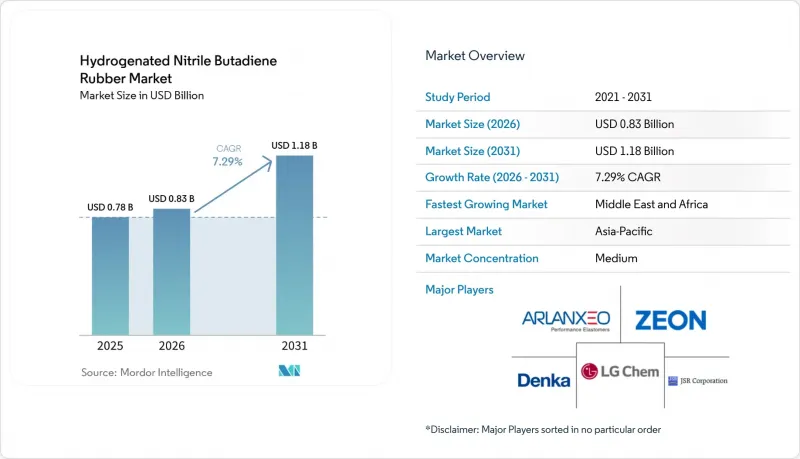
This report is Segmented by Product (Low ACN, Medium ACN, High ACN), Application (Seals and Gaskets, O-Rings, Hoses and Tubing, Belts, and More), End-User Industry (Automotive, Oil and Gas, Industrial Machinery, Aerospace, and More), and Geography (Asia-Pacific, North America, Europe, South America, Middle East and Africa). Market Forecasts are Provided in Terms of Value (USD).
Global Hydrogenated Nitrile Butadiene Rubber Market Trends and Insights
Demand From Advanced ICE and Hybrid Powertrain Seals
Hybrid platforms prolong internal-combustion relevance while imposing harsher duty cycles on timing belts, crankshaft seals, and turbocharger gaskets. Hydrogenated nitrile butadiene rubber resists ozone cracking and thermal oxidation better than conventional nitrile, thereby extending service intervals and lowering warranty costs. China shipped 723,000 new-energy vehicles in February 2026, including 246,000 plug-in hybrids that continue to rely on oil-resistant elastomers. Suppliers certified to IATF 16949 now export hydrogenated nitrile butadiene rubber timing belts worldwide, and demand for low-friction coatings builds a secondary market for specialty adhesion-optimized compounds. Processing gains-such as laser-etched tooth surfaces bonded with peroxide-cured compounds-further entrench the material in propulsion systems as hybrid volumes plateau.
Oil and Gas Deep-Well Elastomer Demands greater than 200 °C
Ultra-deep wells expose seals to 200 °C temperatures, 150 bar pressure, and hydrogen-sulfide levels above 10%. Trelleborg's XploR H9T20 grade, certified under NORSOK M-710, withstands rapid gas decompression inside subsea blowout preventers. Field tests show high-ACN hydrogenated nitrile butadiene rubber maintains hardness after 30 days in 16% H2S, outperforming standard nitrile. Occidental's Brown Pelican CO2-sequestration well in Texas specifies hydrogenated nitrile butadiene rubber packers, signaling that carbon-capture will mirror oil-field material standards. Tool string manufacturers now quote premium-priced peroxide-cured stators for positive-displacement motors, citing 20% longer run time before elastomer extrusion.
Price Premium Versus Conventional Elastomers
Hydrogenated nitrile butadiene rubber sells for USD 4.00 per kg in North America, roughly 60% above standard nitrile rubber, driven by hydrogenation reactor capital cost and high-purity acrylonitrile feedstock volatility. Spot butadiene moved 0.8% month-on-month in March 2026, complicating annual contract negotiations. Integrated Chinese sites, such as Qilu Petrochemical, siphon low-cost feedstocks from adjacent crackers, exporting at prices that erode Western margins. Consequently, industrial machinery OEMs often default to cheaper polyurethane unless the failure risk justifies premium material spend.
Other drivers and restraints analyzed in the detailed report include:
- Breakthrough Peroxide-Cured Low-Temperature Grades
- Rising Replacement of FKM in Cost-Sensitive EV Thermal Loops
- Processing Complexity and Filler Compatibility Limits
For complete list of drivers and restraints, kindly check the Table Of Contents.
Segment Analysis
High-ACN grades captured 46.42% of 2025 revenue, cementing their role in fuel systems, hydraulic cylinders, and oil-field blowout preventers where aggressive hydrocarbon exposure necessitates maximum polarity. Medium-ACN formulations balance oil resistance and processability across general-purpose seals. Low-ACN variants, boosted by pendant-vinyl functionalization, are forecast to grow at an 8.56% CAGR through 2031 because peroxide-cured chemistries now unlock glass-transition points near -40 °C, a realm once reserved for fluoroelastomers.
High-ACN compounds comply with NORSOK M-710 for sour-gas wellheads, while medium-ACN gains share in EV coolant hoses where glycol compatibility is critical. Versalis BALANCE low-ACN hydrogenated nitrile butadiene rubber provides OEMs a route to meet recycled-content mandates without sacrificing performance. Recycled-carbon-black programs remain experimental; above 30% filler substitution, peroxide-cure density drops, constraining circular-economy claims until dispersion technology improves.
Geography Analysis
Asia-Pacific generated 42.18% of 2025 revenue, driven by China's vehicle output and integrated petrochemical capacity. ARLANXEO launched a USD 210 million Changzhou line in February 2026, adding 5,000 tons/year via an oxidation process that cuts emissions by 80%. Chinese producers like Qilu Petrochemical achieve ≥99% hydrogenation conversion, offering lower pricing that pressures Western incumbents. India's machinery export growth is limited due to its limited domestic production.
North America and Europe split a significant share, supported by stringent emissions rules and mature drilling activity. ARLANXEO's Orange, Texas, and Leverkusen, Germany sites form a resilient supply chain, while Zeon's 4,400-tone U.S. plant feeds automotive demand despite postponed expansion amid permitting delays. Bio-attributed hydrogenated nitrile butadiene rubber gains traction in Europe as OEMs target higher recycled-content quotas. Shale and offshore operators in the Gulf of Mexico specify NORSOK-compliant seals for hydrogen-sulfide zones.
The Middle East and Africa are forecast to grow 8.21% annually to 2031. East African Rift geothermal drilling and Arabian Gulf offshore platforms require high-temperature elastomers, while emerging carbon-capture projects adopt oil-field sealing standards. Latin America remains smaller; Brazil's automotive sector and Argentina's shale play add incremental volumes yet rely on imports.
- ACRO Industries
- ARLANXEO
- Dawn Group
- Denka Company Limited
- Exxon Mobil Corporation
- Freudenberg Sealing
- Hutchinson
- JSR Corporation
- Kumho Petrochemical
- LANXESS
- LG Chem
- Lianda Corporation
- Nanjing Dongrun Special Rubber Co., Ltd
- Parker Hannifin Corp
- Polycomp
- Sinopec Mitsui Elastomers
- Sundow Polymers Co., Ltd
- Trelleborg Group
- TSRC
- ZEON CORPORATION
Additional Benefits:
- The market estimate (ME) sheet in Excel format
- 3 months of analyst support
TABLE OF CONTENTS
1 Introduction
- 1.1 Study Assumptions and Market Definition
- 1.2 Scope of the Study
2 Research Methodology
3 Executive Summary
4 Market Landscape
- 4.1 Market Overview
- 4.2 Market Drivers
- 4.2.1 Demand from advanced ICE and hybrid power-train seals
- 4.2.2 Oil- and gas deep-well elastomer demands >200 °C
- 4.2.3 Breakthrough peroxide-cured low-temperature HNBR grades
- 4.2.4 Rising replacement of FKM in cost-sensitive EV thermal loops
- 4.2.5 Next-gen ultra-deep geothermal drilling elastomer demand
- 4.3 Market Restraints
- 4.3.1 Price premium vs. conventional elastomers
- 4.3.2 Processing complexity and filler compatibility limits
- 4.3.3 Growing regulatory push toward bio-based elastomers
- 4.4 Value Chain Analysis
- 4.5 Regulatory Landscape
- 4.6 Porter's Five Forces
- 4.6.1 Bargaining Power of Suppliers
- 4.6.2 Bargaining Power of Buyers
- 4.6.3 Threat of New Entrants
- 4.6.4 Threat of Substitutes
- 4.6.5 Competitive Rivalry
5 Market Size and Growth Forecasts (Value)
- 5.1 By Product
- 5.1.1 Low ACN (Less than 30%)
- 5.1.2 Medium ACN (31-40%)
- 5.1.3 High ACN (More than 40%)
- 5.2 By Application
- 5.2.1 Seals and Gaskets
- 5.2.2 O-Rings
- 5.2.3 Hoses and Tubing
- 5.2.4 Belts (Timing, Auxiliary)
- 5.2.5 Wire and Cable Insulation
- 5.2.6 Rollers and Others
- 5.3 By End-user Industry
- 5.3.1 Automotive
- 5.3.2 Oil and Gas
- 5.3.3 Industrial Machinery
- 5.3.4 Aerospace
- 5.3.5 Medical Devices
- 5.3.6 Other End-user Industries
- 5.4 By Geography
- 5.4.1 North America
- 5.4.1.1 United States
- 5.4.1.2 Canada
- 5.4.1.3 Mexico
- 5.4.2 South America
- 5.4.2.1 Brazil
- 5.4.2.2 Argentina
- 5.4.2.3 Rest of South America
- 5.4.3 Europe
- 5.4.3.1 Germany
- 5.4.3.2 United Kingdom
- 5.4.3.3 France
- 5.4.3.4 Italy
- 5.4.3.5 Spain
- 5.4.3.6 Russia
- 5.4.3.7 Nordic Countries
- 5.4.3.8 Rest of Europe
- 5.4.4 Asia-Pacific
- 5.4.4.1 China
- 5.4.4.2 Japan
- 5.4.4.3 India
- 5.4.4.4 South Korea
- 5.4.4.5 Rest of Asia-Pacific
- 5.4.5 Middle-East and Africa
- 5.4.5.1 Saudi Arabia
- 5.4.5.2 United Arab Emirates
- 5.4.5.3 South Africa
- 5.4.5.4 Rest of Middle East
- 5.4.1 North America
6 Competitive Landscape
- 6.1 Market Concentration
- 6.2 Key Strategic Moves
- 6.3 Market Share(%)/Ranking Analysis
- 6.4 Company Profiles (includes Global level Overview, Market level overview, Core Segments, Financials as available, Strategic Information, Products and Services, and Recent Developments)
- 6.4.1 ACRO Industries
- 6.4.2 ARLANXEO
- 6.4.3 Dawn Group
- 6.4.4 Denka Company Limited
- 6.4.5 Exxon Mobil Corporation
- 6.4.6 Freudenberg Sealing
- 6.4.7 Hutchinson
- 6.4.8 JSR Corporation
- 6.4.9 Kumho Petrochemical
- 6.4.10 LANXESS
- 6.4.11 LG Chem
- 6.4.12 Lianda Corporation
- 6.4.13 Nanjing Dongrun Special Rubber Co., Ltd
- 6.4.14 Parker Hannifin Corp
- 6.4.15 Polycomp
- 6.4.16 Sinopec Mitsui Elastomers
- 6.4.17 Sundow Polymers Co., Ltd
- 6.4.18 Trelleborg Group
- 6.4.19 TSRC
- 6.4.20 ZEON CORPORATION
7 Market Opportunities and Future Outlook
- 7.1 White-space and Unmet-need Assessment
- 7.2 Ultra-deep geothermal sealing solutions
- 7.3 Bio-sourced HNBR and circular-economy plays

