PUBLISHER: Mordor Intelligence | PRODUCT CODE: 2062013

PUBLISHER: Mordor Intelligence | PRODUCT CODE: 2062013
Feminine Wipes - Market Share Analysis, Industry Trends & Statistics, Growth Forecasts (2026 - 2031)
According to Mordor Intelligence, the feminine wipes market is projected to grow from USD 1.35 billion in 2025 to USD 1.45 billion in 2026 and is expected to reach USD 2.06 billion by 2031, registering a CAGR of 7.28% during the forecast period through 2026-2031.
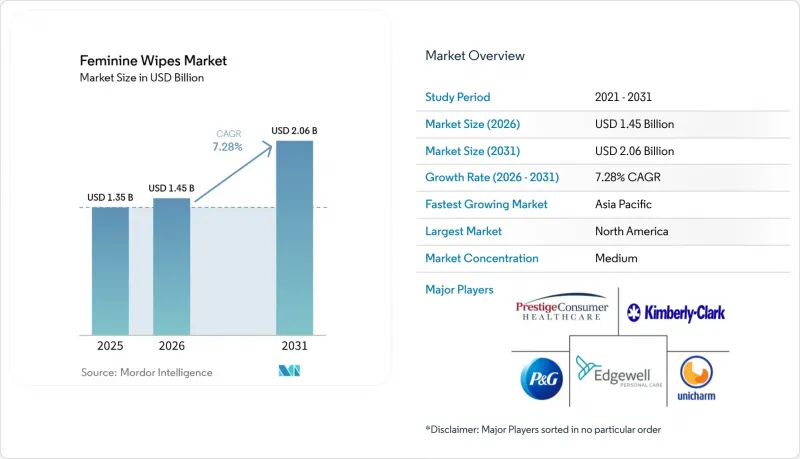
This report is Segmented by Product Type (Intimate Hygiene Wipes, PH-Balanced Wipes, and More), Nature (Conventional and Natural/Organic), Fragrance Type (Scented and Unscented), Distribution Channel (Online Retail Stores, Convenience Stores, and More), and Geography (North America, Europe, Asia-Pacific, South America, and the Middle East and Africa). The Market Forecasts are Provided in Terms of Value (USD).
Global Feminine Wipes Market Trends and Insights
Increasing awareness regarding intimate hygiene and personal wellness
Growing awareness about intimate hygiene and personal wellness is significantly driving the global feminine wipes market. As women become more health-conscious and better educated about hygiene, they are increasingly opting for products that ensure cleanliness, comfort, and convenience in their daily lives. This trend is supported by the World Health Organization's data, which highlights that over 300 million women worldwide are menstruating at any given time, showcasing the vast need for menstrual and intimate care solutions. Feminine wipes are gaining popularity due to their ease of use, portability, and ability to provide quick hygiene solutions, especially for women with busy schedules. These wipes are designed to meet the rising demand for effective and specialized hygiene products. As awareness of personal wellness continues to grow, the market for feminine wipes is expected to expand steadily, driven by the need for practical, reliable hygiene options.
Growing demand for pH-balanced and skin-friendly intimate care products
The increasing demand for pH-balanced, gentle intimate care products is driving growth in the global feminine wipes market. Consumers are becoming more aware of the importance of maintaining intimate health and avoiding irritation, leading them to prefer products specifically designed to address these needs. There is also a growing understanding of the microbiome and skin sensitivity, prompting a shift from basic cleansing wipes to specialized, gentle formulations. According to the Cleveland Clinic, the natural vaginal pH typically ranges from 3.8 to 4.5, underscoring the need for products that help maintain this balance to support overall intimate health. In response, manufacturers are focusing on creating feminine wipes that are pH-balanced, dermatologist-tested, and safe for sensitive skin. These efforts aim to build consumer trust and meet the rising demand for products that align with personal wellness and hygiene preferences.
Concerns regarding the presence of chemicals, fragrances, and preservatives
Concerns about the use of chemicals, fragrances, and preservatives are becoming a significant challenge for the global feminine wipes market. Consumers are increasingly aware of issues such as skin sensitivity, allergic reactions, and potential health risks associated with certain ingredients. This growing awareness has led to more scrutiny of product formulations, with many questioning the safety and transparency of intimate care products, especially those containing synthetic additives and harsh preservatives. As a result, there is a growing demand for products free of harmful chemicals and gentle on the skin. To address these concerns, manufacturers are being pushed to reformulate their products with safer, more natural ingredients. They are also focusing on providing clearer labeling and improving ingredient transparency to build consumer trust. This shift toward cleaner and more skin-friendly options is reshaping the market and influencing product development strategies.
Other drivers and restraints analyzed in the detailed report include:
- Innovation in biodegradable and flushable wipe technologies
- Demand for organic, natural, and chemical-free formulations
- Stringent regulations regarding product ingredients, labeling, and safety claims
For complete list of drivers and restraints, kindly check the Table Of Contents.
Segment Analysis
In 2025, intimate hygiene wipes led the global feminine wipes market, capturing 41.43% of the market. This dominance is attributed to the increasing focus on personal hygiene and the convenience these wipes provide for everyday use and travel. Many consumers prefer these wipes because they offer a quick, effective way to maintain cleanliness and freshness. Their easy availability in retail stores and growing awareness about intimate care have further boosted their demand, making them a staple in personal hygiene routines.
pH-balanced wipes are anticipated to be the fastest-growing segment in the market, with a projected CAGR of 8.54% through 2031. The rising awareness of intimate health and the importance of maintaining the skin's natural pH balance are key drivers of this growth. Consumers are increasingly seeking products that are gentle on the skin, reduce irritation, and promote overall skin health. To cater to this demand, manufacturers are introducing dermatologist-tested, sensitive-skin-friendly options that are gaining popularity among health-conscious buyers. This trend is expected to further expand the market for pH-balanced wipes in the coming years.
In 2025, conventional products led the global feminine wipes market, capturing 73.58% of the market. This segment's success is primarily driven by its affordability, widespread availability, and strong retail presence in both developed and emerging regions. Consumers often choose conventional feminine wipes because they are familiar, easy to find, and budget-friendly, especially in areas where cost is a significant factor. Additionally, the presence of well-known brands and a variety of product options further strengthens the demand for these products, ensuring their continued dominance in the market.
Meanwhile, natural or organic feminine wipes are expected to grow the fastest through 2031, with a projected CAGR of 8.11% over the forecast period. This growth is attributed to rising consumer preference for products free of harmful chemicals, environmentally sustainable, and gentle on the skin. As consumers become more aware of ingredient safety and sustainability, they are increasingly opting for clean-label and eco-friendly personal care products. To meet this demand, manufacturers are developing wipes made from plant-based, naturally derived ingredients, which align with the growing focus on health, wellness, and environmental responsibility. This trend is helping the organic segment attract a wider range of consumers.
Geography Analysis
North America held 36.83% of the global feminine wipes market share in 2025, maintaining its position as the leading region. This dominance is driven by high consumer spending power, widespread use of premium personal care products, and strong awareness of intimate hygiene. The demand for clean-label and high-quality products continues to grow, further boosting the market. Additionally, the presence of well-established brands and a robust retail and e-commerce network supports the region's market growth.
The Asia-Pacific region is expected to grow at the fastest rate, with a projected CAGR of 8.43% through 2031. Factors such as rapid urbanization, increased hygiene awareness, and greater access to modern retail and online shopping platforms are driving this growth. The region's large population, rising disposable incomes, and growing interest in personal care products among younger consumers are also key contributors. Emerging economies in the region present significant opportunities as awareness and product availability improve.
Europe is another significant market, shaped by changing consumer preferences, a focus on sustainability, and stricter product safety standards. Consumers in the region are increasingly seeking eco-friendly products, such as biodegradable and skin-safe feminine wipes. Manufacturers are responding by developing products with cleaner ingredients and sustainable packaging to meet these demands. Both developed and developing markets in Europe continue to offer opportunities for innovation and market expansion, driven by evolving consumer needs.
- The Procter & Gamble Company
- Kimberly-Clark Corporation
- Unicharm Corporation
- Prestige Consumer Healthcare Inc.
- Edgewell Personal Care Company
- The Honey Pot Company, LLC
- Healthy HooHoo
- Bodywise (UK) Ltd
- TZMO Group
- Ontex Group
- VH Essentials
- Forum Brands, LLC
- Lovability
- Diamond Wipes Intl.
- Rael Inc.
- Reckitt Benckiser plc (Queen V)
- Pixie Cup LLC
- Combe Inc.
- Lagom Labs Pvt Ltd
- Urban Essentials India Pvt Ltd
Additional Benefits:
- The market estimate (ME) sheet in Excel format
- 3 months of analyst support
TABLE OF CONTENTS
1 INTRODUCTION
- 1.1 Study Assumptions and Market Definition
- 1.2 Scope of the Study
2 RESEARCH METHODOLOGY
3 EXECUTIVE SUMMARY
4 MARKET LANDSCAPE
- 4.1 Market Overview
- 4.2 Market Drivers
- 4.2.1 Increasing awareness regarding intimate hygiene and personal wellness
- 4.2.2 Growing demand for pH-balanced and skin-friendly intimate care products
- 4.2.3 Increasing participation of brands in educational initiatives related to feminine health
- 4.2.4 Innovation in biodegradable and flushable wipe technologie
- 4.2.5 Demand for organic, natural, and chemical-free formulations
- 4.2.6 Demand for dermatologist-tested and gynecologist-approved products
- 4.3 Market Restraints
- 4.3.1 Concerns regarding the presence of chemicals, fragrances, and preservatives
- 4.3.2 Concerns regarding disruption of natural pH balance and microbiome health
- 4.3.3 Stringent regulations regarding product ingredients, labeling, and safety claims
- 4.3.4 Availability of low-cost substitutes and homemade hygiene solutions
- 4.4 Consumer Behavior Analysis
- 4.5 Regulatory Outlook
- 4.6 Porter's Five Forces
- 4.6.1 Threat of New Entrants
- 4.6.2 Bargaining Power of Buyers
- 4.6.3 Bargaining Power of Suppliers
- 4.6.4 Threat of Substitute Products
- 4.6.5 Intensity of Competitive Rivalry
5 MARKET SIZE AND GROWTH FORECASTS (VALUE)
- 5.1 By Product Type
- 5.1.1 Intimate Hygiene Wipes
- 5.1.2 Menstrual/Sanitary Wipes
- 5.1.3 pH-Balanced Wipes
- 5.1.4 Others
- 5.2 By Nature
- 5.2.1 Conventional
- 5.2.2 Natural/Organic
- 5.3 By Fragrance Type
- 5.3.1 Scented
- 5.3.2 Unscented
- 5.4 By Distribution Channel
- 5.4.1 Supermarkets/Hypermarkets
- 5.4.2 Pharmacies and Drug Stores
- 5.4.3 Convenience Stores
- 5.4.4 Online Retail Stores
- 5.4.5 Other Channels
- 5.5 By Geography
- 5.5.1 North America
- 5.5.1.1 United States
- 5.5.1.2 Canada
- 5.5.1.3 Mexico
- 5.5.1.4 Rest of North America
- 5.5.2 Europe
- 5.5.2.1 Germany
- 5.5.2.2 United Kingdom
- 5.5.2.3 Italy
- 5.5.2.4 France
- 5.5.2.5 Spain
- 5.5.2.6 Poland
- 5.5.2.7 Belgium
- 5.5.2.8 Sweden
- 5.5.2.9 Rest of Europe
- 5.5.3 Asia-Pacific
- 5.5.3.1 China
- 5.5.3.2 Japan
- 5.5.3.3 India
- 5.5.3.4 Australia
- 5.5.3.5 Indonesia
- 5.5.3.6 South Korea
- 5.5.3.7 Thailand
- 5.5.3.8 Singapore
- 5.5.3.9 Rest of Asia-Pacific
- 5.5.4 South America
- 5.5.4.1 Brazil
- 5.5.4.2 Argentina
- 5.5.4.3 Colombia
- 5.5.4.4 Chile
- 5.5.4.5 Peru
- 5.5.4.6 Rest of South America
- 5.5.5 Middle East and Africa
- 5.5.5.1 South Africa
- 5.5.5.2 Saudi Arabia
- 5.5.5.3 United Arab Emirates
- 5.5.5.4 Nigeria
- 5.5.5.5 Egypt
- 5.5.5.6 Morocco
- 5.5.5.7 Turkey
- 5.5.5.8 Rest of Middle East and Africa
- 5.5.1 North America
6 COMPETITIVE LANDSCAPE
- 6.1 Market Concentration
- 6.2 Strategic Moves
- 6.3 Market Share Analysis
- 6.4 Company Profiles (includes Global-level Overview, Market-level Overview, Core Segments, Financials (if available), Strategic Information, Market Rank/Share, Products and Services, Recent Developments)
- 6.4.1 The Procter & Gamble Company
- 6.4.2 Kimberly-Clark Corporation
- 6.4.3 Unicharm Corporation
- 6.4.4 Prestige Consumer Healthcare Inc.
- 6.4.5 Edgewell Personal Care Company
- 6.4.6 The Honey Pot Company, LLC
- 6.4.7 Healthy HooHoo
- 6.4.8 Bodywise (UK) Ltd
- 6.4.9 TZMO Group
- 6.4.10 Ontex Group
- 6.4.11 VH Essentials
- 6.4.12 Forum Brands, LLC
- 6.4.13 Lovability
- 6.4.14 Diamond Wipes Intl.
- 6.4.15 Rael Inc.
- 6.4.16 Reckitt Benckiser plc (Queen V)
- 6.4.17 Pixie Cup LLC
- 6.4.18 Combe Inc.
- 6.4.19 Lagom Labs Pvt Ltd
- 6.4.20 Urban Essentials India Pvt Ltd
7 MARKET OPPORTUNITIES AND FUTURE OUTLOOK

