
PUBLISHER: Mordor Intelligence | PRODUCT CODE: 2062025

PUBLISHER: Mordor Intelligence | PRODUCT CODE: 2062025
Liquid Laundry Detergent - Market Share Analysis, Industry Trends & Statistics, Growth Forecasts (2026 - 2031)
According to Mordor Intelligence, the liquid laundry detergent market size is projected to expand from USD 45.78 billion in 2025 and USD 47.88 billion in 2026 to USD 59.93 billion by 2031, registering a CAGR of 4.59% between 2026 and 2031.
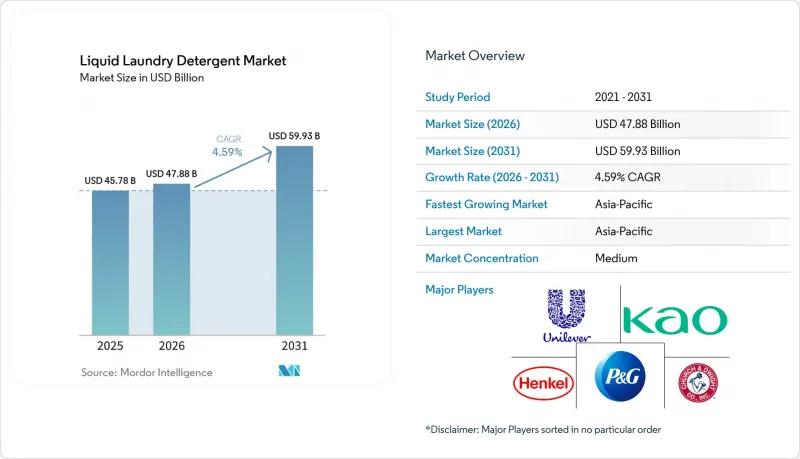
This report is Segmented by Product Type (Enzyme-Based Detergents, Non-Enzyme Detergents, Organic/Natural Detergents, and Other Product Types), Application (Household and Commercial and Industrial (Hotels, Hospitals, and Laundromats)), and Geography (Asia-Pacific, North America, Europe, South America, and the Middle East and Africa). The Market Forecasts are Provided in Terms of Value (USD).
Global Liquid Laundry Detergent Market Trends and Insights
Urbanization-Led Laundry Volume Growth
Rapid migration toward cities in China, India, and Southeast Asia is moving households from infrequent bucket washes to daily machine cycles, lifting per-capita detergent consumption several-fold. Urban families launder garments three to five times more often than rural households because of stricter dress codes, heavier pollution, and better utility access. Liquids gain further as rising incomes push consumers away from traditional bars and powders toward convenient dosing. In Southeast Asia, eco-friendly liquid products logged month-over-month e-commerce demand growth of 25.3%, signaling willingness to pay a premium for plant-based claims. Early distribution in tier-2 and tier-3 cities offers brands an opening to lock in loyalty before multinationals saturate shelves.
Penetration of Automatic Washers in Emerging Markets
Mid-income families in Asia-Pacific and Latin America are buying automatic washers that require liquid rather than powder doses, structurally lifting demand for concentrated liquids optimized for cold-water cleaning. Auto-dosing features on mainstream washer models reduce detergent waste by 31%, reinforcing the shift. Commercial laundries, a USD 7-7.5 billion channel, are co-adopting high-efficiency machines, so liquid suppliers that co-design smart-dosing solutions can win long-term contracts and amortize research and development over larger volumes.
Competition from Sheets and Pods
Pre-measured sheets and pods are growing faster than liquids by combining dosing simplicity with low-waste packaging. Procter & Gamble's Tide evo tile, introduced nationwide in February 2026 at USD 0.48 per load, more than doubled initial sales expectations in Colorado tests. Similar launches from Church & Dwight and Seventh Generation are fragmenting shelf space and pressuring legacy bottle formats in Western markets where e-commerce eases format experimentation.
Other drivers and restraints analyzed in the detailed report include:
- Subscription-Based Refill Services
- Smart-Dispenser/IoT Auto-Dosing Adoption
- Preservative (MI/MCI) Phase-Outs Tighten Reformulation
For complete list of drivers and restraints, kindly check the Table Of Contents.
Segment Analysis
Enzyme-based liquids held 48.12% of the Liquid Laundry detergent market share in 2025, as years of biotech research and development delivered cold-water stain removal that is hard for surfactant-only formulas to match. Lion Corporation's September 2025 NANOX one relaunch, the brand's first new enzyme in its history, showcases gene-level cleaning claims that support premium pricing. Non-enzyme variants continue to cede space as consumers equate enzymes with efficacy and energy savings. Organic and natural liquids are expected to grow at a 5.22% CAGR during the forecast period (2026-2031), catalyzed by third-party ecolabels that reassure buyers on biodegradability and skin safety.
Continuous enzyme breakthroughs underpin the segment's dominance: Novonesis introduced two new protease blends during 2025, and patents from Henkel and BASF describe additives that protect enzyme activity in highly concentrated bases. Meanwhile, International Flavors & Fragrances' Designed Enzymatic Biomaterials platform entered large-scale use in September 2025, replacing synthetic polyquaterniums with biodegradable polysaccharides that soften fabric, pointing to enzymatic advances beyond mere stain removal.
Geography Analysis
Asia-Pacific's 42.24% share of the Liquid Laundry Detergent market in 2025 is projected to climb on a 5.57% CAGR through 2031, propelled by urbanization, rising incomes, and rapid washer penetration in China, India, and ASEAN. Southeast Asian e-commerce data show 25.3% monthly growth for eco-friendly liquids, suggesting stickiness of sustainable claims among new middle-class buyers. Japan and South Korea, already mature, are upgrading to IoT-enabled dosing that pairs with high-performance enzyme liquids.
North America is demand-mature, so growth hinges on format innovation and premium positioning. Tide evo's national US roll-out in February 2026 and Church & Dwight's ARM & HAMMER baking-soda liquid, launched in 2026, illustrate a barbell strategy of premium tiles and value bottles to capture opposite ends of the price spectrum. Nearshoring trends lift Mexican disposable income, nudging households toward liquid conversions.
Europe's stringent November 2025 detergent law tightens biodegradability thresholds and mandates digital product passports, raising compliance costs but allowing formulators to charge higher shelf prices for verified green claims. Private-label penetration above 30% keeps headline pricing in check, forcing branded players to differentiate via enzyme advances and refill subscriptions already popular in the Nordics.
- Amway
- Blue Moon (China) Co., Ltd.
- Church & Dwight Co., Inc.
- Ecover
- Godrej Consumer Products Limited
- Henkel AG and Co. KGaA
- Kao Corporation
- Lion Corporation
- Melaleuca Inc.
- Norwex Norge AS
- Procter & Gamble
- Seventh Generation Inc.
- The Clorox Company
- Unilever
- Werner and Mertz GmbH
Additional Benefits:
- The market estimate (ME) sheet in Excel format
- 3 months of analyst support
TABLE OF CONTENTS
1 Introduction
- 1.1 Study Assumptions and Market Definition
- 1.2 Scope of the Study
2 Research Methodology
3 Executive Summary
4 Market Landscape
- 4.1 Market Overview
- 4.2 Market Drivers
- 4.2.1 Urbanisation-led laundry volume growth
- 4.2.2 Penetration of automatic washers in EMs
- 4.2.3 Subscription-based refill services
- 4.2.4 Smart-dispenser/IoT auto-dosing adoption
- 4.2.5 On-premise shared laundry in multifamily housing
- 4.3 Market Restraints
- 4.3.1 Competition from sheets and pods
- 4.3.2 Preservative (MI/MCI) phase-outs tighten reformulation
- 4.3.3 Deforestation-linked supply risk in bio-surfactants
- 4.4 Value Chain Analysis
- 4.5 Porter's Five Forces
- 4.5.1 Threat of New Entrants
- 4.5.2 Bargaining Power of Buyers
- 4.5.3 Bargaining Power of Suppliers
- 4.5.4 Threat of Substitutes
- 4.5.5 Degree of Competition
5 Market Size and Growth Forecasts (Value)
- 5.1 By Product Type
- 5.1.1 Enzyme-Based Detergents
- 5.1.2 Non-Enzyme Detergents
- 5.1.3 Organic/Natural Detergents
- 5.1.4 Other Product Types (Specialty Hypoallergenic Variants, etc.)
- 5.2 By Application
- 5.2.1 Household
- 5.2.2 Commercial and Industrial (Hotels, Hospitals, Laundromats)
- 5.3 By Geography
- 5.3.1 Asia-Pacific
- 5.3.1.1 China
- 5.3.1.2 Japan
- 5.3.1.3 India
- 5.3.1.4 South Korea
- 5.3.1.5 ASEAN Countries
- 5.3.1.6 Rest of Asia-Pacific
- 5.3.2 North America
- 5.3.2.1 United States
- 5.3.2.2 Canada
- 5.3.2.3 Mexico
- 5.3.3 Europe
- 5.3.3.1 Germany
- 5.3.3.2 United Kingdom
- 5.3.3.3 France
- 5.3.3.4 Italy
- 5.3.3.5 Spain
- 5.3.3.6 Russia
- 5.3.3.7 NORDIC Countries
- 5.3.3.8 Rest of Europe
- 5.3.4 South America
- 5.3.4.1 Brazil
- 5.3.4.2 Argentina
- 5.3.4.3 Rest of South America
- 5.3.5 Middle-East and Africa
- 5.3.5.1 Saudi Arabia
- 5.3.5.2 South Africa
- 5.3.5.3 Rest of Middle-East and Africa
- 5.3.1 Asia-Pacific
6 Competitive Landscape
- 6.1 Market Concentration
- 6.2 Strategic Moves
- 6.3 Market Share(%)/Ranking Analysis
- 6.4 Company Profiles (includes Global Overview, Market Overview, Core Segments, Financials, Strategic Information, Products and Services, Recent Developments)
- 6.4.1 Amway
- 6.4.2 Blue Moon (China) Co., Ltd.
- 6.4.3 Church & Dwight Co., Inc.
- 6.4.4 Ecover
- 6.4.5 Godrej Consumer Products Limited
- 6.4.6 Henkel AG and Co. KGaA
- 6.4.7 Kao Corporation
- 6.4.8 Lion Corporation
- 6.4.9 Melaleuca Inc.
- 6.4.10 Norwex Norge AS
- 6.4.11 Procter & Gamble
- 6.4.12 Seventh Generation Inc.
- 6.4.13 The Clorox Company
- 6.4.14 Unilever
- 6.4.15 Werner and Mertz GmbH
7 Market Opportunities and Future Outlook
- 7.1 White-space and Unmet-need Assessment

