
PUBLISHER: Mordor Intelligence | PRODUCT CODE: 2062033

PUBLISHER: Mordor Intelligence | PRODUCT CODE: 2062033
Bathroom Vanities - Market Share Analysis, Industry Trends & Statistics, Growth Forecasts (2026 - 2031)
According to Mordor Intelligence, the bathroom vanities market size is expected to grow from USD 34.92 billion in 2025 to USD 35.32 billion in 2026 and is forecast to reach USD 48.35 billion by 2031 at 6.48% CAGR over 2026-2031.
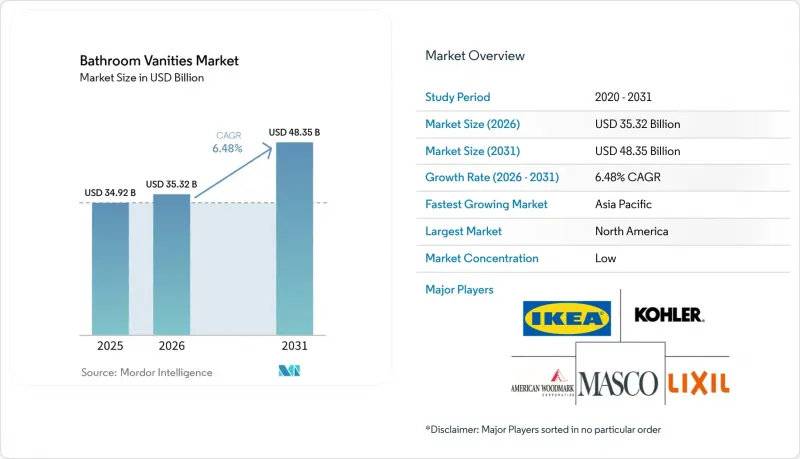
This report is Segmented by Installation Type (Freestanding, Wall-Mounted, Corner), Material (Wood, Ceramic, Stone, Laminate/MDF, Others), Sink Configuration (Single, Double, Others), End-User (Residential, Commercial), Distribution Channel (B2C/Retail, B2B/Direct), and Geography. The Market Forecasts are Provided in Terms of Value (USD).
Global Bathroom Vanities Market Trends and Insights
Rising Home Renovation and Remodeling Activities
Bathroom remodeling ranked as the most common home-improvement project in 2025 among United States remodelers, pointing to a durable upgrade cycle that benefits the bathroom vanities market. Spending on primary bathroom updates stayed resilient, with Houzz reporting higher median outlays for small and large primary baths as homeowners targeted finishes and fixtures that refresh both style and function. Renovation-led demand emphasizes integrated storage, durable surfaces, and coordinated finishes that support a consistent design narrative throughout the room. Baby Boomers led the way and increased their median bathroom spend in 2024, reinforcing aging-in-place upgrades that often include comfort-height options and easy-clean surfaces. These trends sustain project pipelines for installers and drive continuous product refreshes aimed at reducing installation time and simplifying maintenance over the life of the fixture.
Increasing Urbanization and New Residential Construction
Compact homes and high-density living environments are reinforcing demand for space-efficient formats, a shift that supports floating vanities and integrated storage solutions that leave floors clear. Developers and design-build firms continue to weigh footprint and flow in small bathrooms, which favors slim profiles, concealed plumbing, and wall-mounted storage that better utilizes vertical planes. Modular and ready-to-assemble concepts also reduce disruption on site and shorten timelines in multifamily and urban renovations. Brands are aligning with this direction through easier-to-install systems that compress on-site labor and improve predictability for project schedules. These preferences maintain steady support for formats that maximize usable area while preserving a contemporary, minimalist look.
High Initial Costs and Premium Material Pricing
High upfront spend on cabinetry, countertops, and integrated fixtures lifts the entry ticket for a full vanity upgrade, which slows purchase decisions in price-sensitive projects. Premium materials such as engineered stone, natural stone, and solid wood raise unit costs further, and labor-intensive customization amplifies total installed price in developed markets with elevated wages. Tariff and import duty changes on stone, hardware, and fittings can reset quotations mid-cycle, which pressures margins for trade buyers and triggers scope reductions for homeowners. These dynamics extend replacement cycles, encourage value engineering toward standardized sizes and finishes, and limit the adoption of add-ons like smart mirrors and integrated lighting. As a result, the bathroom vanities market experiences demand deferral at the top of the range, while mid-tier assortments capture buyers trading down to meet budget targets. Vendors respond with modular designs, curated bundles, and phased upgrade paths that lower the initial cash outlay without abandoning desired aesthetics.
Other drivers and restraints analyzed in the detailed report include:
- Growing Disposable Incomes and Demand for Luxury Bathroom Fixtures
- Evolving Consumer Preferences for Modern and Aesthetic Bathroom Designs
- Fluctuations in Raw Material Prices and Supply Chain Disruptions
For complete list of drivers and restraints, kindly check the Table Of Contents.
Segment Analysis
Freestanding and floor-standing vanities account for over 61.43% of 2025 placements, reflecting their simple installation and broad compatibility with existing plumbing in older housing stock. In contrast, wall-mounted and floating units are registering a 7.92% CAGR through 2031 as compact homes and modern aesthetics reshape specifications in the bathroom vanities market. The format's clean lines, open floor visibility, and efficient use of vertical space align with urban layout constraints and contemporary design cues. Installers note that wall-mounted systems may require reinforcement to support combined loads from the cabinet, countertop, and fixtures, which adds cost and planning. Despite the added steps, developers and renovators adopt floating formats for their perceived spaciousness and simplified cleaning in everyday use. This balance of style, function, and upkeep is steering assortments toward slimmer profiles and integrated lighting that highlight the wall as a central design feature.
Floating vanities are also benefiting from product innovations that cut on-site labor and increase assembly certainty. IKEA's simplified connector systems in select lines demonstrate how manufacturers reduce tools and steps for do-it-yourself use while preserving a refined look in the bathroom vanities market. Ready-to-install floating options that arrive preassembled can further compress timelines and reduce variability across larger projects. These practical improvements help address skilled-trade constraints while keeping design intent intact for both residential and light commercial applications. Together, faster setup and a space-saving footprint are reinforcing floating formats as the growth engine within installation types.
Wood maintained a 36.71% share in 2025 on the strength of cost-accessible engineered substrates and broad finish options that span paint, laminate, and veneer. Stone materials, including quartz, marble, and granite, are advancing at 8.44% CAGR as projects favor non-porous surfaces that resist stains and reduce maintenance. Granite pricing tiers vary by grade and region, and well-known reference points support typical budgets in paired countertop and vanity packages. The preference for durable surfaces that stand up to daily use is bolstering quartz and granite in homes and commercial spaces where ease of care is a priority in the bathroom vanities market. Moisture-resistant panel grades also play a role in wood-based cabinets for wet environments, where specified cores and finishes help mitigate swelling and edge degradation. Clear care guidance and finish quality are now core to value propositions in both mid-range and premium categories.
Engineered stone producers have also improved design depth and brightness to satisfy marble-look preferences. MSI's LumaLuxe Ultra Quartz showcases this push toward dimensional veining and light performance that pairs with modern, slim-profile vanities. Circular or recycled-content designs expand choice in stone-alternative sinks and surfaces, with Kohler's WasteLAB highlighting how aesthetic and sustainability goals can align without sacrificing design leadership in the bathroom vanities market. In parallel, specification guides encourage moisture-resistant cores and protective finishes for wood-based cabinets in bathrooms, which helps extend service life at accessible price points. These combined advances point to a steady structural pivot toward surfaces that balance aesthetics, durability, and low-effort upkeep.
Geography Analysis
North America led with 36.82% of 2025 revenue as households prioritized bathroom updates that balance aesthetics with lasting performance. Remodel spending in the United States remained healthy in 2024, and primary bathroom projects featured sustained interest in smart lighting, integrated storage, and cleanable surfaces that suit daily routines. Houzz findings show firm spend levels for small and large primary bathrooms, which support material upgrades and better-organized vanities within the bathroom vanities market. Brand investments in the United States manufacturing and design centers reinforce premium and smart features that resonate with homeowners across metropolitan regions. Product launches at design and building events maintain visibility for new collections and fittings that anchor coordinated bathroom suites.
Asia-Pacific is the fastest-growing region at an 8.09% CAGR through 2031, with urbanization and rising incomes elevating expectations for modern bathrooms. Developers and homeowners are adopting stone surfaces and integrated lighting to deliver a contemporary look in compact layouts. In parallel, brands are deepening their presence with investments that localize manufacturing and showcase premium ranges that align with regional design tastes in the bathroom vanities market. New showrooms and design galleries serve the architecture and interior communities and introduce curated vanities and companion fixtures. These moves expand access to higher-spec materials and establish reliable supply for larger projects across the region.
Europe remains a design-forward region with strong emphasis on sustainability, circularity, and heritage renovation. Premium ranges place a clear focus on refined finishes and compact solutions that fit within older building footprints while meeting modern performance expectations. Companies are combining recycled-content sinks with elegant finishes to match environmental goals in the bathroom vanities market. Partnerships and selective acquisitions are helping European brands scale in adjacent categories and reach new audiences globally. In the Middle East and parts of Africa, new hospitality and luxury residential projects are raising specifications for durable, easy-clean vanity systems that hold up in high-use environments. South America shows steady upgrade activity in key cities, while broader economic variability shapes adoption rates for premium materials
- Kohler Co.
- Masco Corporation (Delta, KraftMaid)
- LIXIL Group / American Standard
- IKEA Group
- American Woodmark Corp.
- James Martin Furniture
- Robern
- Duravit AG
- Villeroy & Boch AG
- Roca Sanitario S.A.
- TOTO Ltd.
- Ideagroup Srl
- Burgbad GmbH
- Aquatica Bath
- Virtu USA
- Wyndham Collection
- Swiss Madison LLC
- Avanity Corp.
- Fresca (RGF Brands)
- FUAO Sanitaryware
- Crosswater Ltd.
- VitrA (EczacIbasI Building Products)
Additional Benefits:
- The market estimate (ME) sheet in Excel format
- 3 months of analyst support
TABLE OF CONTENTS
1 Introduction
- 1.1 Study Assumptions & Market Definition
- 1.2 Scope of the Study
2 Research Methodology
3 Executive Summary
4 Market Landscape
- 4.1 Market Overview
- 4.2 Market Drivers
- 4.2.1 Rising Home Renovation and Remodeling Activities
- 4.2.2 Increasing Urbanization and New Residential Construction
- 4.2.3 Growing Disposable Incomes and Demand for Luxury Bathroom Fixtures
- 4.2.4 Evolving Consumer Preferences for Modern and Aesthetic Bathroom Designs
- 4.2.5 Expansion in Hospitality Sector and Commercial Projects
- 4.2.6 Advancements in Smart Features and Space-Efficient Designs
- 4.3 Market Restraints
- 4.3.1 High Initial Costs and Premium Material Pricing
- 4.3.2 Fluctuations in Raw Material Prices and Supply Chain Disruptions
- 4.3.3 Limited Space Constraints in Urban and Compact Households
- 4.3.4 Health and Environmental Concerns Related to Certain Materials
- 4.4 Industry Value Chain Analysis
- 4.5 Porter's Five Forces Analysis
- 4.5.1 Threat of New Entrants
- 4.5.2 Bargaining Power of Suppliers
- 4.5.3 Bargaining Power of Buyers
- 4.5.4 Threat of Substitutes
- 4.5.5 Competitive Rivalry
- 4.6 Insights into the Latest Trends and Innovations in the Market
- 4.7 Insights on Recent Developments (New Product Launches, Strategic Initiatives, Investments, Partnerships, JVs, Expansion, M&As, etc.) in the Market
5 Market Size & Growth Forecasts (Value)
- 5.1 By Installation Type
- 5.1.1 Freestanding / Floor-standing
- 5.1.2 Wall-mounted / Floating
- 5.1.3 Corner
- 5.2 By Material
- 5.2.1 Wood
- 5.2.2 Ceramic
- 5.2.3 Stone (Marble, Quartz, Granite)
- 5.2.4 Laminate / MDF
- 5.2.5 Others (Metal, Glass, Solid Surface)
- 5.3 By Sink Configuration
- 5.3.1 Single Sink
- 5.3.2 Double Sink
- 5.3.3 Others (e.g., Vessel, Integrated Multi-bowl)
- 5.4 By End-User
- 5.4.1 Residential
- 5.4.2 Commercial
- 5.5 By Distribution Channel
- 5.5.1 B2C/Retail
- 5.5.1.1 Home Centers
- 5.5.1.2 Specialty Furniture Stores (including exclusive brand outlets)
- 5.5.1.3 Online
- 5.5.1.4 Other Distribution Channels (includes hypermarkets, supermarkets, teleshopping, warehouse clubs, departmental stores, etc.)
- 5.5.2 B2B/Directly from Manufacturers
- 5.5.1 B2C/Retail
- 5.6 By Geography
- 5.6.1 North America
- 5.6.1.1 Canada
- 5.6.1.2 United States
- 5.6.1.3 Mexico
- 5.6.2 South America
- 5.6.2.1 Brazil
- 5.6.2.2 Peru
- 5.6.2.3 Chile
- 5.6.2.4 Argentina
- 5.6.2.5 Rest of South America
- 5.6.3 Asia-Pacific
- 5.6.3.1 India
- 5.6.3.2 China
- 5.6.3.3 Japan
- 5.6.3.4 Australia
- 5.6.3.5 South Korea
- 5.6.3.6 South East Asia (Singapore, Malaysia, Thailand, Indonesia, Vietnam, and Philippines)
- 5.6.3.7 Rest of Asia-Pacific
- 5.6.4 Europe
- 5.6.4.1 United Kingdom
- 5.6.4.2 Germany
- 5.6.4.3 France
- 5.6.4.4 Spain
- 5.6.4.5 Italy
- 5.6.4.6 BENELUX (Belgium, Netherlands, and Luxembourg)
- 5.6.4.7 NORDICS (Denmark, Finland, Iceland, Norway, and Sweden)
- 5.6.4.8 Rest of Europe
- 5.6.5 Middle East and Africa
- 5.6.5.1 United Arab Emirates
- 5.6.5.2 Saudi Arabia
- 5.6.5.3 South Africa
- 5.6.5.4 Nigeria
- 5.6.5.5 Rest of Middle East and Africa
- 5.6.1 North America
6 Competitive Landscape
- 6.1 Market Concentration
- 6.2 Strategic Moves
- 6.3 Market Share Analysis
- 6.4 Company Profiles {(includes Global level Overview, Market level overview, Core Segments, Financials as available, Strategic Information, Market Rank/Share for key companies, Products & Services, and Recent Developments)}
- 6.4.1 Kohler Co.
- 6.4.2 Masco Corporation (Delta, KraftMaid)
- 6.4.3 LIXIL Group / American Standard
- 6.4.4 IKEA Group
- 6.4.5 American Woodmark Corp.
- 6.4.6 James Martin Furniture
- 6.4.7 Robern
- 6.4.8 Duravit AG
- 6.4.9 Villeroy & Boch AG
- 6.4.10 Roca Sanitario S.A.
- 6.4.11 TOTO Ltd.
- 6.4.12 Ideagroup Srl
- 6.4.13 Burgbad GmbH
- 6.4.14 Aquatica Bath
- 6.4.15 Virtu USA
- 6.4.16 Wyndham Collection
- 6.4.17 Swiss Madison LLC
- 6.4.18 Avanity Corp.
- 6.4.19 Fresca (RGF Brands)
- 6.4.20 FUAO Sanitaryware
- 6.4.21 Crosswater Ltd.
- 6.4.22 VitrA (EczacIbasI Building Products)
7 Market Opportunities & Future Outlook
- 7.1 Demand rises for high-end materials and minimalistic designs
- 7.2 Eco-friendly materials and smart storage/lighting features gain traction

