PUBLISHER: Mordor Intelligence | PRODUCT CODE: 2062035

PUBLISHER: Mordor Intelligence | PRODUCT CODE: 2062035
Catalyst Fertilizers - Market Share Analysis, Industry Trends & Statistics, Growth Forecasts (2026 - 2031)
According to Mordor Intelligence, the catalyst fertilizers market size is projected to be USD 3.2 billion in 2025, USD 3.3 billion in 2026, and reach USD 3.87 billion by 2031, growing at a CAGR of 3.26% from 2026 to 2031.
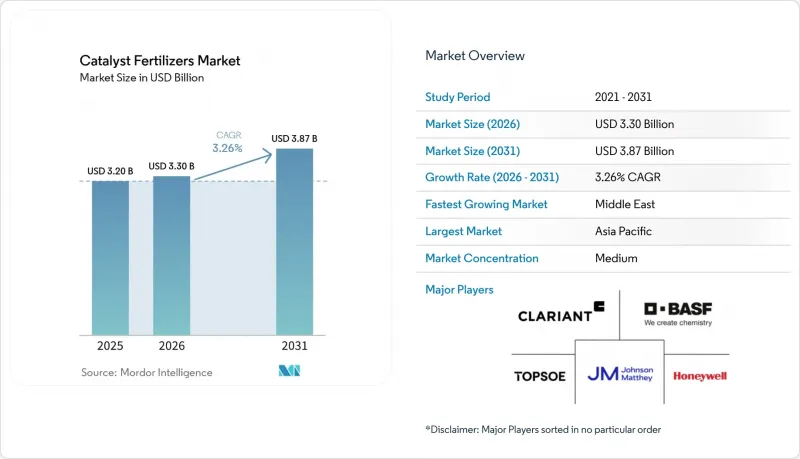
This report is Segmented by Product Type (Nitrogenous, Phosphatic, Potassic, and Complex), by Catalyst Metal Group (Base-Metal and Precious-Metal), by Production Process (Haber-Bosch, Urea, Nitric Acid, and Sulfuric Acid), by Application Stage (Primary Synthesis and Emission-Control), by End-User (Integrated Majors, Independent Producers, and More), and by Geography. Market Forecasts are in Value (USD).
Global Catalyst Fertilizers Market Trends and Insights
Iron-oxide Haber-Bosch Catalysts Cut Energy Use
Wustite-based iron catalysts lower ammonia-synthesis energy consumption by roughly 30%, trimming 1.5 to 2 gigajoules per metric ton of ammonia produced. The gain directly reduces natural gas costs and Scope 1 carbon emissions, which are critical because ammonia synthesis consumes around 2% of the global energy supply. Since its launch in 2020-2021, the AmoMax-Casale catalyst has achieved 30% higher efficiency than traditional wustite catalysts. This allows brownfield plants to increase ammonia yields or reduce loop pressures, delaying major capital upgrades by optimizing existing reactor systems. Adoption is fastest in China and India, where plant fleets are more than 25 years old, and governments are tightening carbon-intensity targets. Europe is following as volatile gas prices during 2022-2024 made energy savings a strategic imperative.
Stringent Nitrous oxide Caps for Nitric-Acid Plants
Recent Environmental Protection Agency (EPA) updates require nitric acid facilities to use Continuous Emission Monitoring Systems (CEMS) for tracking 30-day average emission rates. The guidance also recommends dual-span monitors for accurate measurements during startup and shutdown. Because nitrous oxide has a 273-times higher global-warming potential than carbon dioxide, new regulations are forcing rapid replacement of legacy Pt-Rh gauze and secondary abatement units. KATALCO tertiary decomposition systems from Johnson Matthey destroy up to 99% of Nitrous oxide, letting plants earn voluntary-market carbon credits that partially offset catalyst costs. Similar caps in Europe under the Industrial Emissions Directive sync replacement cycles across advanced economies. Short compliance deadlines between 2026 and 2028 keep the driver's effect front-loaded.
Vanadium Pentoxide Price Volatility
Vanadium pentoxide, the active phase in sulfuric-acid contact catalysts, has traded between USD 5 and USD 9 per pound since 2022, mirroring shifts in ferro-vanadium demand and Chinese export adjustments. To cope, producers stretch catalyst life through regeneration, which restores only 60-70% activity and introduces process-control variability. While long-term offtake contracts exist, many buyers in the Asia-Pacific region prefer spot deals and thus are exposed to short-cycle volatility. The resulting uncertainty delays new installations in phosphate fertilizer complexes, especially in India and China.
Other drivers and restraints analyzed in the detailed report include:
- Green-Ammonia Build-Outs in Asia-Pacific
- Precious-Metal Catalyst Leasing and Recycling
- Limited Awareness Among African Mid-Size Urea Plants
For complete list of drivers and restraints, kindly check the Table Of Contents.
Segment Analysis
Nitrogenous catalysts retained the largest market share at 55% in 2025, reflecting their role as anchors in ammonia and nitric acid production. Potassic systems are the fastest-expanding category, advancing at a fastest 13.9% CAGR through 2026-2031, driven by specialty-fertilizer demand and nano-copper-enabled low-pressure routes. Together, these two segments accounted for roughly three-quarters of the catalyst fertilizers market size in 2025. Producers prioritize nitrogenous upgrades for immediate energy savings, while potassic innovations attract investors looking for premium horticulture margins.
Phosphatic catalysts, tied to sulfuric-acid plants, face cost swings from volatile vanadium prices yet still post steady mid-single-digit growth in Morocco and Saudi Arabia. Complex-fertilizer catalyst packages bundle ammonia, nitric acid, and sulfuric acid stages, appealing to integrated plants seeking one-stop procurement. Uptake of complex catalysts improves operating synergy and trims total cost of ownership by as much as 18%. Suppliers use these bundled offerings to deepen customer relationships and offset pricing pressure in mature nitrogenous lines.
Base-metal formulations, dominated by iron oxides, captured the largest 55% of the market share in 2025, owing to cost advantages and entrenched Haber-Bosch demand. Copper-based alternatives are the fastest-growing, projected to grow at a fastest 12.4% CAGR from 2026-2031, as low-pressure ammonia synthesis gains traction in green projects. The two categories combined account for over 80% of current sales, underscoring their strategic importance in technology roadmaps. Producers balance iron's affordability with copper's superior low-temperature activity to meet evolving efficiency targets.
Precious-metal Pt-Rh gauze holds a stable high-value niche for nitric-acid plants that monetize carbon credits. Vanadium systems support sulfuric-acid production but face margin pressure from raw-material volatility and environmental scrutiny. Nickel and zinc catalysts play specialized roles in urea conditioning and emission reduction, accounting for a modest share of revenue. Suppliers with broad metal portfolios hedge commodity risk and offer recycling programs that curb customer exposure to price swings
Geography Analysis
Asia-Pacific held the largest market share at 46% in 2025, supported by China's sizable ammonia base and India's new urea capacities. The Middle East is the fastest-growing region, advancing at a 14.2% CAGR through 2026-2031, as mega-projects such as the NEOM green-ammonia complex move from construction to start-up. Producers in both regions favor high-activity iron-oxide catalysts that lower energy bills and qualify for carbon credits. Their procurement pipelines already include dynamic formulations designed for renewable-hydrogen inputs, signaling sustained demand through 2031.
North America and Europe focus on catalyst replacements that meet stricter nitrous-oxide and energy-efficiency rules, a trend that stabilizes sales despite limited new capacity. South America benefits from acreage expansion in Brazil and improving logistics for fertilizer distribution, while Africa adds units mainly in Morocco, Nigeria and Egypt as financing becomes available. Russia remains supply-constrained, relying more on Chinese vendors after recent trade disruptions. These five regions together diversify the customer base and buffer suppliers against localized downturns.
Looking ahead, Asia-Pacific will continue to expand lead volumes through brownfield retrofits and government incentives that promote self-sufficiency. The Middle East plans additional green-ammonia hubs that integrate low-cost solar power, ensuring a long runway for load-following catalysts. North America and Europe are upgrading nitric-acid lines for deeper nitrous oxide cuts, creating recurring orders for emission-control formulations. Emerging economies in South America and Africa are scaling specialty-crop output, which should lift demand for next-generation potassic and copper-based systems across the forecast window.
- Clariant AG
- Haldor Topsoe A/S
- Johnson Matthey Plc
- BASF SE
- Honeywell International Inc.
- Axens SA
- Casale SA
- Thyssenkrupp Uhde GmbH
- UNICAT Catalyst Technologies LLC
- SYAMCAT Shandong Avant New Material Technology Co. Ltd.
- W. R. Jiangsu Jingjiang Catalyst Co., Ltd.
- TANAKA Kikinzoku Kogyo K.K.
- KBR Inc.
- LKAB Minerals AB
- Elessent Clean Technologies Inc.
Additional Benefits:
- The market estimate (ME) sheet in Excel format
- 3 months of analyst support
TABLE OF CONTENTS
1 Introduction
- 1.1 Study Assumptions and Market Definition
- 1.2 Scope of the Study
2 Research Methodology
3 Executive Summary
4 Market Landscape
- 4.1 Market Overview
- 4.2 Market Drivers
- 4.2.1 Iron-oxide Haber-Bosch catalysts cut energy use
- 4.2.2 Stringent Nitrous oxide caps for nitric-acid plants
- 4.2.3 Green-ammonia build-outs in Asia-Pacific
- 4.2.4 Precious-metal catalyst leasing and recycling
- 4.2.5 Nano-structured copper catalysts for low-pressure processes
- 4.2.6 Carbon-credit-linked catalyst replacement cycles
- 4.3 Market Restraints
- 4.3.1 Vanadium pentoxide price volatility
- 4.3.2 Limited awareness among African mid-size urea plants
- 4.3.3 Phytotoxicity fears over trace-metal leaching
- 4.3.4 Ambiguity in nano-porous carrier classification
- 4.4 Regulatory Landscape
- 4.5 Technological Outlook
- 4.6 Porter's Five Forces Analysis
- 4.6.1 Threat of New Entrants
- 4.6.2 Bargaining Power of Suppliers
- 4.6.3 Bargaining Power of Buyers
- 4.6.4 Threat of Substitutes
- 4.6.5 Intensity of Competitive Rivalry
5 Market Size and Growth Forecasts (Value)
- 5.1 By Product Type
- 5.1.1 Nitrogenous
- 5.1.2 Phosphatic
- 5.1.3 Potassic
- 5.1.4 Complex
- 5.2 By Catalyst Metal Group
- 5.2.1 Base-metal (Iron, Nickel, Vanadium, Zinc)
- 5.2.2 Precious-metal (Platinum, Rhodium, Ruthenium)
- 5.3 By Production Process
- 5.3.1 Haber Bosch Ammonia Synthesis
- 5.3.2 Urea Plant Catalysts
- 5.3.3 Nitric Acid
- 5.3.4 Sulfuric Acid
- 5.4 By Application Stage
- 5.4.1 Primary Synthesis Catalysts
- 5.4.2 Emission-control / De-NOx Catalysts
- 5.5 By End-user
- 5.5.1 Integrated Fertilizer Majors
- 5.5.2 Independent Ammonia Producers
- 5.5.3 Specialty Ammonia Developers
- 5.6 By Geography
- 5.6.1 North America
- 5.6.1.1 United States
- 5.6.1.2 Canada
- 5.6.1.3 Mexico
- 5.6.1.4 Rest of North America
- 5.6.2 South America
- 5.6.2.1 Brazil
- 5.6.2.2 Argentina
- 5.6.2.3 Rest of South America
- 5.6.3 Europe
- 5.6.3.1 Germany
- 5.6.3.2 France
- 5.6.3.3 Spain
- 5.6.3.4 Russia
- 5.6.3.5 Rest of Europe
- 5.6.4 Asia-Pacific
- 5.6.4.1 China
- 5.6.4.2 India
- 5.6.4.3 Japan
- 5.6.4.4 Rest of Asia-Pacific
- 5.6.5 Middle East
- 5.6.5.1 Saudi Arabia
- 5.6.5.2 Turkey
- 5.6.5.3 Rest of Middle East
- 5.6.6 Africa
- 5.6.6.1 South Africa
- 5.6.6.2 Egypt
- 5.6.6.3 Rest of Africa
- 5.6.1 North America
6 Competitive Landscape
- 6.1 Market Concentration
- 6.2 Strategic Moves
- 6.3 Market Share Analysis
- 6.4 Company Profiles (Includes Global level Overview, Market level overview, Core Segments, Financials as available, Strategic Information, Market Rank/Share for key companies, Products and Services, and Recent Developments)
- 6.4.1 Clariant AG
- 6.4.2 Haldor Topsoe A/S
- 6.4.3 Johnson Matthey Plc
- 6.4.4 BASF SE
- 6.4.5 Honeywell International Inc.
- 6.4.6 Axens SA
- 6.4.7 Casale SA
- 6.4.8 Thyssenkrupp Uhde GmbH
- 6.4.9 UNICAT Catalyst Technologies LLC
- 6.4.10 SYAMCAT Shandong Avant New Material Technology Co. Ltd.
- 6.4.11 W. R. Jiangsu Jingjiang Catalyst Co., Ltd.
- 6.4.12 TANAKA Kikinzoku Kogyo K.K.
- 6.4.13 KBR Inc.
- 6.4.14 LKAB Minerals AB
- 6.4.15 Elessent Clean Technologies Inc.
- 6.5 Market Opportunity and Future Outlook

