
PUBLISHER: Mordor Intelligence | PRODUCT CODE: 2062052

PUBLISHER: Mordor Intelligence | PRODUCT CODE: 2062052
Edible Flowers - Market Share Analysis, Industry Trends & Statistics, Growth Forecasts (2026 - 2031)
According to Mordor Intelligence, the edible flowers market size is projected to be USD 420 million in 2025, USD 441.6 million in 2026, and reach USD 567.7 million by 2031, growing at a CAGR of 5.15% from 2026 to 2031.
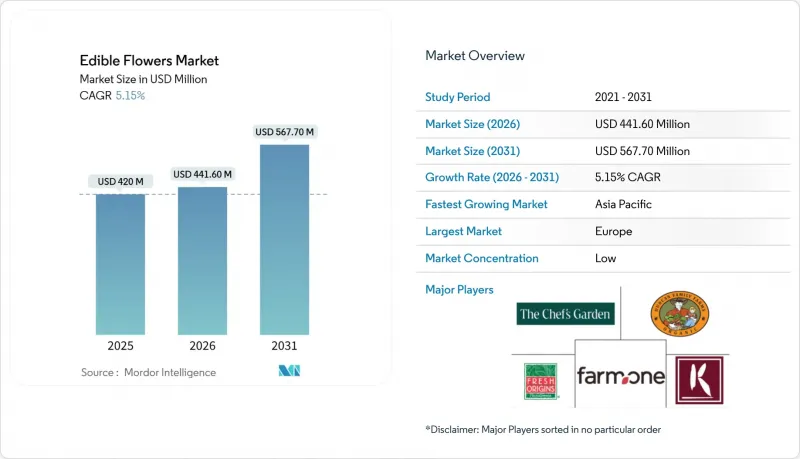
This report is Segmented by Flower Type (Rose, Hibiscus, Lavender, Marigold, Pansy and Viola, Nasturtium, and Other Flower Types), by Form (Fresh, Dried, and Powders), by Distribution Channel (Off-Trade and On-Trade), and by Geography (North America, South America, Europe, Asia-Pacific, Middle East, and Africa). The Market Forecasts are Provided in Terms of Value (USD).
Global Edible Flowers Market Trends and Insights
Clean-Label Demand Shifting from Synthetic to Natural Plate Decor
Premium restaurants are replacing synthetic dyes with nasturtium, pansy, and hibiscus petals to satisfy diners who scan ingredient lists on mobile apps at the table. Michelin-ranked kitchens in Bangkok and New York showcased rooftop-grown flowers during 2026 dining events, demonstrating that culinary credibility now hinges on visible freshness and traceability. Analytical profiling of seven petals used in Madeira's fine-dining scene linked geraniol, linalool, and isothiocyanates to distinctive flavor layers that chefs exploit instead of processed extracts. Retailers are aligning with this trend by offering small packs of organic edible flowers marketed as an "affordable luxury," with influencers promoting floral plating concepts. Growers who use organic or Veriflora-certified practices gain advantages, such as prioritized placement on restaurant procurement lists and in specialty produce sections.
Organic Subsidies Lowering Floriculture Conversion Costs
Targeted funding is accelerating acreage conversion. The USDA disbursed USD 72.9 million in Specialty Crop Block Grants during fiscal 2025 and unlocked another USD 1 billion of Assistance for Specialty Crop Farmers in February 2026, directly covering organic certification and cold-chain upgrades for edible-flower growers. In the European Union, Common Agricultural Policy payments cushion the two-year yield dip while growers transition Provence lavender and Italian rose fields to pesticide-free specification. Regulatory clarity is improving in tandem. The U.S. Food and Drug Administration's (FDA's) 2025 approval of butterfly pea flower extract as a color additive created a template for other species to pursue Generally Recognized as Safe (GRAS) status, further reducing perceived compliance risk.
High Perishability Increasing Cold-Chain Costs and Limiting Retail Reach
Fresh petals have a limited shelf life of 2°C-4°C, necessitating swift transportation and specialized cold-chain logistics, unlike the more stable dried forms. This leads to greater handling complexity, higher product losses, and operational difficulties in retail settings. Although technologies like IoT sensors have enhanced temperature monitoring, they introduce additional costs that smaller producers often struggle to manage. Unless preservation technologies improve significantly or dried formats achieve wider acceptance, cold-chain limitations are anticipated to restrict large-scale market growth.
Other drivers and restraints analyzed in the detailed report include:
- Functional-Food Trends Expanding Petals into Teas, Snacks, and Nutraceuticals
- Plasma Sterilization Extending Shelf Life and Reducing Air-Freight
- Fragmented Regulations Raising Compliance Burden in Exports Markets
For complete list of drivers and restraints, kindly check the Table Of Contents.
Segment Analysis
Rose accounted for the largest share of 28% of the edible flowers market in 2025, driven by heirloom varieties valued for their fragrance in culinary applications. Marigold is the fastest-growing segment, projected to expand at a 6.8% CAGR during 2026-2031, well above the 5.15% growth rate of the edible flowers market, as lutein-dense petals appeal to producers of vision-health supplements. Hibiscus commands mid-tier volume via ready-to-drink teas that leverage tart flavor and anthocyanin claims, whereas lavender sustains premium-price segments tied to Provence appellation controls and aroma therapy crossover.
Breeders are now optimizing marigold genetics for dual-purpose color and 20 mg lutein per dry gram, narrowing the historic price gap versus rose. Rose growers are increasingly utilizing blockchain-based systems to verify single-estate provenance and enhance premium positioning within restaurant channels. Hibiscus supply chains are experiencing commodity pressure as lower-cost regions compete with established producers, while concerns about pollinators may restrict the expansion of lavender cultivation. Nasturtium is gaining popularity in vertical farming due to its microgreen-like flavor profile. Meanwhile, pansy and viola remain favored in restaurants, though their limited shelf life continues to hinder growth in the retail market.
Geography Analysis
Europe held the largest share of 34% of the edible flowers market size in 2025, supported by a well-established regulatory and retail framework. The European Food Safety Authority (EFSA) has progressively clarified safety assessments for edible botanicals, facilitating broader commercialization across member states, despite variations in country-specific pesticide tolerances. Demand in the region is bolstered by premium retail formats, a strong presence of organic products, and the incorporation of edible flowers into high-end culinary applications. Additionally, the region benefits from established cold-chain infrastructure and proximity between growers and end markets, which helps maintain product quality. This has allowed fresh formats to dominate the market while also fostering innovation in value-added products such as powders and extracts.
The Asia-Pacific region is the fastest-growing market, with a CAGR of 7.5% projected through 2026-2031. Growth is driven by increasing urban consumption and the cultural familiarity of floral ingredients in food and beverages. Countries like Japan and those in Southeast Asia benefit from established culinary traditions, although fragmented regulatory pathways and country-specific approval systems influence commercialization strategies. The rapid expansion of modern retail and e-commerce platforms is improving accessibility to both fresh and dried edible flowers. Simultaneously, local production ecosystems are advancing, with controlled-environment agriculture and contract farming models ensuring consistent quality and year-round supply.
In other regions, including North America, South America, and the Middle East & Africa, the edible flowers market is developing at varying rates, shaped by differences in regulatory frameworks and consumer awareness. In North America, the U.S. Food and Drug Administration (FDA) oversees approvals through frameworks such as Generally Recognized as Safe (GRAS), which can delay the introduction of new flower species due to stringent safety documentation requirements. South America is increasingly emerging as a supply base, leveraging favorable growing conditions and export-oriented production. Meanwhile, the Middle East & Africa are experiencing niche adoption, primarily driven by premium hospitality and tourism sectors. Across these regions, market growth is closely linked to regulatory clarity, supply chain development, and efforts to educate consumers on culinary applications.
- Fresh Origins, LLC
- Koppert Cress B.V.
- Farm.One Holdings, Inc.
- The Chef's Garden, Inc.
- Duncan Family Farms, LLC
- Cherry Valley Organics
- Nosh Produce PTE. Ltd.
- LLC Greeneration Advanced Growing of Beverage Crops
- Magnolia's Yarden
- Maddocks Farm Organics
- Bloomish
- San Diego Farms LLC
- Mountain Rose, Inc.
Additional Benefits:
- The market estimate (ME) sheet in Excel format
- 3 months of analyst support
TABLE OF CONTENTS
1 Introduction
- 1.1 Study Assumptions and Market Definition
- 1.2 Scope of the Study
2 Research Methodology
3 Executive Summary
4 Market Landscape
- 4.1 Market Overview
- 4.2 Market Drivers
- 4.2.1 Clean-label demand shifting from synthetic to natural plate decor
- 4.2.2 Organic subsidies lowering floriculture conversion costs
- 4.2.3 Functional-food trends expanding petals into teas, snacks, and nutraceuticals
- 4.2.4 Plasma sterilization extending shelf life and reducing air freight
- 4.2.5 Cruise tourism rebound boosting demand for visually appealing dishes
- 4.2.6 Blockchain authentication strengthening origin traceability in premium segments
- 4.3 Market Restraints
- 4.3.1 High perishability increasing cold-chain costs and limiting retail reach
- 4.3.2 Fragmented regulations raising compliance burden in export markets
- 4.3.3 Pollinator loss from monocropping reducing yield stability
- 4.3.4 Consumer hesitation in price-sensitive markets limiting adoption
- 4.4 Regulatory Landscape
- 4.5 Technological Outlook
- 4.6 Porter's Five Forces
- 4.6.1 Threat of New Entrants
- 4.6.2 Bargaining Power of Suppliers
- 4.6.3 Bargaining Power of Buyers
- 4.6.4 Threat of Substitutes
- 4.6.5 Intensity of Competitive Rivalry
5 Market Size and Growth Forecasts (Value)
- 5.1 By Flower Type
- 5.1.1 Rose
- 5.1.2 Hibiscus
- 5.1.3 Lavender
- 5.1.4 Marigold
- 5.1.5 Pansy and Viola
- 5.1.6 Nasturtium
- 5.1.7 Other Flower Types
- 5.2 By Form
- 5.2.1 Fresh
- 5.2.2 Dried
- 5.2.3 Powders
- 5.3 By Distribution Channel
- 5.3.1 On-Trade
- 5.3.2 Off-Trade
- 5.4 By Geography
- 5.4.1 North America
- 5.4.1.1 United States
- 5.4.1.2 Canada
- 5.4.1.3 Mexico
- 5.4.1.4 Rest of North America
- 5.4.2 South America
- 5.4.2.1 Brazil
- 5.4.2.2 Argentina
- 5.4.2.3 Rest of South America
- 5.4.3 Europe
- 5.4.3.1 Germany
- 5.4.3.2 France
- 5.4.3.3 Italy
- 5.4.3.4 United Kingdom
- 5.4.3.5 Russia
- 5.4.3.6 Rest of Europe
- 5.4.4 Asia-Pacific
- 5.4.4.1 China
- 5.4.4.2 Japan
- 5.4.4.3 India
- 5.4.4.4 Australia
- 5.4.4.5 New Zealand
- 5.4.4.6 South Korea
- 5.4.4.7 Rest of Asia-Pacific
- 5.4.5 Middle East
- 5.4.5.1 United Arab Emirates
- 5.4.5.2 Saudi Arabia
- 5.4.5.3 Rest of Middle East
- 5.4.6 Africa
- 5.4.6.1 South Africa
- 5.4.6.2 Kenya
- 5.4.6.3 Rest of Africa
- 5.4.1 North America
6 Competitive Landscape
- 6.1 Market Concentration
- 6.2 Strategic Moves
- 6.3 Market Share Analysis
- 6.4 Company Profiles (Includes Global level Overview, Market level Overview, Core Segments, Financials as available, Strategic Information, Market Rank/Share for key companies, Products and Services, and Recent Developments)
- 6.4.1 Fresh Origins, LLC
- 6.4.2 Koppert Cress B.V.
- 6.4.3 Farm.One Holdings, Inc.
- 6.4.4 The Chef's Garden, Inc.
- 6.4.5 Duncan Family Farms, LLC
- 6.4.6 Cherry Valley Organics
- 6.4.7 Nosh Produce PTE. Ltd.
- 6.4.8 LLC Greeneration Advanced Growing of Beverage Crops
- 6.4.9 Magnolia's Yarden
- 6.4.10 Maddocks Farm Organics
- 6.4.11 Bloomish
- 6.4.12 San Diego Farms LLC
- 6.4.13 Mountain Rose, Inc.
7 Market Opportunities and Future Outlook

