
PUBLISHER: Mordor Intelligence | PRODUCT CODE: 2062054

PUBLISHER: Mordor Intelligence | PRODUCT CODE: 2062054
Cash Logistics - Market Share Analysis, Industry Trends & Statistics, Growth Forecasts (2026 - 2031)
According to Mordor Intelligence, the cash logistics market size is projected to be USD 28.57 billion in 2025, USD 29.86 billion in 2026, and reach USD 36.97 billion by 2031, growing at a CAGR of 4.36% from 2026 to 2031.
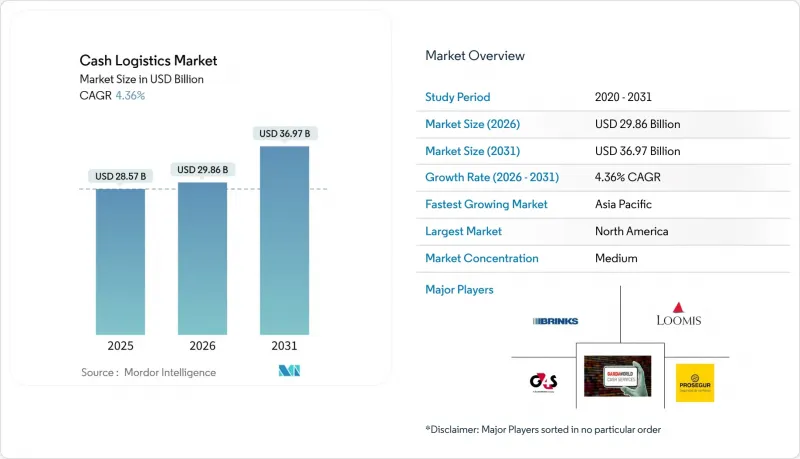
Strong inflationary trends in several emerging economies are keeping physical currency in active circulation, which supports consistent volumes for secure transport and processing. This report is Segmented by Service Type (Cash-In-Transit, Cash Management, ATM Services), by End-User Industry (Banking and Financial Institutions, Retail, Hospitality, Government & Public Sector, and Others), and by Region (North America, South America, Asia-Pacific, Europe, and the Middle East and Africa). The Market Forecasts are Provided in Terms of Value (USD).
Global Cash Logistics Market Trends and Insights
Inflation-Driven Expansion in Physical Currency Circulation
Central banks lifted note issuance after inflation surpassed 5% in many economies during 2024, which left more currency in public hands and raised the frequency of vault rotations and line-haul trips. Emerging markets where 8%-plus inflation persisted saw businesses store higher nominal cash balances, generating immediate volume upside for logistics firms. Providers with established central bank contracts benefited first because they could scale transport runs quickly and add temporary processing shifts. Despite digital wallet growth, IMF research confirms that currency in circulation remains a key monetary component, proving that cash stays relevant under high-price conditions. The boost is expected to normalize after macro-pressures ease, yet the wider base of banknotes will still require ongoing service, anchoring the cash logistics market.
Retail Deployment of Smart Safes and Cash Automation Devices
Labor shortages and higher minimum wages prompted United States and European retailers to roll out smart safes that validate, count, and secure deposits in real time, cutting nightly reconciliation and giving managers back several hours per week. Same-day provisional credit provided by banks improves working-capital cycles, a priority when interest rates remain elevated. Logistics providers now bundle device leasing, monitoring, and cash processing into multiyear contracts, shifting part of their revenue base from distance-driven pickups to subscription technology services. Mid-tier merchants are following big-box chains, widening the total addressable device pool. This momentum continues to lift integrated cash management revenue faster than traditional transport, a factor behind the robust outlook for the cash logistics market.
Escalating Insurance and Liability Premiums for Armored Fleets
A single USD 30 million theft at an armored vault in California led underwriters to reprice risk across the sector, sending premiums sharply higher during 2025. Smaller regionals without spotless loss histories face renewal hikes exceeding 25%, eroding net margins. Many respond by raising minimum contract values or exiting high-crime districts, which could constrain competitive options for banks and retailers. The cost squeeze encourages investments in smart tracking, dual-authentication vault access, and captive insurance to mitigate premium escalation.
Other drivers and restraints analyzed in the detailed report include:
- Persistent ATM Demand in Remittance-Heavy Economies
- Rural Micro-ATM and Agent-Banking Network Proliferation
- Shortage of Licensed Armed Guards Inflating Labor Costs
For complete list of drivers and restraints, kindly check the Table Of Contents.
Segment Analysis
Cash-in-transit retained the largest slice of the cash logistics market at 47.23% cash logistics market share in 2025. However, cash management services are forecast to compound at 6.13% CAGR by 2031. Clients view outsourced processing, vaulting, and reconciliation as a single workflow, so they now issue tenders that bundle physical and digital components. Logistics leaders respond with cloud dashboards that show end-to-end cash positions and predictive replenishment alerts. A shift from mileage-based billing to per-transaction fees improves margin stability.
GardaWorld's Sesami platform illustrates the pivot: by acquiring Tidel and Gunnebo's cash operations, it built an integrated stack that offers IoT smart safes, armored pickup, and AI analytics under one SLA. Similar moves by Brink's and Loomis signal an industry consensus that automation and data services will dominate future growth in the cash logistics market.
Geography Analysis
Asia-Pacific is projected to expand at 6.01% CAGR by 2031 as governments push rural inclusion and remittance corridors deepen. India's state-level ATM rollouts and Indonesia's agent-banking incentives increase pickup points that need low-volume but high-frequency service. China, despite mobile-payment dominance, still circulates large cash volumes for rural trade and festival gifting, requiring high-capacity vaults and multi-currency sorters.
North America held 29.97% of global value in 2025, underpinned by a century-old outsourcing culture and tech-rich service portfolios. Brink's reported USD 5,012 million revenue in 2024, with 12% organic uplift driven by digital retail solutions and ATM managed services. Rolling fleet electrification programs and e-manifest mandates from the Federal Reserve are reshaping operational standards and lowering route miles.
Europe shows mid-single-digit gains as sustainability rules bite. Prosegur's electric truck cut 15 tons of CO2 per year while dropping total vehicle weight 30%, proving regulatory compliance can coexist with cost savings. Low-emission zones in London and Paris accelerate similar upgrades across the region. Latin America and the Middle East & Africa grow from lower bases, with volumes tied to remittance inflows, tourist receipts, and gradual formalization of retail sectors, all of which stimulate incremental demand for the cash logistics market.
- Brink's Company
- Loomis AB
- GardaWorld Cash Services
- Prosegur Cash
- G4S Secure Solutions (acquired by Allied Universal)
- CMS Info Systems
- Armaguard Group
- Cash Logistik Security AG
- Cennox
- Sectran Security
- Titan Armored
- Cash Services Australia (Linfox Armaguard)
- General Secure Logistic Services (GSLS)
- AXIOM Armored
- Cash Connect
- Radiant Cash Management Services
- Transguard Group
- SIS India (Security and Intelligence Services)
- AGS Transact Technologies
- Global Security Services
Additional Benefits:
- The market estimate (ME) sheet in Excel format
- 3 months of analyst support
TABLE OF CONTENTS
1 Introduction
- 1.1 Study Assumptions & Market Definition
- 1.2 Scope of the Study
2 Research Methodology
3 Executive Summary
4 Market Landscape
- 4.1 Market Overview
- 4.2 Market Drivers
- 4.2.1 Inflation-Driven Expansion in Physical Currency Circulation
- 4.2.2 Retail Deployment of Smart Safes and Cash Automation Devices
- 4.2.3 Persistent ATM Demand in Remittance-Heavy Economies
- 4.2.4 Rural Micro-ATM / Agent-Banking Network Proliferation
- 4.2.5 Corporate Cyber-Resilience Plans Boosting On-Site Cash Reserves
- 4.2.6 IoT-Enabled Cash Recyclers Reducing Manual Touchpoints
- 4.3 Market Restraints
- 4.3.1 Escalating Insurance & Liability Premiums for Armored Fleets
- 4.3.2 Shortage of Licensed Armed Guards Inflating Labor Costs
- 4.3.3 Urban Low-Emission Zones Restricting Diesel Armored Trucks
- 4.3.4 Rising Incidence of High-Grade Counterfeits Nudging Digital Shift
- 4.4 Value / Supply-Chain Analysis
- 4.5 Regulatory Landscape
- 4.6 Technological Outlook
- 4.7 Porter's Five Forces
- 4.7.1 Threat of New Entrants
- 4.7.2 Bargaining Power of Suppliers
- 4.7.3 Bargaining Power of Buyers
- 4.7.4 Threat of Substitutes
- 4.7.5 Competitive Rivalry
5 Market Size & Growth Forecasts (Value)
- 5.1 By Service Type
- 5.1.1 Cash-in-Transit (CIT)
- 5.1.2 Cash Management (Processing & Vaulting)
- 5.1.3 ATM Services (Installation, Replenishment, Monitoring)
- 5.2 By End-User Industry
- 5.2.1 Banking and Financial Institutions
- 5.2.2 Retail
- 5.2.3 Hospitality
- 5.2.4 Government & Public Sector
- 5.2.5 Others (Events, Healthcare, etc.)
- 5.3 By Geography
- 5.3.1 North America
- 5.3.1.1 United States
- 5.3.1.2 Canada
- 5.3.1.3 Mexico
- 5.3.2 South America
- 5.3.2.1 Brazil
- 5.3.2.2 Peru
- 5.3.2.3 Chile
- 5.3.2.4 Argentina
- 5.3.2.5 Rest of South America
- 5.3.3 Asia-Pacific
- 5.3.3.1 India
- 5.3.3.2 China
- 5.3.3.3 Japan
- 5.3.3.4 Australia
- 5.3.3.5 South Korea
- 5.3.3.6 South East Asia (Singapore, Malaysia, Thailand, Indonesia, Vietnam, and Philippines)
- 5.3.3.7 Rest of Asia-Pacific
- 5.3.4 Europe
- 5.3.4.1 United Kingdom
- 5.3.4.2 Germany
- 5.3.4.3 France
- 5.3.4.4 Spain
- 5.3.4.5 Italy
- 5.3.4.6 BENELUX (Belgium, Netherlands, and Luxembourg)
- 5.3.4.7 NORDICS (Denmark, Finland, Iceland, Norway, and Sweden)
- 5.3.4.8 Rest of Europe
- 5.3.5 Middle East and Africa
- 5.3.5.1 United Arab Emirates
- 5.3.5.2 Saudi Arabia
- 5.3.5.3 South Africa
- 5.3.5.4 Nigeria
- 5.3.5.5 Rest of Middle East And Africa
- 5.3.1 North America
6 Competitive Landscape
- 6.1 Market Concentration
- 6.2 Strategic Moves
- 6.3 Market Share Analysis
- 6.4 Company Profiles (includes Global level Overview, Market level overview, Core Segments, Financials as available, Strategic Information, Market Rank/Share for key companies, Products & Services, and Recent Developments)
- 6.4.1 Brink's Company
- 6.4.2 Loomis AB
- 6.4.3 GardaWorld Cash Services
- 6.4.4 Prosegur Cash
- 6.4.5 G4S Secure Solutions (acquired by Allied Universal)
- 6.4.6 CMS Info Systems
- 6.4.7 Armaguard Group
- 6.4.8 Cash Logistik Security AG
- 6.4.9 Cennox
- 6.4.10 Sectran Security
- 6.4.11 Titan Armored
- 6.4.12 Cash Services Australia (Linfox Armaguard)
- 6.4.13 General Secure Logistic Services (GSLS)
- 6.4.14 AXIOM Armored
- 6.4.15 Cash Connect
- 6.4.16 Radiant Cash Management Services
- 6.4.17 Transguard Group
- 6.4.18 SIS India (Security and Intelligence Services)
- 6.4.19 AGS Transact Technologies
- 6.4.20 Global Security Services
7 Market Opportunities & Future Outlook

