PUBLISHER: Mordor Intelligence | PRODUCT CODE: 2062062

PUBLISHER: Mordor Intelligence | PRODUCT CODE: 2062062
Engine Driven Welders - Market Share Analysis, Industry Trends & Statistics, Growth Forecasts (2026 - 2031)
According to Mordor Intelligence, the engine driven welders market size is projected to be USD 1.27 billion in 2025, USD 1.33 billion in 2026, and reach USD 1.69 billion by 2031, growing at a CAGR of 4.91% from 2026 to 2031.
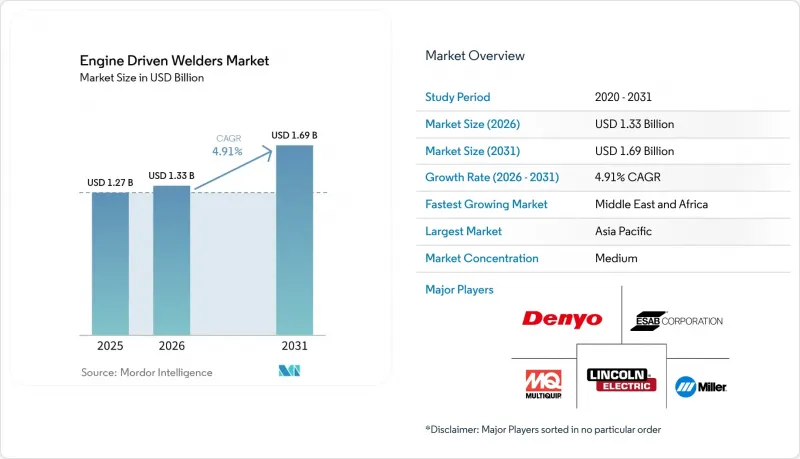
This report is Segmented by Power Output (0-100 A, 101 - 300 A, and More), by Fuel Type (Gasoline, Diesel, and More), by Welding Process (Stick Welding (SMAW), MIG Welding (GMAW) and More), by End-User Industry (Construction & Infrastructure, and More), and by Geography (North America, South America, Europe, Asia-Pacific, Middle East and Africa). The Market Forecasts are Provided in Terms of Value (USD).
Global Engine Driven Welders Market Trends and Insights
Expansion of Oil and Gas Pipeline Infrastructure
The pipeline buildout cycle remains a durable demand engine for high-amperage, constant-voltage engine-driven platforms that can deliver repeatable arc stability for automated girth welding over multi-year project timelines. The INGAA Foundation's long-range outlook for North America highlights around 140,000 miles of new gas transmission and gathering capacity additions through 2052, which sustains a baseline of right-of-way work that depends on mobile welding power at every spread. Recent activity tallies track tens of billions of dollars in active and proposed projects, with examples that include greenfield routes designed to move Permian volumes to Gulf Coast egress and Canadian capacity expansions to support regional demand centers. The construction cadence brings recurring needs for welding systems that handle preheats, bevel tolerances, and strict procedure control in variable environmental conditions. Project timing remains sensitive to midstream economics and downstream offtake conditions, which can shift start dates but rarely eliminate the structural need for on-site welding power in the build phase. Equipment planners who standardize on rugged high-output models with automation-ready duty cycles and auxiliary power headroom protect utilization across thick-wall and long-duration joints in this pipeline backlog context.
Growing Construction Activity in Remote and Rural Areas
Workloads tied to data centre campuses, renewable generation, and corridor infrastructure continue to expand and are shifting more activity into locations where the grid is weak or unavailable during early phases. In the United States, 2026 planning documents point to modest overall start growth, with private office construction dominated by hyperscale data centers that demand high electrical capacity and long construction sequences, which keep welding crews busy across steel frames, racks, and auxiliary structures. Engine-driven welders support this motion because they can power tools, air compressors, and lighting while maintaining stable arcs away from mains power. Contractors balance deployment by emphasizing payload-optimized all-in-one systems on service trucks to cut trips and reduce setup time, which becomes more valuable on large, dispersed sites. Input costs, tariffs, and permitting have extended some timelines, yet the requirement to build out power-hungry facilities in dispersed locations favors mobile platforms for both structural and MRO welding scopes. Contractors that link engine-driven welder performance data to scheduling and labor allocation gain utilization insight and contain fuel overhead on remote work packages.
Emission Regulations Restricting Usage in Enclosed Spaces
Toxic air contaminant designations for several welding-related metals limit unvented engine operation in enclosed spaces, which has narrowed diesel use in tight indoor environments. In regulated jurisdictions, emission standards drive the adoption of aftertreatment and periodic regeneration cycles on diesel engines, adding maintenance steps and affecting scheduling on long shifts. Owners address these constraints with LPG/CNG alternatives in some settings and with battery-hybrid systems that supply arc power without continuous engine exhaust. Site rules in underground work and confined spaces have also accelerated interest in equipment with lower tailpipe emissions and smaller footprints. Organizations that standardize safe ventilation and fume extraction and match equipment to air-quality requirements maintain compliance while preserving productivity. This pattern is reinforcing a mixed-technology toolbox within the engine-driven welders market.
Other drivers and restraints analyzed in the detailed report include:
- Growth in Mobile Welding and Maintenance Services
- Increasing Military and Defense Field Operations Requirements
- High Fuel Consumption and Operational Cost
For complete list of drivers and restraints, kindly check the Table Of Contents.
Segment Analysis
The 101-300 ampere class captured 44.67% of 2025 revenue and remains the workhorse for pipeline crews and light-to-medium structural fabrication across dispersed job sites. These units balance portability with enough output headroom to run common electrodes and to power auxiliary tools through onboard generators, which keeps small teams productive in the field. Buyers select models with stable arc characteristics, strong duty cycles, and easy cable management to handle out-of-position work on steels with variable surface conditions. Companies that deploy these machines at scale often train on AWS structural and pipeline codes so that equipment capability translates into consistent, code-compliant welds. The appeal of this band is its flexibility, which covers a wide swath of use cases while keeping total truck payload in check for service vehicles in the engine-driven welders market.
Above 500 amperes, units are projected to grow at 5.21% through 2031 as heavy fabrication and shipyards automate thick-plate welding and as megaprojects in concrete and steel require higher deposition rates. The value proposition at the high end is sustained output under demanding duty cycles with a footprint that still allows truck or skid mounting, so teams can bring industrial-grade capability to large field assemblies. Users also value the ability to power air-arc gouging and to run larger wire diameters with stable spray transfer, which reduces pass counts. Several integrated models combine welding, compressed air, and auxiliary power to simplify upfits, reflecting the shift to single-chassis solutions that save payload and bed space. That platform consolidation reduces equipment sprawl and speeds setup for crews tasked with diverse steelwork on a given day in the engine-driven welders market.
Diesel powertrains held 67.81% of global sales in 2025 on the strength of durability, fuel efficiency under load, and the ability to run long hours on remote sites without grid support. Pipeline and heavy construction contractors prefer diesel because of robust torque at low RPM and safe handling characteristics on Tier 1 sites, which lowers hazards during refueling. Serviceability is also a differentiator, with mature parts networks and long engine lifecycles when maintenance is consistent and aligned to duty cycles. As ESG policies and local emission constraints tighten, fleet owners are piloting dual-fuel kits that allow LPG blending on appropriate jobs to achieve cleaner operation without losing continuous-duty power. That hybridized approach, paired with idle management and telematics-driven maintenance, allows owners to control costs while meeting site rules in the engine-driven welders market.
LPG/CNG alternatives are projected to expand at 5.78% per year, lifting their role in regulated indoor and urban applications where air-quality limits are tight. Owners adopt these solutions to reduce nitrogen oxide and particulate output and to gain access to sites that restrict diesel engines in enclosed areas. Gasoline continues to serve entry-level and light-duty use where purchase price and low weight matter more than long-hour efficiency, especially for intermittent repair and farm applications. Hybrid configurations that pair engines with batteries are emerging to bridge the gap between clean operation and long shifts, with compact battery-first models already serving certain confined or power-limited environments. As refueling networks and charging infrastructure mature, hybrid and alternative systems will continue to supplement diesel where rules and duty cycles permit in the engine-driven welders market.
Geography Analysis
Asia-Pacific held 48.21% of 2025 revenue on the back of strong manufacturing bases and large public works programs that continue to expand corridors, energy assets, and industrial facilities across diverse climates and terrains. Fabrication tied to shipbuilding, automotive, energy, and large-scale infrastructure sustains regular use of mobile welders for both construction and MRO tasks in areas where temporary power is necessary. The region's project mix favors equipment that can operate in humid, hot, or high-altitude conditions with stable arcs and reliable auxiliary power. As more owners layer in digital monitoring and remote parameter control, multiprocess platforms with telematics are gaining attention across service fleets. Emission constraints vary by city and country, which is prompting selective uptake of LPG and hybrid units for indoor or restricted sites, while diesel remains dominant on open-air projects in the engine-driven welders market.
North America shows stable demand patterns supported by structural steel, energy infrastructure, and expanding data center activity that relies on mobile power at greenfield sites. Contractors respond to labor shortages by investing in integrated welders that compress setup time and allow smaller crews to cover more tasks per shift. Tier 4 Final rules and local toxic air contaminant classifications limit diesel use in enclosed spaces, which lifts interest in LPG and hybrid options for indoor work or night shifts near residences. Field repair and utility work continue to favor robust diesel units for long-hour use in remote or weather-exposed settings. As telematics gain traction across rental and fleet operators, utilization tracking is influencing fleet renewal choices in the engine-driven welders market.
The Middle East and Africa region is projected to grow fastest at 7.21% as countries advance megaprojects, expand energy and petrochemical capacity, and modernize utility networks. Harsh environmental conditions and long distances between depots raise the value of ruggedness, simple maintenance access, and reliable local parts channels. Owners often standardize on global brands that maintain distributor networks with warranty coverage and consumable pipelines to reduce downtime risk. Large fabrication yards and field teams benefit from high-output multiprocess units that share components across fleets, which simplifies stocking and training. The long project horizons and capital intensity of infrastructure and energy investments continue to underpin equipment needs across heavy-duty and service-truck applications in the engine-driven welders market.
- Lincoln Electric Holdings Inc.
- Miller Electric Mfg LLC (ITW)
- ESAB Corp.
- Denyo Co., Ltd.
- Multiquip Inc.
- Vanair Manufacturing
- Hobart Brothers LLC
- MOSA S.p.A.
- Shindaiwa Ltd.
- Atlas Copco AB
- Doosan Portable Power
- Generac Power Systems
- Kohler Co. (Engines)
- Cummins Inc. (Onan Division)
- Briggs & Stratton (Vanguard)
- Harbor Freight (VULCAN Brand)
- AGG Power Solutions
- Yamaha Motor Co. (Industrial Engines)
- Oerlikon Welding (Air Liquide)
- Westinghouse Outdoor Power
- Kipor Power
- Daihen Corp.
- Riland Industrial Co.
- Rental Fleet Leaders (United Rentals, Sunbelt)
Additional Benefits:
- The market estimate (ME) sheet in Excel format
- 3 months of analyst support
TABLE OF CONTENTS
1 Introduction
- 1.1 Study Assumptions & Market Definition
- 1.2 Scope of the Study
2 Research Methodology
3 Executive Summary
4 Market Landscape
- 4.1 Market Overview
- 4.2 Market Drivers
- 4.2.1 Expansion of Oil and Gas Pipeline Infrastructure
- 4.2.2 Growing Construction Activity in Remote and Rural Areas
- 4.2.3 Rising Demand from Agricultural Equipment Manufacturing and Repair
- 4.2.4 Increasing Military and Defense Field Operations Requirements
- 4.2.5 Growth in Mobile Welding and Maintenance Services
- 4.2.6 Natural Disaster Recovery and Emergency Infrastructure Repair
- 4.3 Market Restraints
- 4.3.1 High Fuel Consumption and Operational Cost
- 4.3.2 Noise Pollution and Operator Discomfort
- 4.3.3 Frequent Maintenance Requirements and Downtime
- 4.3.4 Emission Regulations Restricting Usage in Enclosed Spaces
- 4.4 Value / Supply-Chain Analysis
- 4.5 Regulatory Landscape
- 4.6 Technological Outlook
- 4.7 Industry Attractiveness - Porter's Five Forces
- 4.7.1 Threat of New Entrants
- 4.7.2 Bargaining Power of Suppliers
- 4.7.3 Bargaining Power of Buyers
- 4.7.4 Threat of Substitutes
- 4.7.5 Industry Rivalry
- 4.8 Application-Driven Power Output Segmentation
- 4.9 Dual-Purpose Value Proposition Driving Premium Segment
5 Market Size & Growth Forecasts(Value, In USD)
- 5.1 By Power Output
- 5.1.1 0 - 100 A
- 5.1.2 101 - 300 A
- 5.1.3 301 - 500 A
- 5.1.4 Above 500 A
- 5.2 By Fuel Type
- 5.2.1 Gasoline
- 5.2.2 Diesel
- 5.2.3 LPG / CNG
- 5.2.4 Alternative & Hybrid Systems
- 5.3 By Welding Process
- 5.3.1 Stick Welding (SMAW)
- 5.3.2 MIG Welding (GMAW)
- 5.3.3 TIG Welding (GTAW)
- 5.3.4 Advanced Multi-Process (Pulse-MIG, Gouging)
- 5.4 By End-User Industry
- 5.4.1 Construction & Infrastructure
- 5.4.2 Oil & Gas / Pipeline
- 5.4.3 Mining & Quarrying
- 5.4.4 Shipbuilding & Marine
- 5.4.5 Power Generation & Utilities
- 5.4.6 Automotive and General Manufacturing
- 5.4.7 General Maintenance & Repair
- 5.4.8 Others (Agriculture & Farming, Rental & Leasing Companies, etc.)
- 5.5 By Geography
- 5.5.1 North America
- 5.5.1.1 United States
- 5.5.1.2 Canada
- 5.5.1.3 Mexico
- 5.5.2 South America
- 5.5.2.1 Brazil
- 5.5.2.2 Argentina
- 5.5.2.3 Peru
- 5.5.2.4 Rest of South America
- 5.5.3 Europe
- 5.5.3.1 United Kingdom
- 5.5.3.2 Germany
- 5.5.3.3 France
- 5.5.3.4 Italy
- 5.5.3.5 Spain
- 5.5.3.6 BENELUX (Belgium, Netherlands, and Luxembourg)
- 5.5.3.7 NORDICS (Denmark, Finland, Iceland, Norway, and Sweden)
- 5.5.3.8 Rest of Europe
- 5.5.4 Asia-Pacific
- 5.5.4.1 China
- 5.5.4.2 India
- 5.5.4.3 Japan
- 5.5.4.4 Australia
- 5.5.4.5 South Korea
- 5.5.4.6 ASEAN (Indonesia, Thailand, Philippines, Malaysia, Vietnam)
- 5.5.4.7 Rest of Asia-Pacific
- 5.5.5 Middle East and Africa
- 5.5.5.1 Saudi Arabia
- 5.5.5.2 United Arab Emirates
- 5.5.5.3 Qatar
- 5.5.5.4 Kuwait
- 5.5.5.5 Turkey
- 5.5.5.6 Egypt
- 5.5.5.7 South Africa
- 5.5.5.8 Nigeria
- 5.5.5.9 Rest of Middle East and Africa
- 5.5.1 North America
6 Competitive Landscape
- 6.1 Market Concentration
- 6.2 Strategic Moves
- 6.3 Market Share Analysis
- 6.4 Company Profiles (includes Global level Overview, Market level overview, Core Segments, Financials as available, Strategic Information, Products & Services, and Recent Developments)
- 6.4.1 Lincoln Electric Holdings Inc.
- 6.4.2 Miller Electric Mfg LLC (ITW)
- 6.4.3 ESAB Corp.
- 6.4.4 Denyo Co., Ltd.
- 6.4.5 Multiquip Inc.
- 6.4.6 Vanair Manufacturing
- 6.4.7 Hobart Brothers LLC
- 6.4.8 MOSA S.p.A.
- 6.4.9 Shindaiwa Ltd.
- 6.4.10 Atlas Copco AB
- 6.4.11 Doosan Portable Power
- 6.4.12 Generac Power Systems
- 6.4.13 Kohler Co. (Engines)
- 6.4.14 Cummins Inc. (Onan Division)
- 6.4.15 Briggs & Stratton (Vanguard)
- 6.4.16 Harbor Freight (VULCAN Brand)
- 6.4.17 AGG Power Solutions
- 6.4.18 Yamaha Motor Co. (Industrial Engines)
- 6.4.19 Oerlikon Welding (Air Liquide)
- 6.4.20 Westinghouse Outdoor Power
- 6.4.21 Kipor Power
- 6.4.22 Daihen Corp.
- 6.4.23 Riland Industrial Co.
- 6.4.24 Rental Fleet Leaders (United Rentals, Sunbelt)
7 Market Opportunities & Future Outlook
- 7.1 White-space & Unmet-Need Assessment

