PUBLISHER: Mordor Intelligence | PRODUCT CODE: 2062090

PUBLISHER: Mordor Intelligence | PRODUCT CODE: 2062090
Calcium Aluminate Cement - Market Share Analysis, Industry Trends & Statistics, Growth Forecasts (2026 - 2031)
According to Mordor Intelligence, the calcium aluminate cement market size is expected to increase from 3.96 million tons in 2025 to 4.16 million tons in 2026 and reach 5.39 million tons by 2031, growing at a CAGR of 5.32% over 2026-2031.
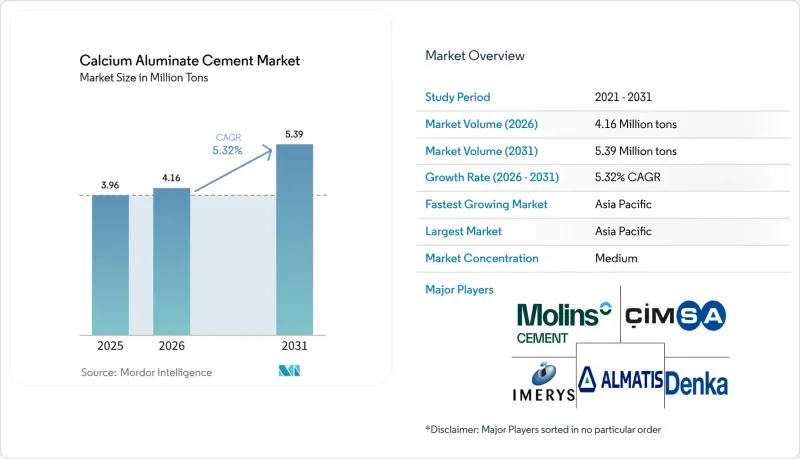
This report is Segmented by Type (High-Alumina Cement, Pre-Mixed Calcium Aluminate Cement, and More), Form (Powder, Premixed Bags, and More), Application (Refractories and More), End-User Industry(Steel and Metallurgy, Oil and Gas, and More), and Geography (Asia-Pacific, North America, Europe, South America, and Middle East and Africa). The Market Forecasts are Provided in Terms of Volume (Tons).
Global Calcium Aluminate Cement Market Trends and Insights
Growing Demand in Refractory Applications
India's transition to electric-arc furnaces increased the demand for refractory castables by 22% in 2023-24, driving higher consumption of calcium aluminate cement (CAC) due to its ability to maintain strength where Portland binders fail. This shift also results in energy savings of 60-70% per ton of steel, while compliance with India's Perform, Achieve, and Trade (PAT) scheme for mandated decarbonization supports sustained demand growth. Similarly, petrochemical cracker upgrades in the Middle East and China are adopting ultra-low cement castables, which combine CAC with reactive alumina to achieve a hot modulus of rupture exceeding 12 megapascals (MPa) at 1,400 degrees Celsius (°C), extending lining lifespans by 15-20%.
Rapid-Setting/High-Performance Concrete Adoption
Calcium sulfoaluminate variants achieve a strength of 35-40 MPa within 72 hours when using seawater, eliminating the need for freshwater in coastal precast yards and reducing carbon dioxide (CO2) emissions by up to 48% compared to Ordinary Portland Cement (OPC). In the United States, bridge-deck overlays funded under the Infrastructure Investment and Jobs Act require such fast-setting materials. Similarly, the Association of Southeast Asian Nations (ASEAN) Connectivity Master Plan permits the use of Calcium Aluminate Cement (CAC) binders to address a USD 210 billion infrastructure gap by 2030.
High Production Costs vs Portland Cement
Sintering at temperatures 100-150°C higher than Portland variants increases Calcium Aluminate Cement (CAC) energy consumption by 15-20% and results in a 25-30% price premium, limiting its adoption in applications where Ordinary Portland Cement (OPC) with accelerators is sufficient. In 2025, Indian buyers faced Chinese imports priced 10-15% lower, which impacted domestic margins and delayed capacity expansions.
Other drivers and restraints analyzed in the detailed report include:
- Expanding Use in Sewerage and Waste-Water Infrastructure
- 3-D Printed Refractory Shapes Enable New CAC Binders
- Energy-Intensive, CO2-Heavy Manufacturing Process
For complete list of drivers and restraints, kindly check the Table Of Contents.
Segment Analysis
Other Specialty Calcium Aluminate Cement (CAC) is projected to account for 28.00% of the 2025 volume, while High-Alumina Cement is expected to grow at an annual rate of 6.12%, driven by the demand for monolithic refractories capable of withstanding thermal shocks of greater than or equal to 1,600 °C, particularly in electric-arc furnace retrofits. Companies in the segment utilize their market size advantage by offering design support, with High-Alumina Cement's market share anticipated to increase as steel producers focus on achieving longer campaign lifespans. Commodity grades with 40-50% alumina content face margin pressures due to competition from Chinese manufacturers. However, sustainability-focused products, such as EcoCaltrix, command a 15-20% price premium in Europe's public procurement channels.
Powder forms are expected to remain dominant, accounting for 46.00% of 2025 demand, as refractory formulators require flexibility to adjust water demand, flow characteristics, and hot strength. Premixed bags, on the other hand, are forecasted to grow at a compound annual growth rate (CAGR) of 6.23%, driven by contractors seeking labor efficiency and consistent batch quality, particularly for emergency pavement repairs. Paste and slurry forms will remain niche products but achieve 25-30% gross margins due to their pumpability and strong adhesion to hot substrates, which are essential for applications such as ladle and kiln-shell patching.
Powder accounted for 46.00% of the projected 2025 volume, indicating its significance in bulk refractory castable mixing. Producers use powder to blend calcium aluminate with alumina aggregates, silica fume, and dispersants to achieve specific rheology and setting time requirements. Premixed bags are expected to grow at a CAGR of 6.23%, driven by contractor demand for consistent, single-source formulations, particularly in rapid-repair and emergency-response applications. Paste/Slurry forms, which are typically thixotropic formulations designed for gunning or troweling, cater to maintenance and repair segments. These forms are valued for their pumpability and ability to adhere to hot substrates (up to 800 degrees Celsius), making them suitable for applications such as kiln-shell repairs and ladle patching. The segmentation by form reflects a balance between customization and convenience: powder allows for precise mix designs tailored to refractory applications, while premixed bags focus on ease of use and reduced labor skill requirements, with some trade-offs in performance potential.
Geography Analysis
Asia-Pacific is projected to retain its 46.50% market share through 2031, with an annual growth rate of 6.15%. This growth is driven by India's 18-percentage-point increase in electric-arc furnace penetration, boosting refractory demand, and capacity expansions by Chinese producers despite competitive pricing pressures. Japan and South Korea prioritize quality over volume, while ASEAN (Association of Southeast Asian Nations) countries depend on imported bagged calcium aluminate cement (CAC) to support infrastructure projects, particularly bridge construction programs.
North America is expected to benefit from RHI Magnesita's acquisition of Resco in 2025. Federal infrastructure funding is anticipated to drive demand for rapid-repair solutions, while Calderys' new plant in Missouri is projected to reduce lead times by 30-40% for buyers in the Midwest region.
Europe continues to lead in sustainability innovations, but experienced a 12% contraction in industrial cement production in 2025. Despite this, sewer upgrades under DWA-A 143 standards and the Carbon Border Adjustment Mechanism's (CBAM) carbon pricing framework indicate long-term growth potential for low-carbon dioxide (CO2) cement grades. High per-capita spending in Nordic countries supports niche demand for premium CAC, despite relatively low production volumes.
South America's market outlook hinges on Brazil's pending antidumping duties, which could protect local producers. Additionally, Argentina's mining sector provides a stable, though modest, baseline for refractory demand.
Growth in the Middle East and Africa is concentrated in Saudi Arabia and South Africa. In Iran, a dominant local supplier meets over 90% of domestic demand and exports to neighboring petrochemical hubs, contributing to regional market stability.
- Almatis
- Caltra Nederland B.V.
- Carborundum Universal Ltd. (CUMI)
- Cimsa
- Denka Company Limited
- Elfusa S/A
- Etex (Ex-Kerneos Latin America)
- Fengrun Metallurgy Material
- Gorka Cement
- Imerys
- Molins
- Refratechnik Group
- RHI Magnesita
- Royal White Cement
- Taiheiyo Cement Corp.
- Target Products Ltd.
- Union Cement Company
- Vicat Group
- Zhengzhou Dengfeng Smelting Materials
Additional Benefits:
- The market estimate (ME) sheet in Excel format
- 3 months of analyst support
TABLE OF CONTENTS
1 Introduction
- 1.1 Study Assumptions and Market Definition
- 1.2 Scope of the Study
2 Research Methodology
3 Executive Summary
4 Market Landscape
- 4.1 Market Overview
- 4.2 Market Drivers
- 4.2.1 Growing demand in refractory applications
- 4.2.2 Rapid-setting/high-performance concrete adoption
- 4.2.3 Expanding use in sewerage and waste-water infrastructure
- 4.2.4 3-D printed refractory shapes enable new CAC binders
- 4.2.5 Low-CO2, energy-efficient CAC production processes
- 4.3 Market Restraints
- 4.3.1 High production costs vs Portland cement
- 4.3.2 Energy-intensive, CO2-heavy manufacturing process
- 4.3.3 Supply risk of high-purity bauxite feedstock
- 4.4 Value Chain Analysis
- 4.5 Regulatory Landscape
- 4.6 Porter's Five Forces
- 4.6.1 Threat of New Entrants
- 4.6.2 Bargaining Power of Buyers
- 4.6.3 Bargaining Power of Suppliers
- 4.6.4 Threat of Substitutes
- 4.6.5 Competitive Rivalry
5 Market Size and Growth Forecasts (Volume)
- 5.1 By Type
- 5.1.1 High-Alumina Cement (CA-50/60)
- 5.1.2 Low-Cement Castables
- 5.1.3 Pre-Mixed/Premixed CAC
- 5.1.4 Ultra-Low Cement and Insulating Grades
- 5.1.5 Other Specialty CAC (FCA 40-90)
- 5.2 By Form
- 5.2.1 Powder
- 5.2.2 Paste / Slurry
- 5.2.3 Premixed Bags
- 5.3 By Application
- 5.3.1 Refractories
- 5.3.2 Construction and Rapid-Repair
- 5.3.3 Chemicals and Petrochemicals
- 5.3.4 Water and Waste-Water Treatment
- 5.3.5 Mining and Power Generation
- 5.4 By End-user Industry
- 5.4.1 Steel and Metallurgy
- 5.4.2 Oil and Gas
- 5.4.3 Infrastructure and Public Works
- 5.4.4 Manufacturing and Process Plants
- 5.4.5 Others (Marine, Energy Storage)
- 5.5 By Geography
- 5.5.1 Asia-Pacific
- 5.5.1.1 China
- 5.5.1.2 Japan
- 5.5.1.3 India
- 5.5.1.4 South Korea
- 5.5.1.5 ASEAN Countries
- 5.5.1.6 Rest of Asia-Pacific
- 5.5.2 North America
- 5.5.2.1 United States
- 5.5.2.2 Canada
- 5.5.2.3 Mexico
- 5.5.3 Europe
- 5.5.3.1 Germany
- 5.5.3.2 United Kingdom
- 5.5.3.3 France
- 5.5.3.4 Italy
- 5.5.3.5 Spain
- 5.5.3.6 Russia
- 5.5.3.7 NORDIC Countries
- 5.5.3.8 Rest of Europe
- 5.5.4 South America
- 5.5.4.1 Brazil
- 5.5.4.2 Argentina
- 5.5.4.3 Rest of South America
- 5.5.5 Middle-East and Africa
- 5.5.5.1 Saudi Arabia
- 5.5.5.2 South Africa
- 5.5.5.3 Rest of Middle-East and Africa
- 5.5.1 Asia-Pacific
6 Competitive Landscape
- 6.1 Market Concentration
- 6.2 Strategic Moves
- 6.3 Market Share (%)/Ranking Analysis
- 6.4 Company Profiles (includes Global Level Overview, Market Level Overview, Core Segments, Financials as available, Strategic Information, Products and Services, and Recent Developments)
- 6.4.1 Almatis
- 6.4.2 Caltra Nederland B.V.
- 6.4.3 Carborundum Universal Ltd. (CUMI)
- 6.4.4 Cimsa
- 6.4.5 Denka Company Limited
- 6.4.6 Elfusa S/A
- 6.4.7 Etex (Ex-Kerneos Latin America)
- 6.4.8 Fengrun Metallurgy Material
- 6.4.9 Gorka Cement
- 6.4.10 Imerys
- 6.4.11 Molins
- 6.4.12 Refratechnik Group
- 6.4.13 RHI Magnesita
- 6.4.14 Royal White Cement
- 6.4.15 Taiheiyo Cement Corp.
- 6.4.16 Target Products Ltd.
- 6.4.17 Union Cement Company
- 6.4.18 Vicat Group
- 6.4.19 Zhengzhou Dengfeng Smelting Materials
7 Market Opportunities and Future Outlook
- 7.1 White-space and Unmet-Need Assessment
- 7.2 Demand for corrosion-resistant, high-performance binders in circular infrastructure
- 7.3 Green-cement technology integration and sustainable construction pathways

