PUBLISHER: Mordor Intelligence | PRODUCT CODE: 2062093

PUBLISHER: Mordor Intelligence | PRODUCT CODE: 2062093
Non Grain Electric Steel - Market Share Analysis, Industry Trends & Statistics, Growth Forecasts (2026 - 2031)
According to Mordor Intelligence, the non grain electric steel market size is projected to expand from USD 19.45 billion in 2025 and USD 20.29 billion in 2026 to USD 25.08 billion by 2031, registering a CAGR of 4.33% between 2026 to 2031.
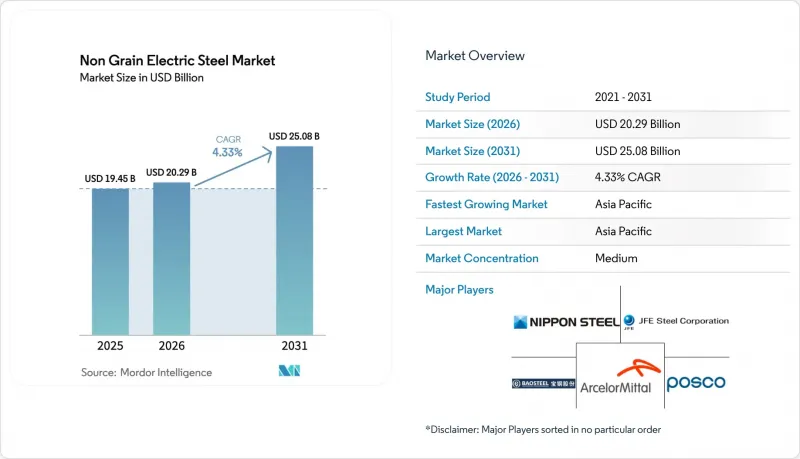
This report is Segmented by Type (Fully-Processed and Semi-Processed), Application (Motors, Transformers, Inductors and Reactors, and More), End-User Industry (Energy and Utilities, Automotive and E-Mobility, Industrial Manufacturing, and More), and Geography (Asia-Pacific, North America, Europe, South America, and Middle-East and Africa). The Market Forecasts are Provided in Terms of Value (USD).
Global Non Grain Electric Steel Market Trends and Insights
Electric Vehicle Production Expansion
Battery-electric and plug-in hybrid sales surpassed 2.146 million units at BYD in the first half of 2025, illustrating how rapidly traction-motor demand is compounding. India's 2.08 million EV sales in 2024 and a 30% penetration goal by 2030 will require large numbers of charging stations, substations, and distribution transformers, all of which use NGOES cores. China's April 2025 export controls on rare-earth minerals restrict neodymium supplies and push automakers toward electrically excited synchronous motors that replace permanent magnets with extra electrical-steel laminations. POSCO's target of 7.5 million motor cores a year by 2030 showcases vertical integration as OEMs safeguard coil supply. High-speed 800-volt traction motors operate above 1,000 hertz, where core loss scales with frequency squared, making 0.20-0.27 millimeter gauges a necessity rather than an option.
Renewable and Wind-Turbine Build-Out
Global wind additions reached 114.3 gigawatts in 2024, driven by China's 79.4 gigawatt build that alone accounted for 69.4% of the total. Offshore turbine ratings climbed toward 10 megawatts on average in 2024, with 16-26 megawatt platforms entering commercial tenders, each using multi-ton generator cores and transformer banks. Electrical-steel shortages lifted transformer prices 75% over 2018 levels as mill capacity lags renewable interconnection queues that now top 1,650 gigawatts worldwide. Electrically excited generators that sidestep rare-earth magnets boost NGOES content per turbine by up to 20%, cushioning the loss of share to amorphous cores in small transformers. Policy support in the EU and APAC continues to funnel capital toward offshore wind clusters that are, by necessity, hungry for premium NGOES grades.
Competition from Amorphous and Nano-Crystalline Alloys
Hitachi Metals started commercial output of 2605HB1M amorphous ribbons at Conway, South Carolina in June 2026, delivering no-load transformer losses barely one-third of grain-oriented silicon steel. The HB1M-LL grade pushes loss down to 0.19 W/kg at 1.42 Tesla and 60 Hz, a 20-40% improvement on earlier amorphous products. Hitachi already controlled 57% of the amorphous-core segment worth USD 865 million in 2024 and aims for 6.9% CAGR through 2032. Although brittleness and low saturation flux limit ribbons to wound cores under 5 MVA, utilities chasing tighter DOE efficiency standards are shifting distribution-transformer specifications accordingly. For NGOES producers this erodes share in small-power units even as rotating-machine demand stays intact.
Other drivers and restraints analyzed in the detailed report include:
- Thin-Gauge NGOES for High-Speed Motors
- Domestic-Content Rules for Transformer Cores
- ESG-Driven Shift to "Green" Steel Alternatives
For complete list of drivers and restraints, kindly check the Table Of Contents.
Segment Analysis
Fully processed grades held 56.11% of non grain electric steel market share in 2025 and are projected to grow at 5.36% CAGR to 2031 as OEMs favor coils that arrive ready for punching without extra annealing. The non-grain electric steel market size for fully processed, reflecting automaker vertical-integration moves such as BYD's in-house lamination stamping and POSCO Mobility Solution's 7.5 million-core goal.
Automotive traction motors, IE4/IE5 industrial drives, and on-board chargers increasingly demand ultra-thin gauges down to 0.10 mm with certified core loss. Investments totaling JPY 213 billion brought Nippon Steel's Hirohata and Setouchi lines online and will add Hanshin and Yawata by 2027, showing the capex race needed to stay relevant. Semi-processed grades remain common in large synchronous generators that undergo site-specific stress relief.
Geography Analysis
Asia-Pacific dominated the non grain electric steel market with 47.11% revenue in 2025 and will log a 5.49% CAGR to 2031. China's 79.4 GW of new wind in 2024 and India's expanding EV ecosystem underpin the region's appetite. Capacity additions at Hirohata, Setouchi, and POSCO's Pohang mobility line ensure local supply for Toyota, Hyundai, and BYD programs.
In North America, Section 48C credits and Buy America clauses redirect demand to Cleveland-Cliffs, Nucor, and ArcelorMittal mills, while Hitachi Metals' Conway ribbon plant positions the region as an amorphous-core hub.
Europe's demand is by Ecodesign IE4 mandates and REPowerEU sourcing rules. Thyssenkrupp's Bluemint and Voestalpine's Greentec steel reinforce the bloc's push toward low-carbon metallurgy, while Gent and Ringwood supply Volkswagen and Stellantis traction programs.
South America, and Middle-East and Africa are hampered by scarce domestic rolling lines, currency swings, and import dependence. Nevertheless, Brazil's industrial electrification and Saudi Arabia's NEOM megaproject offer selective upside for exporters able to certify ESG credentials.
- Ansteel Group Corporation Limited
- ArcelorMittal
- Baoshan Iron & Steel Co. Ltd.
- Cleveland-Cliffs Inc.
- Gerdau S/A
- JFE Steel Corporation
- JSW
- LIBERTY Steel Group
- NIPPON STEEL CORPORATION
- NLMK
- POSCO
- Shandong Iron and Steel Group Co., Ltd.
- Shougang Group
- Tata Steel
- thyssenkrupp AG
- United States Steel Corporation
- voestalpine Stahl GmbH
Additional Benefits:
- The market estimate (ME) sheet in Excel format
- 3 months of analyst support
TABLE OF CONTENTS
1 Introduction
- 1.1 Study Assumptions and Market Definition
- 1.2 Scope of the Study
2 Research Methodology
3 Executive Summary
4 Market Landscape
- 4.1 Market Overview
- 4.2 Market Drivers
- 4.2.1 Electric Vehicle production expansion
- 4.2.2 Renewable and wind-turbine build-out
- 4.2.3 Thin-gauge NGOES for high-speed motors
- 4.2.4 Domestic-content rules for transformer cores
- 4.2.5 Digital-twin-driven grade upgrades
- 4.3 Market Restraints
- 4.3.1 Competition from amorphous and nano-crystalline alloys
- 4.3.2 ESG-driven shift to "green" steel alternatives
- 4.3.3 Hydrogen-embrittlement risk in next-gen drives
- 4.4 Value Chain Analysis
- 4.5 Porter's Five Forces
- 4.5.1 Bargaining Power of Suppliers
- 4.5.2 Bargaining Power of Buyers
- 4.5.3 Threat of New Entrants
- 4.5.4 Threat of Substitutes
- 4.5.5 Competitive Rivalry
5 Market Size and Growth Forecasts (Value)
- 5.1 By Type
- 5.1.1 Fully-processed
- 5.1.2 Semi-processed
- 5.2 By Application
- 5.2.1 Motors
- 5.2.1.1 Traction (EV/rail)
- 5.2.1.2 Industrial (IE4/IE5, HVAC)
- 5.2.2 Transformers
- 5.2.2.1 Power
- 5.2.2.2 Distribution and EV on-board
- 5.2.3 Generators
- 5.2.4 Inductors and Reactors
- 5.2.5 Sensors and Miscellaneous
- 5.2.1 Motors
- 5.3 By End-user Industry
- 5.3.1 Energy and Utilities
- 5.3.2 Automotive and E-mobility
- 5.3.3 Industrial Manufacturing
- 5.3.4 Consumer Appliances
- 5.3.5 Aerospace and eVTOL
- 5.4 By Geography
- 5.4.1 Asia-Pacific
- 5.4.1.1 China
- 5.4.1.2 India
- 5.4.1.3 Japan
- 5.4.1.4 South Korea
- 5.4.1.5 Rest of Asia-Pacific
- 5.4.2 North America
- 5.4.2.1 United States
- 5.4.2.2 Canada
- 5.4.2.3 Mexico
- 5.4.3 Europe
- 5.4.3.1 Germany
- 5.4.3.2 United Kingdom
- 5.4.3.3 France
- 5.4.3.4 Italy
- 5.4.3.5 Rest of Europe
- 5.4.4 South America
- 5.4.4.1 Brazil
- 5.4.4.2 Argentina
- 5.4.4.3 Rest of South America
- 5.4.5 Middle-East and Africa
- 5.4.5.1 Saudi Arabia
- 5.4.5.2 South Africa
- 5.4.5.3 Rest of Middle-East and Africa
- 5.4.1 Asia-Pacific
6 Competitive Landscape
- 6.1 Market Concentration
- 6.2 Strategic Moves
- 6.3 Market Share (%)/Ranking Analysis
- 6.4 Company Profiles (includes Global level Overview, Market level overview, Core Segments, Financials as available, Strategic Information, Products and Services, and Recent Developments)
- 6.4.1 Ansteel Group Corporation Limited
- 6.4.2 ArcelorMittal
- 6.4.3 Baoshan Iron & Steel Co. Ltd.
- 6.4.4 Cleveland-Cliffs Inc.
- 6.4.5 Gerdau S/A
- 6.4.6 JFE Steel Corporation
- 6.4.7 JSW
- 6.4.8 LIBERTY Steel Group
- 6.4.9 NIPPON STEEL CORPORATION
- 6.4.10 NLMK
- 6.4.11 POSCO
- 6.4.12 Shandong Iron and Steel Group Co., Ltd.
- 6.4.13 Shougang Group
- 6.4.14 Tata Steel
- 6.4.15 thyssenkrupp AG
- 6.4.16 United States Steel Corporation
- 6.4.17 voestalpine Stahl GmbH
7 Market Opportunities and Future Outlook
- 7.1 White-space and Unmet-need Assessment

