
PUBLISHER: Mordor Intelligence | PRODUCT CODE: 2062103

PUBLISHER: Mordor Intelligence | PRODUCT CODE: 2062103
Washed Silica Sand - Market Share Analysis, Industry Trends & Statistics, Growth Forecasts (2026 - 2031)
According to Mordor Intelligence, the washed silica sand market size is expected to grow from USD 23.56 billion in 2025 to USD 24.92 billion in 2026 and is forecast to reach USD 32.97 billion by 2031 at 5.76% CAGR over 2026-2031.
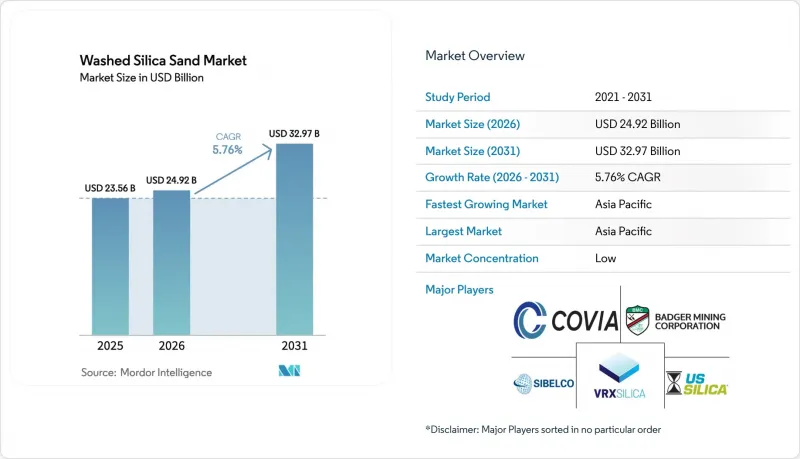
This report is Segmented by Purity (Standard High Purity (99-99. 95%), Industrial Purity (95-99%), and More), Particle Size (Very Coarse (Greater Than 1 Mm), and More), Application (Glass Manufacturing, Foundry and Metal Casting, and More), and Geography (Asia-Pacific, North America, Europe, South America, and Middle East and Africa). The Market Forecasts are Provided in Terms of Value (USD).
Global Washed Silica Sand Market Trends and Insights
Semiconductor Fabs' Ultra-Pure Quartz Appetite
HPQ output doubled at Spruce Pine following a USD 200 million expansion completed in 2025 and a USD 500 million second phase due for 2027, yet analysts still expect a 40-fold increase in demand by 2050 as chip fabs and solar ingot pullers escalate purity specifications to five-nines and beyond. China's 85% share of global silicon metal and 95% dominance in polysilicon in 2025 accentuates OECD supply risk. Hurricane Helene's 2024 disruption highlighted single-source vulnerability, spurring EU and US strategies to bring Norwegian and Portuguese quartz deposits online within three years. Sinova Global's Tennessee silicon metal plant, under construction since 2025, provides a North American diversification pathway. Collectively, these moves keep semiconductor-grade quartz at the core of long-run demand for the washed silica sand market.
Asia-Pacific Float-Glass Furnace Expansions
Daily melt capacity in mainland China stood at 154,555 t in December 2025 across 216 operating lines, despite utilization sliding below 78% because of real-estate weakness. The Ministry of Industry and Information Technology now enforces a 1.25:1 replacement ratio on new lines, steering investment toward low-iron furnaces for BIPV and automotive glazing. Australia's AUD 1.2 billion GlassKote project in Queensland will add 700 tons/day in early 2026, while a 1,000 tons per day sister plant is scheduled for the UAE by mid-2026. These projects create sustained off-take agreements for silica with Fe2O3 below 0.03 weight%. India and ASEAN players likewise scale solar glass capacity to meet domestic installation targets, reinforcing regional leadership in the washed silica sand market.
Multimodal Freight Inflation
Atlas Energy Solutions' realized price declined to USD 21/ton in 2025, down 17% from 2024, even as shipped volumes rose 9%, highlighting freight's drag on margins. Harsh 2026 winter storms cut EBITDA by USD 6 million because rail service stalled, underscoring seasonal exposure. On the ocean side, bulk charter rates rallied 28% year-on-year through Q1 2026 as bunker costs spiked, making long-haul exports less competitive. Delivered cost can double FOB prices once transport exceeds 100 km, incentivizing buyers to procure locally whenever possible. Capital-heavy conveyor belts and on-site wet-plants hedge this volatility but raise barriers to replication by mid-tier producers.
Other drivers and restraints analyzed in the detailed report include:
- Rise of In-Basin Wet-Sand Logistics
- Desalination Boom in Middle East & North America
- Cullet Substitution in Container Glass
For complete list of drivers and restraints, kindly check the Table Of Contents.
Segment Analysis
Ultra-high purity (greater than or equal to 99.99% SiO2) volumes remain small but strategic because semiconductor polysilicon and quartz crucible makers require impurity thresholds below 50 ppm total metallics. Standard high-purity (99-99.95% SiO2) retained 39.12% share in 2025, servicing float glass and foundry customers with 6.11% CAGR expected for the forecast period (2026-2031). Sibelco's Spruce Pine complex doubled HPQ capacity in 2025 and will again by 2027, yet single-site risk remains pronounced, reinforcing calls for diversified European sources such as Norway's Evje-Iveland pegmatite belt. Sinova Global's reopened quarry and Tennessee smelter add domestic buffer capacity by 2028.
Intensive purification technologies, chlorination roasting, magnetic separation, and plasma arc treatment, push capital needs beyond USD 400/ton for incremental capacity, raising entry hurdles. Hurricane disruptions and geopolitical shocks, therefore, exert outsized price elasticity within this bracket. The washed silica sand market share controlled by the top three HPQ suppliers is projected to hold above 75% through 2031, underscoring oligopolistic dynamics in this slice of the value chain.
Geography Analysis
Asia-Pacific captured 46.78% of global revenue in 2025 with 6.09% CAGR projected through 2031. China's 154,555 tons/day float-glass capacity, India's massive infrastructure projects, and ASEAN's solar supply chains anchor demand even as stricter MIIT replacement rules curb speculative builds. The UAE's 1,000 tons/day low-iron float plant catalyzes Gulf consumption starting mid-2026. Japan and South Korea, lacking domestic HPQ, depend on U.S. and future EU supplies, adding geographic complexity to semiconductor quartz sourcing.
North America remains the second-largest cluster, buoyed by Permian Basin hydraulic fracturing. Atlas Energy Solutions alone moved 21.6 million tons in 2025, yet pricing slid 17% year-on-year, reflecting competitive logistics and flagging rig counts. Sibelco's Spruce Pine dominates HPQ exports, but MSHA's April 2026 compliance deadlines raise costs for smaller mines, pushing consolidation.
Europe shows tempered growth as high cullet ratios limit virgin demand. Finland's sand-battery pilots, however, showcase emerging storage markets likely to lift northern European offtake from 2027 onward. Quarzwerke's PV expansion at German sites cuts product carbon footprint by 25%, appealing to automotive and green-building buyers.
The Middle East and Africa combine strong desalination-led filtration needs with pipeline construction. South America remains fragmented, reliant on imports for high-purity grades but steady in construction aggregates.
- Adwan Chemical Industries Co. Ltd. (ACIC)
- Australian Silica Quartz Group Ltd
- Badger Mining Corporation
- Cairominerals
- Covia Holdings LLC.
- EUROQUARZ GmbH
- JFE Mineral & Alloy Co. Ltd
- Mitsubishi Corporation (Cape Flattery Silica)
- Preferred Sands LLC
- Quarzwerke GmbH
- Sibelco
- Silica Services, LLC.
- Superior Silica Sands LLC
- TERENGGANU SILICA CONSORTIUM SDN. BHD
- U.S. Silica Holdings Inc.
- VRX Silica Limited
Additional Benefits:
- The market estimate (ME) sheet in Excel format
- 3 months of analyst support
TABLE OF CONTENTS
1 Introduction
- 1.1 Study Assumptions and Market Definition
- 1.2 Scope of the Study
2 Research Methodology
3 Executive Summary
4 Market Landscape
- 4.1 Market Overview
- 4.2 Market Drivers
- 4.2.1 Semiconductor fabs' ultra-pure quartz appetite
- 4.2.2 Asia-Pacific float-glass furnace expansions
- 4.2.3 Rise of in-basin wet-sand logistics (cost cuts)
- 4.2.4 Desalination boom in Middel-East and North America
- 4.2.5 Sand-battery thermal storage pilots
- 4.3 Market Restraints
- 4.3.1 Multimodal freight inflation (rail and bulk ships)
- 4.3.2 Cullet substitution in container glass
- 4.3.3 OSHA/MSHA crystalline-silica exposure capex
- 4.4 Value Chain Analysis
- 4.5 Porter's Five Forces Analysis
- 4.5.1 Threat of New Entrants
- 4.5.2 Bargaining Power of Buyers
- 4.5.3 Bargaining Power of Suppliers
- 4.5.4 Threat of Substitutes
- 4.5.5 Competitive Rivalry
5 Market Size and Growth Forecasts (Value)
- 5.1 By Purity
- 5.1.1 Standard High Purity (99-99.95%)
- 5.1.2 Ultra-High Purity (Greater than or equal to 99.99% SiO2)
- 5.1.3 PV-Grade High Purity (99.95-99.99%)
- 5.1.4 Industrial Purity (95-99%)
- 5.2 By Particle Size
- 5.2.1 Medium (355-710 µm)
- 5.2.2 Very Coarse (Greater than 1 mm)
- 5.2.3 Coarse (710-1000 µm)
- 5.2.4 Fine (150-355 µm)
- 5.2.5 Very Fine (Less than 150 µm)
- 5.3 By Application
- 5.3.1 Glass Manufacturing
- 5.3.2 Foundry and Metal Casting
- 5.3.3 Construction Materials
- 5.3.4 Water and Industrial Filtration
- 5.3.5 Oil, Gas and Proppants
- 5.3.6 Ceramics and Refractories
- 5.3.7 Electronics Encapsulation
- 5.4 By Geography
- 5.4.1 Asia-Pacific
- 5.4.1.1 China
- 5.4.1.2 Japan
- 5.4.1.3 India
- 5.4.1.4 South Korea
- 5.4.1.5 ASEAN Countries
- 5.4.1.6 Rest of Asia-Pacific
- 5.4.2 North America
- 5.4.2.1 United States
- 5.4.2.2 Canada
- 5.4.2.3 Mexico
- 5.4.3 Europe
- 5.4.3.1 Germany
- 5.4.3.2 United Kingdom
- 5.4.3.3 France
- 5.4.3.4 Italy
- 5.4.3.5 Spain
- 5.4.3.6 Russia
- 5.4.3.7 NORDIC Countries
- 5.4.3.8 Rest of Europe
- 5.4.4 South America
- 5.4.4.1 Brazil
- 5.4.4.2 Argentina
- 5.4.4.3 Rest of South America
- 5.4.5 Middle-East and Africa
- 5.4.5.1 Saudi Arabia
- 5.4.5.2 South Africa
- 5.4.5.3 Rest of Middle-East and Africa
- 5.4.1 Asia-Pacific
6 Competitive Landscape
- 6.1 Market Concentration
- 6.2 Strategic Initiatives
- 6.3 Market Share(%)/Ranking Analysis
- 6.4 Company Profiles (includes Global Overview, Market Overview, Core Segments, Financials, Strategic Information, Market Rank/Share, Products and Services, and Recent Developments)
- 6.4.1 Adwan Chemical Industries Co. Ltd. (ACIC)
- 6.4.2 Australian Silica Quartz Group Ltd
- 6.4.3 Badger Mining Corporation
- 6.4.4 Cairominerals
- 6.4.5 Covia Holdings LLC.
- 6.4.6 EUROQUARZ GmbH
- 6.4.7 JFE Mineral & Alloy Co. Ltd
- 6.4.8 Mitsubishi Corporation (Cape Flattery Silica)
- 6.4.9 Preferred Sands LLC
- 6.4.10 Quarzwerke GmbH
- 6.4.11 Sibelco
- 6.4.12 Silica Services, LLC.
- 6.4.13 Superior Silica Sands LLC
- 6.4.14 TERENGGANU SILICA CONSORTIUM SDN. BHD
- 6.4.15 U.S. Silica Holdings Inc.
- 6.4.16 VRX Silica Limited
7 Market Opportunities and Future Outlook
- 7.1 White-Space and Unmet-Need Assessment

