PUBLISHER: Mordor Intelligence | PRODUCT CODE: 2062115

PUBLISHER: Mordor Intelligence | PRODUCT CODE: 2062115
Silver Paste - Market Share Analysis, Industry Trends & Statistics, Growth Forecasts (2026 - 2031)
According to Mordor Intelligence, the silver paste market size was valued at USD 2.72 billion in 2025 and is estimated to grow from USD 2.85 billion in 2026 to reach USD 3.61 billion by 2031, at a CAGR of 4.82% during the forecast period (2026-2031).
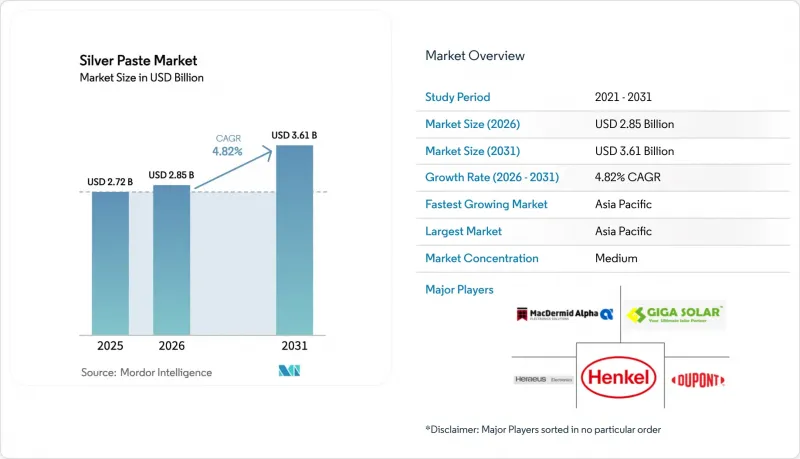
This report is Segmented by Substrate (Ceramic, Glass, Metal, and Polymer), Composition (Silver Flakes, Silver Nanoparticles, Silver Powders, and Other Compositions), Application (Photovoltaics, Automotive Electronics and EV Power Modules, Consumer Electronics, Integrated Circuits, and Other Applications), and Geography (Asia-Pacific, and More). Market Forecasts are Provided in Terms of Value (USD).
Global Silver Paste Market Trends and Insights
Expansion of Automotive and Electric Vehicle Power-Electronics Integration
By 2025, battery-electric vehicles (BEVs) outpaced their internal-combustion engine (ICE) counterparts in silver consumption. Sintered-silver joints, now meeting IATF 16949 reliability standards, endure thousands of thermal cycles, spanning from -40 °C to 175 °C. In June 2025, LG Chem and Noritake introduced a room-temperature-stable nano-silver paste. This breakthrough extends the paste's shelf life from mere weeks to several months, negating the necessity for cold-chain logistics. Consequently, Tier 1 suppliers are increasingly opting for multi-year offtake agreements tied to metal futures - a fresh strategy in the silver paste arena. Moreover, with shear-strength retention proving resilient post-rigorous cycling, there is a marked surge in SiC adoption for traction inverters. These advancements are propelling the demand for automotive silver paste and bolstering consistent margin growth for adept suppliers.
Boom in Printed and Flexible Electronics Manufacturing
Wearable medical patches, curved displays, and polymer substrates now depend on conductive traces that cure at temperatures below 150 °C for their protection. Transparent silver pastes, after a 20-minute cure at 140 °C, achieve low sheet resistance, facilitating in-cell OLED driver integration. Meanwhile, copper-silver core-shell inks reach nearly identical conductivity levels but with a marked reduction in silver usage. This shift encourages formulators to reserve pure-silver systems for designs prioritizing performance. Although the silver paste market has seen a value boost from high-performance niches, its volume growth has not kept pace with device output, thanks to strides in material efficiency. Even as unit counts have surged in smart packaging, structural sensors, and foldable smartphones, leading to only modest tonnage increases, revenue growth has outstripped tonnage, fueled by rising average selling prices.
Competition from Lower-Cost Cu/Al Conductive Materials
Chinese cell manufacturers have transitioned silver-coated copper pilots from laboratories to production lines, successfully reducing silver usage per TOPCon wafer without compromising efficiency. LONGi's adoption of fully copper-electroplated fingers indicates a potential reduction in silver usage per module. Similarly, RFID technology, touch screens, and disposable sensors are shifting toward copper-hybrid inks, meeting electrical standards while significantly reducing costs. While photovoltaics experience a direct revenue dip, the broader silver paste market is also impacted - formulators now face a critical choice between pursuing innovation and confronting the risk of commoditization.
Other drivers and restraints analyzed in the detailed report include:
- Shift to Sintered-Silver Attach in SiC/GaN Power Devices
- Emergence of Low-Temperature Ag2O Pastes for Wearables and µLEDs
- Supply-Chain Risk from Limited Silver-Paste Recycling Capacity
For complete list of drivers and restraints, kindly check the Table Of Contents.
Segment Analysis
In 2025, ceramics, driven by robust demand for direct-bonded-copper power modules requiring bondline conductivity exceeding 200 W/m*K, accounted for 45.11% of the revenue. This segment led the silver paste market share in 2025. Meanwhile, polymer substrates, due to their roles in flexible sensors, smart textiles, and foldable displays, recorded a 5.33% compound annual growth rate (CAGR) - the highest among substrates during the forecast period of 2026-2031.
Withstanding temperatures exceeding 250 °C and offering electrical isolation up to 10 kV, ceramics have cemented their position in electric vehicle (EV) inverters and industrial drives. However, innovations in form factors for polyimide and polyethylene terephthalate (PET) have tapped into a new market, surpassing the conventional thick-film hybrid-circuit sector. As formulators introduced low-temperature curing chemistries, polymer adoption increased significantly, all while maintaining healthy profit margins. This growth has notably benefited the silver paste market, particularly in the flexible electronics segment.
Geography Analysis
In 2025, the Asia-Pacific region dominated the silver paste market, accounting for 64.11% of the revenue and projecting a growth rate of 6.33%. In 2025, driven by advancements to next-generation TOPCon lines, China's domestic sales of silver paste saw a notable surge. By 2029, as silver-powder production capacity is set to reach significant levels, the region not only solidifies its supply resilience but also faces heightened geopolitical risks.
Japan leads in technological innovations. A prominent company, utilizing proprietary atomization, dominates the market, supplying over 50% of the global PV-grade silver powder. Simultaneously, industry leaders like Kyocera, TANAKA, and Asahi Kagaku are at the forefront, offering specialty pastes with conductivity levels surpassing 240 W/m*K. In South Korea, LG Chem and Noritake's partnership is eyeing the automotive SiC attachment, leveraging the country's expanding EV battery landscape. While India and ASEAN nations act as economic assembly centers for commodity solar pastes, their dependence on imports for high-purity nanopowders highlights a limited scope for upstream diversification in the foreseeable future.
North America is establishing its presence through innovative strides. Indium Corporation and MacDermid Alpha have expanded their portfolios to include pressureless sintering. Meanwhile, Henkel has introduced inks with recycled silver, aligning with Scope 3 sustainability benchmarks. Europe adopts a more cautious stance, implementing bans on nano-silver in cosmetics and heeding the European Food Safety Authority's warnings about E 174. This regulatory push aims to curtail broader workplace exposures, prompting EU suppliers to adopt 'safe-by-design' strategies. Germany, fortified by Bosch and ZF's inverter lines, emerges as Europe's dominant volume player. Conversely, South America and the Middle-East predominantly depend on imported pastes for their photovoltaic initiatives. Although these regions hold promise for future growth, they currently lack significant revenue impact on the silver paste market.a
- ANP CORPORATION
- artience Co., Ltd
- Bando Chemical Industries Ltd.
- CAPLINQ Corporation
- DAIKEN CHEMICAL
- DuPont
- Dycotec Materials Ltd.
- Giga Solar Materials Corp.
- Henkel AG & Co. KGaA
- Heraeus Electronics
- Indium Corporation
- Jiangsu Hoyi Technology Co. Ltd.
- Kyocera Corporation
- LEED-INK
- LG Chem
- MacDermid Alpha Electronics Solutions
- NORITAKE CO., LIMITED
- Shanghai EqualOcean Technology Co., Ltd
Additional Benefits:
- The market estimate (ME) sheet in Excel format
- 3 months of analyst support
TABLE OF CONTENTS
1 Introduction
- 1.1 Study Assumptions and Market Definition
- 1.2 Scope of the Study
2 Research Methodology
3 Executive Summary
4 Market Landscape
- 4.1 Market Overview
- 4.2 Market Drivers
- 4.2.1 Expansion of automotive and Electric Vehicle power-electronics integration
- 4.2.2 Boom in printed and flexible electronics manufacturing
- 4.2.3 Shift to sintered-silver attach in SiC/GaN power devices
- 4.2.4 Emergence of low-temperature Ag2O pastes for wearables and µLEDs
- 4.2.5 Circular-economy push for silver-paste recovery and recycling
- 4.3 Market Restraints
- 4.3.1 Competition from lower-cost Cu/Al conductive materials
- 4.3.2 Supply-chain risk from limited silver-paste recycling capacity
- 4.3.3 Stringent environmental regulations on nano-silver emissions
- 4.4 Value Chain Analysis
- 4.5 Porter's Five Forces
- 4.5.1 Bargaining Power of Suppliers
- 4.5.2 Bargaining Power of Buyers
- 4.5.3 Threat of New Entrants
- 4.5.4 Threat of Substitutes
- 4.5.5 Competitive Rivalry
5 Market Size and Growth Forecasts (Value)
- 5.1 By Substrate
- 5.1.1 Ceramic
- 5.1.2 Glass
- 5.1.3 Metal
- 5.1.4 Polymer
- 5.2 By Composition
- 5.2.1 Silver Flakes
- 5.2.2 Silver Nano Particles
- 5.2.3 Silver Powders
- 5.2.4 Other Composition
- 5.3 By Application
- 5.3.1 Photovoltaics (Solar Cells)
- 5.3.2 Automotive Electronics and EV Power Modules
- 5.3.3 Consumer Electronics (displays, wearables)
- 5.3.4 Integrated Circuits and Semiconductors
- 5.3.5 Other Applications (RFID, LEDs, medical devices)
- 5.4 By Geography
- 5.4.1 Asia-Pacific
- 5.4.1.1 China
- 5.4.1.2 India
- 5.4.1.3 Japan
- 5.4.1.4 South Korea
- 5.4.1.5 ASEAN Countries
- 5.4.1.6 Rest of Asia-Pacific
- 5.4.2 North America
- 5.4.2.1 United States
- 5.4.2.2 Canada
- 5.4.2.3 Mexico
- 5.4.3 Europe
- 5.4.3.1 Germany
- 5.4.3.2 United Kingdom
- 5.4.3.3 France
- 5.4.3.4 Italy
- 5.4.3.5 Spain
- 5.4.3.6 Russia
- 5.4.3.7 Rest of Europe
- 5.4.4 South America
- 5.4.4.1 Brazil
- 5.4.4.2 Argentina
- 5.4.4.3 Rest of South America
- 5.4.5 Middle-East and Africa
- 5.4.5.1 Saudi Arabia
- 5.4.5.2 South Africa
- 5.4.5.3 Rest of Middle-East and Africa
- 5.4.1 Asia-Pacific
6 Competitive Landscape
- 6.1 Market Concentration
- 6.2 Strategic Moves
- 6.3 Market Share (%)/Ranking Analysis
- 6.4 Company Profiles (includes Global Overview, Market Overview, Core Segments, Financials, Strategic Information, Products and Services, and Recent Developments)
- 6.4.1 ANP CORPORATION
- 6.4.2 artience Co., Ltd
- 6.4.3 Bando Chemical Industries Ltd.
- 6.4.4 CAPLINQ Corporation
- 6.4.5 DAIKEN CHEMICAL
- 6.4.6 DuPont
- 6.4.7 Dycotec Materials Ltd.
- 6.4.8 Giga Solar Materials Corp.
- 6.4.9 Henkel AG & Co. KGaA
- 6.4.10 Heraeus Electronics
- 6.4.11 Indium Corporation
- 6.4.12 Jiangsu Hoyi Technology Co. Ltd.
- 6.4.13 Kyocera Corporation
- 6.4.14 LEED-INK
- 6.4.15 LG Chem
- 6.4.16 MacDermid Alpha Electronics Solutions
- 6.4.17 NORITAKE CO., LIMITED
- 6.4.18 Shanghai EqualOcean Technology Co., Ltd
7 Market Opportunities and Future Outlook
- 7.1 White-space and Unmet-need Assessment

