PUBLISHER: Mordor Intelligence | PRODUCT CODE: 2062117

PUBLISHER: Mordor Intelligence | PRODUCT CODE: 2062117
Lentil Protein - Market Share Analysis, Industry Trends & Statistics, Growth Forecasts (2026 - 2031)
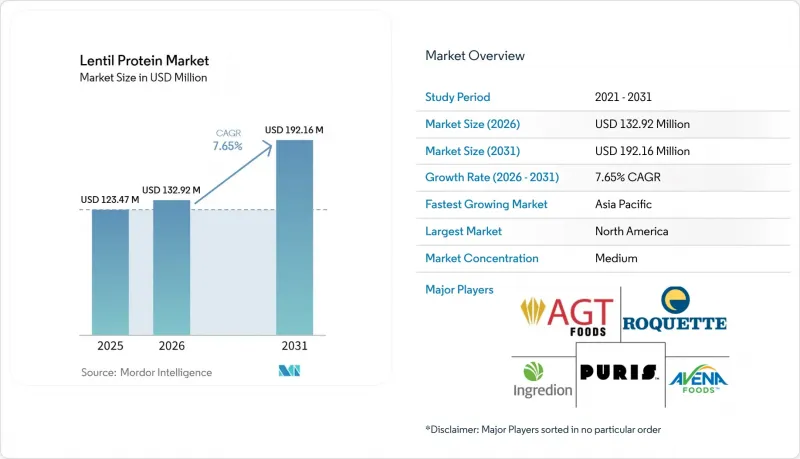
According to Mordor Intelligence, the global lentil protein market is witnessing consistent growth, driven by the increasing preference for plant-based, sustainable, and nutritionally rich protein alternatives. This report is Segmented by Product Type (Lentil Protein Isolate, Lentil Protein Concentrate, and More), End-User (Industrial/Food and Beverage Manufacturers, Animal Nutrition, and Pharmaceuticals and Dietary Supplements), and Geography (North America, Europe, Asia-Pacific, South America, and More). The Market Forecasts are Provided in Both Value (USD) and Volume (Tons).
Global Lentil Protein Market Trends and Insights
Rising adoption of plant-based diets
The growing adoption of plant-based diets is driven by consumer preferences for health, sustainability, and ethical considerations. This shift is prompting food manufacturers to incorporate alternative proteins, such as lentil protein, into their products to meet changing dietary demands. According to the Good Food Institute, 60% of United States households purchased plant-based foods in 2025, underscoring the mainstream acceptance of plant-based consumption . This trend is increasing the demand for diverse and functional plant protein sources beyond traditional options like soy and pea. Lentil protein is emerging as a favorable alternative due to its nutritional benefits and clean-label attributes. As consumers seek variety and innovation in plant-based diets, food producers are broadening their ingredient portfolios to include emerging proteins that provide both nutritional and formulation advantages.
Growing demand for allergen-free proteins
The increasing demand for allergen-free proteins is a key factor driving the global lentil protein market. Consumers are progressively seeking dietary options that exclude common allergens such as dairy, soy, and gluten. Lentil protein, being naturally hypoallergenic compared to many traditional protein sources, is gaining popularity among consumers and manufacturers addressing rising sensitivities and dietary restrictions. According to the Centers for Disease Control and Prevention, 31.7% of adults in the United States were diagnosed with a seasonal allergy, eczema, or food allergy in 2024, highlighting the growing prevalence of allergic conditions . This trend is encouraging food producers to reformulate products using allergen-friendly ingredients, thereby increasing the adoption of lentil protein as a dependable plant-based alternative.
Off-flavor and taste challenges
The off-flavor and taste issues associated with lentil protein serve as a significant restraint in the global lentil protein market, as sensory attributes are a critical factor influencing product acceptance. Lentil protein commonly exhibits a beany, earthy, or slightly bitter taste profile, which can be challenging to mask, especially in applications where flavor neutrality is crucial. These sensory limitations can significantly limit its use in products requiring a clean taste and smooth mouthfeel, creating substantial challenges for manufacturers striving to meet evolving consumer expectations. Furthermore, addressing these flavor concerns often necessitates additional processing steps, the use of flavor-masking agents, or blending with other ingredients, leading to increased formulation complexity, higher production costs, and potential delays in product development timelines.
Other drivers and restraints analyzed in the detailed report include:
- Sustainability and low environmental footprint
- Rising demand for organic and conventional lentil proteins
- Limited consumer awareness
For complete list of drivers and restraints, kindly check the Table Of Contents.
Segment Analysis
The lentil protein concentrate segment, projected to account for 44.68% of the global lentil protein market share in 2025, is driven by its balance of cost-effectiveness, nutritional value, and processing efficiency. Concentrates require less intensive processing compared to more refined variants, reducing production complexity while preserving more of the lentil's natural components. This aligns with the increasing consumer preference for minimally processed and clean-label ingredients. These attributes enable manufacturers to scale production while maintaining competitive pricing, thereby boosting adoption. Furthermore, lentil protein concentrate provides consistent protein content along with retained micronutrients, positioning it as a nutritionally balanced plant-based protein option.
The lentil protein isolate segment is anticipated to grow at a CAGR of 7.89% through 2031, driven by rising demand for high-purity, high-protein plant-based ingredients that meet evolving formulation and nutritional requirements. Isolates offer significantly higher protein content with reduced carbohydrates and fats, making them ideal for manufacturers focused on protein fortification and nutritional precision. This higher purity aligns with the increasing preference for protein-dense formulations and supports the development of products requiring strict macronutrient control. Additionally, lentil protein isolates provide enhanced functional performance, including improved solubility, emulsification, and dispersion, which increases their compatibility with advanced food processing systems and complex formulations.
Geography Analysis
North America is projected to hold 34.12% of the global lentil protein market share in 2025, maintaining its leadership due to a well-established plant-based protein ecosystem, advanced processing infrastructure, and strong innovation capabilities. The region benefits from a high concentration of ingredient manufacturers and food technology companies actively investing in protein extraction, fractionation technologies, and clean-label ingredient development. Additionally, the presence of a mature supply chain, particularly in countries like the United States and Canada-with Canada being one of the largest lentil producers globally-ensures raw material availability and supply stability. This integrated ecosystem supports efficient large-scale production and continuous product innovation, reinforcing North America's dominant position in the market.
Asia-Pacific is emerging as the fastest-growing region, with a CAGR of 8.45% projected through 2031. This growth is driven by strong agricultural production, increasing processing capabilities, and rising adoption of plant-based protein ingredients. Countries such as India play a pivotal role, supported by robust domestic production. According to the Ministry of Agriculture and Farmers Welfare, India produced approximately 1.8 million metric tons of lentils during the 2024 rabi season, ensuring a steady raw material base for protein extraction . The region is also witnessing growing investments in food processing infrastructure and ingredient standardization, enabling manufacturers to scale production and improve product quality. As regional players enhance processing technologies and integrate lentil protein into industrial applications, Asia-Pacific is becoming a key growth hub in the global market.
Europe, along with South America and the Middle East & Africa, is experiencing steady development in the lentil protein market, driven by regulatory support, sustainability initiatives, and the gradual expansion of plant-based ingredient ecosystems. In Europe, stringent regulatory frameworks promoting clean-label ingredients, transparency, and sustainable sourcing are encouraging manufacturers to adopt plant-based proteins such as lentil protein. Meanwhile, South America and the Middle East & Africa are benefiting from improving agricultural practices, increasing awareness of alternative proteins, and investments in food processing capabilities. Although these regions are at a relatively nascent stage, ongoing innovation is expected to gradually strengthen their position in the global lentil protein market.
- AGT Food and Ingredients
- Roquette Freres
- Ingredion Inc.
- Puris Foods
- Avena Foods Limited
- Archer Daniels Midland (ADM)
- Cargill Inc.
- Beneo GmbH
- Vestkorn Milling AS
- Kerry Group plc
- Burcon NutraScience Corp.
- Merit Functional Foods
- COSUCRA Groupe Warcoing
- AM Nutrition
- NutriPea LP
- Shandong Jianyuan Foods
- AGT Poortman
- Equinom Ltd.
- Plantible Foods
- Glanbia plc
Additional Benefits:
- The market estimate (ME) sheet in Excel format
- 3 months of analyst support
TABLE OF CONTENTS
1 INTRODUCTION
- 1.1 Study Assumptions and Market Definition
- 1.2 Scope of the Study
2 RESEARCH METHODOLOGY
3 EXECUTIVE SUMMARY
4 MARKET LANDSCAPE
- 4.1 Market Overview
- 4.2 Market Drivers
- 4.2.1 Rising adoption of plant-based diets
- 4.2.2 Growing demand for allergen-free proteins
- 4.2.3 Sustainability and low environmental footprint
- 4.2.4 Rising demand for organic and conventional lentil proteins
- 4.2.5 Advancements in processing technologies
- 4.2.6 Surge in functional food and beverage applications
- 4.3 Market Restraints
- 4.3.1 Off-flavor and taste challenges
- 4.3.2 Limited consumer awareness
- 4.3.3 Competition from established plant proteins
- 4.3.4 Supply chain and processing complexity
- 4.4 Supply Chain Analysis
- 4.5 Regulatory Landscape
- 4.6 Technological Outlook
- 4.7 Porter's Five Forces Analysis
- 4.7.1 Threat of New Entrants
- 4.7.2 Bargaining Power of Buyers
- 4.7.3 Bargaining Power of Suppliers
- 4.7.4 Threat of Substitutes
- 4.7.5 Intensity of Competitive Rivalry
5 MARKET SIZE AND GROWTH FORECASTS (VALUE AND VOLUME)
- 5.1 By Product Type
- 5.1.1 Lentil Protein Isolate
- 5.1.2 Lentil Protein Concentrate
- 5.1.3 Lentil Protein Flour
- 5.1.4 Textured Lentil Protein
- 5.2 By-End-User
- 5.2.1 Industrial / Food-and-Beverage Manufacturers
- 5.2.1.1 Meat Analogues
- 5.2.1.1.1 Dairy Alternatives
- 5.2.1.1.1.1 Bakery and Snacks
- 5.2.1.1.1.2 Beverages
- 5.2.1.1.1.3 Health and Sports Nutrition
- 5.2.1.1.1 Dairy Alternatives
- 5.2.1.1 Meat Analogues
- 5.2.2 Animal Nutrition
- 5.2.3 Pharmaceuticals and Dietary Supplements
- 5.2.1 Industrial / Food-and-Beverage Manufacturers
- 5.3 By Geography
- 5.3.1 North America
- 5.3.1.1 United States
- 5.3.1.2 Canada
- 5.3.1.3 Mexico
- 5.3.1.4 Rest of North America
- 5.3.2 Europe
- 5.3.2.1 Germany
- 5.3.2.2 United Kingdom
- 5.3.2.3 Italy
- 5.3.2.4 France
- 5.3.2.5 Spain
- 5.3.2.6 Netherlands
- 5.3.2.7 Rest of Europe
- 5.3.3 Asia-Pacific
- 5.3.3.1 China
- 5.3.3.2 India
- 5.3.3.3 Japan
- 5.3.3.4 Australia
- 5.3.3.5 Rest of Asia-Pacific
- 5.3.4 South America
- 5.3.5 Middle East and Africa
- 5.3.1 North America
6 COMPETITIVE LANDSCAPE
- 6.1 Market Concentration
- 6.2 Strategic Moves
- 6.3 Market Positioning Analysis
- 6.4 Company Profiles (includes Global level Overview, Market level overview, Core Segments, Financials as available, Strategic Information, Market Rank/Share for key companies, Products and Services, and Recent Developments)
- 6.4.1 AGT Food and Ingredients
- 6.4.2 Roquette Freres
- 6.4.3 Ingredion Inc.
- 6.4.4 Puris Foods
- 6.4.5 Avena Foods Limited
- 6.4.6 Archer Daniels Midland (ADM)
- 6.4.7 Cargill Inc.
- 6.4.8 Beneo GmbH
- 6.4.9 Vestkorn Milling AS
- 6.4.10 Kerry Group plc
- 6.4.11 Burcon NutraScience Corp.
- 6.4.12 Merit Functional Foods
- 6.4.13 COSUCRA Groupe Warcoing
- 6.4.14 AM Nutrition
- 6.4.15 NutriPea LP
- 6.4.16 Shandong Jianyuan Foods
- 6.4.17 AGT Poortman
- 6.4.18 Equinom Ltd.
- 6.4.19 Plantible Foods
- 6.4.20 Glanbia plc
7 MARKET OPPORTUNITIES AND FUTURE OUTLOOK

