PUBLISHER: Mordor Intelligence | PRODUCT CODE: 2062121

PUBLISHER: Mordor Intelligence | PRODUCT CODE: 2062121
Rust Remover - Market Share Analysis, Industry Trends & Statistics, Growth Forecasts (2026 - 2031)
According to Mordor Intelligence, the rust remover market size is expected to increase from USD 621.44 million in 2025 to USD 654.56 million in 2026 and reach USD 848.62 million by 2031, growing at a CAGR of 5.33% over 2026-2031.
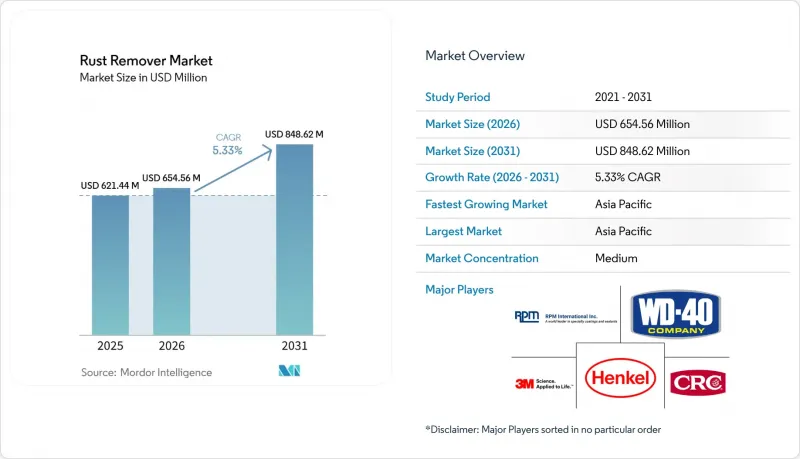
This report is Segmented by Type (Acid-Based Rust Removers, Neutral PH/Chelate-Based Rust Removers, and Bio-Based Rust Removers), Form (Liquid, Gel, Spray, and Wipes), End-User Industry (Automotive, Construction, Industrial Machinery and Equipment, and More), and Geography (Asia-Pacific, North America, Europe, South America, and Middle-East and Africa). The Market Forecasts are Provided in Terms of Value (USD).
Global Rust Remover Market Trends and Insights
Expansion of Manufacturing and Infrastructure Rehabilitation in Emerging Economies
Industrial expansions in India, Vietnam, Indonesia, and Mexico are broadening the market for preventive surface treatments. In India, highway, metro, and port projects mandate corrosion protection for steel rebar and girders. This creates a consistent demand for liquid concentrates compatible with mobile spray rigs at job sites. Vietnam's electronics hubs deploy polyurea barriers to combat salt-laden humidity. However, they still require chemical rust removal during scheduled shutdowns. This is crucial, considering the region faces significant corrosion-related losses impacting its economy. In Mexico, the trend of near-shoring boosts the demand for tooling and mold maintenance. Meanwhile, in Brazil, tax incentives for domestically produced farming equipment ensure repair shops are well-stocked with gel products. These gels are particularly advantageous as they adhere to large castings without runoff. Together, these trends are strengthening the rust removers market, ensuring volume growth even amidst softening commodity prices.
Regulatory Push Toward Low-VOC and Bio-Based Chemistries
In January 2025, the United States Environmental Protection Agency introduced a new aerosol-coatings rule. This rule limits the product-weighted reactivity for rust converters and requires any volatile organic compound present above a certain threshold to be disclosed electronically. If a solvent is not listed, it automatically incurs a significant penalty, making many traditional hydrocarbon carriers impractical. On the other hand, citric-acid systems, derived from corn or cassava sugar, can achieve similar mill-scale removal. These systems produce minimal fumes and, when combined with xanthan gum, create drip-resistant gels suitable for a single vertical coat application. Meanwhile, tightening regulations under the European Union's Registration, Evaluation, Authorization, and Restriction of Chemicals and China's Ministry of Ecology and Environment standards further push global suppliers. They are increasingly moving towards unified formula portfolios that can meet the demands of various jurisdictions. This shift is reshaping the competitive landscape: now, having robust analytical reporting, meticulous volatile organic compound tracking, and access to biobased feedstocks are just as vital as pricing per liter.
Mechanical and Coating-Based Substitutes
Electric-vehicle battery enclosures are increasingly opting for powder coatings, which offer a zero-volatile organic compound application and generate nearly zero waste. This shift is enticing original equipment manufacturers to move away from traditional methods of sequential rust removal and repainting. A survey by AkzoNobel, encompassing manufacturers, revealed that a significant portion of electric vehicle producers now specify powder coatings, slightly outpacing the adoption rate seen in the broader automotive sector. Plasmatreat's AntiCorr, a plasma-enhanced conversion coating, directly applies thin siloxane layers, completely sidestepping traditional chemical baths. With the growing adoption of galvanized steel and aluminum, the once-dominant inventory of bare ferrous surfaces central to the rust removers market has diminished, eroding the market's baseline volume.
Other drivers and restraints analyzed in the detailed report include:
- Refurbishment of Decommissioned Offshore Oil and Gas Platforms
- Pre-Treatment Demand for Green-Hydrogen Electrolyzer Components
- Geopolitical Volatility in Phosphoric and Citric Acid Supply
For complete list of drivers and restraints, kindly check the Table Of Contents.
Segment Analysis
Acid-Based Rust Removers maintained a 52.12% slice of 2025 revenue, while traditional methods anchor legacy maintenance manuals and facilitate heavy-scale removal, rising compliance costs tied to environmental regulations are steering buyers towards citric systems, proudly boasting a certification as fully biobased by the United States Department of Agriculture. Bio-based solutions are projected to expand at 5.81% CAGR between 2026 and 2031. Aerospace maintenance depots, wary of hydrogen embrittlement, are progressively boosting their share of the rust removers market. While still a niche, neutral-pH chelates are securing high-margin contracts in heritage preservation and electronics assembly, where the need for bare-metal precision compensates for their slower kinetics.
Over the forecast period, the market for chelate formulations in rust removers is projected to grow steadily, albeit from a modest base. While acid products continue to dominate heavy machinery refurbishment, the visible costs of additional personal protective equipment, fume extraction, and hazardous waste management are becoming evident in bid comparisons, tightening total cost of ownership gaps. Suppliers are now offering hybrid kits, combining acid pre-wash with chelate polish, to balance performance with regulatory comfort, easing the industry's shift away from a strong-acid-only approach.
Geography Analysis
Asia-Pacific accounted for 45.12% of 2025 revenue and is on track for a 6.11% CAGR between 2026 and 2031. Chinese automotive production lines, which employ inline spray phosphates between welding and e-coating, drain significant volumes daily. Even a small shift towards bio-acids leads to an increase in volume. In India, contractors on the Bharatmala highway corridors, which use large amounts of reinforcing bar per stretch, specify rust treatments to align with the Ministry of Road Transport guidelines. Vietnam, dealing with substantial corrosion losses as a share of its economy, witnesses growing demand in its maritime sector for neutral-pH gels. These gels reduce diver time during hull maintenance. Meanwhile, foreign direct investment incentives from the Association of Southeast Asian Nations attract component suppliers. By adopting low-volatile organic compound liquids, these suppliers position themselves for European exports, advancing cross-regional formulation harmonization.
In North America, the Environmental Protection Agency's electronic-reporting mandate shifts market shares towards citric, gluconic, and other benign acids. Offshore decommissioning bids in the Gulf of Mexico now account for total lifecycle emissions, driving up chelate demands, even at a higher per-liter cost. Furthermore, a strong do-it-yourself culture in the United States sees social-media rust-hack videos translating into active weekend retail sales.
Europe, despite its maturity, remains focused on circular-economy metrics. A study from the Journal of Coatings Technology and Research pointed out that health, safety, and environmental access expenses dominate project spending. This trend nudges asset owners towards durable, low-maintenance coatings that reduce intervention frequency. Suppliers who offer rust removal alongside flash-inhibition gain a competitive edge, saving an extra scaffold cycle a significant advantage in European Union bidding.
While South America and the Middle-East and Africa command smaller market shares, they exhibit areas of rapid growth. In Brazil, soy harvesters face challenges with corrosive fertilizer dust. Meanwhile, in Saudi Arabia, desalination plants manage high-salinity stainless piping. Although political risks and currency fluctuations complicate forecasting, the emergence of localized blending plants offers a solution. These plants reduce import duties and lead times, granting nimble players incremental advantages.
- 3M
- Advanced Protective Technologies, LLC.
- AkzoNobel NV
- BASF
- Capella Solutions Group
- Chempace
- CRC Industries
- Fuchs Petrolub SE
- GUNK
- Henkel AG & Co. KGaA
- JENOLITE
- Kao Corporation
- Permatex
- Rodda Paint, Co.
- RPM International Inc
- Star brite Inc.
- Turtle Wax Inc.
- WD-40
- Zep Inc.
Additional Benefits:
- The market estimate (ME) sheet in Excel format
- 3 months of analyst support
TABLE OF CONTENTS
1 Introduction
- 1.1 Study Assumptions and Market Definition
- 1.2 Scope of the Study
2 Research Methodology
3 Executive Summary
4 Market Landscape
- 4.1 Market Overview
- 4.2 Market Drivers
- 4.2.1 Expansion of manufacturing and infrastructure rehab in emerging economies
- 4.2.2 Regulatory push toward low-VOC and bio-based chemistries
- 4.2.3 Refurbishment of decommissioned offshore oil and gas platforms
- 4.2.4 Pre-treatment demand for green-hydrogen electrolyzer components
- 4.2.5 Robotic/laser in-line rust-removal adoption in smart factories
- 4.3 Market Restraints
- 4.3.1 Mechanical and coating-based substitutes
- 4.3.2 Geopolitical volatility in phosphoric/citric acid supply
- 4.3.3 Rise of micro-abrasive and dry-ice cleaning technologies
- 4.4 Value Chain Analysis
- 4.5 Porter's Five Forces
- 4.5.1 Bargaining Power of Suppliers
- 4.5.2 Bargaining Power of Buyers
- 4.5.3 Threat of New Entrants
- 4.5.4 Threat of Substitutes
- 4.5.5 Competitive Rivalry
5 Market Size and Growth Forecasts (Value)
- 5.1 By Type
- 5.1.1 Acid-Based Rust Removers
- 5.1.2 Neutral pH/Chelate-Based Rust Removers
- 5.1.3 Bio-Based Rust Removers
- 5.2 By Form
- 5.2.1 Liquid
- 5.2.2 Gel
- 5.2.3 Spray
- 5.2.4 Wipes
- 5.3 By End-user Industry
- 5.3.1 Automotive
- 5.3.2 Construction
- 5.3.3 Marine
- 5.3.4 Industrial Machinery and Equipment
- 5.3.5 Household/Consumer
- 5.3.6 Aerospace
- 5.3.7 Oil and Gas
- 5.3.8 Others
- 5.4 By Geography
- 5.4.1 Asia-Pacific
- 5.4.1.1 China
- 5.4.1.2 India
- 5.4.1.3 Japan
- 5.4.1.4 South Korea
- 5.4.1.5 ASEAN Countries
- 5.4.1.6 Rest of Asia-Pacific
- 5.4.2 North America
- 5.4.2.1 United States
- 5.4.2.2 Canada
- 5.4.2.3 Mexico
- 5.4.3 Europe
- 5.4.3.1 Germany
- 5.4.3.2 United Kingdom
- 5.4.3.3 France
- 5.4.3.4 Italy
- 5.4.3.5 Russia
- 5.4.3.6 NORDIC Countries
- 5.4.3.7 Rest of Europe
- 5.4.4 South America
- 5.4.4.1 Brazil
- 5.4.4.2 Argentina
- 5.4.4.3 Rest of South America
- 5.4.5 Middle-East and Africa
- 5.4.5.1 Saudi Arabia
- 5.4.5.2 South Africa
- 5.4.5.3 Rest of Middle-East and Africa
- 5.4.1 Asia-Pacific
6 Competitive Landscape
- 6.1 Market Concentration
- 6.2 Strategic Moves
- 6.3 Market Share (%)/Ranking Analysis
- 6.4 Company Profiles (includes Global Overview, Market Overview, Core Segments, Financials, Strategic Information, Products and Services, and Recent Developments)
- 6.4.1 3M
- 6.4.2 Advanced Protective Technologies, LLC.
- 6.4.3 AkzoNobel NV
- 6.4.4 BASF
- 6.4.5 Capella Solutions Group
- 6.4.6 Chempace
- 6.4.7 CRC Industries
- 6.4.8 Fuchs Petrolub SE
- 6.4.9 GUNK
- 6.4.10 Henkel AG & Co. KGaA
- 6.4.11 JENOLITE
- 6.4.12 Kao Corporation
- 6.4.13 Permatex
- 6.4.14 Rodda Paint, Co.
- 6.4.15 RPM International Inc
- 6.4.16 Star brite Inc.
- 6.4.17 Turtle Wax Inc.
- 6.4.18 WD-40
- 6.4.19 Zep Inc.
7 Market Opportunities and Future Outlook
- 7.1 White-space and Unmet-need Assessment

