PUBLISHER: Mordor Intelligence | PRODUCT CODE: 2062146

PUBLISHER: Mordor Intelligence | PRODUCT CODE: 2062146
Composite Doors And Windows - Market Share Analysis, Industry Trends & Statistics, Growth Forecasts (2026 - 2031)
According to Mordor Intelligence, the composite doors and windows market size is expected to grow from USD 1.15 billion in 2025 to USD 1.20 billion in 2026 and is forecast to reach USD 1.49 billion by 2031 at 4.42% CAGR over 2026-2031.
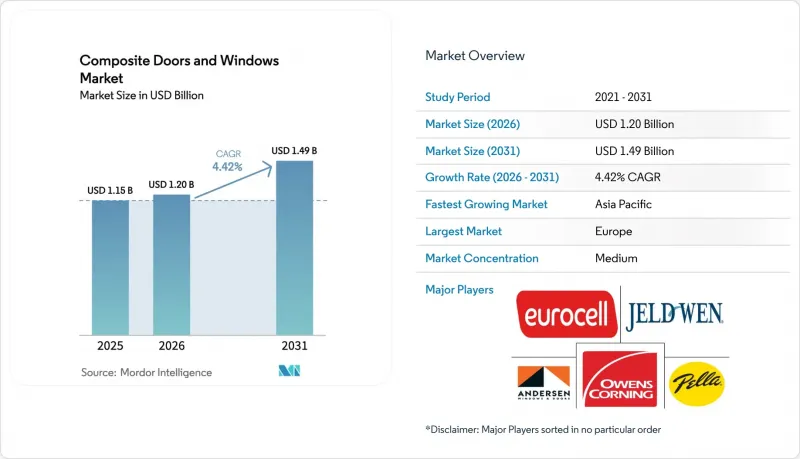
This report is Segmented by Product Type (Composite Doors and Composite Windows), Material Type (Glass Reinforced Plastic, Wood-Plastic Composite, Fibre-Reinforced Polymer, and More), Application (Residential, Industrial/Institutional, and More), and Geography (Asia-Pacific, North America, Europe, South America, and Middle-East and Africa). The Market Forecasts are Provided in Terms of Value (USD).
Global Composite Doors And Windows Market Trends and Insights
Growing Demand for Energy-Efficient Building Envelopes
Stricter building codes in major economies are mandating lower U-values and solar heat gain coefficients, making composite frames a preferred choice. For example, China limits window-to-wall ratios to 20-35% and caps U-values at 1.5-2.0 W/m2*K, as per. Australia's NCC 2022 requires glazing U-values as low as 3.8 W/m2*K, along with mandatory Window Energy Rating Scheme labeling. The EU's recast Energy Performance of Buildings Directive mandates EPC C ratings for public and non-residential buildings by 2030, driving deep-retrofit activities. Composite profiles incorporating aerogels and vacuum insulation panels, with thermal conductivities below 0.020 W/m*K, provide phase-change buffering that reduces HVAC loads and meets Passive House U-value targets of 0.8 W/m2*K. In Florida, the Building Code enforces U-factors no greater than 0.32, encouraging developers to adopt GRP and FRP frames that comply with ASHRAE 90.1-2022 and IECC standards.
Low Maintenance and Superior Durability of Composites
GRP and wood-plastic composite (WPC) frames resist rot, corrosion, and ultraviolet degradation, eliminating the need for repainting common with wood and preventing oxidation seen in aluminum. Andersen's Fibrex, which combines reclaimed wood fiber with vinyl polymer, has surpassed 10 million units sold and achieved an 8% extrusion yield improvement through robotics upgrades. Rehau incorporates up to 86% recycled content, diverting 70,000 tons of material annually and saving 100,000 tons of CO2. Deceuninck's SunShield pigment technology minimizes fading in dark frames exposed to high UV levels. Academic trials with flax-carbon bio-hybrid laminates have shown 24% higher stiffness compared to pure carbon parts, indicating potential for architectural applications.
Limited Installer Awareness in Developing Regions
Composite frames require specialized anchoring, flashing, and sealing techniques, but certified training is limited outside North America and Europe. The FGIA InstallationMasters program is only available in English and Spanish and requires prior field experience, restricting adoption in regions like India, Indonesia, and sub-Saharan Africa. Warranty claims are 30-50% higher in areas where proper installation techniques are not followed, impacting manufacturer margins and consumer confidence. While companies like Modulex and Interarch embed installation crews within their factories, this approach is not scalable for fragmented small-contractor ecosystems. Augmented-reality tools have improved comprehension, with Andersen reporting a 25% increase in lead conversion, but language barriers and inconsistent smartphone access limit their effectiveness in rural markets.
Other drivers and restraints analyzed in the detailed report include:
- Surge in Modular Facade Factories in Emerging Asia-Pacific
- Insurance-Premium Discounts for Hurricane-Rated GRP Frames
- PFAS-Free Resin Mandates Raising Formulation Costs
For complete list of drivers and restraints, kindly check the Table Of Contents.
Segment Analysis
Composite doors accounted for 54.11% of 2025 revenue, but the composite doors and windows market size for composite windows is projected to grow at a 4.81% CAGR through 2031, surpassing the growth rate of doors. In North America, homeowners replace windows every 15-20 years compared to 25-30 years for doors. Additionally, German and French rebates of up to EUR 60,000 per home and EUR 100 per window are driving faster payback periods. ENERGY STAR Most Efficient criteria with U-factors < 0.22 continue to support premium positioning.
Rehau's SLINOVA X sliding system with a 32 mm sash is designed for balcony doors in Europe, while Andersen's expanded 100 Series line has exceeded 10 million units sold, highlighting scale advantages. Deceuninck and Alpen have introduced Elegant triple-pane windows with U-values as low as 0.09, catering to electrochromic retrofits. Doors remain dominant in security and egress applications, with GRP options meeting BS 6853 and EN 45545 fire safety standards.
Geography Analysis
Europe contributed 43.24% of 2025 revenue, supported by generous retrofit programs such as Germany's BEG EM grants of up to EUR 60,000 and 20% subsidies for window upgrades. France's MaPrimeRenov' offers EUR 40-100 per window, and the United Kingdom's ECO4 scheme provides GBP 5,000-15,000 based on household income. Even as Italy's Superbonus drops to 70% in 2024 and phases out, pent-up applications are sustaining demand. The upcoming Digital Product Passport will promote transparent material data, likely favoring FRP systems with lower embodied carbon. Consolidation is accelerating, as evidenced by Eurocell's 2025 acquisition of Alunet Group to scale delivery amid the retrofit surge.
North America is driven by hurricane risk mitigation and federal tax incentives. Wind-storm insurance discounts of 10-45% in Florida reduce GRP window payback periods to under three years, while the Energy Efficient Home Improvement Credit reimburses up to USD 600 per opening. Andersen's USD 420 million expansion in Goodyear, Arizona, doubled Fibrex capacity and reduced freight costs by 15%, improving service in western states. Canada's Greener Homes Grant provides CAD 125-250 per opening, and Mexico's housing recovery in the Bajio corridor is boosting composite adoption.
Asia-Pacific posts the fastest 5.21% CAGR through 2031, fueled by off-site fabrication. Modulex Global's mega-factory near Mumbai produces up to 300,000 m2 of unitized facades annually. China's codes cap U-values at 1.5-2.0 W/m2*K, and its 14th Five-Year Plan targets 350 million m2 of retrofits, driving demand for high-performance frames. Australia's NCC 2022 and upcoming 2025 revisions tighten thermal thresholds, while Japan's seismic replacement initiatives target pre-1981 structures. Early but notable traction is seen in Brazil, where housing recovery is underway, and Saudi Arabia, where giga-projects such as NEOM specify low-carbon composite curtain walls.
- ANDERSEN CORPORATION
- Apeer
- Deceuninck
- Door-Stop International Limited
- Ecoste
- Emplas
- ETO Doors
- Eurocell Plc
- Fibertec Window and Door
- Hurst
- JELD-WEN, Inc.
- Kommerling
- Marvin
- Oknoplast
- Owens Corning
- Pella Corporation
- Plastpro
- Rehau Group
- Safestyle
- Spitfire Doors
- Visen Industries Limited
- VPI Quality Windows, Inc.
- Window Supply Company
Additional Benefits:
- The market estimate (ME) sheet in Excel format
- 3 months of analyst support
TABLE OF CONTENTS
1 Introduction
- 1.1 Study Assumptions and Market Definition
- 1.2 Scope of the Study
2 Research Methodology
3 Executive Summary
4 Market Landscape
- 4.1 Market Overview
- 4.2 Market Drivers
- 4.2.1 Growing demand for energy-efficient building envelopes
- 4.2.2 Low maintenance and superior durability of composites
- 4.2.3 Surge in modular facade factories in emerging Asia-Pacific
- 4.2.4 Insurance-premium discounts for hurricane-rated GRP frames
- 4.2.5 Smart-glazing-ready Composite Frames
- 4.3 Market Restraints
- 4.3.1 Limited installer awareness in developing regions
- 4.3.2 Ambiguous carbon-footprint labelling for hybrid WPC frames
- 4.3.3 Anticipated PFAS-free resin mandates raising formulation costs
- 4.4 Value Chain Analysis
- 4.5 Porter's Five Forces
- 4.5.1 Bargaining Power of Suppliers
- 4.5.2 Bargaining Power of Buyers
- 4.5.3 Threat of New Entrants
- 4.5.4 Threat of Substitutes
- 4.5.5 Competitive Rivalry
5 Market Size and Growth Forecasts (Value)
- 5.1 By Product Type
- 5.1.1 Composite Doors
- 5.1.2 Composite Windows
- 5.2 By Material Type
- 5.2.1 Glass Reinforced Plastic (GRP)
- 5.2.2 Wood-Plastic Composite (WPC)
- 5.2.3 Fibre-Reinforced Polymer (FRP)
- 5.2.4 Other Material Types (Carbon, Bio-composite)
- 5.3 By Application
- 5.3.1 Residential
- 5.3.2 Commercial
- 5.3.3 Industrial/Institutional
- 5.4 By Geography
- 5.4.1 Asia-Pacific
- 5.4.1.1 China
- 5.4.1.2 India
- 5.4.1.3 Japan
- 5.4.1.4 Australia
- 5.4.1.5 Rest of Asia-Pacific
- 5.4.2 North America
- 5.4.2.1 United States
- 5.4.2.2 Canada
- 5.4.2.3 Mexico
- 5.4.3 Europe
- 5.4.3.1 Germany
- 5.4.3.2 United Kingdom
- 5.4.3.3 France
- 5.4.3.4 Italy
- 5.4.3.5 Spain
- 5.4.3.6 NORDIC Countries
- 5.4.3.7 Rest of Europe
- 5.4.4 South America
- 5.4.4.1 Brazil
- 5.4.4.2 Argentina
- 5.4.4.3 Rest of South America
- 5.4.5 Middle-East and Africa
- 5.4.5.1 Saudi Arabia
- 5.4.5.2 South Africa
- 5.4.5.3 Rest of Middle-East and Africa
- 5.4.1 Asia-Pacific
6 Competitive Landscape
- 6.1 Market Concentration
- 6.2 Strategic Moves
- 6.3 Market Share (%)/Ranking Analysis
- 6.4 Company Profiles (includes Global level Overview, Market level overview, Core Segments, Financials as available, Strategic Information, Products and Services, and Recent Developments)
- 6.4.1 ANDERSEN CORPORATION
- 6.4.2 Apeer
- 6.4.3 Deceuninck
- 6.4.4 Door-Stop International Limited
- 6.4.5 Ecoste
- 6.4.6 Emplas
- 6.4.7 ETO Doors
- 6.4.8 Eurocell Plc
- 6.4.9 Fibertec Window and Door
- 6.4.10 Hurst
- 6.4.11 JELD-WEN, Inc.
- 6.4.12 Kommerling
- 6.4.13 Marvin
- 6.4.14 Oknoplast
- 6.4.15 Owens Corning
- 6.4.16 Pella Corporation
- 6.4.17 Plastpro
- 6.4.18 Rehau Group
- 6.4.19 Safestyle
- 6.4.20 Spitfire Doors
- 6.4.21 Visen Industries Limited
- 6.4.22 VPI Quality Windows, Inc.
- 6.4.23 Window Supply Company
7 Market Opportunities and Future Outlook
- 7.1 White-space and Unmet-need Assessment

