PUBLISHER: Mordor Intelligence | PRODUCT CODE: 2062148

PUBLISHER: Mordor Intelligence | PRODUCT CODE: 2062148
Plastic Extrusion Machine - Market Share Analysis, Industry Trends & Statistics, Growth Forecasts (2026 - 2031)
According to Mordor Intelligence, the plastic extrusion machine market size is projected to be USD 7.93 billion in 2025, USD 8.42 billion in 2026, and reach USD 11.33 billion by 2031, growing at a CAGR of 6.12% from 2026 to 2031.
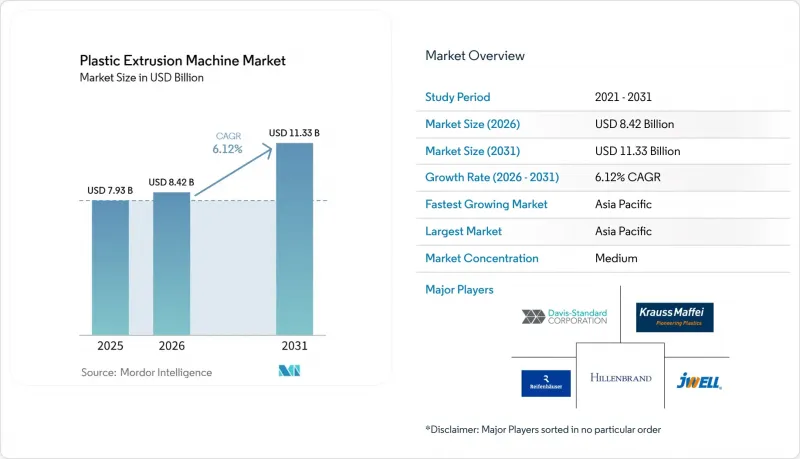
This report is Segmented by Machine Type (Single Screw Extrusion, Twin Screw Extrusion, and More), Process Type (Blown Film Extrusion, Sheet/Film Extrusion, and More), Automation Level (Semi-Automated, Conventional Manual/Relay-based, and Fully-Automated SCADA/IoT-enabled), End-User Industry (Packaging, Building and Construction, and More), and Geography (Asia-Pacific, North America, and More).
Global Plastic Extrusion Machine Market Trends and Insights
Advancements in Automation and Energy-Efficient Machinery
Centralized control platforms, such as Bausano's ORQUESTRA 4.0, collect live operating data and organize maintenance events. This approach reduces unscheduled downtime, helping converters manage margins amid rising power prices in Europe. In 2026, SML introduced a twin-screw system that achieved a 10-15% reduction in specific energy input and a 20% decrease in gels on cast-film lines. This development highlights the growing focus on energy efficiency and quality improvements. Coperion's C-Beyond lifecycle suite monitors gearbox vibrations and provides alerts to prevent catastrophic failures. This feature supports asset-life extensions, addressing challenges posed by the retirement of skilled technicians. Germany and the U.S. are leading early adoption, with the reduced total cost of ownership driving automation as a critical factor in purchase decisions.
Rising Demand for Recycled and Biodegradable Polymer Extrusion
The EU Packaging and Packaging Waste Regulation mandates 30-65% recycled content between 2030 and 2040, prompting a wave of line retrofits that favor twin-screw starve-feeding of dusty flake streams. Coperion's STS 35 Mc 11 boosts throughput by 27% on contaminated regrind because intermeshing screws self-clean and control melt temperature. California's requirement that all packaging be recyclable or compostable by 2032 lifts interest in bio-based PLA extrusion lines. Manufacturers respond with abrasion-resistant screws, tighter residence-time control, and low-shear melting zones that protect recycled polymer integrity, reshaping value propositions across the plastic extrusion machine market.
Environmental Regulations on Virgin-Plastic Use
Canada's prohibition on single-use plastics, along with California's SB 54, is requiring retailers and restaurants to transition from virgin materials to recycled or compostable options. This regulatory compliance has increased demand for food-grade rPET, which is priced 25% higher than its virgin counterpart. Additionally, converters are working within tight deadlines to validate new formulations. In Europe, a 2030 recyclability mandate will restrict multilayer laminates that cannot be easily delaminated. Converters unable to modify their production lines may lose contracts, as brand owners increasingly prefer suppliers that provide traceable recycled content.
Other drivers and restraints analyzed in the detailed report include:
- AI-Enabled Predictive Process Control for Zero-Defect Output
- On-Site Micro-Extrusion for Personalized Medical Implants
- Scarcity of High-Torque Gearbox Suppliers Lengthening Lead Times
For complete list of drivers and restraints, kindly check the Table Of Contents.
Segment Analysis
Twin-screw units are projected to grow faster than the broader plastic extrusion machine market, with a 6.21% CAGR through 2031. This growth is observed across various regions, even though single-screw machines accounted for 53.11% of the plastic extrusion machine market share in 2025. The market size for laboratory twin-screw systems in plastic extrusion remains relatively small today, but it is expanding at a notable rate. This trend is driven by converters in different geographies running trial batches of recycled or bio-based formulations before scaling to production.
Modular screw elements allow operators to adjust kneading, conveying, and devolatilizing sections, which improves pigment dispersion at 0.1% loadings and helps prevent thermal degradation in hygroscopic polymers. Capital investment increases with screw diameter, but throughput grows with the square of that diameter, reducing cost per kilogram for high-volume plants. Single-screw machines continue to dominate the pipe and profile sector due to their simpler maintenance requirements. However, their market share is gradually declining in regions where converters are qualifying high-regrind recipes that only twin-screw machines can process consistently.
In 2025, blown film accounted for 32.24% of the revenue share. However, extrusion coating and lamination are anticipated to grow at a CAGR of 6.42%, reflecting the increasing preference among brand owners for mono-material barrier structures. The plastic extrusion machine market, particularly for nine-to-eleven-layer coating lines, is expanding as food brands transition from mixed laminate pouches to all-PE alternatives that align with upcoming grade-A recyclability labels.
Energy audits indicate that co-extrusion consumes less than 2.6 kWh per square meter, which is approximately half the energy usage of solvent-based laminate production. This allows converters to reduce energy expenses and compliance costs related to solvent emissions. While pipe, tubing, and profile lines continue to meet infrastructure demands in India and ASEAN, investments are gradually shifting toward barrier-film lines. These lines are designed to support contracts requiring extended shelf life for products such as fresh meat and ready-to-eat meals.
Geography Analysis
In 2025, the Asia-Pacific region accounted for 48.22% of global revenue and is projected to achieve a CAGR of 6.88% through 2031, supported by capacity expansions in China, India, and ASEAN nations. Thailand, with its 3,200 converters and 34.6 million tonnes of petrochemical capacity, shows room for improvement in recycling. Growth opportunities may arise if policymakers implement stricter circular-economy targets.
In North America, retrofitting facilities is prioritized over constructing new ones, particularly with regulations such as California's SB 54 and Canadian bans becoming more stringent. However, low mechanical-recycling rates have led to a reliance on importing certified rPET from Europe, which continues to drive investments in twin-screw reclamation lines. Mexico is attracting near-shoring investments, particularly in EV wiring and food-contact films, facilitating cross-border supplies to U.S. OEMs under the USMCA agreement.
Europe operates under some of the most stringent regulations in the industry. The PPWR's focus on recycled content and recyclability grades is encouraging converters to adopt advanced five-to-eleven-layer coextruders equipped with online quality analytics. Germany and Italy are leading in automation adoption, while Eastern Europe and the Nordics are testing chemical-recycling feedstock preparation, which requires high-vacuum devolatilization extruders. In South America and the Middle East, growth remains uneven: Brazil is investing in silage-film lines despite currency fluctuations, and Saudi Arabia is increasing its HDPE pipe capacity to address water infrastructure needs.
- Bausano S.p.A, societa unipersonale
- BREYER Maschinenfabrik GmbH
- Coperion GmbH
- Costruzioni Meccaniche Luigi Bandera SpA
- Cowell (Nanjing) Extrusion Machinery Co., Ltd.
- Davis-Standard, LLC
- Hillenbrand
- JianTai
- JWELL Extrusion Machinery Co., Ltd.
- Kolsite Group (Rajoo Engineers)
- KraussMaffei
- KUNG HSING PLASTIC MACHINERY CO., LTD.
- Leistritz Extrusionstechnik GmbH
- Nanjing KY Chemical Machinery
- Qingdao Shansu Extrusion Equipment Co.,ltd
- Reifenhauser Group
- SML Maschinengesellschaft mbH
- The Japan Steel Works Ltd.
- Windsor Machines Pvt. Ltd.
Additional Benefits:
- The market estimate (ME) sheet in Excel format
- 3 months of analyst support
TABLE OF CONTENTS
1 Introduction
- 1.1 Study Assumptions and Market Definition
- 1.2 Scope of the Study
2 Research Methodology
3 Executive Summary
4 Market Landscape
- 4.1 Market Overview
- 4.2 Market Drivers
- 4.2.1 Advancements in automation and energy-efficient machinery
- 4.2.2 Rising demand for recycled and biodegradable polymer extrusion
- 4.2.3 Government incentive schemes for circular-economy equipment
- 4.2.4 AI-enabled predictive process control for zero-defect output
- 4.2.5 On-site micro-extrusion for personalised medical implants
- 4.3 Market Restraints
- 4.3.1 Environmental regulations on virgin-plastic use
- 4.3.2 Scarcity of high-torque gearbox suppliers lengthening lead-times
- 4.3.3 Skilled operator shortage amid demographic shift
- 4.4 Value Chain Analysis
- 4.5 Porter's Five Forces
- 4.5.1 Bargaining Power of Suppliers
- 4.5.2 Bargaining Power of Buyers
- 4.5.3 Threat of New Entrants
- 4.5.4 Threat of Substitutes
- 4.5.5 Competitive Rivalry
5 Market Size and Growth Forecasts (Value)
- 5.1 By Machine Type
- 5.1.1 Single Screw Extrusion
- 5.1.2 Twin Screw Extrusion
- 5.1.3 Multi-screw and Exotic Configurations
- 5.1.4 Ancillary Down-stream Equipment
- 5.2 By Process Type
- 5.2.1 Blown Film Extrusion
- 5.2.2 Sheet / Film Extrusion
- 5.2.3 Tubing and Profile Extrusion
- 5.2.4 Pipe Extrusion
- 5.2.5 Extrusion Coating and Lamination
- 5.2.6 Other Process Types
- 5.3 By Automation Level
- 5.3.1 Semi-Automated (PLC-integrated)
- 5.3.2 Conventional (Manual / Relay-based)
- 5.3.3 Fully-Automated (SCADA / IoT-enabled)
- 5.4 By End-user Industry
- 5.4.1 Packaging
- 5.4.2 Building and Construction
- 5.4.3 Automotive and Transportation
- 5.4.4 Electrical and Electronics
- 5.4.5 Consumer Goods and Appliances
- 5.4.6 Medical and Healthcare
- 5.4.7 Agriculture
- 5.4.8 Other End-user Industries
- 5.5 By Geography
- 5.5.1 Asia-Pacific
- 5.5.1.1 China
- 5.5.1.2 India
- 5.5.1.3 Japan
- 5.5.1.4 South Korea
- 5.5.1.5 ASEAN Countries
- 5.5.1.6 Rest of Asia-Pacific
- 5.5.2 North America
- 5.5.2.1 United States
- 5.5.2.2 Canada
- 5.5.2.3 Mexico
- 5.5.3 Europe
- 5.5.3.1 Germany
- 5.5.3.2 United Kingdom
- 5.5.3.3 France
- 5.5.3.4 Italy
- 5.5.3.5 Spain
- 5.5.3.6 Russia
- 5.5.3.7 NORDIC Countries
- 5.5.3.8 Rest of Europe
- 5.5.4 South America
- 5.5.4.1 Brazil
- 5.5.4.2 Argentina
- 5.5.4.3 Rest of South America
- 5.5.5 Middle-East and Africa
- 5.5.5.1 Saudi Arabia
- 5.5.5.2 South Africa
- 5.5.5.3 Rest of Middle-East and Africa
- 5.5.1 Asia-Pacific
6 Competitive Landscape
- 6.1 Market Concentration
- 6.2 Strategic Moves
- 6.3 Market Share (%)/Ranking Analysis
- 6.4 Company Profiles (includes Global Overview, Market Overview, Core Segments, Financials, Strategic Information, Products and Services, and Recent Developments)
- 6.4.1 Bausano S.p.A, societa unipersonale
- 6.4.2 BREYER Maschinenfabrik GmbH
- 6.4.3 Coperion GmbH
- 6.4.4 Costruzioni Meccaniche Luigi Bandera SpA
- 6.4.5 Cowell (Nanjing) Extrusion Machinery Co., Ltd.
- 6.4.6 Davis-Standard, LLC
- 6.4.7 Hillenbrand
- 6.4.8 JianTai
- 6.4.9 JWELL Extrusion Machinery Co., Ltd.
- 6.4.10 Kolsite Group (Rajoo Engineers)
- 6.4.11 KraussMaffei
- 6.4.12 KUNG HSING PLASTIC MACHINERY CO., LTD.
- 6.4.13 Leistritz Extrusionstechnik GmbH
- 6.4.14 Nanjing KY Chemical Machinery
- 6.4.15 Qingdao Shansu Extrusion Equipment Co.,ltd
- 6.4.16 Reifenhauser Group
- 6.4.17 SML Maschinengesellschaft mbH
- 6.4.18 The Japan Steel Works Ltd.
- 6.4.19 Windsor Machines Pvt. Ltd.
7 Market Opportunities and Future Outlook
- 7.1 White-space and Unmet-need Assessment

