PUBLISHER: Mordor Intelligence | PRODUCT CODE: 2062190

PUBLISHER: Mordor Intelligence | PRODUCT CODE: 2062190
Military Vehicle Electrification - Market Share Analysis, Industry Trends & Statistics, Growth Forecasts (2026 - 2031)
According to Mordor Intelligence, the military vehicle electrification market was valued at USD 3.82 billion in 2025, and is projected to grow from USD 4.53 billion in 2026 to reach USD 9.35 billion by 2031, at a 15.59% CAGR over 2026-2031.
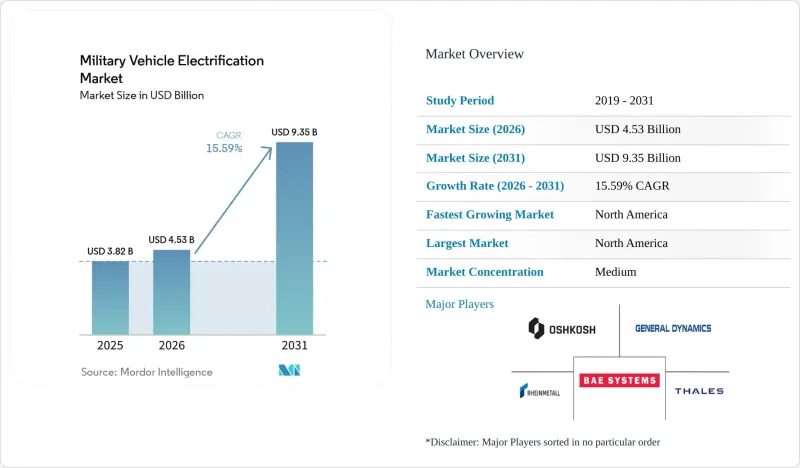
This report is Segmented by Propulsion Type (Hybrid-Electric and Fully Electric), Platform (Combat Vehicles, Support Vehicles, and Unmanned Ground Vehicles), System (Power Generation, Cooling, Energy Storage, Traction Drive, and More), Voltage Class (Low, Medium, and High), and Geography (North America, Europe, Asia-Pacific, and More). The Market Forecasts are Provided in Terms of Value (USD).
Global Military Vehicle Electrification Market Trends and Insights
Increased Defense Funding for Ground Vehicle Modernization Programs
Accelerated appropriations are channeling unprecedented sums into electrification. The US Army's climate strategy pursues an all-electric non-tactical fleet by 2027 and hybridized tactical platforms beginning with the M1E3 Abrams program, which integrates an advanced battery pack derived from GM Defense's Ultium technology. In parallel, the European Union earmarked EUR 150 billion (USD 175.83 billion) within its ReArm Europe framework to seed next-generation powertrains, positioning electrification as a force multiplier for readiness. Such funding pools de-risk supplier investment in solid-state chemistry, cooling subsystems, and power electronics, accelerating the global adoption curve of the military vehicle electrification market.
Global Emissions and Fuel-Efficiency Standards Influencing Defense Fleets
Federal Executive Orders 14008 and 14057 require US government agencies to transition to zero-emission vehicles on aggressive timelines, a mandate that affects the Department of Defense's (DoD's) vast tactical inventory. NATO members embed similar sustainability metrics into the 2% of GDP defense-spending guideline, compelling procurement offices to favor hybrid and electric variants. These policies codify stealth, reduced thermal signature, and lower maintenance overhead as co-benefits, reinforcing the long-run growth trajectory of the military vehicle electrification market.
Insufficient Tactical Charging and Battlefield Refueling Infrastructure
Pilot installations of Level-3 chargers on US bases underscore progress, yet expeditionary forces lack ruggedized, grid-independent solutions. DoD microgrid tests using solar-generator hybrids and modular lithium packs indicate feasibility, but large-scale deployment awaits MIL-spec certification and doctrinal integration. Until portable high-capacity chargers are ready, range anxiety will temper adoption rates in the military vehicle electrification market.
Other drivers and restraints analyzed in the detailed report include:
- Technological Advancements in High-Energy-Density Lithium and Solid-State Batteries
- Operational Savings from Reduced Fuel Logistics and Supply-Chain Dependencies
- High Initial Costs for Procurement and Retrofitting of Electric Platforms
For complete list of drivers and restraints, kindly check the Table Of Contents.
Segment Analysis
Hybrid-electric systems generated 76.00% of 2025 revenue, leveraging regenerative braking, on-the-move power export, and compatibility with existing refueling doctrine. This portion of the military vehicle electrification market supports near-term fleet upgrades without demanding radical infrastructure overhaul. Though smaller today, fully electric platforms are posting an 19.88% CAGR and benefit from advances in cell chemistry that enable armored vehicles to travel mission-relevant distances on a single charge.
Combat platforms accounted for 48.97% of 2025 demand, propelled by marquee programs such as the M1E3 Abrams and the Boxer hybridization effort. The requirement for exportable electrical power to new sensor suites and laser countermeasures aligns naturally with electrified drivelines, keeping combat vehicles central to growth in the military vehicle electrification market.
Support and logistics vehicles are the fastest-growing segment, with a 17.81% CAGR through 2031, as they increasingly integrate modular battery pods and auxiliary inverters, creating rolling microgrids capable of powering field hospitals and radar stations. This secondary demand stream further diversifies revenue opportunities and cushions suppliers against the cyclicality of big-ticket combat vehicle awards.
Geography Analysis
North America, which accounted for 51.62% of 2025 revenue, is projected to grow at a 16.30% CAGR through 2031. This growth trajectory mirrors the DoD's investments, spanning from battery standardization to supply-chain onshoring. Notable programs like the Next-Generation Tactical Vehicle-Hybrid and the hybridized Abrams underscore the confidence in scalable electrification. Furthermore, Canada's modernization initiatives, prioritizing cold-weather and silent mobility, highlight how regional climate factors influence specifications in the military vehicle electrification arena.
In South Korea, Japan, and Australia, large-scale modernization efforts are fueling growth in the Asia-Pacific region, with each nation pursuing energy independence and aiming to minimize logistics footprints. Demonstrating its commitment, the region has showcased government-funded trials of hydrogen-powered armored vehicles and high-voltage support trucks. Such initiatives are set to diversify the technological landscape of the military vehicle electrification sector.
Europe's trajectory is guided by funding for the Common Security and Defence Policy and by tightened sustainability mandates. The EUR 1.7 billion (USD 1.99 billion) integration of Iveco Defence into Leonardo cements Italy's position as a European land-systems powerhouse and accelerates the continent's closed-loop supply of electrified drivetrains. Interoperability requirements under NATO rail-carriage dimensions and cross-country mobility standards further harmonize demand across member states, elevating the collective bargaining power of the European defense bloc within the military vehicle electrification market.
- Oshkosh Corporation
- General Motors Company
- General Dynamics Corporation
- BAE Systems plc
- Leonardo S.p.A.
- Textron Inc.
- Singapore Technologies Engineering Ltd.
- QinetiQ Group plc
- Rheinmetall AG
- Thales Group
- KNDS N.V.
- FNSS Savunma Sistemleri A.S.
- Arquus (John Cockerill Group)
- Patria Group
- Allison Transmission Holdings, Inc.
- Hyundai Rotem Company
Additional Benefits:
- The market estimate (ME) sheet in Excel format
- 3 months of analyst support
TABLE OF CONTENTS
1 INTRODUCTION
- 1.1 Study Assumptions and Market Definition
- 1.2 Scope of the Study
2 RESEARCH METHODOLOGY
3 EXECUTIVE SUMMARY
4 MARKET LANDSCAPE
- 4.1 Market Overview
- 4.2 Market Drivers
- 4.2.1 Technological advancements in high-energy-density lithium and solid-state batteries
- 4.2.2 Rising onboard power requirements for directed-energy and C4ISR systems
- 4.2.3 Increased defense funding for ground vehicle modernization programs
- 4.2.4 Operational savings from reduced fuel logistics and supply chain dependencies
- 4.2.5 Tactical benefits of silent mobility for ISR and electronic warfare operations
- 4.2.6 Global emissions and fuel efficiency standards influencing defense fleets
- 4.3 Market Restraints
- 4.3.1 Supply chain vulnerabilities in critical minerals under defense procurement policies
- 4.3.2 Insufficient tactical charging and battlefield refueling infrastructure
- 4.3.3 High initial costs for procurement and retrofitting of electric platforms
- 4.3.4 Thermal signature risks associated with large-capacity battery systems
- 4.4 Value Chain Analysis
- 4.5 Regulatory Landscape
- 4.6 Technological Outlook
- 4.7 Porter's Five Forces Analysis
- 4.7.1 Threat of New Entrants
- 4.7.2 Bargaining Power of Suppliers
- 4.7.3 Bargaining Power of Buyers
- 4.7.4 Threat of Substitutes
- 4.7.5 Intensity of Competitive Rivalry
5 MARKET SIZE AND GROWTH FORECASTS (VALUE)
- 5.1 By Propulsion Type
- 5.1.1 Hybrid-Electric
- 5.1.2 Fully Electric
- 5.2 By Platform
- 5.2.1 Combat Vehicles
- 5.2.2 Support Vehicles
- 5.2.3 Unmanned Ground Vehicles (UGVs)
- 5.3 By System
- 5.3.1 Power Generation
- 5.3.2 Cooling
- 5.3.3 Energy Storage
- 5.3.4 Traction Drive
- 5.3.5 Power Conversion
- 5.3.6 Transmission
- 5.4 By Voltage Class
- 5.4.1 Low (Less than 50 V)
- 5.4.2 Medium (50 V to 600 V)
- 5.4.3 High (Greater than 600 V)
- 5.5 By Geography
- 5.5.1 North America
- 5.5.1.1 United States
- 5.5.1.2 Canada
- 5.5.1.3 Mexico
- 5.5.2 Europe
- 5.5.2.1 United Kingdom
- 5.5.2.2 France
- 5.5.2.3 Germany
- 5.5.2.4 Italy
- 5.5.2.5 Rest of Europe
- 5.5.3 Asia-Pacific
- 5.5.3.1 China
- 5.5.3.2 India
- 5.5.3.3 Japan
- 5.5.3.4 South Korea
- 5.5.3.5 Australia
- 5.5.3.6 Rest of Asia-Pacific
- 5.5.4 South America
- 5.5.4.1 Brazil
- 5.5.4.2 Rest of South America
- 5.5.5 Middle East and Africa
- 5.5.5.1 Middle East
- 5.5.5.1.1 United Arab Emirates
- 5.5.5.1.2 Saudi Arabia
- 5.5.5.1.3 Rest of the Middle East
- 5.5.5.2 Africa
- 5.5.5.2.1 South Africa
- 5.5.5.2.2 Rest of Africa
- 5.5.5.1 Middle East
- 5.5.1 North America
6 COMPETITIVE LANDSCAPE
- 6.1 Market Concentration
- 6.2 Strategic Moves
- 6.3 Market Share Analysis
- 6.4 Company Profiles (includes Global level Overview, Market level overview, Core Segments, Financials as available, Strategic Information, Market Rank/Share for key companies, Products and Services, and Recent Developments)
- 6.4.1 Oshkosh Corporation
- 6.4.2 General Motors Company
- 6.4.3 General Dynamics Corporation
- 6.4.4 BAE Systems plc
- 6.4.5 Leonardo S.p.A.
- 6.4.6 Textron Inc.
- 6.4.7 Singapore Technologies Engineering Ltd.
- 6.4.8 QinetiQ Group plc
- 6.4.9 Rheinmetall AG
- 6.4.10 Thales Group
- 6.4.11 KNDS N.V.
- 6.4.12 FNSS Savunma Sistemleri A.S.
- 6.4.13 Arquus (John Cockerill Group)
- 6.4.14 Patria Group
- 6.4.15 Allison Transmission Holdings, Inc.
- 6.4.16 Hyundai Rotem Company
7 MARKET OPPORTUNITIES AND FUTURE OUTLOOK
- 7.1 White-Space and Unmet-Need Assessment

