
PUBLISHER: Mordor Intelligence | PRODUCT CODE: 2062254

PUBLISHER: Mordor Intelligence | PRODUCT CODE: 2062254
PET Film Coated Steel Coil - Market Share Analysis, Industry Trends & Statistics, Growth Forecasts (2026 - 2031)
According to Mordor Intelligence, the pET film coated steel coil market size is expected to grow from USD 16.35 billion in 2025 to USD 17.20 billion in 2026 and is forecast to reach USD 22.14 billion by 2031 at 5.18% CAGR over 2026-2031.
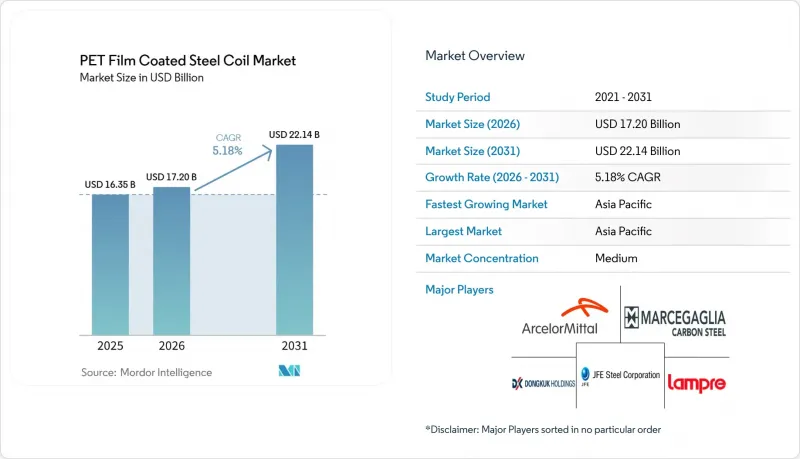
This report is Segmented by Substrate Type (Cold-Rolled Steel, and More), Coating Type (Single-Side PET, and More), Application (Wall Panels and Roofing Sheets, and More), End-User Industry (Construction and Infrastructure, and More), and Geography (Asia-Pacific, North America, Europe, South America, and Middle East and Africa). The Market Forecasts are Provided in Terms of Value (USD).
Global PET Film Coated Steel Coil Market Trends and Insights
Expansion of Appliance Manufacturing Using Aesthetic Steel Panels
White-goods producers in Asia-Pacific are specifying PET laminates to avoid post-assembly painting, cut volatile-organic-compound emissions, and deliver uniform gloss. Jindal India's February 2026 coating line lifts value-added capacity by 60% to 300,000 tons/year, targeting refrigerators, washer housings, and solar structures. ArcelorMittal Nippon Steel India aims to raise value-added revenue share to 75% with two new coated brands positioned for appliance OEMs. As e-commerce distribution grows, dent-resistant, scratch-proof panels maintain a showroom finish through long logistics chains, shifting margin pools toward downstream lamination.
Preference for PET-Coated Steel Over PVC on Sustainability Grounds
Regulators are phasing out PVC because of chlorine chemistry and poor recyclability. Germany's December 2024 National Circular Economy Strategy introduces polymer-specific recycled-content quotas and digital product passports, encouraging mono-material PET designs. The European Union's draft Packaging Regulation seeks 70% recycling by 2030, making chlorine-free PET laminates preferable to PVC coatings that hinder material recovery. Peer-reviewed work shows PET-coated steel eliminates spray-paint VOCs while maintaining barrier integrity.
Limited Recyclability of Multilayer Coated Substrates
Fused polymer-metal interfaces resist mechanical separation, complicating European recycling targets. Cleaner-Production reviews find multilayer films already 17% of flexible output, yet advanced recovery routes raise GHGs by 21% versus incineration at the current scale. Chemical depolymerization options are unproven commercially, pressuring manufacturers to trial water-soluble adhesives or split-layer designs.
Other drivers and restraints analyzed in the detailed report include:
- Improved Scratch Resistance and Color Retention Driving OEM Usage
- Adoption in Smart-Home Exterior Panels Requiring IR-Reflective Coatings
- Technical Challenges in Adhesion and Film Delamination
For complete list of drivers and restraints, kindly check the Table Of Contents.
Segment Analysis
Galvanized coil delivered 53.22% revenue in 2025, but galvalume/aluzinc steel is forecast to grow at a 5.81% CAGR during the forecast period (2026-2031) as coastal infrastructure adopts ISO 12944 C4-C5 durability. Salt-spray tests show galvalume loses only 0.03 mm/year after 2,000 hours, extending field life beyond 20 years. The PET film coated steel coil market size for galvalume substrates is therefore set to expand faster than for galvanized, even considering its USD 150/ton price premium. Producers are recalibrating adhesion layers to match the higher aluminum oxide content that can impair bonding and require modified primers.
Advanced AI quality-control on new coating lines supports uniform galvalume thickness control and raises yield. Predictive maintenance has already cut unplanned downtime 50% at Chinese mills, tipping project economics toward high-grade metallic coatings. As renewable-energy farms and data-center campuses cluster near humid coastal zones, PET film coated steel coil market demand for galvalume and aluzinc will keep climbing through 2031.
Single-side PET film coating retained 63.35% revenue in 2025 because most appliance back panels require only front-face protection. The PET film coated steel coil market size for antibacterial and functional PET films, however, is growing at a 5.97% CAGR for the forecast period (2026-2031) as hospitals, canteens, and cleanrooms specify ISO 22196-compliant solutions. Silver-ion coatings maintain more than 99% bacterial suppression for a decade without discoloration.
Double-side, matte, and UV-stable products serve architectural interiors and elevator cabins where both faces are visible or sunlight exposure is severe. Functional differentiation shields margins from Asian commodity overcapacity: nanoparticle, anti-fingerprint, and IR-reflective variants command 20-40% premiums, helping suppliers offset resin cost spikes. Market leaders that integrate co-extrusion of additives are positioned to widen their PET film coated steel coil market share over strip-paint rivals.
Geography Analysis
Asia-Pacific generated 52.26% revenue in 2025 and will grow at 6.12% CAGR through 2031. India's newly commissioned INR 11 billion (approximately USD 132 million) line lifts domestic coated-steel capacity, aiming at 300,000 tons/year for appliances and solar racks. ArcelorMittal Nippon Steel is shifting 75% of revenue to value-added grades, leveraging India's 10% annual appliance demand growth. China's resin surplus powers exports even as anti-dumping cases rise, sustaining utilization near 75%. ASEAN tinplate expansions further embed PET laminates into regional supply chains.
North America and Europe show slower volume growth yet command higher per-ton margins driven by VOC caps and recycled-content quotas. The U.S. EPA (Environmental Protection Agency) moved iron-and-steel air-rule compliance to April 2027, affecting substrate costs for domestic laminators. Germany's circular-economy program mandates digital product passports by 2030, boosting traceable PET coatings. Freight premiums lifted Q4 2025 BOPET (Biaxially Oriented Polyethylene Terephthalate) prices in the United States despite soft converter demand.
South America and the Middle East & Africa remain smaller, opportunity-rich regions where infrastructure megaprojects and petrochemical plants need corrosion-proof cladding. Their dependence on Asian film imports intensifies volatility, yet localized slitting centers could shorten lead times and lift PET film coated steel coil market penetration.
- ArcelorMittal
- Baosteel Co., Ltd.
- DONGKUKHOLDINGS CO., LTD.
- HYUNDAI STEEL
- JFE Steel Corporation
- Jiangyin Woda New Materials Co., Ltd.
- JSW Steel
- Lampre s.r.l.
- LIENCHY LAMINATED METAL CO., LTD.
- MARCEGAGLIA CARBON STEEL S.p.A.
- NIPPON STEEL CORPORATION
- NLMK
- POSCO
- Severstal
- Shandong Colour-Coated Steel
- Ternium
- ThyssenKrupp Steel Europe
- Yieh Phui Enterprise Co., Ltd.
Additional Benefits:
- The market estimate (ME) sheet in Excel format
- 3 months of analyst support
TABLE OF CONTENTS
1 Introduction
- 1.1 Study Assumptions and Market Definition
- 1.2 Scope of the Study
2 Research Methodology
3 Executive Summary
4 Market Landscape
- 4.1 Market Overview
- 4.2 Market Drivers
- 4.2.1 Expansion of appliance manufacturing using aesthetic steel panels
- 4.2.2 Preference for PET-coated steel over PVC on sustainability grounds
- 4.2.3 Improved scratch resistance and colour retention driving OEM usage
- 4.2.4 Adoption in smart-home exterior panels requiring IR-reflective coatings
- 4.2.5 Emergence of ultra-thin PET films enabling laser micro-perforation for ventilation
- 4.3 Market Restraints
- 4.3.1 Limited recyclability of multilayer coated substrates
- 4.3.2 Technical challenges in adhesion and film delamination
- 4.3.3 Scarce global PET-grade film supply outside of Asia
- 4.4 Value Chain Analysis
- 4.5 Porter's Five Forces
- 4.5.1 Threat of New Entrants
- 4.5.2 Bargaining Power of Buyers
- 4.5.3 Bargaining Power of Suppliers
- 4.5.4 Threat of Substitutes
- 4.5.5 Competitive Rivalry
5 Market Size and Growth Forecasts (Value)
- 5.1 By Substrate Type
- 5.1.1 Cold-Rolled Steel (CR Steel)
- 5.1.2 Galvanized Steel
- 5.1.3 Galvalume/Aluzinc Steel
- 5.1.4 Other Substrate Types
- 5.2 By Coating Type
- 5.2.1 Single-side PET Film Coating
- 5.2.2 Double-side PET Film Coating
- 5.2.3 UV/Matte/Glossy PET Film Coatings
- 5.2.4 Antibacterial and Functional PET Films
- 5.3 By Application
- 5.3.1 Home Appliances
- 5.3.2 Wall Panels and Roofing Sheets
- 5.3.3 Doors and Partition Panels
- 5.3.4 Electrical Cabinets and Enclosures
- 5.3.5 Shipping Containers and Industrial Shelters
- 5.3.6 Other Applications (Elevators, Cladding, and Signage)
- 5.4 By End-user Industry
- 5.4.1 Construction and Infrastructure
- 5.4.2 Consumer Appliances
- 5.4.3 Industrial Equipment
- 5.4.4 Transportation and Automotive
- 5.4.5 Electrical and Electronics
- 5.4.6 Other End-user Industries (Retail, Furniture, and Interior Decor)
- 5.5 By Geography
- 5.5.1 Asia-Pacific
- 5.5.1.1 China
- 5.5.1.2 India
- 5.5.1.3 Japan
- 5.5.1.4 South Korea
- 5.5.1.5 ASEAN Countries
- 5.5.1.6 Rest of Asia-Pacific
- 5.5.2 North America
- 5.5.2.1 United States
- 5.5.2.2 Canada
- 5.5.2.3 Mexico
- 5.5.3 Europe
- 5.5.3.1 Germany
- 5.5.3.2 United Kingdom
- 5.5.3.3 France
- 5.5.3.4 Italy
- 5.5.3.5 Spain
- 5.5.3.6 Russia
- 5.5.3.7 NORDIC Countries
- 5.5.3.8 Rest of Europe
- 5.5.4 South America
- 5.5.4.1 Brazil
- 5.5.4.2 Argentina
- 5.5.4.3 Rest of South America
- 5.5.5 Middle-East and Africa
- 5.5.5.1 Saudi Arabia
- 5.5.5.2 South Africa
- 5.5.5.3 Rest of Middle-East and Africa
- 5.5.1 Asia-Pacific
6 Competitive Landscape
- 6.1 Market Concentration
- 6.2 Strategic Moves
- 6.3 Market Share(%)/Ranking Analysis
- 6.4 Company Profiles (includes Global Overview, Market Overview, Core Segments, Financials, Strategic Information, Products and Services, and Recent Developments)
- 6.4.1 ArcelorMittal
- 6.4.2 Baosteel Co., Ltd.
- 6.4.3 DONGKUKHOLDINGS CO., LTD.
- 6.4.4 HYUNDAI STEEL
- 6.4.5 JFE Steel Corporation
- 6.4.6 Jiangyin Woda New Materials Co., Ltd.
- 6.4.7 JSW Steel
- 6.4.8 Lampre s.r.l.
- 6.4.9 LIENCHY LAMINATED METAL CO., LTD.
- 6.4.10 MARCEGAGLIA CARBON STEEL S.p.A.
- 6.4.11 NIPPON STEEL CORPORATION
- 6.4.12 NLMK
- 6.4.13 POSCO
- 6.4.14 Severstal
- 6.4.15 Shandong Colour-Coated Steel
- 6.4.16 Ternium
- 6.4.17 ThyssenKrupp Steel Europe
- 6.4.18 Yieh Phui Enterprise Co., Ltd.
7 Market Opportunities and Future Outlook
- 7.1 White-space and Unmet-Need Assessment

