PUBLISHER: Mordor Intelligence | PRODUCT CODE: 2062255

PUBLISHER: Mordor Intelligence | PRODUCT CODE: 2062255
Refrigerated Air Dryer - Market Share Analysis, Industry Trends & Statistics, Growth Forecasts (2026 - 2031)
According to Mordor Intelligence, the refrigerated air dryer market size is expected to increase from USD 2.26 billion in 2025 to USD 2.39 billion in 2026 and reach USD 3.15 billion by 2031, growing at a CAGR of 5.71% over 2026-2031.
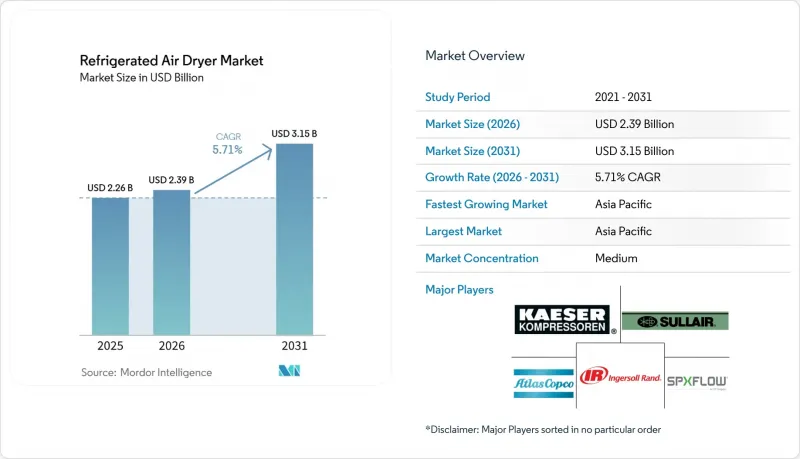
This report is Segmented by Dryer Type (Cycling Refrigerated Dryers and More), Refrigerant Type (HFC-Based and More), Cooling Method (Air-Cooled and More), Flow Capacity (Less Than 500 M3/H and More), End-User Industry (Automotive and More), and Geography (Asia-Pacific, North America, Europe, South America, and Middle East and Africa). The Market Forecasts are Provided in Terms of Value (USD).
Global Refrigerated Air Dryer Market Trends and Insights
Stringent ISO 8573 Compliance in Regulated Industries
Regulators now view compressed air as a critical utility with the same validation rigor as process water. ISO 8573-1 Class 2 requires a -40°C pressure-dew-point ceiling, forcing retirement of older cycling dryers that drift during off-load periods. Pharmaceutical aseptic lines and brewery carbonation systems are leading adopters of non-cycling and VSD models because batch losses linked to transient moisture exceed the replacement cost of advanced dryers. Annual third-party testing, costing USD 5,000-15,000 per system, and HACCP alignment in the European Union add to the compliance bill, yet most plants accept the trade-off because audit failures trigger costlier shutdowns.
Expansion of Global Discrete-Manufacturing Capacity Post-2025
Fixed-asset investment in China's discrete-manufacturing sector rose 8.3% in 2025, while India commissioned 14 new component plants aimed at "China Plus One" supply chains. ASEAN attracted USD 22 billion of electronics FDI in 2024-2025, and each new facility specified refrigerated dryers as part of Class 1 cleanroom builds. North America's semiconductor renaissance under the CHIPS and Science Act added 11 announced fabs that will each consume up to 20,000 m3/h of conditioned compressed air by 2028. Long order lead times, 24-32 weeks for large custom units, are prompting buyers to commit capital 18 months before plant start-up.
Large Upfront CAPEX for Industrial-Grade Units
Installed prices of USD 40,000-120,000 for 1,000 m3/h and above deter cash-constrained plants in emerging economies, even though moisture-related downtime can cost multiples of that over five years. Equipment-as-a-service contracts in North America let customers pay per cubic meter of dry air, but adoption outside mature markets is hamstrung by weak leasing infrastructure. Long fabrication lead times further strain working capital because buyers must post letters of credit months in advance.
Other drivers and restraints analyzed in the detailed report include:
- Energy-Efficiency Incentives and Carbon-Credit Schemes for VSD Dryers
- Growth of Hybrid Desiccant-Refrigerated Dryers for Low-Dew-Point LNG Fueling
- HFC Phasedown Under Kigali Amendment Raises Refrigerant-Compliance Cost
For complete list of drivers and restraints, kindly check the Table Of Contents.
Segment Analysis
Non-cycling models retained 38.12% refrigerated air dryer market share in 2025 on the back of simple maintenance and 20-30% lower purchase prices. They run compressors continuously, which wastes 10-15% energy when demand dips. Variable-speed (VSD) refrigerated dryers, growing at 5.92% CAGR for the forecast period (2026-2031), fine-tune motor speed to real-time load, harvesting 15-25% electricity savings that offset higher purchase prices in high-tariff regions. Cycling designs are losing momentum because start-stop spikes jeopardize ISO 8573 Class 2 compliance in pharmaceutical lines. Hybrid desiccant-refrigerated units sit at 4% of shipments yet clock 8-10% annual growth in LNG and CNG fueling, where -70°C dew points are mandatory. Atlas Copco's 2025 expansion in New York will add capacity for large VSD centrifugal trains, signaling confidence that installations above 500 m3/h will increasingly default to variable speed. The overall shift suggests a future where intelligence and speed modulation become baseline features even in mid-size systems.
VSD adoption changes aftermarket dynamics. Because variable-speed drives limit mechanical stress, expected overhaul intervals stretch from seven to nine years, lowering parts revenue per installed base. OEMs compensate by bundling cloud monitoring that sells as recurring software. Non-cycling units stay relevant under 300 m3/h where energy savings cannot justify the drive premium, especially in markets with subsidized electricity. As utility tariffs rise, however, even small workshops may migrate, compressing the price gap and eroding non-cycling leadership.
HFC-Based (R-134a and R-404A) powered 47.55% of 2025 shipments, reflecting historical safety and service familiarity. The Kigali phase-down shifts momentum to low-GWP HFOs and natural/hydrocarbon (R-290 and CO2), expected to expand at 6.11% CAGR during the forecast period (2026-2031). R-290 uptake is restrained by A3 flammability limits that cap charge sizes at 150g, whereas CO2 systems incur heavy-wall and high-pressure penalties that confine use to cold climates. HFOs such as R-513A offer a middle road but still carry a 30-40% price adder over R-134a. Europe banned R-404A in new dryers and slashed R-134a quotas, creating a bifurcated global aftermarket that inflates service costs for late adopters. Multirefrigerant platforms help customers hedge but add 8-12% to list prices and complicate inventory. The installed base will remain mixed through 2031, with retrofit and service markets mirroring local regulatory clocks.
Service technicians need new certifications to handle flammable or high-pressure media, tightening labor availability, and raising maintenance fees by 15-20% in regions where skilled refrigeration labor is scarce. Plants that switch early lock in predictable compliance costs yet must trust OEMs (Original Equipment Manufacturers) to secure long-term HFO and parts supply in a fluid regulatory landscape. Conversely, operators who delay upgrades risk sticker shock as virgin HFC allowances shrink and reclaimed stocks thin out.
Geography Analysis
Asia-Pacific held 36.11% of 2025 revenue and is set to notch a 6.63% CAGR through 2031 on the back of China's 8.3% jump in discrete-manufacturing investment and India's GMP-driven pharmaceutical retrofits. Eighteen Chinese semiconductor fabs broke ground in 2024-2025 under the "Made in China 2025" banner, each demanding 10,000-20,000 m3/h of ultra-dry air. India's Tamil Nadu and Gujarat added 14 new automotive-component plants aligned to global OEM near-shoring. ASEAN's USD 22 billion electronics FDI wave is equipping greenfield lines with advanced refrigerated dryers, while South Korea's power-price spike shortened VSD paybacks below 18 months, accelerating replacement of cycling units. Supply-side frictions remain: ELGi postponed a Kinathukadavu capacity expansion to 2027-2028 because of regulatory delays, showing infrastructure still lags demand.
In North America, CHIPS Act fabs in Arizona, Texas, and Ohio will collectively order more than 350 large-capacity dryers by 2028. Inflation Reduction Act credits cover up to 30% of VSD premiums, boosting adoption across the general industry. The United States opened 127 new CNG fueling stations during 2024-2025; every station installs a hybrid dryer for -70°C dew points. Canada's utility rebates drove a year-on-year rise in dryer-upgrade applications in 2025, while Mexico's near-shoring wave added nine automotive-component plants that replicate parent-company air-quality specs.
In Europe, growth is tempered by a mature base but re-energized by the F-Gas Regulation that bans R-404A and restricts R-134a, forcing a refrigerant rethink that inflates equipment cost 30-40%. Germany, the largest regional buyer, now exceeds 60% VSD penetration in new 500-2,000 m3/h orders because tariffs passed USD 0.15/kWh. Southern Europe leans toward air-cooled units as drought-related water tariffs doubled after 2024. Russia, under sanctions, reverse-engineers Western designs for domestic oil and gas projects but remains isolated from global OEM (original equipment manufacturer) supply chains.
South America and the Middle East and Africa share the least market share. Brazil's beverage-bottling boom added seven plants in 2024-2025, each mandating ISO Class 2 air for direct product contact. Saudi Aramco's Jafurah scheme is installing multiple 3,000 m3/h dryers certified to API 618 for sour-gas duty. South African mines postpone upgrades because rolling blackouts force capex into diesel generators, while Nigeria's currency volatility leaves the market to uncertified imports that underperform in ISO audits.
- Air & Gas Solutions
- ALMiG Kompressoren GmbH
- Atlas Copco AB
- BEKO TECHNOLOGIES
- BOGE
- Chicago Pneumatic
- Donaldson Company, Inc.
- ELGI
- Ingersoll Rand
- KAESER KOMPRESSOREN
- MIKROPOR MAKINA SAN.TIC.A.S.
- OMI Italy
- PRKER HANNIFIC CORP
- Quincy Compressor
- Risheng
- SPX Flow
- Sullair LLC
Additional Benefits:
- The market estimate (ME) sheet in Excel format
- 3 months of analyst support
TABLE OF CONTENTS
1 Introduction
- 1.1 Study Assumptions and Market Definition
- 1.2 Scope of the Study
2 Research Methodology
3 Executive Summary
4 Market Landscape
- 4.1 Market Overview
- 4.2 Market Drivers
- 4.2.1 Stringent ISO 8573 compliance in regulated industries
- 4.2.2 Expansion of global discrete-manufacturing capacity post-2025
- 4.2.3 Energy-efficiency incentives and carbon-credit schemes for VSD dryers
- 4.2.4 Growth of hybrid desiccant-refrigerated dryers for low-dew-point LNG fueling
- 4.2.5 Surge in containerised micro-breweries and craft food plants needing compact units
- 4.3 Market Restraints
- 4.3.1 Large upfront CAPEX for industrial-grade units
- 4.3.2 HFC phasedown (Kigali Amendment) raising refrigerant-compliance cost
- 4.3.3 Volatility in stainless-steel prices impacting BOM costs
- 4.4 Value Chain Analysis
- 4.5 Porter's Five Forces
- 4.5.1 Bargaining Power of Suppliers
- 4.5.2 Bargaining Power of Buyers
- 4.5.3 Threat of New Entrants
- 4.5.4 Threat of Substitutes
- 4.5.5 Competitive Rivalry
5 Market Size and Growth Forecasts (Value)
- 5.1 By Dryer Type
- 5.1.1 Cycling Refrigerated Dryers
- 5.1.2 Non-Cycling Refrigerated Dryers
- 5.1.3 Variable-Speed (VSD) Refrigerated Dryers
- 5.1.4 Hybrid Desiccant-Refrigerated Dryers
- 5.2 By Refrigerant Type
- 5.2.1 HFC-Based (R-134a and R-404A)
- 5.2.2 HFO-Based (R-1234ze and R-513A)
- 5.2.3 Natural/Hydrocarbon (R-290 and CO2)
- 5.3 By Cooling Method
- 5.3.1 Air-Cooled
- 5.3.2 Water-Cooled
- 5.4 By Flow Capacity
- 5.4.1 Less than 500 m3/h
- 5.4.2 500-2,000 m3/h
- 5.4.3 Greater than 2,000 m3/h
- 5.5 By End-user Industry
- 5.5.1 Manufacturing and General Industrial
- 5.5.2 Food and Beverage
- 5.5.3 Pharmaceuticals and Healthcare
- 5.5.4 Oil and Gas and Petrochemical
- 5.5.5 Automotive
- 5.5.6 Electronics and Semiconductor
- 5.5.7 Other Industries
- 5.6 By Geography
- 5.6.1 Asia-Pacific
- 5.6.1.1 China
- 5.6.1.2 India
- 5.6.1.3 Japan
- 5.6.1.4 South Korea
- 5.6.1.5 ASEAN Countries
- 5.6.1.6 Rest of Asia-Pacific
- 5.6.2 North America
- 5.6.2.1 United States
- 5.6.2.2 Canada
- 5.6.2.3 Mexico
- 5.6.3 Europe
- 5.6.3.1 Germany
- 5.6.3.2 United Kingdom
- 5.6.3.3 France
- 5.6.3.4 Italy
- 5.6.3.5 Spain
- 5.6.3.6 Russia
- 5.6.3.7 Rest of Europe
- 5.6.4 South America
- 5.6.4.1 Brazil
- 5.6.4.2 Argentina
- 5.6.4.3 Rest of South America
- 5.6.5 Middle East and Africa
- 5.6.5.1 Saudi Arabia
- 5.6.5.2 United Arab Emirates
- 5.6.5.3 South Africa
- 5.6.5.4 Nigeria
- 5.6.5.5 Rest of Middle East and Africa
- 5.6.1 Asia-Pacific
6 Competitive Landscape
- 6.1 Market Concentration
- 6.2 Strategic Moves
- 6.3 Market Share(%)/Ranking Analysis
- 6.4 Company Profiles (includes Global Overview, Market Overview, Core Segments, Financials, Strategic Information, Products and Services, and Recent Developments)
- 6.4.1 Air & Gas Solutions
- 6.4.2 ALMiG Kompressoren GmbH
- 6.4.3 Atlas Copco AB
- 6.4.4 BEKO TECHNOLOGIES
- 6.4.5 BOGE
- 6.4.6 Chicago Pneumatic
- 6.4.7 Donaldson Company, Inc.
- 6.4.8 ELGI
- 6.4.9 Ingersoll Rand
- 6.4.10 KAESER KOMPRESSOREN
- 6.4.11 MIKROPOR MAKINA SAN.TIC.A.S.
- 6.4.12 OMI Italy
- 6.4.13 PRKER HANNIFIC CORP
- 6.4.14 Quincy Compressor
- 6.4.15 Risheng
- 6.4.16 SPX Flow
- 6.4.17 Sullair LLC
7 Market Opportunities and Future Outlook
- 7.1 White-space and Unmet-Need Assessment

