PUBLISHER: Mordor Intelligence | PRODUCT CODE: 2062287

PUBLISHER: Mordor Intelligence | PRODUCT CODE: 2062287
Cold Gas Spray Coating - Market Share Analysis, Industry Trends & Statistics, Growth Forecasts (2026 - 2031)
According to Mordor Intelligence, the cold gas spray coating market size is expected to grow from USD 1.42 billion in 2025 to USD 1.48 billion in 2026 and is forecast to reach USD 1.83 billion by 2031 at 4.34% CAGR over 2026-2031.
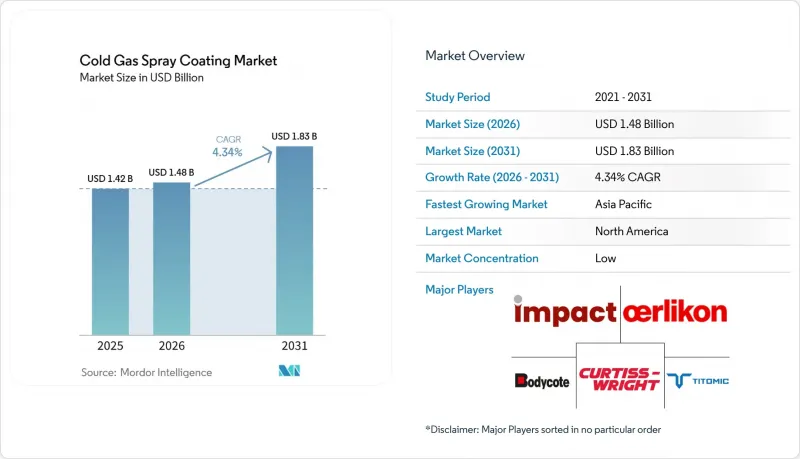
This report is Segmented by Substrate (Metals, Ceramics, Polymers and Plastics, and Other Substrates), Process (High-Pressure Cold Spray and Low/Medium-Pressure Cold Spray), End-User Industry (Aerospace and Defense, Automotive, and More), and Geography (Asia-Pacific, North America, Europe, South America, and Middle-East and Africa). The Market Forecasts are Provided in Terms of Value (USD).
Global Cold Gas Spray Coating Market Trends and Insights
Adoption Across Aging Military Fleets
Cold spray technology is now used to repair aluminum and magnesium components such as gearboxes, wing skins, and hull panels, which previously required depot-level welding or replacement. The U.S. Navy applies this method to F/A-18 and MV-22 structures following MIL-STD-3021 certification for airworthiness, reducing turnaround times from months to weeks. Containerized systems, developed by the University of Tennessee and the Army Research Laboratory, enable in-theater restoration, improving fleet readiness without the need for retrograde logistics. Equipment suppliers are increasingly bundling operator training with powder supply to accelerate field adoption.
Qualification of CSAM for In-Orbit Satellite Repair
Titomic and NASA are focusing on bus and antenna components affected by micrometeorite impacts, where molten repair methods are unsafe in microgravity. The ASTROBEAT experiment aboard the ISS demonstrated the viability of solid-state bonding, and DNV's April 2026 qualification has provided underwriters with the confidence to finance robotic servicing campaigns. Successful deployment of this technology could extend satellite service life to 25 years, reducing the frequency of constellation replacements.
Limited Material Compatibility vs. HVOF/Plasma
Cold spray technology bonds ductile metals effectively but performs poorly with materials like WC-Co and alumina, where porosities exceed 15%, and bond strength falls below 30 MPa. SAE AMS7057 outlines these limitations, prompting users to adopt hybrid systems that combine HVOF torches with cold spray guns. However, the capital investment for such systems exceeds USD 1 million, limiting adoption to large service bureaus.
Other drivers and restraints analyzed in the detailed report include:
- Demand for High-Performance Low-Heat Coatings on EV Power Electronics
- HEA and Nanostructured Powders Enabling Next-Gen Functionality
- Global Helium-Supply Volatility
For complete list of drivers and restraints, kindly check the Table Of Contents.
Segment Analysis
Metals accounted for 66.12% of the 2025 cold gas spray coating market share, driven by aluminum grades 6061, 7075, and 2024 that bond effectively at nitrogen velocities. Copper coatings for data-center CPUs provide 400 W/m*K thermal paths without oxidation, enhancing the market's role in electronics thermal management. Titanium and nickel alloys contribute to high-margin propulsion and turbine applications; Northrop Grumman's cold-sprayed thrust chamber passed hot-fire qualification without weld stress.
Polymers and plastics are growing at a 5.32% CAGR through 2031, with PEEK and carbon-fiber housings incorporating aluminum skins for EMI shielding. Water-cooled injectors and gas streams below 150 °C prevent substrate distortion, enabling lightweight enclosures to gain traction in the cold gas spray coating market. Ceramics and glass remain niche due to their brittleness, but are used in busbar and tooling repairs where moderate load adhesion is sufficient.
Geography Analysis
North America held 39.22% of 2025 revenue, supported by Department of Defense budgets and NASA's space-repair programs. The Dyess Air Force Base center has standardized B-1B repairs for global replication. Titomic's AS9100-certified line in Alabama supplies Boeing and Northrop Grumman, while CenterLine and Triton collaborate on low-SWaP units for forward repair. Mexico's EV supply chain is adopting polymer metallization, though on a smaller scale.
Asia-Pacific is expected to grow at a 5.23% CAGR through 2031. Japan's Plasma Giken achieves 30 MPa bond targets for LNG pump maintenance. China is localizing turbine-blade renewals to reduce reliance on Western MROs. South Korea is integrating copper spraying into EV inverter production lines. India and ASEAN countries are showing initial demand in the automotive and power sectors, but require local helium alternatives for broader adoption.
Europe maintains a steady share, supported by aerospace and automotive clusters. The Royal Netherlands Aerospace Center purchased a USD 1.7 million Titomic cell in March 2026. Germany's Fraunhofer is researching HEA powders for turbine shrouds, while RINA's laboratory in Italy provides third-party validation, accelerating OEM processes. South America and the Middle-East and Africa are experiencing niche growth, driven by offshore oil opportunities in Brazil and corrosion-prone petrochemical assets in the Gulf.
- Bodycote plc
- CenterLine (Windsor) Limited
- CSAT
- Curtiss-Wright Corporation
- Dycomet Europe
- Flame Spray Technologies BV
- HAI Inc.
- Hannecard Roller Coatings, Inc
- Impact Innovations GmbH
- Linde PLC
- OC Oerlikon Management AG
- Plasma Giken Co., Ltd.
- TITOMIC
- Turbine Surface Technologies
- VRC Metal Systems
Additional Benefits:
- The market estimate (ME) sheet in Excel format
- 3 months of analyst support
TABLE OF CONTENTS
1 Introduction
- 1.1 Study Assumptions and Market Definition
- 1.2 Scope of the Study
2 Research Methodology
3 Executive Summary
4 Market Landscape
- 4.1 Market Overview
- 4.2 Market Drivers
- 4.2.1 Adoption across ageing military fleets
- 4.2.2 Qualification of CSAM for in-orbit satellite repair
- 4.2.3 Demand for high-performance low-heat coatings on EV power-electronics
- 4.2.4 HEA and nanostructured powders enabling next-gen functionality
- 4.2.5 Helium-recovery and N2-blend systems slashing operating cost
- 4.3 Market Restraints
- 4.3.1 Limited material compatibility vs. HVOF/plasma
- 4.3.2 Global helium-supply volatility
- 4.3.3 Qualification lag for safety-critical parts
- 4.4 Value Chain Analysis
- 4.5 Porter's Five Forces
- 4.5.1 Bargaining Power of Suppliers
- 4.5.2 Bargaining Power of Buyers
- 4.5.3 Threat of New Entrants
- 4.5.4 Threat of Substitutes
- 4.5.5 Competitive Rivalry
5 Market Size and Growth Forecasts
- 5.1 By Substrate
- 5.1.1 Metals
- 5.1.2 Ceramics
- 5.1.3 Polymers and Plastics
- 5.1.4 Other Substrates
- 5.2 By Process
- 5.2.1 High-Pressure Cold Spray (HPCS)
- 5.2.2 Low/Medium-Pressure Cold Spray (L/MPCS)
- 5.3 By End-user Industry
- 5.3.1 Aerospace and Defense
- 5.3.2 Automotive
- 5.3.3 Oil and Gas
- 5.3.4 Medical
- 5.3.5 Electronics
- 5.3.6 Other End-user Industries
- 5.4 By Geography
- 5.4.1 Asia-Pacific
- 5.4.1.1 China
- 5.4.1.2 India
- 5.4.1.3 Japan
- 5.4.1.4 South Korea
- 5.4.1.5 Rest of Asia-Pacific
- 5.4.2 North America
- 5.4.2.1 United States
- 5.4.2.2 Canada
- 5.4.2.3 Mexico
- 5.4.3 Europe
- 5.4.3.1 Germany
- 5.4.3.2 United Kingdom
- 5.4.3.3 France
- 5.4.3.4 Italy
- 5.4.3.5 Rest of Europe
- 5.4.4 South America
- 5.4.4.1 Brazil
- 5.4.4.2 Argentina
- 5.4.4.3 Rest of South America
- 5.4.5 Middle-East and Africa
- 5.4.5.1 Saudi Arabia
- 5.4.5.2 South Africa
- 5.4.5.3 Rest of Middle-East and Africa
- 5.4.1 Asia-Pacific
6 Competitive Landscape
- 6.1 Market Concentration
- 6.2 Strategic Moves
- 6.3 Market Share (%)/Ranking Analysis
- 6.4 Company Profiles (includes Global level Overview, Market level overview, Core Segments, Financials as available, Strategic Information, Products and Services, and Recent Developments)
- 6.4.1 Bodycote plc
- 6.4.2 CenterLine (Windsor) Limited
- 6.4.3 CSAT
- 6.4.4 Curtiss-Wright Corporation
- 6.4.5 Dycomet Europe
- 6.4.6 Flame Spray Technologies BV
- 6.4.7 HAI Inc.
- 6.4.8 Hannecard Roller Coatings, Inc
- 6.4.9 Impact Innovations GmbH
- 6.4.10 Linde PLC
- 6.4.11 OC Oerlikon Management AG
- 6.4.12 Plasma Giken Co., Ltd.
- 6.4.13 TITOMIC
- 6.4.14 Turbine Surface Technologies
- 6.4.15 VRC Metal Systems
7 Market Opportunities and Future Outlook
- 7.1 White-space and Unmet-Need Assessment

