PUBLISHER: Mordor Intelligence | PRODUCT CODE: 2062342

PUBLISHER: Mordor Intelligence | PRODUCT CODE: 2062342
Oilfield Scale Inhibitor - Market Share Analysis, Industry Trends & Statistics, Growth Forecasts (2026 - 2031)
According to Mordor Intelligence, the oilfield scale inhibitor market size is expected to increase from USD 1.59 billion in 2025 to USD 2.52 billion in 2026 and reach USD 3.46 billion by 2031, growing at a CAGR of 6.02% over 2026-2031.
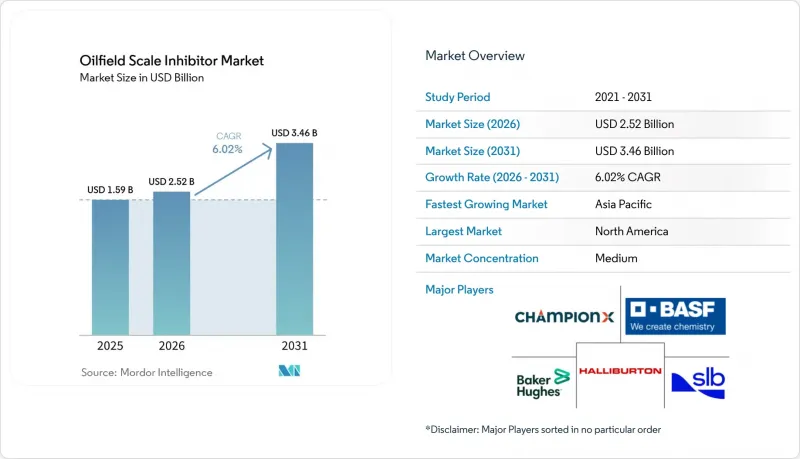
This report is Segmented by Type (Phosphonates, Carboxylates/Acrylics, Polymeric, Biodegradable, and Organophosphates), Application (Downhole Prevention, Tubing Protection, Surface Treatment, Pipeline Control, Water Injection, and Produced-Water Reinjection), and Geography (Asia-Pacific, North America, Europe, South America, and Middle-East and Africa). Market Forecasts are Provided in Value (USD).
Global Oilfield Scale Inhibitor Market Trends and Insights
Growing Demand for Scale Control in Mature Fields
Operators face increasing challenges in managing the growing volumes of brine, which have a high potential for scaling, as mature reservoirs worldwide experience rising water cuts. In the Permian Basin, operators generate significant volumes of produced water daily, with water-to-oil ratios ranging from 3:1 to 12:1. As they reinject and recycle this water, they inadvertently concentrate carbonate and sulfate ions, leading to a heightened reliance on advanced squeeze programs. While the Asia-Pacific region has grappled with a sustained production decline, intensifying workover and Enhanced Oil Recovery (EOR) activities, Norway's newly tapped North Sea fields have adopted a dual approach - pairing 18-24 month squeeze cycles with online residual analyzers to curtail downtime on floating facilities. Given these dynamics, the oilfield scale inhibitor market has emerged as a cost-effective safeguard, protecting against potential million-dollar daily losses stemming from scale-induced outages.
Expansion of Offshore Exploration and Pipeline Activities
By 2025, Brazil's pre-salt output surged, reaching millions of barrels per day. Each new FPSO now features inhibitor packages specifically designed for CO2-rich fluids, spanning 18-kilometer tiebacks. CNOOC increased its production, achieving millions of barrels of oil equivalent per day. The company adopted seawater injection, a strategy that increases the risk of calcium-sulfate scaling in subsea manifolds. In the West-African region, deepwater systems face similar challenges, relying on long-residence squeeze chemistries that are expected to enhance revenue in the oilfield scale inhibitor market during the forecast period of 2026-2031.
Volatile Crude Prices Curbing Chemical Budgets
Brent prices are projected to peak in Q2 2026 before declining in the following year. This significant drop has historically led to a reduction in discretionary chemical spending. In response, North American independents are already postponing non-critical squeezes, putting pressure on premium suppliers in the oilfield scale inhibitor market.
Other drivers and restraints analyzed in the detailed report include:
- Adoption of EOR Techniques Elevating Chemical Consumption
- Growth in Unconventional Oil Resources
- Tightening Discharge Regulations on Phosphorus and Heavy Metals
For complete list of drivers and restraints, kindly check the Table Of Contents.
Segment Analysis
In 2025, phosphonates, with a robust thermal endurance and a calcium tolerance exceeding 1,000 mg/L, captured a dominant 45.82% share of the oilfield scale inhibitor market, growing at an annual rate of 6.83% CAGR from 2026 to 2031. By 2026, ongoing seawater-injection projects in the Middle-East, increasingly favoring aminomethylene blends at sub-ppm treatment rates, will support this growth. While carboxylates and acrylics are gaining traction - driven by EPA and REACH pressures to curtail phosphorus discharge - these alternatives often require double-digit ppm dosages. This necessity has limited their adoption in deepwater Brazil, where chemical logistics heavily impact total costs. In produced-water reinjection networks, where managing suspended solids alongside scaling ions is vital, polymeric and phosphorus-tagged hybrids are becoming more popular. Notably, PETRONAS utilizes multifunctional dispersants throughout its extensive pipeline network. Although biodegradable formulations occupy a niche segment, they are witnessing the fastest growth rate in percentage terms. Operators in the North Sea are investing in products classified under OSPAR's "Yellow C" designation, highlighting the market's environmental focus.
For wells facing challenges like hydrogen sulfide or iron co-production, organophosphates and synergistic blends provide solutions where traditional single-chemistry methods falter. Suppliers are trialing tracer-tagged molecules to enhance efficiency. Detectable via fiber optics, these molecules allow operators to accurately map downhole distribution and reduce overtreatment, potentially boosting the market share for these specialized solutions. The landscape is intricate: while global giants register REACH dossiers, regional formulators champion classic phosphonates, benefiting from lighter oversight. As environmental regulations tighten and operational temperatures rise, the demand for diverse chemistries ensures a balanced market, accommodating both established and emerging inhibitor families during the forecast period of 2026-2031.
Geography Analysis
In 2025, North America commanded a 36.11% share of the oilfield scale inhibitor market, driven by activities converging in shale regions, the offshore Gulf, and Vaca Muerta. Continuous chemical dosing was essential for the produced-water stream in the Permian Basin. Operators in the Appalachian shale, facing price pressures and extended squeeze intervals, are resulting in mixed dynamics across the region. While North America's oilfield scale inhibitor market was on a steady growth trajectory during the forecast period 2026-2031, fluctuations in crude prices posed challenges to short-term budgets. In Canada, oil sands operations, requiring inhibitors compatible with hot bitumen, experienced consistent but slower unit growth.
Asia-Pacific led as the fastest-growing region, registering a 6.79% CAGR during the forecast period 2026-2031. China's offshore expansions, Indonesia's polymer floods, and Malaysia's burgeoning pipeline network spurred heightened chemical usage. Despite annual declines in ASEAN fields prompting workovers and increased brine pH and scaling risks, the oilfield scale inhibitor market's outlook remained optimistic. CNOOC's production boost in the base year 2025, alongside seawater injections in Bohai Bay, amplified demand. Furthermore, the collaboration between ONGC and Reliance in India's KG basin unlocked volumes necessitating high-salinity-tolerant chemicals. PETRONAS's two-decade extension of the PM3 project underscored the enduring chemical demand in Southeast Asia.
Europe experienced modest growth yet sustained stable consumption. In the base year 2025, Norway's seven newly tapped fields favored high-performance inhibitors, particularly those adept against electrified subsea systems. The United Kingdom's decommissioning activities spurred sporadic demand for well-preservation chemicals, offsetting the nation's gradual production declines. Russia's market, while sizable, remained opaque due to sanctions and leaned predominantly on domestic phosphonate production. The Middle-East, though not leading in percentage growth, was poised for the most substantial absolute volume increase. Industry giants such as Saudi Aramco, ADNOC, and Kuwait Oil Company made significant investments in injection and enhanced oil recovery (EOR) infrastructure. In South America, Brazil emerged as a focal point, particularly in regions outside Argentina. Petrobras, capitalizing on its production in the base year 2025, deployed acid-stable inhibitors specifically designed for CO2-rich pre-salt fluids.
- Afton Chemical
- Arkema
- Ashland
- Baker Hughes Company
- BASF
- ChampionX
- Clariant
- Dow
- Halliburton
- Huntsman
- Innospec
- Italmatch Oil & Gas
- Kemira
- LANXESS
- SLB (Schlumberger)
- SNDB
- SNF
- Solenis
- Solvay
- Stepan Company
- Thermax Limited
Additional Benefits:
- The market estimate (ME) sheet in Excel format
- 3 months of analyst support
TABLE OF CONTENTS
1 Introduction
- 1.1 Study Assumptions and Market Definition
- 1.2 Scope of the Study
2 Research Methodology
3 Executive Summary
4 Market Landscape
- 4.1 Market Overview
- 4.2 Market Drivers
- 4.2.1 Growing demand for scale control in mature fields
- 4.2.2 Expansion of offshore exploration and pipeline activities
- 4.2.3 Adoption of EOR techniques elevating chemical consumption
- 4.2.4 Growth in unconventional oil resources
- 4.2.5 Real-time digital inhibitor dosing and monitoring
- 4.2.6 Shift toward produced-water reinjection in water-scarce regions
- 4.3 Market Restraints
- 4.3.1 Volatile crude prices curbing chemical budgets
- 4.3.2 Tightening discharge regulations on phosphorus and heavy metals
- 4.3.3 All-electric subsea systems reducing chemical injection points
- 4.3.4 Persistent supply-chain risk for phosphonate intermediates
- 4.4 Value Chain Analysis
- 4.5 Porter's Five Forces
- 4.5.1 Threat of New Entrants
- 4.5.2 Bargaining Power of Buyers
- 4.5.3 Bargaining Power of Suppliers
- 4.5.4 Threat of Substitutes
- 4.5.5 Competitive Rivalry
5 Market Size and Growth Forecasts (Value)
- 5.1 By Type
- 5.1.1 Phosphonates
- 5.1.2 Carboxylates/Acrylics
- 5.1.3 Polymeric/Phosphorus-tagged Polymers
- 5.1.4 Biodegradable and Green Inhibitors
- 5.1.5 Organophosphates and Synergistic Blends
- 5.2 By Application
- 5.2.1 Downhole Scale Prevention (Squeeze)
- 5.2.2 Tubing and Casing Protection
- 5.2.3 Surface Facility Treatment
- 5.2.4 Pipeline and Flowline Scale Control
- 5.2.5 Water-Injection Systems
- 5.2.6 Produced-Water Reinjection and Disposal
- 5.3 By Geography
- 5.3.1 Asia-Pacific
- 5.3.1.1 China
- 5.3.1.2 India
- 5.3.1.3 Japan
- 5.3.1.4 South Korea
- 5.3.1.5 ASEAN Countries
- 5.3.1.6 Rest of Asia-Pacific
- 5.3.2 North America
- 5.3.2.1 United States
- 5.3.2.2 Canada
- 5.3.2.3 Mexico
- 5.3.3 Europe
- 5.3.3.1 Germany
- 5.3.3.2 United Kingdom
- 5.3.3.3 France
- 5.3.3.4 Italy
- 5.3.3.5 Spain
- 5.3.3.6 Russia
- 5.3.3.7 Nordic Countries
- 5.3.3.8 Rest of Europe
- 5.3.4 South America
- 5.3.4.1 Brazil
- 5.3.4.2 Argentina
- 5.3.4.3 Rest of South America
- 5.3.5 Middle-East and Africa
- 5.3.5.1 Saudi Arabia
- 5.3.5.2 South Africa
- 5.3.5.3 Rest of Middle-East and Africa
- 5.3.1 Asia-Pacific
6 Competitive Landscape
- 6.1 Market Concentration
- 6.2 Strategic Moves
- 6.3 Market Share(%)/Ranking Analysis
- 6.4 Company Profiles {(includes Global level Overview, Market level overview, Core Segments, Financials as available, Strategic Information, Products and Services, and Recent Developments)}
- 6.4.1 Afton Chemical
- 6.4.2 Arkema
- 6.4.3 Ashland
- 6.4.4 Baker Hughes Company
- 6.4.5 BASF
- 6.4.6 ChampionX
- 6.4.7 Clariant
- 6.4.8 Dow
- 6.4.9 Halliburton
- 6.4.10 Huntsman
- 6.4.11 Innospec
- 6.4.12 Italmatch Oil & Gas
- 6.4.13 Kemira
- 6.4.14 LANXESS
- 6.4.15 SLB (Schlumberger)
- 6.4.16 SNDB
- 6.4.17 SNF
- 6.4.18 Solenis
- 6.4.19 Solvay
- 6.4.20 Stepan Company
- 6.4.21 Thermax Limited
7 Market Opportunities and Future Outlook
- 7.1 White-space and Unmet-Need Assessment
- 7.2 Smart inhibitors with embedded fibre-optic sensing

