PUBLISHER: Mordor Intelligence | PRODUCT CODE: 2062349

PUBLISHER: Mordor Intelligence | PRODUCT CODE: 2062349
Flat Carbon Steel - Market Share Analysis, Industry Trends & Statistics, Growth Forecasts (2026 - 2031)
According to Mordor Intelligence, the flat carbon steel market size is projected to be USD 661.67 billion in 2025, USD 700.25 billion in 2026, and reach USD 929.60 billion by 2031, growing at a CAGR of 5.83% from 2026 to 2031.
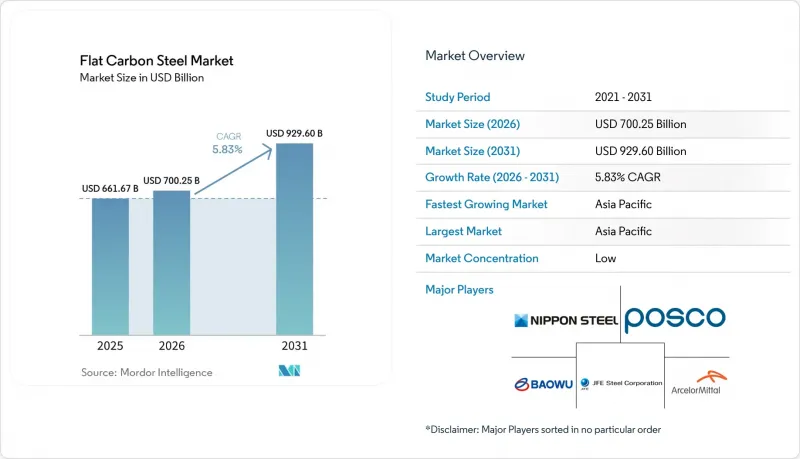
This report is Segmented by Product Type (Hot Rolled Coil, Cold Rolled Coil, and More), Thickness (Ultra-Thin (Less Than 0. 8 Mm) and More), Production Route (Basic Oxygen Furnace (BOF) and More), End-Use Application (Home Appliances and More), and Geography (Asia-Pacific, North America, Europe, South America, and Middle-East and Africa). The Market Forecasts are Provided in Terms of Value (USD).
Global Flat Carbon Steel Market Trends and Insights
Rising Demand in Automotive and Shipbuilding
Automotive electrification maintains steel content at approximately 1,200 kilograms per vehicle, including up to 100 kilograms of electrical steel, sustaining cold-rolled coil demand despite a plateau in unit production. Asian shipyards face three-year backlogs for liquefied natural gas (LNG) carriers, requiring high-toughness plate grades and premium coatings, which support pricing for shipbuilding steel. In 2024, India added 65 million white goods, increasing galvanized coil volumes, though thinner gauges reduced per-unit steel usage. China's focus on improving scrap quality following the Hong Kong International Convention for the Safe and Environmentally Sound Recycling of Ships is raising feed costs for electric arc furnace (EAF) mills supplying automotive stampers. South Korea's Hyper-Gap Vision 2040 program is driving demand for advanced plate in liquefied carbon dioxide (CO2) carriers and dual-fuel ships.
Global Infrastructure and Appliance Build-Out
U.S. construction starts reached an annualized USD 1.24 trillion in January 2026, with nearly USD 20 billion attributed to just three megaprojects, introducing volatility to the flat carbon steel market. India's INR 1,110 million (USD 11.82 million) infrastructure pipeline supports a projected 252 million tons of finished steel demand by fiscal year (FY) 2034. The Association of Southeast Asian Nations (ASEAN)'s USD 3.1 trillion development program is boosting regional coil flows under the Regional Comprehensive Economic Partnership (RCEP) while reducing reliance on Chinese imports. Heating, ventilation, and air conditioning (HVAC) shipments declined by 20% in 2025 to 7.7 million units, negatively impacting sheet volumes for cabinets and ducts. In the Middle East, demand remains steady at approximately 50 million tons, driven by projects like NEOM and Vision 2030, which drive heavy plate and structural beam consumption.
Volatile Iron-Ore and Coking-Coal Prices
U.S. metallurgical coal exports are projected to rise to 53.4 million short tons by 2026, affecting global coke supplies and increasing furnace costs. Disruptions in Brazilian mining operations and port delays in Australia have caused significant monthly fluctuations in iron-ore prices, impacting mill working capital. Spot coking coal prices increased following shipping disruptions in the Middle East, further widening the cost difference between blast furnace (BF) and electric arc furnace (EAF) production routes. Additionally, blast furnace producers are facing increasing carbon fees, while EAF mills are dealing with scrap price increases, with busheling reaching USD 422.50 per gross ton. Higher diesel and power tariffs have also increased freight and melting costs, reducing profit margins across the Flat carbon steel industry.
Other drivers and restraints analyzed in the detailed report include:
- Offshore Wind Tower Build-Out
- OEM Scope-3 Goals Driving Green Flat Steel
- Persistent Global Over-Capacity
For complete list of drivers and restraints, kindly check the Table Of Contents.
Segment Analysis
Galvanized sheet and coil are projected to grow at a rate of 6.47% by 2031. Hot rolled coil accounted for 32.89% of the flat carbon steel market share in 2025, supported by demand for structural beams, ship plates, and automotive panels. The market size for galvanized products is expected to expand alongside Asia's shipbuilding recovery and India's growing appliance industry. Cold-rolled coil, while essential for automotive stampings, faces substitution challenges due to gauge-thinning alternatives. Electro-galvanized sheet maintains a small but steady niche in automotive exposed panels. Other coated flat steel products benefit from growth in food packaging and solar-roof initiatives.
Mills with in-house galvanizing and continuous annealing lines have a competitive advantage as customers prioritize certified coating weights. China's sufficient plate capacity enables shipyards to demand higher standards, creating challenges for new market entrants. ArcelorMittal has invested EUR 500 million (USD 585.5 million) in a French electrical-steel line to supply electric vehicle (EV) motors and diversify into silicon grades. Premium ship plates command higher prices due to requirements for liquefied natural gas (LNG) containment and cryogenic properties. Appliance manufacturers pay a premium for tighter thickness tolerances, which digital-twin mills can reliably produce.
Light-gauge coil under 2 millimeters (mm) is expected to grow at 6.62%, driven by the adoption of 0.4-0.6 mm panels in refrigerators and washing machines without compromising rigidity. Medium-gauge steel held a 41.92% share of the flat carbon steel market in 2025, owing to its versatility in beams, automotive chassis, and offshore monopiles. The market benefits from digital roll models that reduce gauge spreads to below 0.5%, enabling appliance original equipment manufacturers (OEMs) to source niche widths domestically. Ultra-thin strips below 0.8 mm support applications in packaging and EV laminations.
Heavy plates over 10 mm are essential for wind towers and shipbuilding but remain capacity-constrained, giving pricing power to qualified mills. U.S. utility projects are driving medium-gauge demand, while multifamily housing supports light-gauge steel for studs. Although Chinese overcapacity pressures mid-gauge margins, quality improvements are opening export opportunities. Data indicates that appliances produced in Asia require fewer kilograms of steel per unit, but rising production volumes offset material reductions, sustaining tonnage growth.
Geography Analysis
Asia-Pacific accounted for 44.37% of the flat carbon steel market in 2025 and is projected to grow at a rate of 6.72% through 2031. This growth is supported by India's INR 1,110 million (USD 11.82 million) infrastructure pipeline and the expansion of manufacturing in ASEAN countries, which sustains demand for steel coils. China's 1.5:1 capacity-swap rule reduced crude steel output to 960.81 million tonnes, yet the country remains the lowest-cost supplier, stabilizing regional prices. India's per-capita steel consumption stands at 93 kg, significantly below the global average of 219 kg, indicating substantial growth potential for the flat carbon steel market. Meanwhile, Japan and South Korea are focusing on high-value products such as ship plates and automotive electrical steel, supported by government-backed innovation funds.
North America emphasizes decarbonization and reshoring efforts. Nippon Steel's USD 14.9 billion acquisition of U.S. Steel includes an additional USD 11 billion capital plan aimed at modernizing hot-strip mills and increasing DRI capacity. Construction starts reached an annualized USD 1.24 trillion in January 2026, though growth depends on sporadic megaprojects. Section 122 tariffs have increased utilization rates to 79.1%, but they also raise costs for downstream fabricators. Canada and Mexico benefit from near-shoring vehicle assembly operations but remain vulnerable to shifts in U.S. policies.
Europe is navigating carbon regulations and high energy costs. ArcelorMittal's Dunkirk EAF and Mardyck electrical steel line highlight the transition to scrap-based, low-carbon steel production. Steel demand in the EU and UK is expected to recover by 3.2% in 2026, driven by offshore wind projects requiring up to 25 million tonnes of steel plate. Germany and France are investing in grid upgrades and electric vehicle value chains. Meanwhile, CIS steel supply is being redirected to Asia due to sanctions. South America's growth is tied to Brazilian iron ore exports and local construction activities. In the Middle East, efforts to achieve self-sufficiency are evident, with Emirates Steel Arkan increasing capacity to 5.5 million tonnes. Gulf mills are positioning themselves to export green-premium steel plates to Europe, benefiting from CBAM relief measures.
- AM/NS India
- ARCELORMITTAL
- BlueScope Steel Limited.
- China BaoWu Steel Group Corp. Ltd.
- Cleveland-Cliffs Inc.
- Gerdau S/A
- Hyundai Steel
- JFE Steel Corporation
- JSW
- LIBERTY Steel Group
- NIPPON STEEL CORPORATION
- Nucor Corporation
- POSCO
- SAIL
- Severstal
- SSAB AB
- Tata Steel
- Thyssenkrupp Steel Europe
- United States Steel Corporation
- voestalpine Stahl GmbH
Additional Benefits:
- The market estimate (ME) sheet in Excel format
- 3 months of analyst support
TABLE OF CONTENTS
1 Introduction
- 1.1 Study Assumptions and Market Definition
- 1.2 Scope of the Study
2 Research Methodology
3 Executive Summary
4 Market Landscape
- 4.1 Market Overview
- 4.2 Market Drivers
- 4.2.1 Rising demand in automotive and shipbuilding
- 4.2.2 Global infrastructure and appliance build-out
- 4.2.3 Cost-efficient high-strength grades in construction
- 4.2.4 Offshore-wind tower build-out (heavy-gauge plate)
- 4.2.5 OEM Scope-3 goals driving 'green flat steel'
- 4.2.6 Digital-twin yield optimisation (scrap-cut)
- 4.3 Market Restraints
- 4.3.1 Volatile iron-ore and coking-coal prices
- 4.3.2 Stringent carbon-emission regulations
- 4.3.3 Persistent global over-capacity
- 4.3.4 Scarce prime scrap for EAF decarbonisation
- 4.4 Value Chain Analysis
- 4.5 Porter's Five Forces
- 4.5.1 Bargaining Power of Suppliers
- 4.5.2 Bargaining Power of Buyers
- 4.5.3 Threat of New Entrants
- 4.5.4 Threat of Substitutes
- 4.5.5 Competitive Rivalry
5 Market Size and Growth Forecasts (Value)
- 5.1 By Product Type
- 5.1.1 Hot Rolled Coil
- 5.1.2 Cold Rolled Coil
- 5.1.3 Galvanized Sheet/Coil
- 5.1.4 Electro-Galvanized Sheet
- 5.1.5 Other Coated or Treated Flat Steel
- 5.2 By Thickness
- 5.2.1 Ultra-Thin (Less than 0.8 mm)
- 5.2.2 Light-Gauge (Less than 2 mm)
- 5.2.3 Medium-Gauge (2-10 mm)
- 5.2.4 Heavy-Gauge (Greater than 10 mm)
- 5.3 By Production Route
- 5.3.1 Basic Oxygen Furnace (BOF)
- 5.3.2 Electric Arc Furnace (EAF)
- 5.3.3 Hydrogen-DRI + EAF
- 5.4 By End-Use Application
- 5.4.1 Construction and Infrastructure
- 5.4.2 Automotive and Transportation
- 5.4.3 Home Appliances
- 5.4.4 Machinery and Industrial Equipment
- 5.4.5 Renewable Energy and Power Equipment
- 5.4.6 Shipbuilding and Marine
- 5.4.7 Other Applications
- 5.5 By Geography
- 5.5.1 Asia-Pacific
- 5.5.1.1 China
- 5.5.1.2 India
- 5.5.1.3 Japan
- 5.5.1.4 South Korea
- 5.5.1.5 ASEAN Countries
- 5.5.1.6 Rest of Asia-Pacific
- 5.5.2 North America
- 5.5.2.1 United States
- 5.5.2.2 Canada
- 5.5.2.3 Mexico
- 5.5.3 Europe
- 5.5.3.1 Germany
- 5.5.3.2 United Kingdom
- 5.5.3.3 France
- 5.5.3.4 Italy
- 5.5.3.5 Spain
- 5.5.3.6 Russia
- 5.5.3.7 Nordic Countries
- 5.5.3.8 Rest of Europe
- 5.5.4 South America
- 5.5.4.1 Brazil
- 5.5.4.2 Argentina
- 5.5.4.3 Rest of South America
- 5.5.5 Middle East and Africa
- 5.5.5.1 Saudi Arabia
- 5.5.5.2 South Africa
- 5.5.5.3 Rest of Middle East and Africa
- 5.5.1 Asia-Pacific
6 Competitive Landscape
- 6.1 Market Concentration
- 6.2 Strategic Moves
- 6.3 Market Share(%)/Ranking Analysis
- 6.4 Company Profiles {(includes Global level Overview, Market level overview, Core Segments, Financials as available, Strategic Information, Products and Services, and Recent Developments)}
- 6.4.1 AM/NS India
- 6.4.2 ARCELORMITTAL
- 6.4.3 BlueScope Steel Limited.
- 6.4.4 China BaoWu Steel Group Corp. Ltd.
- 6.4.5 Cleveland-Cliffs Inc.
- 6.4.6 Gerdau S/A
- 6.4.7 Hyundai Steel
- 6.4.8 JFE Steel Corporation
- 6.4.9 JSW
- 6.4.10 LIBERTY Steel Group
- 6.4.11 NIPPON STEEL CORPORATION
- 6.4.12 Nucor Corporation
- 6.4.13 POSCO
- 6.4.14 SAIL
- 6.4.15 Severstal
- 6.4.16 SSAB AB
- 6.4.17 Tata Steel
- 6.4.18 Thyssenkrupp Steel Europe
- 6.4.19 United States Steel Corporation
- 6.4.20 voestalpine Stahl GmbH
7 Market Opportunities and Future Outlook
- 7.1 White-space and Unmet-Need Assessment

