PUBLISHER: Mordor Intelligence | PRODUCT CODE: 2062360

PUBLISHER: Mordor Intelligence | PRODUCT CODE: 2062360
Soda Ash - Market Share Analysis, Industry Trends & Statistics, Growth Forecasts (2026 - 2031)
According to Mordor Intelligence, the soda ash market size is projected to be 71.31 Million tons in 2025, 73.09 Million tons in 2026, and reach 83.14 Million tons by 2031, growing at a CAGR of 2.61% from 2026 to 2031.
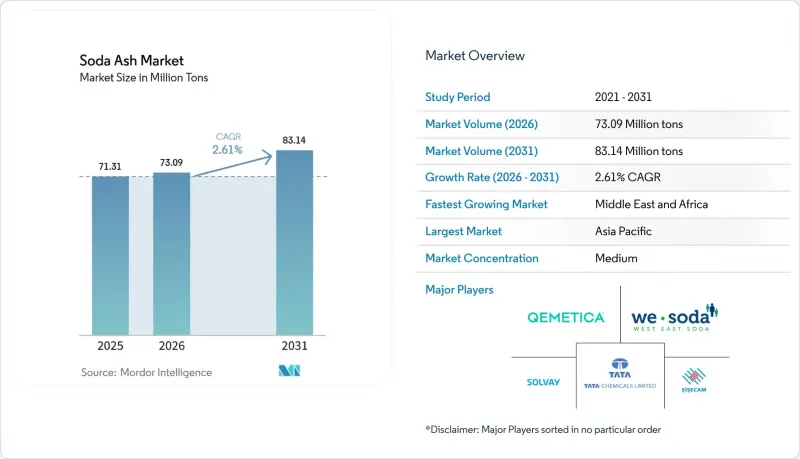
This report is Segmented by Type (Light Soda Ash, Dense Soda Ash), Source (Natural (Trona-Based), Synthetic (Solvay, Hou, Dual-Process)), Application (Glass Manufacturing, Detergents and Soaps, and More), End-User Industry (Building and Construction, Automotive, and More), and Geography (Asia-Pacific, North America, and More). The Market Forecasts are Provided in Terms of Volume (tons).
Global Soda Ash Market Trends and Insights
Surging Demand for Flat, Container and Solar Glass
Global photovoltaic build-outs are rewiring raw-material flows as every GW of new solar capacity requires roughly 75 kt of ultra-clear glass, pushing soda ash purity specifications higher and widening price differentials for dense grade supply. Container glass growth in the soda ash industry rides buoyant beverage and pharmaceutical packaging trends that favor infinitely recyclable glass over single-use plastics. Chinese float-flat inventories of 68.66 million weight cases in 2024 underscore the scale of the regional base yet also hint at cyclical volatility as developers modulate real-estate exposure. Automotive glazing upgrades alongside low-emissivity architectural facades continue to integrate energy-saving coatings that raise soda ash volume per square meter relative to legacy formulations. Collectively, these outlets lock more than half of global soda ash volumes into glass value chains, amplifying the sensitivity of the soda ash market to glazing investment cycles.
Rebound in Powdered Detergents in Emerging Economies
Rising household penetration of automatic washing machines in India, Indonesia and Nigeria revives demand in the soda ash market for high-alkalinity powdered formats that outperform liquids in hard-water regions. Local formulators are pivoting toward denser powders that carry higher soda ash loadings per unit, strengthening backward-integration incentives for detergent majors. Urbanization supports brand premiumization, yet rural channels still prize cost efficiency, locking in soda ash as the preferred pH builder that offsets zeolite hardness. Multinationals with captive ash supply enjoy margin insulation as volatile freight rates inflate delivered costs for import-reliant blenders. Regulatory movements to phase out phosphates in South American detergents further raise soda ash substitution potential through eco-label compliant alkaline systems.
High CO2 Footprint and Tightening Emission Norms
Under the EU Emissions Trading System, soda ash plants must purchase allowances for each ton of CO2 released, sharply eroding Solvay-process margins and encouraging capacity curtailments. Glass producers simultaneously face scope-1 levies because sodium carbonate decarbonates inside furnaces, doubling the carbon-compliance burden along the value chain. Alternative alkali such as caustic soda presents disposal and chlorine co-product challenges that undercut replacement economics. Carbon capture pilots show promise, yet capital intensity near USD 120 million per 1 Mt of annual capacity strains balance sheets, particularly for mid-size Asian operators. Absent breakthrough abatement technologies, regulatory tightening could cap synthetic output growth and marginalize high-cost plants from the global soda ash market.
Other drivers and restraints analyzed in the detailed report include:
- Capacity Additions in Lithium Carbonate (EV Batteries)
- Emerging Sodium-Ion and Thermal Energy-Storage Uses
- Global Over-Capacity Led by China and Turkiye Price Pressure
For complete list of drivers and restraints, kindly check the Table Of Contents.
Segment Analysis
Dense grade accounted for 57.78% share of the soda ash market in 2024, reflecting its superior handling profile and reduced dust emissions that enable continuous float-glass furnace operation. Logistics efficiency rises because higher bulk density lowers freight cost per active ton, a decisive advantage as container shortages inflate shipping premiums. Light grade is projected to grow at a 3.89% CAGR to 2030, capturing municipal water-softening projects where rapid dissolution improves process economics. Glass furnaces require consistent granulometry to avoid throat build-up, cementing dense-grade incumbency despite its nominal price premium. Light soda ash continues to benefit from detergent production that favors faster solubility, yet its market ceiling remains capped by glass's dominant pull on global volumes.
Competitive positioning in dense grade tilts toward trona miners able to offer large parcels of uniform chemistry, insulating them from regional price skirmishes. Producers are investing in enclosed pneumatic loading systems to preserve density integrity through the supply chain. Light-grade manufacturers, meanwhile, diversify into micronized specialty powders for electronics and pharmaceutical fillers, attempting to lift margins above commodity thresholds. Although both grades share common raw materials, divergent crystallization and drying regimes create unique cost curves that dictate pricing corridors within the soda ash market.
Synthetic facilities retained 61.12% revenue share in 2024, yet natural suppliers are on track for the fastest 4.12% CAGR thanks to ESG procurement mandates and energy-price asymmetry. The soda ash market size for natural grades is projected to swell as utilities and glassmakers source low-carbon raw materials to meet Scope-3 targets. Trona resources in Wyoming's Green River Basin can sustain global demand for centuries, underpinning supply-security narratives that resonate with import-dependent European buyers.
Synthetic incumbents confront rising carbon levies and feedstock volatility, spurring retrofit programs such as Solvay's electrified kilns that aim for 50% emission cuts by 2030. Natural extraction's warrant includes lower water usage and limited chemical reagents, two parameters scrutinized by green-finance frameworks. Investment surges into solution mining in Turkiye and Peninsular Malaysia illustrate capital rotation toward geological ore bodies. Over the forecast horizon, synthetic capacity rationalization is expected, with high-cost Asian units most exposed, sharpening the competitive edge enjoyed by natural-grade participants within the soda ash market.
Geography Analysis
Asia-Pacific retained 43.12% share of global consumption in 2024, underpinned by China's twin role as the largest producer and end-user at 36 Mt of annual output. India's apparent consumption in the soda ash market grew 4.1% year-on-year to 4.14 Mt in FY 2024, buoyed by real-estate starts and container-glass demand for food packaging. Japan and South Korea contribute steady high-margin offtake for specialty glass and electronics, stabilizing regional average selling prices.
North America benefits from natural-grade cost leadership anchored in Wyoming, where 12 Mt of trona-based soda ash valued at USD 2.5 billion moved in 2024. U.S. export corridors into Latin America and East Asia capture currency-hedging advantages, while Canada's float-glass revival secures local off-take. Mexico leans on U.S. imports for container-glass furnaces that supply an expanding beverage sector, reinforcing cross-border supply interdependence within the soda ash market.
The Middle East and Africa is forecast to grow at 3.78% CAGR through 2030 as Saudi Vision 2030 and UAE industrial strategies channel capex toward flat-glass and fiberglass facilities. Turkiye's solution-mined capacity positions the country as both regional supplier and global swing exporter, diluting European reliance on domestic synthetic plants under emission pressure. South Africa's automotive and construction recoveries lift soda ash call in sub-Saharan markets, while Nigeria signals nascent demand for water-treatment grades. Europe, squeezed by energy costs, pivots toward imported natural soda ash despite freight exposure, a rebalancing that re-shapes trans-Atlantic trade lanes in the soda ash market.
- ANSAC (American Natural Soda Ash Corp.)
- Botswana Ash South Africa (PTY) Ltd.
- Genesis Energy
- GHCL Limited
- Inner Mongolia Yuanxing Energy
- NIRMA
- QEMETICA
- Shandong Haihua Group Co., Ltd.
- Sisecam
- Solvay
- TANGSHAN SANYOU CHEMICAL INDUSTRIES CO., LTD.
- Tata Chemicals Ltd.
- Tronox Holdings Plc.
- We Soda Ltd.
- Yidu Huaxun Intelligent Conveyor Co.,Ltd
Additional Benefits:
- The market estimate (ME) sheet in Excel format
- 3 months of analyst support
TABLE OF CONTENTS
1 Introduction
- 1.1 Study Assumptions & Market Definition
- 1.2 Scope of the Study
2 Research Methodology
3 Executive Summary
4 Market Landscape
- 4.1 Market Overview
- 4.2 Market Drivers
- 4.2.1 Surging demand for flat, container and solar glass
- 4.2.2 Rebound in powdered detergents in emerging economies
- 4.2.3 Capacity additions in lithium carbonate (EV batteries)
- 4.2.4 Transition from synthetic to natural soda ash (ESG, cost)
- 4.2.5 Emerging sodium-ion and thermal energy-storage uses
- 4.3 Market Restraints
- 4.3.1 High CO2 footprint and tightening emission norms
- 4.3.2 Volatile trona / energy / freight prices
- 4.3.3 Global over-capacity led by China and Turkiye price pressure
- 4.4 Value Chain Analysis
- 4.5 Porter's Five Forces Analysis
- 4.5.1 Bargaining Power of Suppliers
- 4.5.2 Bargaining Power of Buyers
- 4.5.3 Threat of New Entrants
- 4.5.4 Threat of Substitutes
- 4.5.5 Competitive Rivalry
5 Market Size & Growth Forecasts (Volume)
- 5.1 By Type
- 5.1.1 Light Soda Ash
- 5.1.2 Dense Soda Ash
- 5.2 By Source
- 5.2.1 Natural (Trona-based)
- 5.2.2 Synthetic (Solvay, Hou, Dual-process)
- 5.3 By Application
- 5.3.1 Glass Manufacturing
- 5.3.2 Detergents and Soaps
- 5.3.3 Chemical Processing
- 5.3.4 Pulp and Paper
- 5.3.5 Metallurgy (Ore Smelting and Desulfurization)
- 5.3.6 Water Treatment
- 5.3.7 Food and Beverage Processing
- 5.4 By End-user Industry
- 5.4.1 Building and Construction
- 5.4.2 Automotive
- 5.4.3 Chemicals
- 5.4.4 Textiles
- 5.4.5 Food and Beverage
- 5.4.6 Renewable Energy (Solar PV glass, Batteries)
- 5.4.7 Electronics and Electrical
- 5.4.8 Healthcare and Pharmaceuticals
- 5.5 By Geography
- 5.5.1 Asia-Pacific
- 5.5.1.1 China
- 5.5.1.2 India
- 5.5.1.3 Japan
- 5.5.1.4 South Korea
- 5.5.1.5 ASEAN Countries
- 5.5.1.6 Australia and New Zealand
- 5.5.1.7 Rest of Asia-Pacific
- 5.5.2 North America
- 5.5.2.1 United States
- 5.5.2.2 Canada
- 5.5.2.3 Mexico
- 5.5.3 Europe
- 5.5.3.1 Germany
- 5.5.3.2 United Kingdom
- 5.5.3.3 France
- 5.5.3.4 Italy
- 5.5.3.5 Spain
- 5.5.3.6 Russia
- 5.5.3.7 Rest of Europe
- 5.5.4 South America
- 5.5.4.1 Brazil
- 5.5.4.2 Argentina
- 5.5.4.3 Chile
- 5.5.4.4 Rest of South America
- 5.5.5 Middle-East and Africa
- 5.5.5.1 Saudi Arabia
- 5.5.5.2 Turkey
- 5.5.5.3 South Africa
- 5.5.5.4 Nigeria
- 5.5.5.5 Rest of Middle-East and Africa
- 5.5.1 Asia-Pacific
6 Competitive Landscape
- 6.1 Market Concentration
- 6.2 Strategic Moves (M&A, Capacity Expansions, JV, Tech)
- 6.3 Market Share (%)/ Ranking Analysis
- 6.4 Company Profiles (includes Global level Overview, Market level overview, Core Segments, Financials as available, Strategic Information, Market Rank/Share for key companies, Products & Services, and Recent Developments)
- 6.4.1 ANSAC (American Natural Soda Ash Corp.)
- 6.4.2 Botswana Ash South Africa (PTY) Ltd.
- 6.4.3 Genesis Energy
- 6.4.4 GHCL Limited
- 6.4.5 Inner Mongolia Yuanxing Energy
- 6.4.6 NIRMA
- 6.4.7 QEMETICA
- 6.4.8 Shandong Haihua Group Co., Ltd.
- 6.4.9 Sisecam
- 6.4.10 Solvay
- 6.4.11 TANGSHAN SANYOU CHEMICAL INDUSTRIES CO., LTD.
- 6.4.12 Tata Chemicals Ltd.
- 6.4.13 Tronox Holdings Plc.
- 6.4.14 We Soda Ltd.
- 6.4.15 Yidu Huaxun Intelligent Conveyor Co.,Ltd
7 Market Opportunities & Future Outlook
- 7.1 Growth in solar, flat & container glass demand
- 7.2 Uptake in water softening & effluent treatment
- 7.3 Natural-soda-ash supply shift & low-carbon production

