PUBLISHER: Mordor Intelligence | PRODUCT CODE: 2062361

PUBLISHER: Mordor Intelligence | PRODUCT CODE: 2062361
Military Wearables - Market Share Analysis, Industry Trends & Statistics, Growth Forecasts (2026 - 2031)
According to Mordor Intelligence, the military wearables market size is projected to expand from USD 4.53 billion in 2025 and USD 4.70 billion in 2026 to USD 5.67 billion by 2031, registering a CAGR of 3.82% between 2026 and 2031.
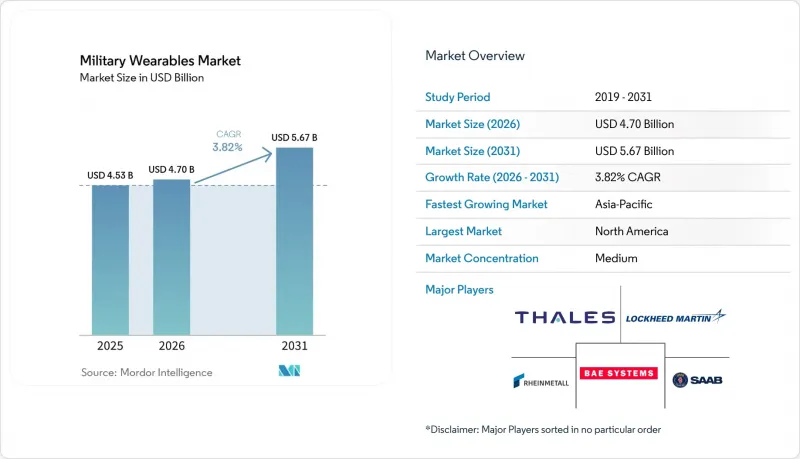
This report is Segmented by Wearable Type (Headwear, Eyewear, Wristwear, Bodywear, Hearables, and Exoskeletons), Application (Communication and Computing, Vision and Surveillance, and More), End-User (Land Forces, Airborne Forces, and Naval Forces), Core Technology (Smart Textiles, and More), and Geography (North America, Europe, and More). The Market Forecasts are Provided in Terms of Value (USD).
Global Military Wearables Market Trends and Insights
Increased Global Investment in Next-Generation Soldier Modernization Programs
Defense modernization spending is the clearest demand anchor for the military wearables market because several large soldier programs are now in delivery rather than concept stages. Germany moved the pace higher when Rheinmetall secured a EUR 3.1 billion (USD 3.21 billion) framework for IdZ-ES soldier systems in February 2025, covering up to 368 platoon-level equipment sets through 2030. That program received another boost in April 2026 with a EUR 1.0 billion (USD 1.21 billion) call-off order for 8,600 additional soldiers, which extended near-term visibility into demand for networked armor, night vision, and tactical computing. Canada added another clear procurement signal in May 2025 when its Department of National Defense contracted Logistik Unicorp for CAD 19.70 million (USD 14.19 million) to deliver modernized equipment for 3,000 soldiers as part of its light forces upgrade effort. These awards matter beyond the top line because each soldier system order pulls through demand for protective carriers, embedded electronics, textiles, power modules, and rugged interfaces across the military wearables market. The result is a procurement environment where large national contracts keep prime contractors central. Still, they also create a larger downstream opportunity set for subsystem vendors that can meet military qualification standards.
Growing Operational Need for Real-Time Biometric and Health Monitoring
Real-time physiological monitoring is becoming a practical capability in the military wearables market rather than a limited pilot concept. The US Army announced that the Wearable All-Hazard Remote Monitoring Program was deployed to select special operations units in late 2025 and is scheduled for broader joint-force deployment in fiscal year 2026. That shift matters because it shows that wearable systems are now expected to support training, safety, hazard awareness, and mission readiness within the same hardware environment. RTI International's AlphaWear program integrates heat strain and infection risk monitoring into a defense-focused precision health platform. Launched in October 2025, AlphaWear is a wearable data platform for US military personnel that enables real-time tracking of heat stress, infection risk, and mental health using fitness-style devices. This technology highlights the growing role of wearables in enhancing military readiness and operational efficiency. As this capability expands, the military wearables market is separating further from consumer formats, as military designs must accommodate ballistic protection, communications gear, and contested field conditions rather than comfort-led daily use, strengthening a protected niche where defense-specific integration matters as much as sensor performance. It also raises the value of software layers that can turn raw biometric data into usable alerts without adding more hardware burden per soldier.
Lack of Standardized Interoperability Frameworks Across Allied Forces
Interoperability remains a structural brake on the military wearables market because coalition operations still do not operate around a single shared hardware and data standard. The US Army's Mission Partner Kit enhanced multinational command-and-control connectivity during exercises such as Saber Strike 24 and Saber Junction 24 by enabling shared situational awareness, secure chat, voice communication, and collaboration tools. However, significant challenges persist in achieving broader coalition interoperability, particularly regarding incompatible communication networks, data-sharing protocols, classification rules, and the adoption of standardized software-based frameworks across allied formations. Europe is trying to address that gap through structured programs such as the ACHILE effort, which is working to harmonize next-generation dismounted soldier systems across multiple member states through 2027. The same push is visible in the broader European defense base, where the ARMETISS program is developing common smart garment modules across a multi-country consortium. Until these efforts translate into procurement-level interface discipline, armies will continue to face higher integration costs whenever national wearable stacks meet in joint deployments. That raises switching costs and tends to favor established cross-border suppliers over smaller specialists, which slows the pace at which the military wearables market can scale across alliances.
Other drivers and restraints analyzed in the detailed report include:
- Integration of Augmented-Reality Systems for Battlefield Visualization
- Open-Standard Modular AI Accelerators Reducing SWaP for On-Edge Processing
- High Cybersecurity Costs Outweighing ROI Compared to Legacy Equipment
For complete list of drivers and restraints, kindly check the Table Of Contents.
Segment Analysis
Bodywear accounted for the largest share in 2025, with 41.55%, and that base still defines the center of volume in the military wearables market. This position reflects the fact that bodywear already sits at the core of protection and load carriage, which makes it the easiest layer for electronics integration to enter through existing purchasing channels. Headwear is becoming increasingly significant as helmets evolve toward modular digital architectures. Anduril's EagleEye program exemplifies this trend by integrating ballistic protection, AI-enabled vision, and command interfaces into a unified platform. Eyewear remains active through night vision and display upgrades, while wristwear and hearables continue to serve smaller but useful roles in local control, team awareness, and protected communications. The military wearables market, therefore, still depends on stable body-borne procurement for scale, even as exoskeletons attract the strongest growth narrative at the edge of the segment.
Exoskeletons are forecast to grow at a 6.65% CAGR through 2031, making them the fastest-growing category in the military wearables market within the wearable type segmentation. That pace reflects a clear shift from demonstration programs toward operational relevance, especially in missions where endurance, load carriage, and repetitive strain matter more than broad unit scale. The strongest near-term signal came from Ukraine in March 2026, when forces began using exoskeletons on the frontline to reduce strain and improve artillery loading productivity under combat conditions. In the military wearable industry, this type of live use carries more weight than lab performance because procurement agencies look for evidence that wearable support systems can work under field stress, maintenance pressure, and uncertain power conditions.
Communication and computing led the application split, accounting for 37.20% of the military wearables market in 2025, indicating that networked operations remain central to current demand. This category remains anchored by radios, tactical displays, and battle management interfaces that connect the individual soldier to the wider unit. Vision and surveillance continue to attract funding through night-vision and augmented display programs, while navigation and positioning are gaining weight as forces prepare for more degraded or denied-signal environments. Protection and survivability still provide the most stable volume base because they are tied to long-established procurement cycles, and health and stress monitoring is gaining ground as systems like WARP show practical value in training safety and force readiness. The military wearables market is therefore broadening across applications. However, the largest spending still follows communications, while the fastest change is occurring in how programs manage power across the full soldier kit.
Power and energy management is projected to grow at a CAGR of 5.80% through 2031, emerging as the fastest-growing application area within the military wearables market. The increase is attributed to a fundamental operational factor: each additional display, sensor, radio, or computing module raises the soldier's power requirements. The segment is gaining importance because modern soldier kits can no longer be optimized as independent devices; instead, they need shared power logic, higher battery density, and lower overall energy waste during extended missions. In the military wearable industry, energy management is moving from a support function to a core part of system design because endurance directly affects mission time, mobility, and gear weight.
Geography Analysis
North America held 47.65% of the market in 2025, giving the region the largest share of the military wearables market and of global defense wearable procurement. Its lead comes from the depth of US defense budgets, the presence of major system integrators, and a procurement base that can absorb both established primes and newer technology firms.
Europe is seeing synchronized program activity, and that is lifting the military wearables market across both national procurement and shared industrial initiatives. The IVAS program's shift in 2025, when Anduril and Microsoft expanded their partnership for future development and cloud support, showed how quickly the region can redirect program leadership when performance expectations are not met. The UK reinforced this regional momentum in February 2026 when the MoD awarded BlackTree Technologies a contract worth up to GBP 86 million (USD 116.99 million) for the Dismounted Data System. The AI-capable system includes radios, headsets, display tablets, cables, batteries, pouches, and antennas, with deliveries to the UK Army planned in tranches from September 2026 and full rollout expected by 2027. In April 2026, Germany's IdZ-ES call-off order activated a major tranche under the February 2025 framework contract, the largest soldier-systems procurement framework for Rheinmetall and BAAINBw. The EUR 1.04 billion (USD 1.21 billion) order includes modernizing existing systems, procuring 237 additional platoon systems, and supporting subcontractors involved in IT equipment, optics, optronics, military clothing, protective gear, and related services. Regional capability building is also visible in common development projects, especially ARMETISS, which links seven nations and 20 partners around smart garment technologies. This is significant as Europe is increasing its equipment purchases but also working to establish a unified architecture and enhance local industrial capabilities for future replacement cycles. In contrast, the Middle East and Africa account for a smaller share of the overall market. However, interest in advanced optics, head-mounted systems, and localized protective manufacturing is driving selective growth opportunities for suppliers with regional partnerships.
Asia Pacific is forecast to grow at a 6.45% CAGR through 2031, making it the fastest-growing regional market for military wearables. This pace reflects rising defense budgets, stronger indigenous content rules, and the need to modernize large ground forces in contested security environments. India's F-INSAS effort, South Korea's Warrior Platform work, and China's continued investment in exoskeletons and digital soldier tools show that the region is not relying on a single model of adoption, but on several national pathways with different industrial strategies. Australia also adds relevance through battery development work that supports the longer endurance goals behind wearable deployments. The larger strategic effect is that Asia Pacific growth is building local supply capacity and demand, which may improve resilience for national programs but can also deepen interoperability gaps across the wider military wearables market.
- BAE Systems plc
- Lockheed Martin Corporation
- Thales Group
- Elbit Systems Ltd.
- Safran SA
- Northrop Grumman Corporation
- Rheinmetall AG
- RTX Corporation
- L3Harris Technologies, Inc.
- Honeywell International Inc.
- SAAB AB
- Gentex Corporation
- Teledyne Technologies Incorporated
- Ekso Bionics Holdings, Inc.
- Black Diamond Advanced Technology, LLC
Additional Benefits:
- The market estimate (ME) sheet in Excel format
- 3 months of analyst support
TABLE OF CONTENTS
1 INTRODUCTION
- 1.1 Study Assumptions and Market Definition
- 1.2 Scope of the Study
2 RESEARCH METHODOLOGY
3 EXECUTIVE SUMMARY
4 MARKET LANDSCAPE
- 4.1 Market Overview
- 4.2 Market Drivers
- 4.2.1 Increased global investment in next-generation soldier modernization programs
- 4.2.2 Growing operational need for real-time biometric and health monitoring
- 4.2.3 Advancements in battery energy density enhancing mission endurance
- 4.2.4 Deployment of AI-driven sensor fusion for enhanced situational awareness
- 4.2.5 Emergence of low-SWaP photonics enabling wearable directed-energy technologies
- 4.2.6 Integration of augmented reality (AR) systems for battlefield visualization and mission planning
- 4.3 Market Restraints
- 4.3.1 Lack of standardized interoperability frameworks across allied forces
- 4.3.2 High cybersecurity costs outweighing ROI compared to legacy equipment
- 4.3.3 Geopolitical instability impacting lithium and critical battery material supply chains
- 4.3.4 Rising ethical concerns over continuous biometric surveillance of soldiers
- 4.4 Value Chain Analysis
- 4.5 Regulatory Landscape
- 4.6 Technological Outlook
- 4.7 Porter's Five Forces Analysis
- 4.7.1 Threat of New Entrants
- 4.7.2 Bargaining Power of Buyers
- 4.7.3 Threat of Substitutes
- 4.7.4 Intensity of Competitive Rivalry
- 4.7.5 Bargaining Power of Suppliers
5 MARKET SIZE AND GROWTH FORECASTS (VALUE)
- 5.1 By Wearable Type
- 5.1.1 Headwear
- 5.1.2 Eyewear
- 5.1.3 Wristwear
- 5.1.4 Bodywear
- 5.1.5 Hearables
- 5.1.6 Exoskeletons
- 5.2 By Application
- 5.2.1 Communication and Computing
- 5.2.2 Vision and Surveillance
- 5.2.3 Navigation and Positioning
- 5.2.4 Power and Energy Management
- 5.2.5 Protection and Survivability
- 5.2.6 Health and Stress Monitoring
- 5.3 By End-User
- 5.3.1 Land Forces
- 5.3.2 Airborne Forces
- 5.3.3 Naval Forces
- 5.4 By Core Technology
- 5.4.1 Smart Textiles
- 5.4.2 AR/VR Optics and Waveguides
- 5.4.3 AI-Driven Sensor Fusion
- 5.4.4 Energy Harvesting
- 5.4.5 Wearable Robotics and Actuators
- 5.4.6 Flexible and Transparent Displays
- 5.5 By Geography
- 5.5.1 North America
- 5.5.1.1 United States
- 5.5.1.2 Canada
- 5.5.1.3 Mexico
- 5.5.2 Europe
- 5.5.2.1 United Kingdom
- 5.5.2.2 France
- 5.5.2.3 Germany
- 5.5.2.4 Italy
- 5.5.2.5 Rest of Europe
- 5.5.3 Asia-Pacific
- 5.5.3.1 China
- 5.5.3.2 India
- 5.5.3.3 Japan
- 5.5.3.4 South Korea
- 5.5.3.5 Australia
- 5.5.3.6 Rest of Asia-Pacific
- 5.5.4 South America
- 5.5.4.1 Brazil
- 5.5.4.2 Rest of South America
- 5.5.5 Middle East and Africa
- 5.5.5.1 Middle East
- 5.5.5.1.1 United Arab Emirates
- 5.5.5.1.2 Saudi Arabia
- 5.5.5.1.3 Rest of Middle East
- 5.5.5.2 Africa
- 5.5.5.2.1 South Africa
- 5.5.5.2.2 Rest of Africa
- 5.5.5.1 Middle East
- 5.5.1 North America
6 COMPETITIVE LANDSCAPE
- 6.1 Market Concentration
- 6.2 Strategic Moves
- 6.3 Market Share Analysis
- 6.4 Company Profiles (includes Global-level Overview, Market-level Overview, Core Segments, Financials as available, Strategic Information, Market Rank/Share, Products and Services, and Recent Developments)
- 6.4.1 BAE Systems plc
- 6.4.2 Lockheed Martin Corporation
- 6.4.3 Thales Group
- 6.4.4 Elbit Systems Ltd.
- 6.4.5 Safran SA
- 6.4.6 Northrop Grumman Corporation
- 6.4.7 Rheinmetall AG
- 6.4.8 RTX Corporation
- 6.4.9 L3Harris Technologies, Inc.
- 6.4.10 Honeywell International Inc.
- 6.4.11 SAAB AB
- 6.4.12 Gentex Corporation
- 6.4.13 Teledyne Technologies Incorporated
- 6.4.14 Ekso Bionics Holdings, Inc.
- 6.4.15 Black Diamond Advanced Technology, LLC
7 MARKET OPPORTUNITIES AND FUTURE OUTLOOK
- 7.1 White-space and Unmet-Need Assessment

