PUBLISHER: Mordor Intelligence | PRODUCT CODE: 2062373

PUBLISHER: Mordor Intelligence | PRODUCT CODE: 2062373
Car Air Freshener - Market Share Analysis, Industry Trends & Statistics, Growth Forecasts (2026 - 2031)
According to Mordor Intelligence, the air fresheners market size is expected to increase from USD 2.57 billion in 2025 to USD 2.71 billion in 2026 and reach USD 3.55 billion by 2031, growing at a CAGR of 5.53% over 2026-2031.
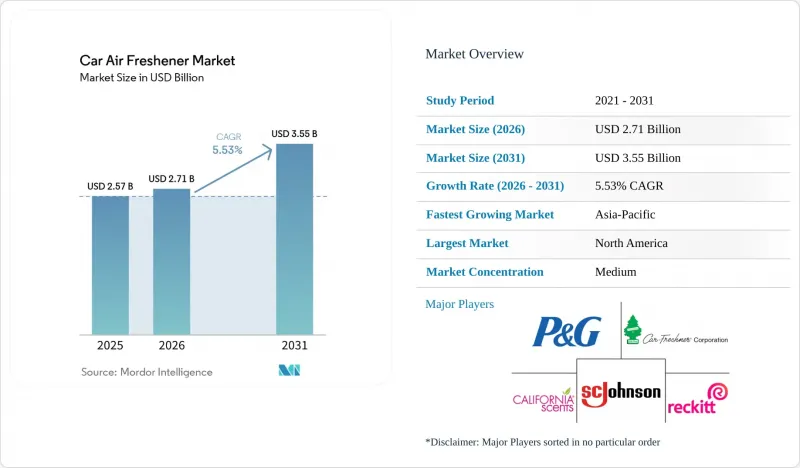
This report is Segmented by Product Type (Hanging Air Fresheners, Vent Clip Air Fresheners, Spray/Aerosol Air Fresheners, Gel-Based Air Fresheners, and More), Category (Mass, Premium), Distribution Channel (Offline Retail Stores, Online Retail Stores), and Geography (North America, Europe, Asia-Pacific, South America, Middle East and Africa). The Market Forecasts are Provided in Terms of Value (USD).
Global Car Air Freshener Market Trends and Insights
Continuous fragrance-format innovation
Adjustable dial vent clips, motion-activated gel pods, and time-releasing spray aerosols are reshaping consumer expectations in the hanging air fresheners market. Procter & Gamble's Febreze CAR vent clip, set for a 2024 release, boasts a 40-day lifespan and a 20% reduction in plastic use. This innovation highlights how modular designs not only enhance product sustainability but also drive recurring refill sales without increasing initial costs, making it appealing to environmentally conscious consumers. Yankee Candle's Sidekick cartridge is versatile, fitting vent, visor, and pendant holders, enabling users to change forms without discarding the base. This adaptability caters to diverse consumer preferences, offering convenience and reducing waste. Additionally, cross-brand compatibility, like Glade refills in Air Wick dispensers, lowers the barriers for consumers by providing flexibility and cost savings. This "razor-and-blade" strategy is now being adopted by ride-share fleets, which need quick scent changes between passengers to maintain a fresh and pleasant environment. Brands that separate devices from their consumables can enhance their lifetime value, improve customer retention, and significantly reduce their environmental impact.
Preference for Long-Lasting, Intense Fragrances
Commuters and ride-share drivers are gravitating towards high "throw" fragrances, ones that linger for over a month. This trend has led suppliers to highlight performance benchmarks of 60 or even 365 days in the Hanging air fresheners market. PURGGO, with its bamboo-charcoal absorber, claims a year-long efficacy and boasts solar rechargeability, positioning itself as a sustainable alternative to products that require frequent refills. This product not only appeals to environmentally conscious consumers but also addresses the growing demand for low-maintenance, long-lasting solutions. Regional preferences are evident: customers in the Middle East are drawn to oud notes, which are rich and woody, while those in North America favor a zesty citrus touch, offering a fresh and clean aroma. A 2024 study on cabin air quality found total VOC levels spiking to 364.3 µg/m3 after 15 sprays. Additionally, it observed a 25.3% rise in nanoparticle fractions at 25 °C, highlighting the health considerations suppliers must address. These findings emphasize the need for manufacturers to balance fragrance performance with safety standards. Today's consumers are increasingly evaluating the cost per day, showing a preference for products that balance intensity with lasting power, ensuring both value and satisfaction.
Health concerns over VOCs and Allergens
A study identified 546 volatile organic compounds (VOCs) in a dozen car air fresheners, including 30 hazardous ones like acetaldehyde and beta-myrcene, all without any label disclosures. This revelation has sown seeds of distrust among consumers in the Hanging air fresheners market, as they become increasingly aware of potential health risks. The U.S. EPA has highlighted that during product use, cabin VOC levels can spike by as much as 1,000 times, and such exposure is linked to respiratory and neurological problems, raising significant safety concerns. In response, regulatory bodies like CARB and IFRA are tightening the reins on permissible fragrance allergens, leading to expensive reformulations for brands. Federal standards set VOC content limits for a range of products: single-phase air fresheners are allowed up to 70% VOCs, double-phase can have up to 30%, liquids and pump sprays are restricted to 18%, while solids and gels are limited to a mere 3%.These regulatory changes aim to mitigate health risks but pose challenges for manufacturers in maintaining product appeal. Those unable to strike a balance between scent performance and emission safety may swiftly lose market share to hypoallergenic or fragrance-free alternatives, which are gaining traction among health-conscious consumers.
Other drivers and restraints analyzed in the detailed report include:
- Shift toward natural and eco-friendly ingredients
- Growth in premium and designer offerings
- Cabin-air purifiers cannibalizing fragrance sales
For complete list of drivers and restraints, kindly check the Table Of Contents.
Segment Analysis
In 2025, hanging air fresheners dominated the market, capturing 43.87% share. This stronghold is attributed to their established brand equity, widespread retail presence, and decades of consumer familiarity. Traditional paper-based air fresheners, priced under USD 3, spurred impulse buys in convenience and automotive sectors. Yet, these face challenges: their scent longevity and intensity lag behind newer alternatives. Meanwhile, vent-mounted clips and gel pots, with their practical designs, cater to distracted-driver regulations and offer a passive scent release over 30 days, solidifying their place in the mid-price category. Despite rising competition from electric and programmable options, hanging air fresheners maintain their dominance.
Plug-in and electric air fresheners are on a rapid ascent, with projections indicating a 6.24% CAGR through 2031. This surge is driven by innovations like battery-powered vent clips boasting 40-70 day scent cycles, USB-charged diffusers, and solar-assisted models. The latter are particularly favored by ride-share drivers for their adjustable intervals. As aerosol sprays, which raised cabin VOCs to 364.3 µg/m3 in 2024, see a decline in preference, the shift towards these cleaner, longer-lasting alternatives accelerates. Premium products, such as Inhalio's app-controlled LIN/CAN-bus units and PURGGO's bamboo-charcoal bags, stand out in the market, commanding 3-5X price multiples among niche customers. With a growing emphasis on sustainability and health, these electric air fresheners are poised for an expanded market presence.
Geography Analysis
In 2025, North America accounted for 41.52% of the revenue in the hanging air fresheners market. In the U.S., consumers spent between USD 8-12 annually per vehicle. As regulatory complexities mount, with California imposing an 18% VOC cap and nine states banning rear-view-mirror hangers, consumers are increasingly gravitating towards vent clips. Procter & Gamble, eyeing the under-penetrated 170 million replacement gap, is set to launch Febreze-branded cabin filters in 2026, hinting at a strategic blend of filtration and fragrance. While Canada and Mexico contribute to demand through OEM accessory packs in new vehicles, their per-capita spending lags behind that of the U.S.
Asia-Pacific is poised for the swiftest growth at a 6.58% CAGR, driven by China's expansive vehicle base of over 300 million and India's brisk motorization. Chinese regulations mandate ingredient disclosures in the local language, giving an edge to domestic players who can certify their formulations. Cultural nuances shape preferences: Japan and South Korea favor bamboo-charcoal absorbers and subtle scents, prioritizing odor neutralization over pronounced fragrances. In India, metropolitan areas are leaning towards premium diffusers, while rural locales stick to budget-friendly paper trees, highlighting the market's diverse landscape.
Europe experiences steady growth, navigating challenges like REACH allergen warnings and IFRA sensitizer restrictions. Premium brands like BMW Atmosphere and Mercedes scent systems find a foothold in Germany and the UK, while Nordic nations show a preference for fragrance-free alternatives. As OEM-embedded modules gain traction, they're drawing affluent consumers away from aftermarket refills, shifting the market's focus towards mid-tier and value offerings. Brazil leads in South America, but its momentum is tempered by economic fluctuations. Meanwhile, in the Middle East, markets like Saudi Arabia and the UAE maintain robust per-vehicle fragrance expenditures, with a distinct preference for premium-priced oud-based notes.
- Procter and Gamble (Febreze / Ambi Pur)
- Car-Freshner Corp. (Little Trees)
- Reckitt Benckiser (Air Wick)
- California Scents
- SC Johnson (Glade)
- Yankee Candle (Newell Brands)
- Church and Dwight (Arm and Hammer)
- Henkel
- Godrej Consumer Products
- Dabur
- HandStands / Energizer Brands
- Auto Expressions (Gold Eagle)
- Areon (Balev Corp.)
- Bullsone
- Sakura Group
- Aromate Industries
- Air Spencer
- Jo Malone Automotive Editions
- SmarDy
- Little Joe
- ELiX Scent (AROMATONE)
- Farcent Enterprise
- Kobayashi Pharmaceutical
- CAR MATE
- Involve Your Senses
Additional Benefits:
- The market estimate (ME) sheet in Excel format
- 3 months of analyst support
TABLE OF CONTENTS
1 INTRODUCTION
- 1.1 Study Assumptions and Market Definition
- 1.2 Scope of the Study
2 RESEARCH METHODOLOGY
3 EXECUTIVE SUMMARY
4 MARKET LANDSCAPE
- 4.1 Market Overview
- 4.2 Market Drivers
- 4.2.1 Continuous fragrance-format innovation
- 4.2.2 Preference for long-lasting, intense fragrances
- 4.2.3 Shift toward natural and eco-friendly ingredients
- 4.2.4 Growth in premium and designer offerings
- 4.2.5 AI-driven scent personalization and connected-car integration
- 4.2.6 Emergence of solid-state, refill-free substrates (bio-polymer beads, bamboo)
- 4.3 Market Restraints
- 4.3.1 Health concerns over VOCs and allergens
- 4.3.2 Cabin-air purifiers cannibalising fragrance sales
- 4.3.3 Lower odour emissions in EV interiors
- 4.3.4 Regional rear-view-mirror hanging bans and distracted-driver regulations
- 4.4 Consumer Behavior Analysis
- 4.5 Regulatory Outlook
- 4.6 Technological Outlook
- 4.7 Porter's Five Forces Analysis
- 4.7.1 Threat of New Entrants
- 4.7.2 Bargaining Power of Buyers
- 4.7.3 Bargaining Power of Suppliers
- 4.7.4 Threat of Substitutes
- 4.7.5 Competitive Rivalry
5 MARKET SIZE AND GROWTH FORECASTS (VALUE)
- 5.1 By Product Type
- 5.1.1 Hanging Air Freshners
- 5.1.2 Vent Clip Air Freshners
- 5.1.3 Spray/Aerosol Air Freshners
- 5.1.4 Gel-based Air Freshners
- 5.1.5 Plug-in/Electric Air Freshners
- 5.1.6 Paper Air Fresheners
- 5.1.7 Others
- 5.2 By Category
- 5.2.1 Mass
- 5.2.2 Premium
- 5.3 By Distribution Channel
- 5.3.1 Offline Retail Stores
- 5.3.2 Online Retail Stores
- 5.4 By Geography
- 5.4.1 North America
- 5.4.1.1 United States
- 5.4.1.2 Canada
- 5.4.1.3 Mexico
- 5.4.1.4 Rest of North America
- 5.4.2 Europe
- 5.4.2.1 Germany
- 5.4.2.2 United Kingdom
- 5.4.2.3 Italy
- 5.4.2.4 France
- 5.4.2.5 Spain
- 5.4.2.6 Netherlands
- 5.4.2.7 Poland
- 5.4.2.8 Belgium
- 5.4.2.9 Sweden
- 5.4.2.10 Rest of Europe
- 5.4.3 Asia-Pacific
- 5.4.3.1 China
- 5.4.3.2 India
- 5.4.3.3 Japan
- 5.4.3.4 Australia
- 5.4.3.5 Indonesia
- 5.4.3.6 South Korea
- 5.4.3.7 Thailand
- 5.4.3.8 Singapore
- 5.4.3.9 Rest of Asia-Pacific
- 5.4.4 South America
- 5.4.4.1 Brazil
- 5.4.4.2 Argentina
- 5.4.4.3 Colombia
- 5.4.4.4 Chile
- 5.4.4.5 Peru
- 5.4.4.6 Rest of South America
- 5.4.5 Middle East and Africa
- 5.4.5.1 South Africa
- 5.4.5.2 Saudi Arabia
- 5.4.5.3 United Arab Emirates
- 5.4.5.4 Nigeria
- 5.4.5.5 Egypt
- 5.4.5.6 Morocco
- 5.4.5.7 Turkey
- 5.4.5.8 Rest of Middle East and Africa
- 5.4.1 North America
6 COMPETITIVE LANDSCAPE
- 6.1 Market Concentration
- 6.2 Strategic Moves
- 6.3 Market Share Analysis
- 6.4 Company Profiles {(includes Global level Overview, Market level overview, Core Segments, Financials as available, Strategic Information, Market Rank/Share for key companies, Products and Services, and Recent Developments)}
- 6.4.1 Procter and Gamble (Febreze / Ambi Pur)
- 6.4.2 Car-Freshner Corp. (Little Trees)
- 6.4.3 Reckitt Benckiser (Air Wick)
- 6.4.4 California Scents
- 6.4.5 SC Johnson (Glade)
- 6.4.6 Yankee Candle (Newell Brands)
- 6.4.7 Church and Dwight (Arm and Hammer)
- 6.4.8 Henkel
- 6.4.9 Godrej Consumer Products
- 6.4.10 Dabur
- 6.4.11 HandStands / Energizer Brands
- 6.4.12 Auto Expressions (Gold Eagle)
- 6.4.13 Areon (Balev Corp.)
- 6.4.14 Bullsone
- 6.4.15 Sakura Group
- 6.4.16 Aromate Industries
- 6.4.17 Air Spencer
- 6.4.18 Jo Malone Automotive Editions
- 6.4.19 SmarDy
- 6.4.20 Little Joe
- 6.4.21 ELiX Scent (AROMATONE)
- 6.4.22 Farcent Enterprise
- 6.4.23 Kobayashi Pharmaceutical
- 6.4.24 CAR MATE
- 6.4.25 Involve Your Senses
7 MARKET OPPORTUNITIES AND FUTURE OUTLOOK

