PUBLISHER: Mordor Intelligence | PRODUCT CODE: 2062377

PUBLISHER: Mordor Intelligence | PRODUCT CODE: 2062377
K-12 Technology Training For Teachers - Market Share Analysis, Industry Trends & Statistics, Growth Forecasts (2026 - 2031)
According to Mordor Intelligence, the k-12 technology training for teachers market size is projected to expand from USD 4.48 billion in 2025 and USD 4.75 billion in 2026 to USD 7.13 billion by 2031, registering a CAGR of 8.47% between 2026 to 2031.
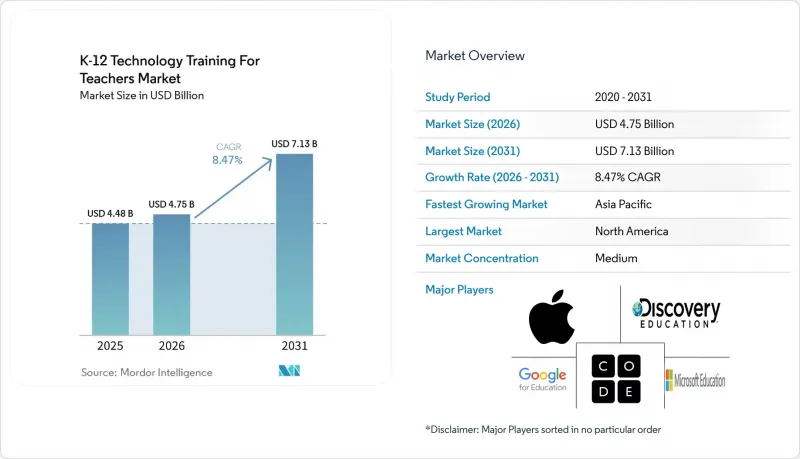
This report is Segmented by Training Modality (Online Self-Paced, Instructor-Led Virtual, and More), Delivery Mode (Subscription-Based PD Platforms, Pay-As-You-Go Courses, and More), Technology Focus (Basic Digital Literacy, STEM, and More), End-User Level (Elementary School Teachers, Middle School Teachers, and More), and Geography. The Market Forecasts are Provided in Value (USD).
Global K-12 Technology Training For Teachers Market Trends and Insights
Hybrid PD Adoption Accelerates Globally
Blended professional development that merges live cohort sessions with asynchronous micro-lessons is scaling as districts seek better completion and classroom transfer without increasing after-hours demands. LAUSD's micro-credentialing structure uses a clear split between face-to-face time, online modules, and applied homework, leading to high completion and salary point eligibility, which reinforces teacher participation. District teams cite real-time interaction for modeling and Q&A, flexible pacing for busy schedules, and embedded check-ins that surface misconceptions before classroom use, which fit practical needs in 2026. PowerSchool University's open labs and embedded micro-trainings around product updates complement hybrid pathways by addressing time-sensitive workflow changes within the tools teachers already use. These practices reduce churn during LMS or content updates and encourage sustained use of new features inside the K-12 technology training for teachers market. As hybrid formats align with contract time and recognized credits, they become a default choice for districts upgrading technology fluency at scale.
Generative AI Classroom PD Demand
Districts are moving to close the proficiency gap between student familiarity with AI and teacher use of AI-aligned tools by prioritizing AI literacy and responsible-use frameworks in PD catalogs. Google introduced the Gemini Certified Educator exam in April 2026, offering a six-month free window, positioning verified AI credentials as a scalable signal of competency for K-12 educators worldwide. Microsoft's Elevate for Educators program created no-cost credentials, AI communities, and a Teach in Microsoft 365 Copilot app that aligns lesson planning and assessments with safe practice in 2026. Discovery Education's connected ecosystem integrates IBM SkillsBuild PD and AI TeacherTools, so educators receive contextual nudges tied to classroom resources and student data. Policy is also a catalyst, with China's April 2026 AI Plus Education plan embedding AI competencies into teacher qualification exams by 2030, which expands AI-focused PD demand system-wide. These developments raise the floor for AI literacy and safe practice in the K-12 technology training for teachers market in 2026.
Post-ESSER PD Budgets Compress
Late-liquidation limits in 2025 created uncertainty for obligated funds and paused payments to providers, which disrupted multi-year PD planning in many districts. Districts with strong evidence systems can better defend renewals by linking PD completions to student outcomes and verified credentials in 2026. Title II-A funding remains a baseline, but administrators now prioritize offers with clear pathways to endorsements and salary credits that are recognized across schools. Providers have adapted with evidence portfolios and compliance-ready modules that help districts retain training lines within slimmer budgets. This favors solutions that demonstrate impact and credential portability across employers in the K-12 technology training for teachers market. The shift reduces one-off workshops and elevates multi-session sequences with verified assessments and transparent rostering.
Other drivers and restraints analyzed in the detailed report include:
- CS Mandates Expand Teacher PD
- Rapid LMS Upgrades Require Retraining
- Teacher Burnout Limits PD Time
For complete list of drivers and restraints, kindly check the Table Of Contents.
Segment Analysis
Online self-paced and virtual formats held 37.38% share in 2025, while blended learning is projected to grow at 14.36% CAGR through 2031 as teachers seek live cohort interaction with flexible pacing. The K-12 technology training for teachers market is shifting toward hybrid pathways that pair synchronous modeling with asynchronous practice, aligning with contract time and reducing burnout from extended evening sessions. Districts improve completion when portfolios and classroom application are required for credit and compensation, which encourages deeper transfer of new skills. Embedded micro-training on platform updates within LMS portals provides timely support at points of use, which strengthens day-to-day adoption. Content ecosystems that surface targeted PD nudges inside dashboards are helping educators link training to real student needs. The K-12 technology training for teachers market benefits when providers align a hybrid design to assessment-backed credentials recognized by districts.
Completion and persistence are stronger when blended courses include feedback on evidence and coaching on classroom implementation for curricula such as CS Principles and CSA. The K-12 technology training for teachers market size for blended modality is projected to grow as districts standardize cohort models with live touchpoints and asynchronous practice. Live virtual workshops remain an option when travel is limited, yet time zones and coverage still constrain participation in large districts. Providers add bite-sized refreshers so teachers can relearn workflows after updates without repeating full modules, which supports continuous change cycles in 2026. Alignment to recognized credentials and district salary lanes increases teacher motivation to complete blended pathways that include evidence and applied tasks. This modality is positioned to outpace legacy self-paced models inside the K-12 technology training for teachers market.
District-wide contracts and institutional programs accounted for 39.87% in 2025, as platform providers embedded PD into SIS and LMS agreements that renew on multi-year cycles. Certification-based and subscription platforms are forecast to grow at 15.44% CAGR as educators seek stackable recognition and evidence-based credentials that travel between schools. The K-12 technology training for teachers market reflects this mix as districts maintain large ecosystem agreements while adding subscription cohorts to address emerging competencies between contract refreshes. Google introduced a six-month free window for Gemini educator certification in 2026 to seed AI literacy at scale across languages and contexts. Microsoft's Elevate for Educators adds no-cost credentials and AI communities that districts can deploy within school-based networks to support peers and maintain continuity. These shifts increase credential portability and reduce reliance on one-off workshops across the K-12 technology training for teachers market.
Despite district-wide contracts accounting for the largest share of the K-12 technology training for teachers market in 2025, subscription and certification models now expand faster due to clear crosswalks into salary lanes and renewals. Associations and nonprofits scale competency-based assessment by validating classroom evidence rather than seat time, which appeals to self-directed educators and secondary teachers pursuing endorsements. State stipend programs influence completion rates based on coverage levels and cohort structure, factors that districts consider when choosing delivery partners for high-priority endorsements. Interoperability for roster sync and completion records is an adoption driver, since it lowers administrative overhead and simplifies audits for PD coordinators. As recognition clarity improves, subscription and certification cohorts become a regular complement to district-wide agreements inside the K-12 technology training for teachers market.
Geography Analysis
North America accounted for 37.35% of the K-12 technology training for teachers market share in 2025 as districts aligned PD with multi-year ecosystem contracts and managed post-ESSER transitions that affected provider payments and renewals. State-level CS endorsement policies strengthened demand for structured cohorts that document competencies and satisfy staffing plans across middle and high school. Interoperability standards such as OneRoster and Ed-Fi continued to shape credential portability and rostering practices, simplifying district audits and compliance. Vendor events and open-lab formats accelerated the adoption of new features as teachers received hands-on guidance from engineers on the exact tools they use every day. Ownership changes at major platforms in 2024 reinforced the role of bundled PD as a retention lever across large districts in 2026.
Asia-Pacific is projected to expand at a 13.38% CAGR through 2031 as national programs prioritize AI literacy and credential-aligned training for teachers. The K-12 technology training for teachers market in Asia-Pacific is set to grow as ministries embed credentials into national platforms and build peer communities that sustain adoption. China's AI Plus Education plan mandates AI competencies in teacher qualification exams by 2030, which anchors long-term PD demand. Regional exchanges such as Learning Impact Japan spread standards, work, and PD design practices that support interoperability and evidence tracking. SEAMEO-led initiatives and national projects continue to emphasize blended formats and competency frameworks that scale across diverse school systems.
Europe maintains steady adoption as member states align with DigCompEdu and expand hybrid PD that combines live cohorts and asynchronous modules anchored to national platforms. Device and display ecosystems recognize exemplary schools where ongoing PD and teacher communities drive sustained use and classroom innovation. Latin America advances CS and AI teacher training through public-private programs and regional partners that deliver facilitated workshops in secondary and middle grades. In the Middle East and Africa, recognition programs and platform partnerships encourage formal PD communities, while budgets and connectivity shape local pacing and scale. These regional patterns collectively support a diverse growth outlook for the K-12 technology training for teachers market in 2026.
- Google for Education
- Microsoft Education
- Apple Education
- Discovery Education
- BetterLesson
- Instructure (Canvas / Impact)
- PowerSchool (Schoology Learning)
- ISTE + ASCD (ISTE Certification)
- Common Sense Education (PD)
- Code.org (Teacher Professional Learning)
- LEGO Education (Professional Development)
- Edmentum (Professional Services)
- HMH (Professional Learning)
- Savvas Learning Company (Professional Learning)
- Amplify (Professional Development)
- Nearpod (PD / Camp Engage)
- Seesaw (Training & PD)
- Promethean (Learn Promethean)
- SMART Technologies (Learn SMART)
- GoGuardian (Training / University)
- Teq (OTIS for Educators)
- D2L Brightspace (K-12 Professional Learning)
- Blackboard / Anthology (Professional Development)
Additional Benefits:
- The market estimate (ME) sheet in Excel format
- 3 months of analyst support
TABLE OF CONTENTS
1 Introduction
- 1.1 Study Assumptions & Market Definition
- 1.2 Scope of the Study
2 Research Methodology
3 Executive Summary
4 Market Landscape
- 4.1 Market Overview
- 4.2 Market Drivers
- 4.2.1 Hybrid PD adoption accelerates globally
- 4.2.2 Generative AI classroom PD demand
- 4.2.3 CS mandates expand teacher PD
- 4.2.4 Rapid LMS upgrades require retraining
- 4.2.5 Micro-credential incentives spur upskilling
- 4.2.6 Interoperability, rostering standards demand training
- 4.3 Market Restraints
- 4.3.1 Post-ESSER PD budgets compress
- 4.3.2 Teacher burnout limits PD time
- 4.3.3 Fragmented credential recognition slows uptake
- 4.3.4 Procurement, privacy reviews delay pilots
- 4.4 Value / Supply-Chain Analysis
- 4.5 Regulatory Landscape
- 4.6 Technological Outlook
- 4.7 Porter's Five Forces Analysis
- 4.7.1 Competitive Rivalry
- 4.7.2 Threat of New Entrants
- 4.7.3 Bargaining Power of Buyers
- 4.7.4 Bargaining Power of Suppliers
- 4.7.5 Threat of Substitutes
5 Market Size & Growth Forecasts
- 5.1 By Training Modality
- 5.1.1 Online Self-paced
- 5.1.2 Instructor-led Virtual
- 5.1.3 Blended
- 5.1.4 On-site Workshops
- 5.2 By Delivery Mode
- 5.2.1 Subscription-based PD Platforms
- 5.2.2 Pay-as-you-go Courses
- 5.2.3 District-wide Contracts
- 5.2.4 Certification Programs
- 5.3 By Technology Focus
- 5.3.1 Basic Digital Literacy
- 5.3.2 STEM / Coding & Robotics
- 5.3.3 LMS Utilisation
- 5.3.4 Emerging Tech (AR/VR, AI)
- 5.3.5 Cyber-security & Data Privacy
- 5.4 By End-User Level
- 5.4.1 Elementary School Teachers
- 5.4.2 Middle School Teachers
- 5.4.3 High School Teachers
- 5.4.4 Special Education Teachers
- 5.5 By Geography
- 5.5.1 North America
- 5.5.1.1 Canada
- 5.5.1.2 United States
- 5.5.1.3 Mexico
- 5.5.2 South America
- 5.5.2.1 Brazil
- 5.5.2.2 Peru
- 5.5.2.3 Chile
- 5.5.2.4 Argentina
- 5.5.2.5 Rest of South America
- 5.5.3 Europe
- 5.5.3.1 United Kingdom
- 5.5.3.2 Germany
- 5.5.3.3 France
- 5.5.3.4 Spain
- 5.5.3.5 Italy
- 5.5.3.6 BENELUX
- 5.5.3.7 NORDICS
- 5.5.3.8 Rest of Europe
- 5.5.4 Asia-Pacific
- 5.5.4.1 India
- 5.5.4.2 China
- 5.5.4.3 Japan
- 5.5.4.4 Australia
- 5.5.4.5 South Korea
- 5.5.4.6 South-East Asia
- 5.5.4.7 Rest of Asia-Pacific
- 5.5.5 Middle East & Africa
- 5.5.5.1 United Arab Emirates
- 5.5.5.2 Saudi Arabia
- 5.5.5.3 South Africa
- 5.5.5.4 Nigeria
- 5.5.5.5 Rest of Middle East & Africa
- 5.5.1 North America
6 Competitive Landscape
- 6.1 Market Concentration
- 6.2 Strategic Moves
- 6.3 Market Share Analysis
- 6.4 Company Profiles [(includes Global level Overview, Market level overview, Core Segments, Financials as available, Strategic Information, Market Rank/Share for key companies, Products & Services, and Recent Developments)]
- 6.4.1 Google for Education
- 6.4.2 Microsoft Education
- 6.4.3 Apple Education
- 6.4.4 Discovery Education
- 6.4.5 BetterLesson
- 6.4.6 Instructure (Canvas / Impact)
- 6.4.7 PowerSchool (Schoology Learning)
- 6.4.8 ISTE + ASCD (ISTE Certification)
- 6.4.9 Common Sense Education (PD)
- 6.4.10 Code.org (Teacher Professional Learning)
- 6.4.11 LEGO Education (Professional Development)
- 6.4.12 Edmentum (Professional Services)
- 6.4.13 HMH (Professional Learning)
- 6.4.14 Savvas Learning Company (Professional Learning)
- 6.4.15 Amplify (Professional Development)
- 6.4.16 Nearpod (PD / Camp Engage)
- 6.4.17 Seesaw (Training & PD)
- 6.4.18 Promethean (Learn Promethean)
- 6.4.19 SMART Technologies (Learn SMART)
- 6.4.20 GoGuardian (Training / University)
- 6.4.21 Teq (OTIS for Educators)
- 6.4.22 D2L Brightspace (K-12 Professional Learning)
- 6.4.23 Blackboard / Anthology (Professional Development)
7 Market Opportunities & Future Outlook
- 7.1 White-space & unmet-need assessment

