PUBLISHER: Mordor Intelligence | PRODUCT CODE: 2062382

PUBLISHER: Mordor Intelligence | PRODUCT CODE: 2062382
Lightweight Aggregate Concrete - Market Share Analysis, Industry Trends & Statistics, Growth Forecasts (2026 - 2031)
According to Mordor Intelligence, the lightweight aggregate concrete market size is expected to grow from USD 9.88 billion in 2025 to USD 10.29 billion in 2026 and is forecast to reach USD 12.59 billion by 2031 at 4.12% CAGR over 2026-2031.
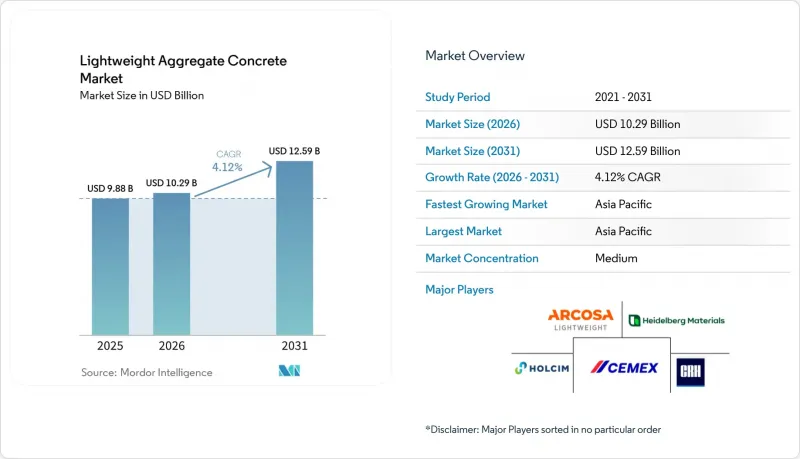
This report is Segmented by Type of Aggregate (Expanded Clay, Expanded Slate, and More), Application (Structural Concrete, Block and Panel Production, and More), End-User Industry (Residential, Commercial, Industrial, and More), and Geography (Asia-Pacific, North America, Europe, South America, and Middle East and Africa). The Market Forecasts are Provided in Terms of Value (USD).
Global Lightweight Aggregate Concrete Market Trends and Insights
Growing Demand for Lightweight and High-Strength Construction Materials
Project engineers are specifying lightweight aggregate concrete to achieve span-to-depth ratios that exceed the capabilities of normal-weight mixes. This enables the construction of 100-meter prestressed bridge girders without surpassing deflection limits. Rotary-kiln shale aggregates have demonstrated compressive strengths of 6,000 pounds per square inch (psi) at densities around 1,920 kilograms per cubic meter (kg/m3), showing that reducing mass does not compromise strength. Research conducted in 2025 highlighted lightweight ultra-high-strength formulations achieving compressive strengths of 102-123 megapascals (MPa) while reducing self-weight by up to 20%. In seismic regions such as Japan and California, lower dead loads directly reduce base shear, leading to cost savings in foundation construction. Holcim's ECOPact platform combines lightweight aggregates with supplementary cementitious materials to achieve LC60 classes while reducing embodied carbon dioxide (CO2) by 30-50%, demonstrating that structural performance and decarbonization objectives can align.
Increasing Use in High-Rise and Precast Structures
Labor shortages are driving developers toward modular and precast construction methods, where pumpability and lighter panels help reduce crane cycle times. For instance, a 2025 balcony retrofit project in Halle-Neustadt utilized Liapor LC30/33D1.8, successfully pumping concrete to the 18th floor and completing 220 slabs within weeks, showcasing vertical conveyance without segregation. Case studies in Hong Kong revealed a 10.1% reduction in embodied carbon for non-structural floors after substituting lightweight materials, with even greater benefits when prefabrication is adopted. In India, suppliers are promoting lightweight mixes that also function as passive cooling masses in tropical high-rise buildings. Additionally, fabricators using welded-wire mesh and glass fibers in lightweight expanded clay aggregate (LECA)-based self-consolidating slabs report a 45% increase in load-carrying capacity compared to unreinforced alternatives.
Higher Cost Versus Conventional Concrete
Lightweight concrete mixes incur a 15-25% cost premium due to the rotary-kiln energy requirements of 1.5-2.0 gigajoules (GJ) per ton, significantly higher than the 0.5 GJ per ton for crushed stone. While sintered fly-ash technology reduces fuel consumption, turnkey plants remain 30-40% more expensive than crushing units. Developers with single-digit profit margins face challenges in transferring these additional costs to homebuyers, limiting the use of lightweight concrete to high-end construction projects. Value-engineering studies indicate 5-10% total project savings when accounting for foundation costs, crane time, and schedule compression, but these life-cycle benefits are often overlooked due to siloed procurement practices.
Other drivers and restraints analyzed in the detailed report include:
- Reduction in Dead Load Enabling Cost-Efficient Designs
- Stricter Energy-Efficiency and Insulation Codes
- Scarcity of Premium Lightweight Aggregates
For complete list of drivers and restraints, kindly check the Table Of Contents.
Segment Analysis
Expanded clay accounted for 34.44% of the lightweight aggregate concrete market in 2025, supported by established rotary-kiln infrastructure in Europe and Asia-Pacific. Perlite is the fastest-growing aggregate, with a projected growth rate of 4.58% through 2031. The market size associated with this segment is expected to grow steadily, driven by its suitability for bridge builders and retrofitting agencies due to its strength classes exceeding 40 megapascals (MPa). Perlite is anticipated to grow 16 basis points faster than the overall aggregate category, benefiting from its low thermal conductivity of 0.08 watts per meter-kelvin (W/mK), which is particularly suitable for 3D printing and ultra-insulating screeds.
In the United States, expanded shale and slate are widely used in structural applications requiring densities above 1,600 kilograms per cubic meter (kg/m3) and compressive strengths exceeding 6,000 pounds per square inch (psi), as demonstrated by projects like California's Shasta Arch Bridge. Pumice is primarily used in decorative and landscaping applications, with sourcing concentrated in the western United States and the Aegean region. Vermiculite and emerging bio-aggregates together account for less than 5% of the market volume due to cost and durability constraints. In China, pre-screened reservoir-silt pellets are expected to diversify supply once JC/T 2772-2024 standards enable non-structural applications up to LC25.
Geography Analysis
Asia-Pacific accounted for 47.89% of the projected 2025 revenue and is expected to grow at a rate of 6.11% through 2031, nearly 50% higher than the global lightweight aggregate concrete market growth rate. In China, the JC/T 2772-2024 mandate for recycled content in lightweight aggregates has introduced new supply chains, diverting demolition waste from landfills. Additionally, 26-story towers in Benxi demonstrated a 21-25% reduction in self-weight, leading to smaller seismic base shear forces. In India, precast operators have reduced project timelines by up to 50% using branded lightweight mixes, which also serve as passive cooling mass in tropical climates. Japan's adoption is driven by seismic performance improvements, with lightweight ultrahigh-strength concrete achieving 100 megapascals (MPa) strength at densities below 2,100 kilograms per cubic meter (kg/m3).
North America's market growth is supported by Arcosa's kiln network, strategic mergers and acquisitions, and Bridge Authority pilot projects. Following a USD 450 million barge divestiture and a USD 60 million aggregate acquisition in Florida, Arcosa has redirected capital toward higher-margin infrastructure-grade products. Titan America's artificial intelligence (AI)-enabled mix design platform optimizes performance and carbon footprint predictions, reducing quotation cycles from weeks to hours. Florida's regulatory endorsement of lightweight roof fills for hurricane-prone areas highlights growing regional acceptance.
Europe emphasizes carbon reduction and heritage rehabilitation. Projects such as the KabelstraBen-Brucke in Wuppertal and the bridge widening in Straubing achieved 100-ton weight savings, preserving existing structural piers. Norway's BetongVIND initiative and the Horizon-Europe MADE4WIND consortia are positioning lightweight concrete as a critical component for deep-water wind projects, targeting an 80% reduction in carbon dioxide (CO2) emissions for serial gravity-foundation production. In the United Kingdom, LECA's third-party-verified Environmental Product Declarations (EPDs) support buildings in securing Building Research Establishment Environmental Assessment Method (BREEAM) credits while aligning with 2030 carbon reduction goals.
South America benefits from Votorantim Cimentos' BRL 5 billion (USD 0.97 billion) expansion, which will increase Mato Grosso's production capacity to 1.2 million tons and achieve a 90% renewable energy grid mix by March 2026. The Middle East and Africa are in the early stages of adoption, with applications concentrated in Saudi Arabia's high-rise cores and liquefied natural gas (LNG) terminals, where weight reductions help minimize quay wall reinforcement. However, reliance on imports and high freight costs remain significant barriers to broader regional uptake.
- Arcosa Lightweight
- Argex SA
- Boral Limited
- Buildex
- Cemex S.A.B DE C.V.
- Charah Solutions Inc.
- CRH
- H+H International
- Heidelberg Materials AG
- Holcim
- Laterlite SpA
- Leca International
- Liapor Group
- PORAVER
- Pumice Products International
- Saint-Gobain
- Titan America
- Votorantim Cimentos
- Vulcan Materials Company
Additional Benefits:
- The market estimate (ME) sheet in Excel format
- 3 months of analyst support
TABLE OF CONTENTS
1 Introduction
- 1.1 Study Assumptions and Market Definition
- 1.2 Scope of the Study
2 Research Methodology
3 Executive Summary
4 Market Landscape
- 4.1 Market Overview
- 4.2 Market Drivers
- 4.2.1 Growing Demand for Lightweight and High-Strength Construction Materials
- 4.2.2 Increasing Use in High-Rise and Precast Structures
- 4.2.3 Reduction in Dead Load Enabling Cost-Efficient Designs
- 4.2.4 Stricter Energy-Efficiency and Insulation Codes
- 4.2.5 Emerging 3D-Printed Concrete Applications
- 4.3 Market Restraints
- 4.3.1 Higher Cost Versus Conventional Concrete
- 4.3.2 Scarcity of Premium Lightweight Aggregates
- 4.3.3 Moisture-Induced Variability in Mechanical Properties
- 4.4 Value Chain Analysis
- 4.5 Porter's Five Forces
- 4.5.1 Bargaining Power of Suppliers
- 4.5.2 Bargaining Power of Buyers
- 4.5.3 Threat of New Entrants
- 4.5.4 Threat of Substitutes
- 4.5.5 Competitive Rivalry
5 Market Size and Growth Forecasts (Value)
- 5.1 By Type of Aggregate
- 5.1.1 Expanded Clay
- 5.1.2 Expanded Shale
- 5.1.3 Expanded Slate
- 5.1.4 Perlite
- 5.1.5 Pumice
- 5.1.6 Others (Vermiculite, Bio-aggregates)
- 5.2 By Application
- 5.2.1 Structural Concrete
- 5.2.2 Precast/Prefabricated Elements
- 5.2.3 Block and Panel Production
- 5.2.4 Bridge Decks and Infrastructure
- 5.2.5 Insulating Screeds and Roof Fills
- 5.2.6 Others
- 5.3 By End-user Industry
- 5.3.1 Residential
- 5.3.2 Commercial
- 5.3.3 Industrial
- 5.3.4 Infrastructure
- 5.3.5 Energy and Utilities (Off-shore wind, LNG)
- 5.4 By Geography
- 5.4.1 Asia-pacific
- 5.4.1.1 China
- 5.4.1.2 India
- 5.4.1.3 Japan
- 5.4.1.4 South Korea
- 5.4.1.5 Australia and New Zealand
- 5.4.1.6 ASEAN Countries
- 5.4.1.7 Rest of Asia-Pacific
- 5.4.2 North America
- 5.4.2.1 United States
- 5.4.2.2 Canada
- 5.4.2.3 Mexico
- 5.4.3 Europe
- 5.4.3.1 Germany
- 5.4.3.2 United Kingdom
- 5.4.3.3 France
- 5.4.3.4 Italy
- 5.4.3.5 Spain
- 5.4.3.6 Russia
- 5.4.3.7 Rest of Europe
- 5.4.4 South America
- 5.4.4.1 Brazil
- 5.4.4.2 Argentina
- 5.4.4.3 Rest of South America
- 5.4.5 Middle-East and Africa
- 5.4.5.1 Saudi Arabia
- 5.4.5.2 South Africa
- 5.4.5.3 Rest of Middle-East and Africa
- 5.4.1 Asia-pacific
6 Competitive Landscape
- 6.1 Market Concentration
- 6.2 Strategic Moves
- 6.3 Market Share/Ranking Analysis
- 6.4 Company Profiles (includes Global level Overview, Market level overview, Core Segments, Financials as available, Strategic Information, Market Rank/Share for key companies, Products and Services, and Recent Developments)
- 6.4.1 Arcosa Lightweight
- 6.4.2 Argex SA
- 6.4.3 Boral Limited
- 6.4.4 Buildex
- 6.4.5 Cemex S.A.B DE C.V.
- 6.4.6 Charah Solutions Inc.
- 6.4.7 CRH
- 6.4.8 H+H International
- 6.4.9 Heidelberg Materials AG
- 6.4.10 Holcim
- 6.4.11 Laterlite SpA
- 6.4.12 Leca International
- 6.4.13 Liapor Group
- 6.4.14 PORAVER
- 6.4.15 Pumice Products International
- 6.4.16 Saint-Gobain
- 6.4.17 Titan America
- 6.4.18 Votorantim Cimentos
- 6.4.19 Vulcan Materials Company
7 Market Opportunities and Future Outlook
- 7.1 White-space and Unmet-need Assessment
- 7.2 Modular and prefabricated construction adoption

