PUBLISHER: Mordor Intelligence | PRODUCT CODE: 2062388

PUBLISHER: Mordor Intelligence | PRODUCT CODE: 2062388
Automotive Plastic Compounding - Market Share Analysis, Industry Trends & Statistics, Growth Forecasts (2026 - 2031)
According to Mordor Intelligence, the automotive plastic compounding market size is projected to be USD 9.18 billion in 2025, USD 9.68 billion in 2026, and reach USD 12.65 billion by 2031, growing at a CAGR of 5.49% from 2026 to 2031.
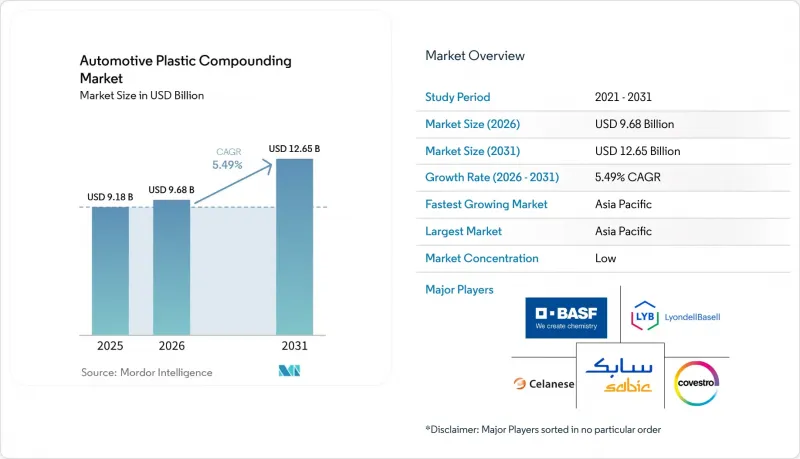
This report is Segmented by Polymer Type (Polypropylene (PP), and More), by Filler/Modifier (Glass-Fiber Reinforced, and More), by Application (Interior Components, Exterior Panels and Trim, and More), by Vehicle Type (Passenger Cars and More), and Geography (Asia-Pacific, North America, Europe, South America, and the Middle-East and Africa). The Market Forecasts are Provided in Terms of Value (USD).
Global Automotive Plastic Compounding Market Trends and Insights
OEM Lightweighting Mandates
In response to mandates for reduced fleet-average carbon dioxide emissions, automakers are transitioning from traditional stamped steel to advanced materials like glass-fiber polypropylene and polyamide. These new materials significantly reduce weight while maintaining stiffness. Long-glass-fiber polypropylene is already a foundational element in front-end modules for next-generation battery platforms. Additionally, weight savings showcased in concept vehicles hint at the potential for deeper integration of these materials. Such lightweight structures are pivotal in counterbalancing the additional weight of batteries in electric vehicles, directly impacting their range. Suppliers who combine weight reduction with recycled or bio-based content enjoy a significant compliance edge. Consequently, engineered polyolefins are set to dominate the semi-structural parts segment, solidifying their central role in the automotive plastic compounding market in the near future.
Rapid EV Rollout Needs Heat- and Flame-Resistant Compounds
In recent years, production of battery-electric vehicles has experienced a significant surge. Today, every pack, inverter, and charging port is designed with compounds that can withstand high-temperature continuous use, all while meeting stringent safety ratings for flammability. Hydrolysis-resistant polyamides significantly enhance the lifespan of parts in humid, fast-charge conditions. Meanwhile, blends of polyphenylene sulfide further improve performance under high-temperature conditions, though they are associated with higher costs. In Europe and North America, flame-retardant additives have transitioned to halogen-free chemistries, simplifying end-of-life recovery processes. As a result, battery enclosures have emerged as the fastest-growing application in the automotive plastic compounding market, driving specialty thermoplastics into broader adoption. Vendors with proprietary flame-retardant formulations benefit from premium pricing and extended customer qualification cycles.
Crude-Linked Resin Price Volatility
In early 2026, a single quarter experienced a significant increase in polypropylene prices, which tightened the margins for compounders. This fluctuation in polypropylene, along with shifts in prices for polyamide and polycarbonate feedstocks, closely mirrored the trends in crude oil and natural gas prices. Premiums for polyamide 6.6 have increased due to disruptions in adiponitrile supply, while polycarbonate costs have risen because of restrictions related to phosgene. Producers with integrated operations mitigate risks through upstream assets, whereas independent producers face challenges from mismatched contracts. Bio-based polyamides provide some protection against market volatility but are associated with higher costs.
Other drivers and restraints analyzed in the detailed report include:
- Global Vehicle Production Rebound Post-2025
- Laser-Weldable Polyolefin Compounds for Modular Lighting
- Recycling Infrastructure Deficit for Mixed-Filler Streams
For complete list of drivers and restraints, kindly check the Table Of Contents.
Segment Analysis
Polypropylene compounds delivered 34.87% of the automotive plastic compounding market share in 2025 on the strength of cost-effective glass-filled grades for bumpers, door modules, and dashboards. The Automotive plastic compounding market size for bio-polymers, though smaller, is projected to expand at 6.11% CAGR between 2026 and 2031, catalyzed by OEM net-zero agendas and renewable-content credits.
Flanking polypropylene's footprint, hydrolysis-resistant polyamides secure under-hood and battery-enclosure real estate, polycarbonate offers optical clarity for glazing, and ABS persists in high-finish interior parts. Bio-based polyamides derived from castor oil combine temperature resistance with renewable feedstock, signaling an emerging premium niche. The resulting material matrix confirms a gradual but noticeable tilt toward low-carbon chemistries within the broader Automotive plastic compounding market.
Glass-fiber reinforcements contributed 29.04% to 2025 revenue and will climb at a 5.89% CAGR over 2026 to 2031. Long-fiber thermoplastics are increasingly being used in semi-structural battery trays and front-end carriers. While carbon-fiber grades enhance the stiffness-to-weight ratios for premium electric vehicles, their significantly higher cost limits widespread adoption.
Mineral fillers, like talc, help reduce costs for wheel-arch liners and under-body shields. Meanwhile, flame-retardant packages are transitioning to halogen-free systems, ensuring compliance with UL 94 V-0 standards and facilitating recycling. In Europe, recycled-content modifiers are witnessing the fastest growth, driven by mandatory thresholds. These choices in filler technology underscore the importance of property tailoring in capturing value within the automotive plastic compounding market.
Geography Analysis
Asia-Pacific held the largest 47.18% share of the Automotive plastic compounding market size in 2025 and is also projected to post the quickest 6.45% CAGR over 2026-2031, highlighting the region's leadership in both scale and momentum. China stands out, commanding a significant portion of the regional demand. This dominance is bolstered by China's impressive vehicle production and its aggressive dual-credit policies, which are fast-tracking the adoption of electric vehicles. Meanwhile, in India, government incentives and a surge in sport utility vehicle sales are driving market expansion. Notably, polypropylene compounds have captured a considerable share of the local demand, underscoring a trend towards cost-focused part specifications. Japan is shifting its focus towards mono-material bumper programs and is increasingly utilizing recycled polypropylene grades. South Korea's large family-owned business groups are ramping up polyamide capacity, catering to domestic battery-electric plants, which have shown substantial growth.
North America holds a substantial stake, accounting for a notable share of the global automotive plastic compounding market. Trade regulations are channeling assembly and compounding activities into Mexico. A testament to this shift is Husco International's acquisition of Mayfair Plastics, which brought in numerous injection lines with sourcing compliant to tariffs. Meanwhile, the United States Inflation Reduction Act is igniting a surge in domestic production of flame-retardant polyamide and polypropylene grades, crucial for battery enclosures. Both BASF and Covestro have scheduled their production start-ups. In a strategic move, LyondellBasell and Sipchem are conducting feasibility studies on a mixed-feed cracker in Saudi Arabia, signaling a push for upstream integration in the Middle-East, targeting North American clients downstream.
Despite grappling with high energy costs, Europe continues to wield significant influence in innovation and regulation. The revised End-of-Life Vehicle regulations, which mandate a specific percentage of recycled content by a future date, are driving investments from industry players. Companies like Borealis, Trinseo, and MBA Polymers are pivoting towards circular-ready polypropylene and polycarbonate compounds. Borealis is making a significant investment in its Schwechat line, focusing on glass-fiber and flame-retardant grades tailored for European electric vehicles. On a larger scale, Mutares has bolstered its regional presence with the acquisition of SABIC's engineering thermoplastics division. In South America, Brazil's vehicle assembly footprint remains the focal point. Meanwhile, in the Middle-East and Africa, demand is still in its infancy but on an upward trajectory. Saudi Arabia is ramping up its polymer capacity, and South Africa is making strides to address its energy challenges.
- Asahi Kasei Corporation
- BASF
- Borealis GmbH
- Celanese Corporation
- Covestro AG
- Dow
- DSM Engineering Materials
- EMS-CHEMIE Holding AG
- Ensinger
- Formosa Plastics Corporation U.S.A.
- HDC HYUNDAI EP COMPANY
- Kingfa Science & Technology (India) Limited
- LANXESS
- LOTTE Chemical Corporation
- LyondellBasell Industries Holdings B.V.
- Mitsui Plastics, Inc.
- Radici Partecipazioni SpA
- Ravago Manufacturing.
- SABIC
- SIBUR Holding PJSC
- Sirmax S.p.A
- Solvay
- Washington Penn
Additional Benefits:
- The market estimate (ME) sheet in Excel format
- 3 months of analyst support
TABLE OF CONTENTS
1 Introduction
- 1.1 Study Assumptions and Market Definition
- 1.2 Scope of the Study
2 Research Methodology
3 Executive Summary
4 Market Landscape
- 4.1 Market Overview
- 4.2 Market Drivers
- 4.2.1 OEM lightweighting mandates
- 4.2.2 Rapid EV rollout needs heat- and flame-resistant compounds
- 4.2.3 Global vehicle production rebound post-2025
- 4.2.4 Laser-weldable polyolefin compounds for modular lighting
- 4.2.5 Mono-material bumper systems enabling recyclability
- 4.3 Market Restraints
- 4.3.1 Crude-linked resin price volatility
- 4.3.2 Recycling infrastructure deficit for mixed-filler streams
- 4.3.3 Heat-soak and EMI limits in e-powertrains
- 4.4 Value Chain Analysis
- 4.5 Porter's Five Forces
- 4.5.1 Threat of New Entrants
- 4.5.2 Bargaining Power of Buyers
- 4.5.3 Bargaining Power of Suppliers
- 4.5.4 Threat of Substitutes
- 4.5.5 Competitive Rivalry
5 Market Size and Growth Forecasts (Value)
- 5.1 By Polymer Type
- 5.1.1 Polypropylene (PP)
- 5.1.2 Polyamide (PA 6, 6.6, 12)
- 5.1.3 Polycarbonate (PC)
- 5.1.4 Polyethylene (HDPE, LDPE)
- 5.1.5 Acrylonitrile-Butadiene-Styrene (ABS)
- 5.1.6 Polyvinyl Chloride (PVC)
- 5.1.7 Polybutylene Terephthalate (PBT)
- 5.1.8 Polyphenylene Sulfide (PPS) and LCP
- 5.1.9 High-performance Bio-polymers
- 5.2 By Filler / Modifier Type
- 5.2.1 Mineral-filled (Talc, CaCO3)
- 5.2.2 Glass-fibre Reinforced
- 5.2.3 Carbon-fibre and LFT
- 5.2.4 Flame-retardant Compounds
- 5.2.5 Impact Modifiers and Tougheners
- 5.2.6 UV / IR Stabiliser Packages
- 5.2.7 Recycled-content (>30 % PCR) Compounds
- 5.3 By Application
- 5.3.1 Interior Components
- 5.3.2 Exterior Panels and Trim
- 5.3.3 Under-hood / Power-electronics
- 5.3.4 Lighting Systems and Lens Housings
- 5.3.5 High-voltage Battery Enclosures
- 5.3.6 Fuel- and Fluid-contact Systems
- 5.4 By Vehicle Type
- 5.4.1 Passenger Cars
- 5.4.2 Light Commercial Vehicles
- 5.4.3 Heavy Trucks and Buses
- 5.4.4 Battery-Electric and Hybrid Vehicles
- 5.5 By Geography
- 5.5.1 Asia-Pacific
- 5.5.1.1 China
- 5.5.1.2 India
- 5.5.1.3 Japan
- 5.5.1.4 South Korea
- 5.5.1.5 ASEAN Countries
- 5.5.1.6 Rest of Asia-Pacific
- 5.5.2 North America
- 5.5.2.1 United States
- 5.5.2.2 Canada
- 5.5.2.3 Mexico
- 5.5.3 Europe
- 5.5.3.1 Germany
- 5.5.3.2 United Kingdom
- 5.5.3.3 France
- 5.5.3.4 Italy
- 5.5.3.5 Spain
- 5.5.3.6 Russia
- 5.5.3.7 Nordic Countries
- 5.5.3.8 Rest of Europe
- 5.5.4 South America
- 5.5.4.1 Brazil
- 5.5.4.2 Argentina
- 5.5.4.3 Rest of South America
- 5.5.5 Middle-East and Africa
- 5.5.5.1 Saudi Arabia
- 5.5.5.2 South Africa
- 5.5.5.3 Rest of Middle-East and Africa
- 5.5.1 Asia-Pacific
6 Competitive Landscape
- 6.1 Market Concentration
- 6.2 Strategic Moves
- 6.3 Market Share(%)/Ranking Analysis
- 6.4 Company Profiles (includes Global level Overview, Market level overview, Core Segments, Financials as available, Strategic Information, Products and Services, Recent Developments)
- 6.4.1 Asahi Kasei Corporation
- 6.4.2 BASF
- 6.4.3 Borealis GmbH
- 6.4.4 Celanese Corporation
- 6.4.5 Covestro AG
- 6.4.6 Dow
- 6.4.7 DSM Engineering Materials
- 6.4.8 EMS-CHEMIE Holding AG
- 6.4.9 Ensinger
- 6.4.10 Formosa Plastics Corporation U.S.A.
- 6.4.11 HDC HYUNDAI EP COMPANY
- 6.4.12 Kingfa Science & Technology (India) Limited
- 6.4.13 LANXESS
- 6.4.14 LOTTE Chemical Corporation
- 6.4.15 LyondellBasell Industries Holdings B.V.
- 6.4.16 Mitsui Plastics, Inc.
- 6.4.17 Radici Partecipazioni SpA
- 6.4.18 Ravago Manufacturing.
- 6.4.19 SABIC
- 6.4.20 SIBUR Holding PJSC
- 6.4.21 Sirmax S.p.A
- 6.4.22 Solvay
- 6.4.23 Washington Penn
7 Market Opportunities and Future Outlook
- 7.1 White-space and Unmet-need Assessment
- 7.2 Recyclate-rich and Bio-sourced PP Compounds

