PUBLISHER: Mordor Intelligence | PRODUCT CODE: 2062392

PUBLISHER: Mordor Intelligence | PRODUCT CODE: 2062392
Insulated Shipper - Market Share Analysis, Industry Trends & Statistics, Growth Forecasts (2026 - 2031)
According to Mordor Intelligence, the insulated shipper market size was valued at USD 9.76 billion in 2025 and is estimated to grow from USD 10.44 billion in 2026 to reach USD 14.59 billion by 2031, at a CAGR of 6.92% during the forecast period (2026-2031).
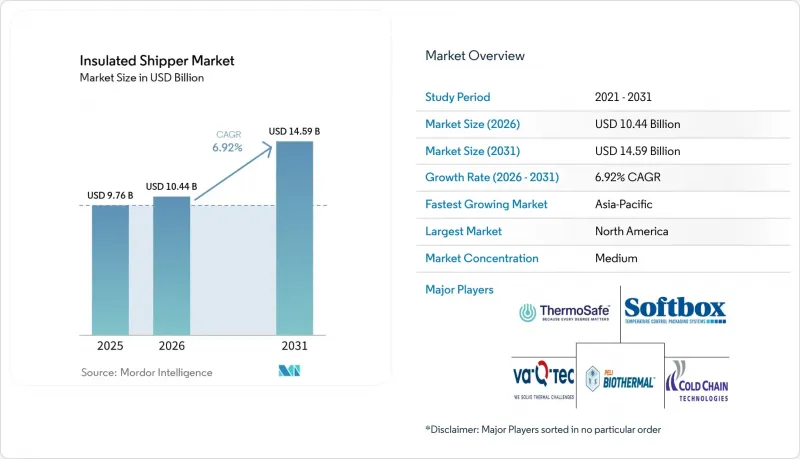
This report is Segmented by Product Type (Single-Use Insulated Shippers, Reusable Insulated Shippers, and Active Temperature-Controlled Containers), Material (Expanded Polystyrene (EPS), Polyurethane (PUR), and More), Application (Pharmaceutical and Biotechnology, Food and Beverage, and More), and Geography (Asia-Pacific, North America, and More). The Market Forecasts are Provided in Terms of Value (USD).
Global Insulated Shipper Market Trends and Insights
Temperature-Sensitive Pharma and Biologics Volume Surge
GLP-1 drugs, mRNA vaccines, and CAR-T therapies are driving the need for shippers to validate performance for extreme conditions, including temperatures as low as -196 °C for cell-and-gene therapy transportation. Nordic Cold Chain Solutions introduced the Nordic Express Pack in late 2025, the first ISTA-tested passive box designed for GLP-1 molecules. Latin American pharmaceutical sales reached USD 136.5 billion in 2024 and are growing at an annual rate of 9.7%, increasing the demand for GDP-compliant lanes with continuous monitoring. Growth in cold-chain logistics is increasingly tied to the rising share of high-value biologics, which require premium cold-chain services, rather than overall medicine volumes.
E-Grocery and Meal-Kit Last-Mile Deliveries Expand
Meal-kit companies and premium seafood exporters rely on overnight delivery services utilizing phase-change materials capable of withstanding weekend delays. Pelican BioThermal's Credo Cargo, launched through Polar Group Brazil in March 2026, offers 120-168 hours of protection while reducing dry ice usage by 75%, thereby lowering freight weight and carbon emissions. However, reverse logistics remains a challenge, as returning reusable boxes can increase delivery costs by 15%-25%. IoT-enabled lease models are mitigating this issue by automating return labels and improving asset utilization rates to over 80%.
High Total Cost of VIP/PCM Configurations
VIPs provide 10 times the insulation of EPS but increase ownership costs by 125%-180%, restricting their use to high-value pharmaceuticals. Even with reuse, reverse-logistics costs can negate savings unless shipment volumes exceed 500 per week. Solutions like EcoFlex 3's prepaid return labels demonstrate how process improvements can reduce costs, but the food industry is likely to continue using foams until regulatory changes mandate alternatives.
Other drivers and restraints analyzed in the detailed report include:
- Cold-Chain Infrastructure Modernization in Emerging Markets
- Regulatory Mandates for Validated Passive Packaging
- Single-Use Foam Phase-Outs (EU, selected U.S. states)
For complete list of drivers and restraints, kindly check the Table Of Contents.
Segment Analysis
Single-use insulated shippers held 47.44% of the insulated shipper market share in 2025 and are expected to grow at a 7.31% CAGR through 2031. Active temperature-controlled containers, designed for cargo requiring -70 °C to -196 °C, add USD 200-500 per trip. Developments like EcoFlex 3 and Credo on Demand are encouraging pharmaceutical shippers to consider reusable options, provided reverse-logistics costs drop below a 10% threshold.
Reusable programs perform well in areas with efficient return loops, such as metro corridors or closed pharmaceutical distribution systems. Europe's 2030 reuse mandate is already influencing purchasing trends, while North America and Asia-Pacific lag due to less stringent policy frameworks.
Geography Analysis
North America's 46.44% of the 2025 revenue share stems from mature pharma supply chains and early IoT adoption. FedEx Surround and UPS Premier provide sub-five-minute telemetry, and DHL's USD 1.1 billion regional spend deepens network density. Canada and Mexico contribute cross-border flows that reinforce demand for ISTA-graded packaging.
Asia-Pacific is the fastest region at a 7.27% CAGR through 2031. India's cold-chain outlays, and Vietnam's Dong Nai hub underpin growth, while China invests in mRNA capacity that triggers demand for -70 °C lanes. However, uneven rural infrastructure means that boxes must perform beyond the standard ISTA hot-lane baselines.
Europe remains regulation-led: GDP, PPWR, and CEIV Pharma certifications accelerate reusable uptake and single-use foam withdrawals. DHL's Florstadt expansion and va-Q-tec's merged platform with Envirotainer underscore that integrated service plus validated hardware is the new competitive norm.
South America's pharma spend is rising nearly 10% per year, but gaps in reverse logistics hamper reuse. Pelican's Credo Cargo launch with Polar Group Brazil is an early test of rental economics under less-developed retrieval networks.
Middle-East and Africa show infrastructure growth yet live with 40% post-harvest spoilage. Solar-assisted cold rooms and Tower Cold Chain's -80 °C boxes leased by Saudia Cargo illustrate solutions tuned for grid interruptions and vast desert transits.
- ACH Foam Technologies
- Aeris Dynamics Pte Ltd.
- AmerisourceBergen
- Cold Chain Technologies
- Cryopak
- CSAFE
- DHL Group
- Envirotainer
- FedEx
- Intelsius
- KODIAKOOLER
- Nordic Cold Chain Solutions.
- Panasonic Corporation
- Peli BioThermal LLC
- Sealed Air
- Sofrigam Group
- SOFTBOX SYSTEMS (I) PVT. LIMITED
- ThermoSafe
- United Parcel Service of America, Inc.
- va-Q-tec Thermal Solutions GmbH
Additional Benefits:
- The market estimate (ME) sheet in Excel format
- 3 months of analyst support
TABLE OF CONTENTS
1 Introduction
- 1.1 Study Assumptions and Market Definition
- 1.2 Scope of the Study
2 Research Methodology
3 Executive Summary
4 Market Landscape
- 4.1 Market Overview
- 4.2 Market Drivers
- 4.2.1 Temperature-sensitive pharma and biologics volume surge
- 4.2.2 E-grocery and meal-kit last-mile deliveries expand
- 4.2.3 Cold-chain infrastructure modernization in emerging markets
- 4.2.4 Regulatory mandates for validated passive packaging
- 4.2.5 AI-driven lane-specific predictive pack-out design adoption
- 4.3 Market Restraints
- 4.3.1 High total cost of VIP/PCM configurations
- 4.3.2 Single-use polymer foam phase-outs (EU, selected US states)
- 4.3.3 Supply bottlenecks in high-barrier films and fumed-silica powders
- 4.4 Value Chain Analysis
- 4.5 Porter's Five Forces
- 4.5.1 Bargaining Power of Suppliers
- 4.5.2 Bargaining Power of Buyers
- 4.5.3 Threat of New Entrants
- 4.5.4 Threat of Substitutes
- 4.5.5 Competitive Rivalry
5 Market Size and Growth Forecasts (Value)
- 5.1 By Product Type
- 5.1.1 Single-use Insulated Shippers
- 5.1.2 Reusable Insulated Shippers
- 5.1.3 Active Temperature-Controlled Containers
- 5.2 By Material
- 5.2.1 Expanded Polystyrene (EPS)
- 5.2.2 Polyurethane (PUR)
- 5.2.3 Vacuum-Insulated (VIP) Panels
- 5.2.4 Phase-Change-Material (PCM) Composites
- 5.2.5 Bio-based Fiber and Wool
- 5.2.6 Other Materials
- 5.3 By Application
- 5.3.1 Pharmaceutical and Biotechnology
- 5.3.2 Cell/Gene Therapy and Clinical Trials
- 5.3.3 Food and Beverage
- 5.3.4 Chemicals and Specialty Chemicals
- 5.3.5 Electronics and Semiconductors
- 5.3.6 Other Applications
- 5.4 By Geography
- 5.4.1 Asia-Pacific
- 5.4.1.1 China
- 5.4.1.2 India
- 5.4.1.3 Japan
- 5.4.1.4 South Korea
- 5.4.1.5 ASEAN Countries
- 5.4.1.6 Rest of Asia-Pacific
- 5.4.2 North America
- 5.4.2.1 United States
- 5.4.2.2 Canada
- 5.4.2.3 Mexico
- 5.4.3 Europe
- 5.4.3.1 Germany
- 5.4.3.2 United Kingdom
- 5.4.3.3 France
- 5.4.3.4 Italy
- 5.4.3.5 Spain
- 5.4.3.6 Russia
- 5.4.3.7 NORDIC Countries
- 5.4.3.8 Rest of Europe
- 5.4.4 South America
- 5.4.4.1 Brazil
- 5.4.4.2 Argentina
- 5.4.4.3 Rest of South America
- 5.4.5 Middle-East and Africa
- 5.4.5.1 Saudi Arabia
- 5.4.5.2 South Africa
- 5.4.5.3 Rest of Middle-East and Africa
- 5.4.1 Asia-Pacific
6 Competitive Landscape
- 6.1 Market Concentration
- 6.2 Strategic Moves
- 6.3 Market Share (%)/Ranking Analysis
- 6.4 Company Profiles (includes Global level Overview, Market level overview, Core Segments, Financials as available, Strategic Information, Products and Services, and Recent Developments)
- 6.4.1 ACH Foam Technologies
- 6.4.2 Aeris Dynamics Pte Ltd.
- 6.4.3 AmerisourceBergen
- 6.4.4 Cold Chain Technologies
- 6.4.5 Cryopak
- 6.4.6 CSAFE
- 6.4.7 DHL Group
- 6.4.8 Envirotainer
- 6.4.9 FedEx
- 6.4.10 Intelsius
- 6.4.11 KODIAKOOLER
- 6.4.12 Nordic Cold Chain Solutions.
- 6.4.13 Panasonic Corporation
- 6.4.14 Peli BioThermal LLC
- 6.4.15 Sealed Air
- 6.4.16 Sofrigam Group
- 6.4.17 SOFTBOX SYSTEMS (I) PVT. LIMITED
- 6.4.18 ThermoSafe
- 6.4.19 United Parcel Service of America, Inc.
- 6.4.20 va-Q-tec Thermal Solutions GmbH
7 Market Opportunities and Future Outlook
- 7.1 White-space and Unmet-need Assessment

