PUBLISHER: Mordor Intelligence | PRODUCT CODE: 2062395

PUBLISHER: Mordor Intelligence | PRODUCT CODE: 2062395
Shielding Gas For Welding - Market Share Analysis, Industry Trends & Statistics, Growth Forecasts (2026 - 2031)
According to Mordor Intelligence, the shielding gas for welding market size is projected to expand from USD 6.14 billion in 2025 and USD 6.46 billion in 2026 to USD 8.31 billion by 2031, registering a CAGR of 5.18% between 2026 to 2031.
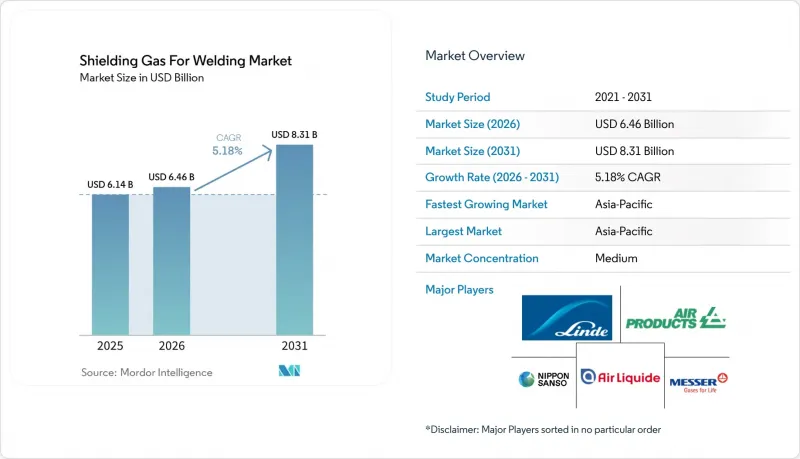
This report is Segmented by Gas Type (Argon, Carbon Dioxide, Helium, and More), Welding Process (Metal Inert Gas (MIG), Tungsten Inert Gas(TIC), and More), Application (Automotive and Transportation, Shipbuilding, Aerospace and Defense, and More), and Geography (Asia-Pacific, North America, Europe, South America, and Middle East and Africa). The Market Forecasts are Provided in Terms of Value (USD).
Global Shielding Gas For Welding Market Trends and Insights
Expansion of Automotive, Shipbuilding, and Construction Welding Demand
The automotive sector plays a significant role in the base-load consumption of argon-carbon dioxide blends, alongside the shipbuilding and infrastructure sectors. The industry's adoption of automation further emphasizes this importance. For instance, Liebherr's Telfs plant reported a substantial increase in production efficiency after implementing an autonomous robotic welding cell, showcasing how original equipment manufacturers are leveraging robotics to address the shortage of skilled welding labor. In 2024, LNG Canada's project relied on a significant number of pipe welders, utilizing substantial amounts of shielding gas during continuous hours of welding its final seam. India's extensive National Infrastructure Pipeline, along with China's ongoing construction of a vast network of high-speed rail, drives consistent demand for metal inert gas and flux-cored arc welding. This demand, in turn, encourages the establishment of new air-separation units. For structural steel applications, the preferred choice remains argon-carbon dioxide mixtures, as they promote deep penetration and minimize spatter, leading to notable rework savings. The concentration of these large-scale projects not only justifies investments in local air-separation units but also strengthens regional supply chains, bolstering the market for welding shielding gases.
Rapid Uptake of MIG/TIG for Thin-Gauge Precision Components
Fabricators are increasingly turning to digitally controlled inverters, which provide stable tungsten inert gas arcs at low currents and metal inert gas arcs at moderate currents, for processing materials under minimal thickness. Sichuan Morrow's WSM-400 showcases an ultralow-current tungsten inert gas capability, adept at preventing burn-through on aerospace titanium with extremely thin dimensions. NASA's PRC-0002 specification underscores the necessity of high-purity argon gas and explicitly bans gas metal arc welding for titanium, amplifying the demand for high-purity gas. While automotive body-panel suppliers are transitioning cosmetic seams to laser welding, tungsten inert gas welding remains crucial for repairs and visible joints, especially in areas inaccessible to lasers. Consequently, the industry's shift towards thinner materials is bolstering a niche, premium segment in the shielding gas market for welding.
Volatile Prices and Logistics for Argon/CO2 Cylinders
In early 2026, argon spot prices experienced significant fluctuations. During the same period, the price of Linde's cylinder refill for shielding gas increased notably, creating cost uncertainties for fabricators. Localized shortages, such as the argon supply constraints in Maharashtra in 2024, compelled emergency sourcing at higher rates and heightened interest in bulk-delivery contracts. Suppliers with regional air separation unit networks have gained leverage. However, increasing logistics expenses are squeezing margins, curtailing the expansion of the near-term shielding gas market for welding.
Other drivers and restraints analyzed in the detailed report include:
- Growing Infrastructure Spending in Emerging Economies
- Productivity Push via Automated and Robotic Welding Cells
- Strict Safety and Hazmat Regulations on High-Pressure Gas Handling
For complete list of drivers and restraints, kindly check the Table Of Contents.
Segment Analysis
Argon retained 45.01% shielding gas for the welding market share in 2025, its inertness aligning with MIG and TIG mainstream processes. Hydrogen-enriched blends are forecast to log the highest 5.75% CAGR between 2026 and 2031. WAAM users achieve significantly deeper penetration on the GH3535 alloy by adding a small percentage of hydrogen to argon. While carbon dioxide remains a preferred choice for cost-sensitive steel fabrication, its pure form reduces elongation compared to argon mixes. This limitation encourages users to adopt blends that balance toughness and bead geometry. In the aluminum WAAM segment, helium finds a niche application, where its addition to argon effectively reduces porosity. Furthermore, specialty ternary mixes are utilized to optimize both thermal conductivity and bead shape. Together, these gas mixtures enhance the value-added segment of the welding shielding gas market, while argon continues to maintain its leadership in terms of volume.
Nippon Sanso's Operational Excellence initiative, aimed at achieving significant cost savings, highlights a strong belief in argon's continued dominance, especially with investments in onsite air separation unit argon recovery. However, the growing adoption of hydrogen introduces premium-priced formulations, which increase per-cubic-foot revenues, even though the volumes remain relatively small.
Geography Analysis
Asia-Pacific, with 39.75% share in 2025, grows fastest at 6.14% CAGR between 2026 and 2031. China operates an extensive network of high-speed rail, and India is making significant investments in infrastructure, both driving sustained gas orders. In South Korea, liquefied natural gas shipyards utilize high-purity argon-hydrogen blends for nickel storage tanks. Meanwhile, the auto and electronics sectors in the Association of Southeast Asian Nations boost demand for these cylinders. Nippon Sanso, through its acquisition spree, including Coregas in Australia, broadens its air separation unit presence, aiming to shorten delivery times and shield customers from unpredictable imports.
North America is set to benefit from substantial infrastructure investments targeting bridges, pipelines, and renewable energy towers. Linde's air separation unit in Oshkosh, scheduled for the latter half of the decade, strategically positions its supply close to Wisconsin's metals hub. Concurrently, Air Liquide is investing significantly in upgrading its Louisiana facility, bolstering flows for the Gulf Coast's heavy industry. Messer's air separation units in Berryville and Bryan are designed to reduce transport costs and capitalize on the region's manufacturing expansion.
Europe, while growing at a slower pace, showcases a technology-driven demand, particularly in aerospace, medical devices, and the evolving electric vehicle sector. Nippon Sanso's acquisition of Polaris enhances its modular air separation unit engineering capabilities, allowing better service for specialty gas clients in Germany and Italy. In South America, demands are closely linked to agriculture and mining. Conversely, projects in the Middle East and Africa focus on petrochemical plants and desalination facilities, leading to increased consumption of flux-cored arc welding and submerged arc welding gases in their hot, windy climates.
- AHG
- Air Gas Middle East
- Air Liquide Offshore Energies
- Air Products and Chemicals, Inc.
- Air Water America Inc.
- American Welding & Gas Inc.
- BOC
- GCE Group
- Gulf Cryo
- Iwatani Corporation
- Linde plc
- Messer SE & Co. KGaA
- MIGAL CO GmbH
- NIPPON SANSO MATHESON, INC.
- Nippon Sanso Corporation
- Shenghui Gas China
- SOL Hellas a.e.
- Weldstar Company Inc.
Additional Benefits:
- The market estimate (ME) sheet in Excel format
- 3 months of analyst support
TABLE OF CONTENTS
1 Introduction
- 1.1 Study Assumptions and Market Definition
- 1.2 Scope of the Study
2 Research Methodology
3 Executive Summary
4 Market Landscape
- 4.1 Market Overview
- 4.2 Market Drivers
- 4.2.1 Expansion of Automotive, Shipbuilding and Construction Welding Demand
- 4.2.2 Rapid Uptake of MIG/TIG for Thin-Gauge Precision Components
- 4.2.3 Growing Infrastructure Spending in Emerging Economies
- 4.2.4 Productivity Push via Automated and Robotic Welding Cells
- 4.2.5 Additive Manufacturing (LMD/WAAM) Needs Ultra-High-Purity Shield Gases
- 4.3 Market Restraints
- 4.3.1 Volatile Prices and Logistics for Argon/CO2 Cylinders
- 4.3.2 Strict Safety and Hazmat Regulations on High-Pressure Gas Handling
- 4.3.3 Substitution Threat from Solid-State and Friction-Stir Welding
- 4.4 Value Chain Analysis
- 4.5 Porter's Five Forces
- 4.5.1 Threat of New Entrants
- 4.5.2 Bargaining Power of Buyers
- 4.5.3 Bargaining Power of Suppliers
- 4.5.4 Threat of Substitutes
- 4.5.5 Competitive Rivalry
5 Market Size and Growth Forecasts (Value)
- 5.1 By Gas Type
- 5.1.1 Argon
- 5.1.2 Carbon Dioxide
- 5.1.3 Helium
- 5.1.4 Hydrogen
- 5.1.5 Oxygen
- 5.1.6 Nitrogen
- 5.1.7 Mixture Gases
- 5.1.8 Other Types
- 5.2 By Welding Process
- 5.2.1 MIG (Metal Inert Gas)
- 5.2.2 MAG (Metal Active Gas)
- 5.2.3 TIG (Tungsten Inert Gas)
- 5.2.4 FCAW (Flux-Cored Arc Welding)
- 5.2.5 Plasma Arc Welding
- 5.2.6 Other Welding Processes (Laser, Sub-Arc, EBW)
- 5.3 By Applications
- 5.3.1 Automotive and Transportation
- 5.3.2 Shipbuilding
- 5.3.3 Construction and Infrastructure
- 5.3.4 Aerospace and Defense
- 5.3.5 Machinery and Equipment Mfg.
- 5.3.6 Energy and Power
- 5.3.7 Heavy Fabrication and Metalworking
- 5.3.8 Other Applications (Rail, Pipeline, Repair)
- 5.4 By Geography
- 5.4.1 Asia-Pacific
- 5.4.1.1 China
- 5.4.1.2 India
- 5.4.1.3 Japan
- 5.4.1.4 South Korea
- 5.4.1.5 ASEAN Countries
- 5.4.1.6 Rest of Asia-Pacific
- 5.4.2 North America
- 5.4.2.1 United States
- 5.4.2.2 Canada
- 5.4.2.3 Mexico
- 5.4.3 Europe
- 5.4.3.1 Germany
- 5.4.3.2 United Kingdom
- 5.4.3.3 France
- 5.4.3.4 Italy
- 5.4.3.5 Spain
- 5.4.3.6 Russia
- 5.4.3.7 Nordic Countries
- 5.4.3.8 Rest of Europe
- 5.4.4 South America
- 5.4.4.1 Brazil
- 5.4.4.2 Argentina
- 5.4.4.3 Rest of South America
- 5.4.5 Middle-East and Africa
- 5.4.5.1 Saudi Arabia
- 5.4.5.2 South Africa
- 5.4.5.3 Rest of Middle-East and Africa
- 5.4.1 Asia-Pacific
6 Competitive Landscape
- 6.1 Market Concentration
- 6.2 Strategic Moves
- 6.3 Market Share(%)/Ranking Analysis
- 6.4 Company Profiles (includes Global level Overview, Market level overview, Core Segments, Financials as available, Strategic Information, Products and Services, Recent Developments)
- 6.4.1 AHG
- 6.4.2 Air Gas Middle East
- 6.4.3 Air Liquide Offshore Energies
- 6.4.4 Air Products and Chemicals, Inc.
- 6.4.5 Air Water America Inc.
- 6.4.6 American Welding & Gas Inc.
- 6.4.7 BOC
- 6.4.8 GCE Group
- 6.4.9 Gulf Cryo
- 6.4.10 Iwatani Corporation
- 6.4.11 Linde plc
- 6.4.12 Messer SE & Co. KGaA
- 6.4.13 MIGAL CO GmbH
- 6.4.14 NIPPON SANSO MATHESON, INC.
- 6.4.15 Nippon Sanso Corporation
- 6.4.16 Shenghui Gas China
- 6.4.17 SOL Hellas a.e.
- 6.4.18 Weldstar Company Inc.
7 Market Opportunities and Future Outlook
- 7.1 White-Space and Unmet-Need Assessment
- 7.2 High-Performance Blends for Advanced and Additive Welding

