PUBLISHER: Mordor Intelligence | PRODUCT CODE: 2062417

PUBLISHER: Mordor Intelligence | PRODUCT CODE: 2062417
Purpose-Built Backup Appliance (PBBA) - Market Share Analysis, Industry Trends & Statistics, Growth Forecasts (2026 - 2031)
Integrated systems generated 61.32% of 2025 revenue, anchoring the purpose-built backup appliance market share by combining storage media, software, and deduplication in a single SKU. Banking and healthcare buyers appreciate the unified support path and predictable maintenance windows. Target appliances are projected to log an 11.34% CAGR through 2031 as enterprises that standardize on Commvault or Veeam favor protocol-flexible storage pools that avoid software lock-in.
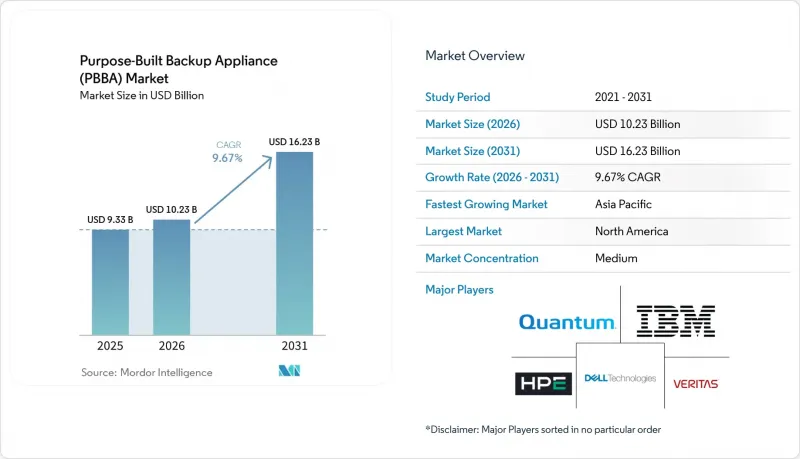
According to Mordor Intelligence, the market size of the Purpose-Built Backup Appliance (PBBA) market was valued at USD 9.33 billion in 2025 and is expected to increase to USD 10.23 billion in 2026. This report is Segmented by Appliance Type (Integrated PBBA, and Target PBBA), Deployment Mode (On-Premises, Cloud-Connected, and More), Form Factor (Rack-Mounted, Tower, and More), End-User Industry (Banking and Financial Services, Healthcare, Life Sciences, Government and Defense, Retail and E-Commerce, and More), and Geography. The Market Forecasts are Provided in Terms of Value (USD).
Global Purpose-Built Backup Appliance (PBBA) Market Trends and Insights
Exploding Ransomware Incidents Elevating Demand for Immutable Backup Targets
Ransomware attackers compromise backup repositories in 96% of successful breaches, making immutable storage a frontline defense. Tiered architectures such as ExaGrid's non-network-facing repository layer now isolate data from production networks. AI-driven anomaly detection flags suspicious deletions and triggers automated safeguards. Cyber-insurance providers grant 10-15% premium reductions to clients deploying certified immutable targets. Object First's Ootbi appliance achieves eleven-nines durability while maintaining a complete air gap. These economic and security incentives accelerate Purpose-Built Backup Appliance market adoption across regulated industries.
Mandatory Data-Sovereignty and Cyber-Resiliency Regulations in OECD and BRICS
India's Digital Personal Data Protection Act requires in-country storage for payment data, pushing local appliance deployments. GDPR enforcement in Europe has levied EUR 1.32 billion in fines, reinforcing the need for verifiable backup controls. Brazil's AI strategy revived the debate on digital sovereignty, highlighting the role of localized infrastructure. Appliances with object-lock and geo-fencing enable enterprises to satisfy residency rules without ceding operational flexibility. Data-Residency-as-a-Service platforms such as InCountry underscore emerging demand for compliant regional backup nodes. NIST's revised framework now embeds backup integrity as a mandatory resilience control.
Rising Adoption of Agentless Cloud Backup-as-a-Service Reducing On-Prem PBBA Spend
Cloud-native offerings deliver agentless protection with 40-60% lower total cost of ownership compared with appliance ownership. Veeam's Microsoft partnership channels AI analytics into policy management, attracting SaaS-first buyers. Even so, data-localization rules and recovery-time guarantees keep hybrid models relevant, prompting Commvault's acquisition of Clumio to widen cloud coverage. Vendors thus hedge with subscription services layered on existing hardware portfolios. The restraint lies in diverted cap-ex, not the elimination of the Purpose-Built Backup Appliance market.
Other drivers and restraints analyzed in the detailed report include:
- Cloud-Connected PBBA Integrated into Hybrid-IT Architectures
- Hardware-Level Support for Object-Lock and WORM Enabling Cyber-Insurance Discounts
- Budget Squeeze Amid Macro IT Cap-ex Re-Prioritization
For complete list of drivers and restraints, kindly check the Table Of Contents.
Segment Analysis
The purpose-built backup appliance market size attached to target platforms is expected to outpace integrated models in the second half of the forecast horizon, driven by container-native data flows and multi-cloud workload mobility.
Modular licensing blurs the integrated-versus-target distinction. Quantum's DXi-series firmware now lets administrators flip between modes without swapping hardware. This elasticity extends asset life by up to three budget cycles and supports phased migrations when application portfolios shift. Vendors updating appliances over-the-air rather than through forklift replacements also reduce customer churn and seed recurring revenue.
On-premises installations retained 49.82% of 2025 spending as latency-sensitive workloads and sovereignty laws restrict off-site replication. Hybrid deployments are scaling at a 10.46% CAGR to 2031 because firms keep hot restores on local flash while pushing long-term copies to low-cost object stores, cutting storage expense by more than half for cold data sets. The purpose-built backup appliance market size tied to hybrid architectures should climb steadily as WAN optimization algorithms mature and cloud egress fees remain punitive for bulk restores.
Nevertheless, network bandwidth often caps cloud replication volume, and a 100 TB recovery from a hyperscaler can incur USD 9,000 in transfer fees. Suppliers now bundle layered deduplication, adaptive tiering, and bandwidth throttling. ExaGrid's January 2026 release prioritizes datasets most likely to be restored, freeing bandwidth for mission-critical objects. These enhancements widen the hybrid appeal without compromising recovery-time objectives.
Geography Analysis
North America generated 37.78% of 2025 revenue, its cyber-insurance underwriters compelling policyholders to operate immutable backups and quarterly restore tests. Vacancy in the region's data-center market fell to 1.4% during 2025, and Northern Virginia alone absorbed 1,102 MW of additional capacity, a scenario that amplified appetite for high-density backup gear placed inside colocation suites. Power pricing above USD 190 per kW tipped procurement toward liquid-cooled appliance lines such as Dell's PowerProtect DP5500, which boosts deduplication throughput per rack unit while cutting thermal load.
Asia-Pacific is on track for a 9.96% CAGR through 2031, undergirded by USD 772 billion in data-center pipelines that add 24 GW of capacity between 2025 and 2030. India's installed base could multiply sixfold by 2032, and Johor, Malaysia, already hosts 897 MW with a sub-1% vacancy rate. Sovereignty laws barring cross-border replication obligate enterprises to deploy local backup appliances, bolstering the purpose-built backup appliance market in jurisdictions where hyperscale cloud coverage lags. KPMG projects the region's data-center power demand will climb to 37,580 MW by 2030, a 165% jump from 2024 levels, indicating corresponding acceleration for associated data-protection infrastructure.
Europe's growth leans on DORA compliance across financial services, while Middle East and Africa momentum stems from sovereign AI infrastructure such as Saudi Arabia's HUMAIN project that earmarks 6 GW for GPU-rich data halls. These new facilities require flash-heavy backup appliances able to restore 10 TB model checkpoints within minutes, driving niche demand for GPU-tuned platforms. South America remains modest in scale, with Brazil's financial regulators and Argentina's telecom operators forming the primary purchase base.
- Dell Technologies Inc.
- Hewlett Packard Enterprise Company
- International Business Machines Corporation
- Quantum Corporation
- Veritas Technologies LLC
- Hitachi Vantara LLC
- Cohesity Inc.
- Commvault Systems Inc.
- ExaGrid Systems Inc.
- Fujitsu Limited
- NetApp Inc.
- Oracle Corporation
- Arcserve LLC
- Rubrik Inc.
- Veeam Software AG
- StorageCraft Technology Corporation
- Acronis International GmbH
- Unitrends Inc.
- Barracuda Networks Inc.
- Spectra Logic Corporation
- Druva Inc.
Additional Benefits:
- The market estimate (ME) sheet in Excel format
- 3 months of analyst support
TABLE OF CONTENTS
1 INTRODUCTION
- 1.1 Study Assumptions and Market Definition
- 1.2 Scope of the Study
2 RESEARCH METHODOLOGY
3 EXECUTIVE SUMMARY
4 MARKET LANDSCAPE
- 4.1 Market Overview
- 4.2 Market Drivers
- 4.2.1 Rising Data Volumes From Edge-Generated Workloads
- 4.2.2 Stricter Global Data Protection Regulations
- 4.2.3 Declining Cost per Terabyte of Flash Storage
- 4.2.4 Integration of Backup Appliances With Cyber-Recovery Vaults
- 4.2.5 Growing Adoption of Containerized Application Architectures
- 4.2.6 ESG-Driven IT Modernization Mandates
- 4.3 Market Restraints
- 4.3.1 Proliferation of Cloud-Native Backup-as-a-Service Offerings
- 4.3.2 Budget Freezes in Public Sector IT Modernization
- 4.3.3 Skills Gap in Advanced Data Protection Administration
- 4.3.4 High Energy Consumption of On-Premises Appliances
- 4.4 Industry Value Chain Analysis
- 4.5 Regulatory Landscape
- 4.6 Technological Outlook
- 4.7 Impact of Macroeconomic Factors on the Market
- 4.8 Porter's Five Forces Analysis
- 4.8.1 Threat of New Entrants
- 4.8.2 Bargaining Power of Suppliers
- 4.8.3 Bargaining Power of Buyers
- 4.8.4 Threat of Substitutes
- 4.8.5 Degree of Competition
5 MARKET SIZE AND GROWTH FORECASTS
- 5.1 Segmentation by Appliance Type
- 5.1.1 Integrated PBBA
- 5.1.2 Target PBBA
- 5.2 Segmentation by Deployment Mode
- 5.2.1 On-Premises
- 5.2.2 Cloud-Connected
- 5.2.3 Hybrid
- 5.3 Segmentation by Form Factor
- 5.3.1 Rack-Mounted
- 5.3.2 Tower
- 5.3.3 Modular / Scale-Out Nodes
- 5.4 Segmentation by End-User Industry
- 5.4.1 Banking and Financial Services
- 5.4.2 Healthcare and Life Sciences
- 5.4.3 Government and Defense
- 5.4.4 Telecom and Media
- 5.4.5 Manufacturing
- 5.4.6 Retail and e-Commerce
- 5.5 Segmentation by Geography
- 5.5.1 North America
- 5.5.1.1 United States
- 5.5.1.2 Canada
- 5.5.1.3 Mexico
- 5.5.2 South America
- 5.5.2.1 Brazil
- 5.5.2.2 Argentina
- 5.5.2.3 Rest of South America
- 5.5.3 Europe
- 5.5.3.1 Germany
- 5.5.3.2 United Kingdom
- 5.5.3.3 France
- 5.5.3.4 Rest of Europe
- 5.5.4 Asia-Pacific
- 5.5.4.1 China
- 5.5.4.2 Japan
- 5.5.4.3 India
- 5.5.4.4 South Korea
- 5.5.4.5 Rest of Asia-Pacific
- 5.5.5 Middle East and Africa
- 5.5.1 North America
6 COMPETITIVE LANDSCAPE
- 6.1 Market Concentration
- 6.2 Strategic Moves
- 6.3 Market Share Analysis
- 6.4 Company Profiles (includes Global Level Overview, Market Level Overview, Core Segments, Financials as available, Strategic Information, Market Rank/Share, Products and Services, Recent Developments)
- 6.4.1 Dell Technologies Inc.
- 6.4.2 Hewlett Packard Enterprise Company
- 6.4.3 International Business Machines Corporation
- 6.4.4 Quantum Corporation
- 6.4.5 Veritas Technologies LLC
- 6.4.6 Hitachi Vantara LLC
- 6.4.7 Cohesity Inc.
- 6.4.8 Commvault Systems Inc.
- 6.4.9 ExaGrid Systems Inc.
- 6.4.10 Fujitsu Limited
- 6.4.11 NetApp Inc.
- 6.4.12 Oracle Corporation
- 6.4.13 Arcserve LLC
- 6.4.14 Rubrik Inc.
- 6.4.15 Veeam Software AG
- 6.4.16 StorageCraft Technology Corporation
- 6.4.17 Acronis International GmbH
- 6.4.18 Unitrends Inc.
- 6.4.19 Barracuda Networks Inc.
- 6.4.20 Spectra Logic Corporation
- 6.4.21 Druva Inc.
7 MARKET OPPORTUNITIES AND FUTURE OUTLOOK
- 7.1 White-Space and Unmet-Need Assessment

