
PUBLISHER: Mordor Intelligence | PRODUCT CODE: 2062429

PUBLISHER: Mordor Intelligence | PRODUCT CODE: 2062429
Inkjet Coders - Market Share Analysis, Industry Trends & Statistics, Growth Forecasts (2026 - 2031)
According to Mordor Intelligence, the inkjet coders market size is expected to increase from USD 2.23 billion in 2025 to USD 2.41 billion in 2026 and reach USD 3.64 billion by 2031, growing at a CAGR of 8.23% over 2026-2031.
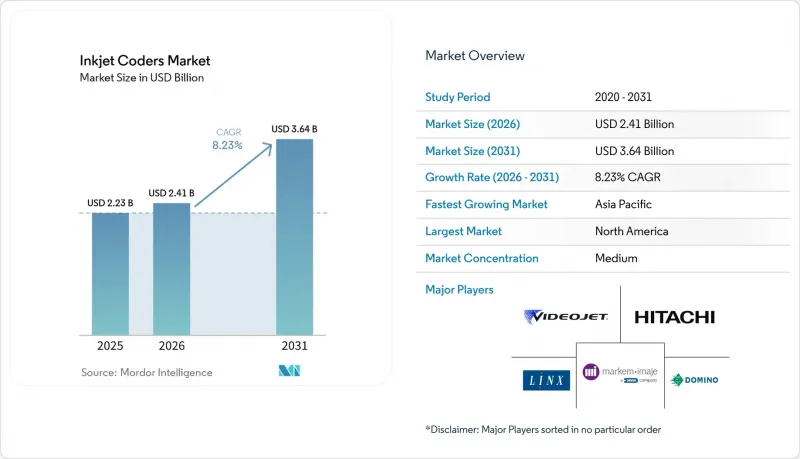
This report is Segmented by Technology (Continuous Inkjet, and More), End-Use Industry (Food and Beverage, Pharmaceuticals and Healthcare, and More), Ink Type (Solvent-Based Dye Inks, UV-Curable and LED Inks, and More), Substrate Material (Plastics, Paper and Paperboard, and More), and Geography (North America, Asia-Pacific, and More). The Market Forecasts are Provided in Terms of Value (USD).
Global Inkjet Coders Market Trends and Insights
Stringent Serialization and Traceability Regulations
Drug-supply-chain laws in the United States and the European Union now obligate every prescription pack to carry Data Matrix barcodes that pass ISO/IEC 15415 grade 1.5 or higher, pushing manufacturers to retrofit or replace coders for compliant high-resolution printing. China's National Medical Products Administration and India's iVEDA export program extended the same requirement to Asian producers, while Saudi Arabia's dual-language mandate, effective October 2025, added multi-character-set capability to procurement checklists. Food traceability is moving in parallel, as the U.S. FSMA Rule 204 and the GS1 Sunrise 2027 initiative force high-risk foods to carry serialized 2D codes readable at retail. Collectively, these policies compress decision windows, making compliance-ready inkjet coders market solutions central to capital plans.
Proliferation of High-Speed FMCG Production Lines
Beverage, dairy, and snack plants now run at 1,200 units per minute, narrowing the print window to fractions of a second. Markem-Imaje's 9750 thermal inkjet achieved 120,000 cans per hour in 2024 trials, highlighting throughput advantages over legacy continuous inkjet on small-character codes. Domino's Gx-Series meets similar speeds on flexible films, ensuring crisp, high-contrast marks on flow-wrap pouches. Asia-Pacific beverage hubs lead installations, while North American dairies retrofit HDPE jug lines. Cameras wired into reject stations verify every code in real time, safeguarding against recalls and penalties.
VOC-Related Emissions Rules Limiting Solvent-Based Inks
California Air Resources Board caps and EU REACH limits on methyl ethyl ketone, toluene, and xylene force converters to replace solvent inks with UV-curable or water-based formulations. Although solvent inks still offer superior adhesion on HDPE and PP, new VOC thresholds accelerate UV-LED adoption that eliminates airborne pollutants and aligns with food-contact migration rules.
Other drivers and restraints analyzed in the detailed report include:
- Rapid Shift to Sustainable, Washable and Returnable Packaging
- Integration of CIJ/TIJ Heads into Industry 4.0 MES Stacks
- Capital-Expenditure Freezes in Recession-Exposed Sectors
For complete list of drivers and restraints, kindly check the Table Of Contents.
Segment Analysis
Thermal inkjet lines captured expanding beverage and dairy demand, pushing the segment toward a 9.9% CAGR, while continuous inkjet still held 43.2% of 2025 revenue. The inkjet coders market size for continuous inkjet remains buoyed by its non-contact versatility across plastics, films and corrugate. High-resolution piezo drop-on-demand platforms gained share in pharmaceutical serialization, printing Data Matrix codes at ISO/IEC grades that legacy systems cannot match. Adoption of valve-jet units stayed strong in construction and agro-chemical packaging where character height outweighs graphic fidelity. Ongoing R&D in high-viscosity piezo heads, exemplified by Kyocera's 1,584-nozzle model able to jet 80 mPa*s fluids, will extend inkjet into decorative coatings and 3D molds.
Scaling lessons differ. Thermal heads excel where line speeds exceed 1,000 units per minute, yet nozzle lifespan and cartridge cost remain scrutinized. Continuous inkjet vendors counter with self-cleaning printhead diagnostics and lower per-code consumables, defending dominance in flexible packaging. Mixed-technology footprints are therefore common, allowing plants to allocate the right head to the right substrate without sacrificing uptime.
Food and beverage lines accounted for 40.5% of the revenue in 2025, driven by extensive SKU counts and retailer requirements for 2D barcodes. This segment remains dominant due to its broad application across various product categories. However, the pharmaceutical and healthcare sectors are experiencing the fastest growth, with a compound annual growth rate (CAGR) of 9.7%, fueled by global serialization initiatives. The inkjet coders market, primarily led by food companies, is expected to maintain its stronghold. At the same time, the increasing demand for high-resolution coding in injectable biologics, pre-filled syringes, and medical-device kits is creating opportunities for higher-margin unit volumes. Additionally, electronics manufacturers are adopting UV-curable and laser hybrid technologies to meet IPC traceability standards, while automotive and aerospace industries are integrating valve-jet coders for engine blocks and composite panels.
Cosmetics brands are also adapting to evolving requirements, particularly indelible batch-code regulations, by transitioning to UV-LED inks. These inks are specifically designed to bond seamlessly to soft-touch laminates without causing blemishes, ensuring compliance and maintaining product aesthetics. The growing emphasis on traceability and regulatory compliance across industries is driving innovation in coding and marking technologies. As a result, manufacturers are increasingly investing in advanced solutions to meet these demands while enhancing operational efficiency. This trend highlights the critical role of coding technologies in supporting industry-specific needs and addressing the challenges posed by stringent regulations and consumer expectations.
Geography Analysis
North America contributed 33.3% of 2025 revenue on the back of DSCSA and FSMA Rule 204, spurring wide deployment of 2D-capable printers in pharmaceutical and high-risk food plants. Producers integrate coders with MES and ERP suites to automate variable data and remote diagnostics, reducing manual errors and labor overhead. California's tougher VOC caps accelerate UV-LED conversions, although high capital cost tempers rollout among smaller processors.
Asia-Pacific registers the fastest 9.1% CAGR, fueled by China's botulinum-toxin serialization, India's GS1 QR mandates, and Saudi Arabia's dual-language barcode rule that impacts exporters across the region. Investments include SATO's USD 11.3 million Thai label plant that produces 7 million m2 annually to service Southeast Asia. Local vendors such as Chengdu Kelier scale modular coders priced 30-40% below Western brands, capturing share in small-to-medium enterprises.
Europe sustains sizeable demand under the Falsified Medicines Directive Phase 2 and the 2024 Packaging Waste Regulation, which require reusable containers and VOC-free inks. Premium brands upgrade to UV-LED while cost-sensitive firms retrofit CIJ with eco-solvent blends. Germany, the U.K. and France spearhead Industry 4.0 coder integration, whereas Eastern Europe balances compliance needs against budget constraints. Additional momentum stems from Middle East and African serialization laws aligned with EU standards and Brazil's digital drug passport now active across South America.
- Videojet Technologies, Inc.
- Markem-Imaje SAS
- Domino Printing Sciences plc
- Hitachi Industrial Equipment Systems Co., Ltd.
- Linx Printing Technologies Ltd.
- Control Print Limited
- REA Elektronik GmbH
- Matthews International Corporation (Matthews Marking Systems)
- Needham Ink Technologies Ltd.
- FoxJet LLC
- InkJet, Inc.
- KEYENCE Corporation
- Koenig and Bauer Coding GmbH (KBA-Metronic)
- KGK Jet India Pvt. Ltd.
- RN Mark Inc.
- Squid Ink Manufacturing Inc.
- Weber Marking Systems GmbH
- Zanasi S.r.l.
- HSA Systems A/S
- Leibinger GmbH
- EBS Ink-Jet Systeme GmbH
- ATD Ltd. (ALE)
- Guangzhou EC-JET Electronic Co., Ltd.
Additional Benefits:
- The market estimate (ME) sheet in Excel format
- 3 months of analyst support
TABLE OF CONTENTS
1 INTRODUCTION
- 1.1 Study Assumptions and Market Definition
- 1.2 Scope of the Study
2 RESEARCH METHODOLOGY
3 EXECUTIVE SUMMARY
4 MARKET LANDSCAPE
- 4.1 Market Overview
- 4.2 Market Drivers
- 4.2.1 Stringent Serialization and Traceability Regulations
- 4.2.2 Proliferation of High-Speed FMCG Production Lines
- 4.2.3 Rapid Shift to Sustainable, Washable and Returnable Packaging
- 4.2.4 Integration of CIJ/TIJ Heads into Industry 4.0 MES Stacks
- 4.2.5 Adoption of UV-Curable Inks for Counterfeit Mitigation
- 4.2.6 AI-Enabled Predictive-Maintenance Algorithms for Print-Heads
- 4.3 Market Restraints
- 4.3.1 VOC-Related Emissions Rules Limiting Solvent-Based Inks
- 4.3.2 Capital-Expenditure Freezes in Recession-Exposed Sectors
- 4.3.3 Rising Competition from Laser Coders on High-Contrast Packs
- 4.3.4 Supply-Chain Bottlenecks for Piezo Print-Head Components
- 4.4 Industry Value / Supply-Chain Analysis
- 4.5 Regulatory Landscape
- 4.6 Impact of Macroeconomic Factors on the Market
- 4.7 Technological Outlook
- 4.8 Porter's Five Forces Analysis
- 4.8.1 Threat of New Entrants
- 4.8.2 Bargaining Power of Suppliers
- 4.8.3 Bargaining Power of Buyers
- 4.8.4 Threat of Substitutes
- 4.8.5 Competitive Rivalry
5 MARKET SIZE AND GROWTH FORECASTS (VALUE)
- 5.1 By Technology
- 5.1.1 Continuous Inkjet (CIJ)
- 5.1.2 Thermal Inkjet (TIJ)
- 5.1.3 Piezo Drop-on-Demand
- 5.1.4 Valve-Jet / Large-Character
- 5.2 By End-Use Industry
- 5.2.1 Food and Beverage
- 5.2.2 Pharmaceuticals and Healthcare
- 5.2.3 Electronics and Electrical
- 5.2.4 Automotive and Aerospace
- 5.2.5 Cosmetics and Personal Care
- 5.2.6 Chemicals and Industrial Manufacturing
- 5.3 By Ink Type
- 5.3.1 Solvent-Based Dye Inks
- 5.3.2 UV-Curable and LED Inks
- 5.3.3 Water-Based Inks
- 5.3.4 Food-Grade and Edible Inks
- 5.3.5 Pigmented and Specialty Inks
- 5.4 By Substrate Material
- 5.4.1 Plastics (HDPE, PET, PP)
- 5.4.2 Paper and Paperboard
- 5.4.3 Glass
- 5.4.4 Metals (Aluminum, Steel)
- 5.4.5 Flexible Films and Laminates
- 5.5 By Geography
- 5.5.1 North America
- 5.5.1.1 United States
- 5.5.1.2 Canada
- 5.5.1.3 Mexico
- 5.5.2 Europe
- 5.5.2.1 Germany
- 5.5.2.2 United Kingdom
- 5.5.2.3 France
- 5.5.2.4 Russia
- 5.5.2.5 Rest of Europe
- 5.5.3 Asia-Pacific
- 5.5.3.1 China
- 5.5.3.2 Japan
- 5.5.3.3 India
- 5.5.3.4 South Korea
- 5.5.3.5 Australia
- 5.5.3.6 Rest of Asia-Pacific
- 5.5.4 Middle East and Africa
- 5.5.4.1 Middle East
- 5.5.4.1.1 Saudi Arabia
- 5.5.4.1.2 United Arab Emirates
- 5.5.4.1.3 Rest of Middle East
- 5.5.4.2 Africa
- 5.5.4.2.1 South Africa
- 5.5.4.2.2 Egypt
- 5.5.4.2.3 Rest of Africa
- 5.5.4.1 Middle East
- 5.5.5 South America
- 5.5.5.1 Brazil
- 5.5.5.2 Argentina
- 5.5.5.3 Rest of South America
- 5.5.1 North America
6 COMPETITIVE LANDSCAPE
- 6.1 Market Concentration
- 6.2 Strategic Moves
- 6.3 Market Share Analysis
- 6.4 Company Profiles (includes Global Level Overview, Market Level Overview, Core Segments, Financials as available, Strategic Information, Market Rank/Share, Products and Services, Recent Developments)
- 6.4.1 Videojet Technologies, Inc.
- 6.4.2 Markem-Imaje SAS
- 6.4.3 Domino Printing Sciences plc
- 6.4.4 Hitachi Industrial Equipment Systems Co., Ltd.
- 6.4.5 Linx Printing Technologies Ltd.
- 6.4.6 Control Print Limited
- 6.4.7 REA Elektronik GmbH
- 6.4.8 Matthews International Corporation (Matthews Marking Systems)
- 6.4.9 Needham Ink Technologies Ltd.
- 6.4.10 FoxJet LLC
- 6.4.11 InkJet, Inc.
- 6.4.12 KEYENCE Corporation
- 6.4.13 Koenig and Bauer Coding GmbH (KBA-Metronic)
- 6.4.14 KGK Jet India Pvt. Ltd.
- 6.4.15 RN Mark Inc.
- 6.4.16 Squid Ink Manufacturing Inc.
- 6.4.17 Weber Marking Systems GmbH
- 6.4.18 Zanasi S.r.l.
- 6.4.19 HSA Systems A/S
- 6.4.20 Leibinger GmbH
- 6.4.21 EBS Ink-Jet Systeme GmbH
- 6.4.22 ATD Ltd. (ALE)
- 6.4.23 Guangzhou EC-JET Electronic Co., Ltd.
7 MARKET OPPORTUNITIES AND FUTURE OUTLOOK
- 7.1 White-Space and Unmet-Need Assessment

