PUBLISHER: Mordor Intelligence | PRODUCT CODE: 2062440

PUBLISHER: Mordor Intelligence | PRODUCT CODE: 2062440
AI Code Tools - Market Share Analysis, Industry Trends & Statistics, Growth Forecasts (2026 - 2031)
According to Mordor Intelligence, the artificial intelligence (AI) code tools market size is projected to be USD 7.37 billion in 2025, USD 9.35 billion in 2026, and reach USD 29.96 billion by 2031, growing at a CAGR of 26.23% from 2026 to 2031.
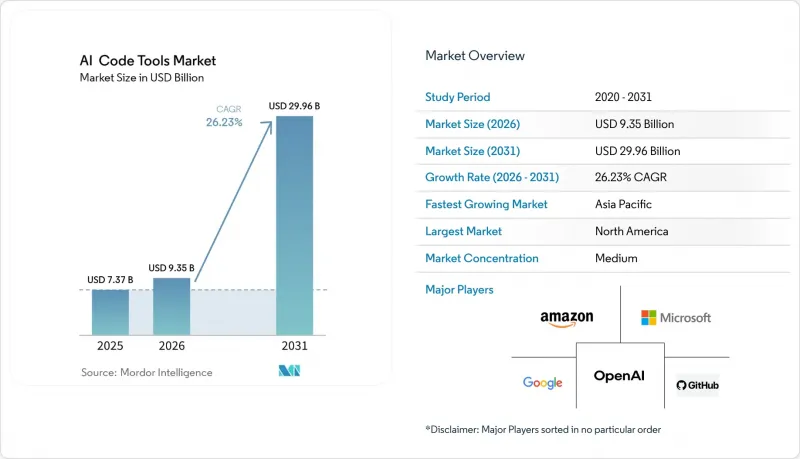
This report is Segmented by Deployment Mode (Cloud-Based, and More), Tool Functionality (Code Completion, Code Generation, Code Review and Optimization, and More), End-User Industry (IT and Telecom, BFSI, Healthcare and Life Sciences, Retail and E-Commerce, and More), Organization Size (Large Enterprises, and Small and Medium Enterprises), and Geography. The Market Forecasts are Provided in Terms of Value (USD).
Global AI Code Tools Market Trends and Insights
Exploding LLM Accuracy Drives Enterprise Confidence in Code Generation
Foundation-model accuracy surged past 90% on HumanEval in 2025, with OpenAI's o1-mini and Anthropic's Claude 3.5 Sonnet both hitting 92.4%, effectively matching senior-developer performance on standardized tasks. Enterprises that once rejected AI-generated code at double-digit error rates now accept agentic refactors without manual, line-by-line review. Moonshot AI's Kimi K2 pushed the ceiling to 94.5%, proving the improvement arc is still steep. NatWest's operational data shows that once accuracy exceeded 90%, AI code assistants moved from shadow testing into production pipelines. Higher accuracy also unlocks multi-agent workflows in which models plan, refactor, and compile code across repositories, though Anthropic's 2026 survey notes that engineers delegate only 0-20% of tasks fully, signaling persistent human oversight.
IDE Plug-in Proliferation Embeds AI into Daily Developer Workflows
AI assistants are now native features inside Visual Studio Code and JetBrains IDEs rather than standalone sidebars. Google Cloud's Gemini Code Assist added enterprise-grade GitHub integrations in October 2025, targeting the 60.2% of teams whose code-review cycles exceed a day. Cursor, an AI-native fork of VS Code, reached USD 500 million ARR by mid-2025, proving that context-aware AI editors can outpace plug-in approaches when multi-file reasoning is essential. Microsoft doubled down in March 2026 by embedding agentic features across Word, Excel, and Outlook, signaling that generative coding is no longer a developer-only phenomenon. Citing 40 minutes saved per developer transaction and more than 500,000 hours saved overall, the move highlights the tangible hours freed by plug-in ubiquity.
IP and Copyright Liability Concerns Slow Enterprise Procurement
Copyright disputes intensified in 2025, creating uncertainty for CIOs drafting indemnity clauses. A Southern District of New York judge let class-action claims against OpenAI proceed, ruling that substantial-similarity arguments merited discovery. GitHub Copilot faces a Ninth Circuit appeal over alleged DMCA violations for stripping attribution. News Corp's suit against Perplexity AI claims retrieval-augmented generation harms publishers by bypassing paywalls. These high-profile cases push buyers to demand duplication-detection tools that flag license conflicts before committing code. The EU AI Act compounds risks by requiring providers to publish summaries of their training data and to handle rights-holder complaints, with enforcement starting in August 2026.
Other drivers and restraints analyzed in the detailed report include:
- Vendor-Bundled Cloud Credits and Free Tiers Expand Access
- 75% of Enterprise Developers to Use AI Assistants by 2028
- Model Hallucination and Security Vulnerabilities Constrain Production Deployment
For complete list of drivers and restraints, kindly check the Table Of Contents.
Segment Analysis
The cloud-based slice of the Artificial Intelligence (AI) code tools market accounted for 72.47% of overall revenue, while on-premises deployments accounted for the balance. On-premises options are set to grow at a 26.55% CAGR as banks, health systems, and defense agencies shun third-party data processing that might breach sovereignty rules. Vault's 200-server footprint and Anaconda's Llama 2 fine-tuning kits exemplify the appetite for self-hosted stacks. The EU AI Act's transparency fines strengthen the case for keeping models behind corporate firewalls, especially where sensitive personally identifiable information appears in code comments.
Cloud providers retain an edge in speed and diversity. Google Cloud's March 2026 rollout of Gemini 3.1 Pro with a 1-million-token window illustrates innovations that would be costly to replicate on-site. Microsoft's Frontier Suite dynamically routes prompts among Anthropic and OpenAI models, a feature that single-tenant clusters struggle to match. Hybrid strategies dominate roadmaps, sensitive repositories remain on-premises while low-criticality tasks use SaaS APIs, enabling firms to maximize capabilities without breaching compliance guardrails. As a result, the AI code tools market continues to bifurcate into cloud-native convenience and on-premises control.
Code completion accounted for 38.19% of 2025 revenue, yet the security-assistant niche is now the fastest-growing at a 26.83% CAGR. Automated scanners cross-reference generated snippets against vulnerability databases and flag incompatible licenses before merge, easing audit fatigue. Anthropic's 2026 usage data shows that developers invoke security checks in 42% of agentic sessions, up from 18% in early 2025. This acceleration aligns with EU mandates that require documentation of training data and governance controls.
Documentation bots and AI-powered test generators follow close behind. Continuous-integration pipelines pass off flaky test detection and coverage analysis to LLMs, shortening release cycles by double-digit percentages. The AI code tools market share for code-review bots remains sticky because many teams treat AI as a second pair of eyes rather than an autonomous approver. As compliance automation drives adoption, the functionality hierarchy is shifting from productivity to risk management, cementing security as the new killer feature.
Geography Analysis
North America accounted for 41.89% of 2025 revenue, reflecting hyperscaler investments, venture funding density, and early enterprise adoption. US banks and Canadian telcos have institutionalized AI governance offices that standardize prompt libraries and risk controls, embedding assistants deeply into secure software development lifecycles. Intellectual property litigation remains a regional headwind, but legal certainty often arrives more quickly in US courts, encouraging first-mover experimentation.
Europe is progressing under a compliance-first approach, emphasizing adherence to regulatory frameworks. The General-Purpose AI Code of Practice, introduced in July 2025, offers providers a set of voluntary checklists focusing on critical aspects such as copyright compliance and transparency. This initiative is designed to prepare the region for the enforcement of the EU AI Act, which is scheduled to come into effect in August 2026. In response to these regulatory developments, banks and insurers are increasingly adopting on-premises clusters to comply with stringent data-residency requirements. This shift is driving growth in the AI code tools market across the continent, while also redirecting spending priorities toward governance-related features to ensure compliance with the evolving regulatory landscape.
Asia-Pacific is the standout growth engine, with a 26.68% CAGR. Chinese vendors like Alibaba's Qwen now offer multimodal, agent-ready models at one-sixth the US cost, unlocking adoption among Indian outsourcers and Southeast-Asian startups. Government grants in Singapore and South Korea fund in-country accelerators that waive GPU fees for SMEs. The price-performance edge tilts spending toward cost-optimized stacks, even as English-language proficiency broadens addressable developer bases. South America, the Middle East, and Africa sit at earlier stages of AI adoption, but government digital-transformation agendas and offshore support hubs are beginning to pull AI code tools into public tenders and local tech ecosystems.
- GitHub, Inc.
- Amazon.com, Inc. (Amazon Web Services, Inc.)
- Google LLC
- Microsoft Corporation
- International Business Machines Corporation
- JetBrains s.r.o.
- Tabnine Ltd.
- Sourcegraph, Inc.
- OpenAI OpCo, LLC
- Anthropic PBC
- Meta Platforms, Inc.
- DeepSeek Inc.
- Alibaba Cloud Computing Co., Ltd.
- Tencent Cloud Computing (Beijing) Co., Ltd.
- Replit, Inc.
- Anysphere, Inc.
- Magic AI, Inc.
- Qodo, Inc.
- Phind, Inc.
- salesforce.com, inc.
- Harness Inc.
- CodeRabbit, Inc.
- Cohere Inc.
- BigCode Project (Software Heritage and Hugging Face)
Additional Benefits:
- The market estimate (ME) sheet in Excel format
- 3 months of analyst support
TABLE OF CONTENTS
1 INTRODUCTION
- 1.1 Study Assumptions and Market Definition
- 1.2 Scope of the Study
2 RESEARCH METHODOLOGY
3 EXECUTIVE SUMMARY
4 MARKET LANDSCAPE
- 4.1 Market Overview
- 4.2 Market Drivers
- 4.2.1 Exploding LLM Accuracy (>90% HumanEval)
- 4.2.2 Soaring IDE Plug-in Adoption (VS Code, JetBrains)
- 4.2.3 Vendor-Bundled Cloud Credits and Free Tiers
- 4.2.4 75% of Enterprise Developers to Use AI Assistants by 2028
- 4.2.5 Shift to Private or Local Models for IP Control
- 4.2.6 Edge-Optimized LLMs Reducing Latency for AR, VR Coding
- 4.3 Market Restraints
- 4.3.1 IP and Copyright Liability Concerns
- 4.3.2 Model Hallucination and Security-Bug Risk
- 4.3.3 Rising GPU or ASIC Shortages for On-Prem Clusters
- 4.3.4 Developer-Skill Erosion (Prompt-Engineer Paradox)
- 4.4 Industry Value-Chain Analysis
- 4.5 Impact of Macroeconomic Factors on the Market
- 4.6 Technological Outlook
- 4.7 Regulatory Landscape
- 4.8 Porter's Five Forces Analysis
- 4.8.1 Threat of New Entrants
- 4.8.2 Bargaining Power of Suppliers
- 4.8.3 Bargaining Power of Buyers
- 4.8.4 Threat of Substitutes
- 4.8.5 Competitive Rivalry
5 MARKET SIZE AND GROWTH FORECASTS (VALUE)
- 5.1 By Deployment Mode
- 5.1.1 Cloud-Based
- 5.1.2 On-Premises
- 5.2 By Tool Functionality
- 5.2.1 Code Completion
- 5.2.2 Code Generation
- 5.2.3 Code Review and Optimization
- 5.2.4 Automated Testing
- 5.2.5 Security and Compliance Assistants
- 5.2.6 Documentation and Commenting
- 5.3 By End-User Industry
- 5.3.1 IT and Telecom
- 5.3.2 BFSI
- 5.3.3 Healthcare and Life Sciences
- 5.3.4 Retail and E-Commerce
- 5.3.5 Media and Entertainment
- 5.3.6 Government and Public Sector
- 5.3.7 Others End-User Industry
- 5.4 By Organization Size
- 5.4.1 Large Enterprises
- 5.4.2 Small and Medium Enterprises
- 5.5 By Geography
- 5.5.1 North America
- 5.5.1.1 United States
- 5.5.1.2 Canada
- 5.5.1.3 Mexico
- 5.5.2 Europe
- 5.5.2.1 Germany
- 5.5.2.2 United Kingdom
- 5.5.2.3 France
- 5.5.2.4 Italy
- 5.5.2.5 Spain
- 5.5.2.6 Rest of Europe
- 5.5.3 Asia-Pacific
- 5.5.3.1 China
- 5.5.3.2 Japan
- 5.5.3.3 India
- 5.5.3.4 South Korea
- 5.5.3.5 Australia
- 5.5.3.6 Rest of Asia-Pacific
- 5.5.4 South America
- 5.5.4.1 Brazil
- 5.5.4.2 Argentina
- 5.5.4.3 Rest of South America
- 5.5.5 Middle East and Africa
- 5.5.5.1 Middle East
- 5.5.5.1.1 Saudi Arabia
- 5.5.5.1.2 United Arab Emirates
- 5.5.5.1.3 Rest of Middle East
- 5.5.5.2 Africa
- 5.5.5.2.1 South Africa
- 5.5.5.2.2 Egypt
- 5.5.5.2.3 Rest of Africa
- 5.5.5.1 Middle East
- 5.5.1 North America
6 COMPETITIVE LANDSCAPE
- 6.1 Market Concentration
- 6.2 Strategic Moves
- 6.3 Market Share Analysis
- 6.4 Company Profiles (includes Global Level Overview, Market Level Overview, Core Segments, Financials as available, Strategic Information, Market Rank/Share, Products and Services, Recent Developments)
- 6.4.1 GitHub, Inc.
- 6.4.2 Amazon.com, Inc. (Amazon Web Services, Inc.)
- 6.4.3 Google LLC
- 6.4.4 Microsoft Corporation
- 6.4.5 International Business Machines Corporation
- 6.4.6 JetBrains s.r.o.
- 6.4.7 Tabnine Ltd.
- 6.4.8 Sourcegraph, Inc.
- 6.4.9 OpenAI OpCo, LLC
- 6.4.10 Anthropic PBC
- 6.4.11 Meta Platforms, Inc.
- 6.4.12 DeepSeek Inc.
- 6.4.13 Alibaba Cloud Computing Co., Ltd.
- 6.4.14 Tencent Cloud Computing (Beijing) Co., Ltd.
- 6.4.15 Replit, Inc.
- 6.4.16 Anysphere, Inc.
- 6.4.17 Magic AI, Inc.
- 6.4.18 Qodo, Inc.
- 6.4.19 Phind, Inc.
- 6.4.20 salesforce.com, inc.
- 6.4.21 Harness Inc.
- 6.4.22 CodeRabbit, Inc.
- 6.4.23 Cohere Inc.
- 6.4.24 BigCode Project (Software Heritage and Hugging Face)
7 MARKET OPPORTUNITIES AND FUTURE OUTLOOK
- 7.1 White-Space and Unmet-Need Assessment

