PUBLISHER: Mordor Intelligence | PRODUCT CODE: 2062443

PUBLISHER: Mordor Intelligence | PRODUCT CODE: 2062443
Aerospace Testing - Market Share Analysis, Industry Trends & Statistics, Growth Forecasts (2026 - 2031)
According to Mordor Intelligence, the aerospace testing market size is expected to grow from USD 5.58 billion in 2025 to USD 5.91 billion in 2026 and is forecast to reach USD 7.64 billion by 2031 at a 5.29% CAGR over 2026-2031.
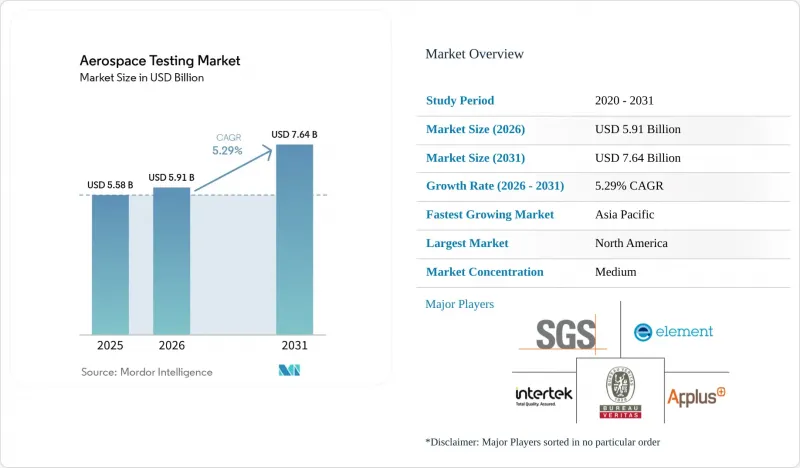
This report is Segmented by Service Type (Non-Destructive Testing, Environmental and Climatic Testing, Structural and Load Testing, and More), Component (Airframe, Avionics and Electrical Systems, Propulsion Systems, and More), Testing Method (Physical Testing, and Virtual, Digital-Twin Testing), End-User (OEMs, Mros, and More), and Geography. The Market Forecasts are Provided in Terms of Value (USD).
Global Aerospace Testing Market Trends and Insights
Accelerating Composites Adoption Elevates NDT Demand
Composite structures now exceed 50% of the empty weight on platforms such as the 787 and A350, and higher laminate content introduces failure modes that visual inspection cannot catch.Automated phased-array ultrasonics screen sandwich panels up to 27 times faster than single-element probes, while adaptive plane-wave imaging cuts amplitude variation from 23.18 dB to 1.86 dB, improving defect detection in curved spars. Nadcap accreditation for composite NDT has therefore become mandatory for Tier-1 suppliers, but the pipeline for Level 3 inspectors remains tight, extending lead times and keeping prices firm. Rising composite penetration is expected to uphold premium rates for accredited labs even as OEMs automate lay-up and cure monitoring. These dynamics jointly sustain the aerospace testing market's appetite for advanced NDT capacity through the medium term.
Rapid Ramp-Up of Satellite Megaconstellations
Starlink operated more than 7,000 satellites by 2025 and targets 12,000 before 2030, while Project Kuiper and OneWeb together plan another 4,000-plus spacecraft. Every satellite requires thermal-vacuum testing from -150 °C to +150 °C and EMI screening to comply with ITU and FCC Part 25 spectrum rules. Chamber queues are lengthening; consequently, prime contractors are building captive test bays, and independents such as Element have added a Texas composites center designed to handle 15,000 samples a year to relieve bottlenecks. Virtual twins are also gaining traction, allowing engineers to iterate on antenna patterns or thermal paths without tying up scarce hardware. This constellation boom is set to anchor double-digit growth for space-related environmental and vibration services.
High Capex for Environmental and Anechoic Chambers
A 3-meter EMC chamber costs USD 150,000-400,000, while full-scale temperature-humidity-vibration rigs exceed USD 1 million, deterring new entrants and slowing capacity expansion. TUV SUD's EUR 15 million (USD 17.5 million) Volpiano complex underscores the investment needed for Nadcap-ready sites. Lead times of 12-18 months to source chambers can create short-term supply squeezes, leading to higher pricing. Emerging-market labs struggle most due to limited access to low-cost capital and concentrated customer bases. High capex thus tempers growth even as demand climbs.
Other drivers and restraints analyzed in the detailed report include:
- Stricter ICAO and FAA Sustainability, NOx Rules
- Digital-Twin Validation Cuts Physical Test Cycles
- Shortage of AS9100-Certified Testing Talent
For complete list of drivers and restraints, kindly check the Table Of Contents.
Segment Analysis
The aerospace testing market service type, non-destructive testing (NDT), accounted for 62.52%. However, software and simulation services are advancing 5.93% annually, reflecting OEM strategies to validate designs virtually before committing to prototypes. Physical NDT remains fundamental because Nadcap and regulators still demand proof loads, fracture mechanics coupons, and real-environment exposure. Yet digital twins now incorporate many early iterations, allowing labs to monetize high-value correlation projects rather than commodity coupon runs. Hybrid providers that host both GPU clusters and vibration shakers are capturing sticky, multi-year contracts.
Growth in simulation is also widening access for smaller suppliers by reducing barriers to entry. Cloud-native platforms enable Tier-2 metal formers to avoid capital-intensive solvers while providing primes with standardized data formats. Over 40% of major OEMs now use lifecycle twins to forecast maintenance requirements, driving increased demand for prognostics and health management test services. Consequently, the service-type mix is shifting structurally toward virtual validation, even as destructive testing remains essential for certification purposes. This hybrid approach is shaping the future of aerospace testing services.
In 2025, airframe structures accounted for 37.19% of total revenue. However, as advancements in hydrogen, hybrid-electric, and hypersonic engines take center stage, propulsion testing is poised to lead with the fastest growth rate, projected at 5.78% CAGR. Propulsion programs, demanding precision, utilize cryogenic handling at a frigid -253 °C, high-altitude combustor rigs, and wind tunnels exceeding Mach 5, all commanding premium prices. These advanced testing requirements are critical for ensuring the reliability and performance of next-generation propulsion systems. Concurrently, materials labs are focused on ceramic matrix composites and additive titanium coupons, working to qualify higher-temperature cores and maintain a steady baseline. These efforts are essential to meet the increasing demand for materials capable of withstanding extreme conditions in modern aerospace applications.
Avionics testing is on the rise, driven by fly-by-wire retrofits and stringent cybersecurity mandates. The growing adoption of fly-by-wire systems enhances aircraft performance and safety, while cybersecurity measures address the increasing risks associated with digital avionics systems. At the same time, qualifying composite materials remains crucial; every new resin or fiber variant necessitates thorough evidence of thermal, flammability, and fatigue properties. This rigorous qualification process ensures compliance with safety standards and supports the development of lighter, more efficient aircraft. Collectively, the intricate nature of propulsion and its heightened regulatory scrutiny are steering capital investments towards engine test cells, propelling the aerospace testing market into its next growth phase. These investments are expected to drive innovation and support the evolving needs of the aerospace industry.
Geography Analysis
North America contributed 46.47% of 2025 revenue, driven by a robust network of OEM headquarters, NASA facilities, and over 200 Nadcap-accredited labs. Investments like Lockheed Martin's USD 17.1 million Hypersonic System Integration Lab in Alabama aim to mitigate risks in classified schedules while opening up commercial slots for third-party testing. Despite its maturity, the region faces increasing demand as megaconstellation payloads and hydrogen engines compete for limited vacuum and cryogenic testing bays. This competition has led to longer chamber queues, highlighting the need for expanded capacity to meet growing requirements. North America remains a critical hub for advanced testing infrastructure and innovation.
Asia-Pacific is the fastest-growing region, with a projected CAGR of 5.84% through 2031, supported by initiatives such as China's C919 certification flights and India's development of five AMCA prototypes by 2031. Governments in the region are actively co-funding test hubs, including Singapore's engine MRO expansions and South Korea's Sacheon complex, to enhance supply chain efficiency and develop local expertise. Tier-2 suppliers are moving up the value chain, as seen with Bharat Forge's ring-rolling plant, which will supply components for Rolls-Royce's Pearl 10X programs. These developments are solidifying the region's position as a key player in the global testing market. Asia-Pacific's growth is further fueled by its focus on reducing dependency on external markets.
Europe continues to hold significant influence through its established Airbus, Rolls-Royce, and Safran ecosystems, operating under EASA's regulatory framework. The EUR 64 million (USD 74.51 million) UltraFan 30 grant demonstrates strong institutional support for green propulsion testbeds, while TUV SUD's EUR 15 million (USD 17.46 million) Volpiano lab reflects independent players aligning with OEM investments. Emerging clusters in South America, the Middle East, and Africa are also gaining traction, focusing on free-zone MRO parks and localized NDT services. These regions benefit from lower regulatory barriers and cost advantages, attracting price-sensitive projects and fostering growth in their testing capabilities. Europe's leadership in green technology and innovation remains a key differentiator in the global market.
- SGS SA
- Bureau Veritas SA
- Intertek Group plc
- Element Materials Technology
- Applus+ Laboratories
- TUV SUD AG
- National Technical Systems Inc.
- Mistras Group Inc.
- Dayton T. Brown Inc.
- IABG mbH
- DNV AS
- TUV Rheinland AG
- Eurofins Scientific SE
- L3Harris Environmental Test Labs
- Lockheed Martin Test Labs
- Boeing Test & Evaluation
- Airbus Defence & Space Structural Test Centre
- Northrop Grumman Structural Testing Services
- Rolls-Royce Testing & Development
- Safran Engineering Services
Additional Benefits:
- The market estimate (ME) sheet in Excel format
- 3 months of analyst support
TABLE OF CONTENTS
1 INTRODUCTION
- 1.1 Study Assumptions and Market Definition
- 1.2 Scope of the Study
2 RESEARCH METHODOLOGY
3 EXECUTIVE SUMMARY
4 MARKET LANDSCAPE
- 4.1 Market Overview
- 4.2 Market Drivers
- 4.2.1 Accelerating Composites Adoption Elevates NDT Demand
- 4.2.2 Rapid Ramp-Up of Satellite Megaconstellations
- 4.2.3 Stricter ICAO and FAA Sustainability, NOx Rules
- 4.2.4 Digital-Twin Validation Cuts Physical Test Cycles
- 4.2.5 Hypersonic Flight Programs Across Major Powers
- 4.2.6 AI-Driven Conformity Analytics Reduces Retest Rates
- 4.3 Market Restraints
- 4.3.1 High Capex for Environmental and Anechoic Chambers
- 4.3.2 Shortage of AS9100-Certified Testing Talent
- 4.3.3 Data-Ownership Conflicts in OEM-Lab Partnerships
- 4.3.4 Cryogenic Hydrogen Safety Protocol Complexity
- 4.4 Industry Value-Chain Analysis
- 4.5 Regulatory Landscape
- 4.6 Technological Outlook
- 4.7 Impact of Macroeconomic Factors on the Market
- 4.8 Porter's Five Forces Analysis
- 4.8.1 Threat of New Entrants
- 4.8.2 Bargaining Power of Suppliers
- 4.8.3 Bargaining Power of Buyers
- 4.8.4 Threat of Substitutes
- 4.8.5 Competitive Rivalry
5 MARKET SIZE AND GROWTH FORECASTS (VALUE)
- 5.1 By Service Type
- 5.1.1 Non-Destructive Testing
- 5.1.2 Environmental and Climatic Testing
- 5.1.3 Structural and Load Testing
- 5.1.4 Vibration and Acoustic Testing
- 5.1.5 EMI / EMC Testing
- 5.1.6 Software and Simulation-Based Testing
- 5.2 By Component Tested
- 5.2.1 Airframe
- 5.2.2 Avionics and Electrical Systems
- 5.2.3 Propulsion Systems
- 5.2.4 Materials and Composites
- 5.3 By Testing Method
- 5.3.1 Physical Testing
- 5.3.2 Virtual, Digital-Twin Testing
- 5.4 By End-User
- 5.4.1 OEMs
- 5.4.2 MROs
- 5.4.3 Independent Test Labs and Certification Bodies
- 5.5 By Geography
- 5.5.1 North America
- 5.5.1.1 United States
- 5.5.1.2 Canada
- 5.5.1.3 Mexico
- 5.5.2 South America
- 5.5.2.1 Brazil
- 5.5.2.2 Argentina
- 5.5.2.3 Rest of South America
- 5.5.3 Europe
- 5.5.3.1 Germany
- 5.5.3.2 France
- 5.5.3.3 United Kingdom
- 5.5.3.4 Rest of Europe
- 5.5.4 Asia-Pacific
- 5.5.4.1 China
- 5.5.4.2 Japan
- 5.5.4.3 India
- 5.5.4.4 Rest of Asia-Pacific
- 5.5.5 Middle East
- 5.5.5.1 Saudi Arabia
- 5.5.5.2 United Arab Emirates
- 5.5.5.3 Turkey
- 5.5.5.4 Rest of Middle East
- 5.5.6 Africa
- 5.5.6.1 South Africa
- 5.5.6.2 Egypt
- 5.5.6.3 Rest of Africa
- 5.5.1 North America
6 COMPETITIVE LANDSCAPE
- 6.1 Market Concentration
- 6.2 Strategic Moves
- 6.3 Market Share Analysis
- 6.4 Company Profiles (includes Global Level Overview, Market Level Overview, Core Segments, Financials as available, Strategic Information, Market Rank/Share, Products and Services, Recent Developments)
- 6.4.1 SGS SA
- 6.4.2 Bureau Veritas SA
- 6.4.3 Intertek Group plc
- 6.4.4 Element Materials Technology
- 6.4.5 Applus+ Laboratories
- 6.4.6 TUV SUD AG
- 6.4.7 National Technical Systems Inc.
- 6.4.8 Mistras Group Inc.
- 6.4.9 Dayton T. Brown Inc.
- 6.4.10 IABG mbH
- 6.4.11 DNV AS
- 6.4.12 TUV Rheinland AG
- 6.4.13 Eurofins Scientific SE
- 6.4.14 L3Harris Environmental Test Labs
- 6.4.15 Lockheed Martin Test Labs
- 6.4.16 Boeing Test & Evaluation
- 6.4.17 Airbus Defence & Space Structural Test Centre
- 6.4.18 Northrop Grumman Structural Testing Services
- 6.4.19 Rolls-Royce Testing & Development
- 6.4.20 Safran Engineering Services
7 MARKET OPPORTUNITIES AND FUTURE OUTLOOK
- 7.1 White-Space and Unmet-Need Assessment

