PUBLISHER: Mordor Intelligence | PRODUCT CODE: 2062463

PUBLISHER: Mordor Intelligence | PRODUCT CODE: 2062463
India Mango - Market Share Analysis, Industry Trends & Statistics, Growth Forecasts (2026 - 2031)
According to Mordor Intelligence, the india mango market size is projected to grow from USD 2.30 billion in 2025 to USD 2.46 billion in 2026, reaching USD 3.43 billion by 2031, with a CAGR of 6.9% during 2026-2031.
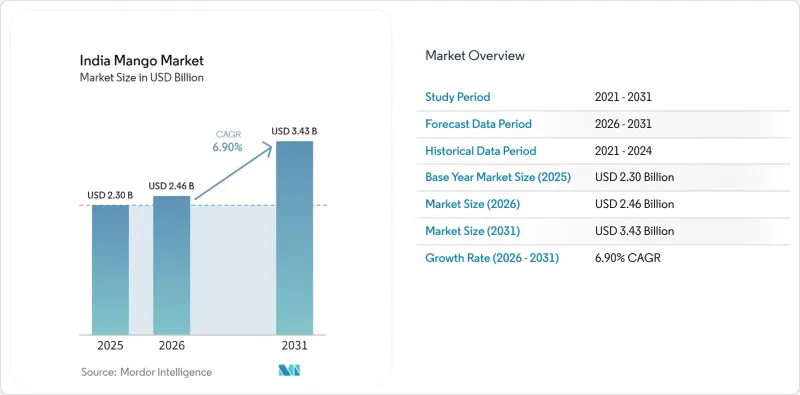
The India Mango Market Report Includes Production Analysis (Volume), Consumption Analysis (Value and Volume), Export Analysis (Value and Volume), Import Analysis (Value and Volume), Wholesale Price Trend Analysis and Forecast, Regulatory Framework, Logistics and Infrastructure, and Seasonality Analysis. The Market Forecasts are Provided in Terms of Value (USD) and Volume (Metric Tons).
India Mango Market Trends and Insights
Favorable Agro-Climatic Diversity Enabling Year-Round Output
India's fifteen agro-climatic zones extend the commercial mango season from March to August, effectively doubling the marketing window compared to single-origin suppliers. For instance, when Maharashtra's Konkan belt experienced a 60-70% yield loss in 2026, concurrent harvests in Karnataka and Andhra Pradesh helped prevent nationwide shortages . Variety specialization, such as Alphonso in coastal Maharashtra, Kesar in Gujarat, Dasheri in Uttar Pradesh, and Totapuri in Karnataka, enables processors to cater to both premium and industrial demand streams within the Indian Mango Market. India's mango harvesting season varies across regions, with production occurring from March to July, depending on the state, reflecting the country's diverse agro-climatic conditions and enabling a staggered supply cycle .
Rising Disposable Income Driving Premium Demand
Affluent Indian consumers demonstrated consistent demand for GI-tagged Alphonso mangoes in March 2026. Kesar mango purchases increased in the second quarter of 2025, driven by younger consumers preferring naturally ripened fruit for use in desserts and milkshakes. While premium consumers absorbed price volatility, mid-income groups shifted toward non-GI varieties, reducing volume fluctuations but maintaining revenue for quality-focused growers. Direct-to-consumer platforms, such as MangoPoint, which raised funding in August 2025, addressed market dispersion by offering traceable, farm-fresh deliveries. This trend of premiumization has significantly increased retail margins within the Indian mango market.
Erratic Monsoons Increasing Yield Volatility
The 2026 Konkan season experienced a significant decline, with output dropping to 10% of normal levels. This sharp reduction drove Alphonso wholesale prices to range between USD 29-34 per dozen, making them less accessible to mid-income buyers . Humid conditions led to an increase in thrips and hoppers, which negatively impacted flower retention and raised pesticide costs, further hindering growth in the Indian mango market. Additionally, alternate bearing cycles exacerbated the situation, as trees entering low-yield phases after bumper crop years struggled to maintain production even under normal weather conditions. To mitigate income fluctuations, growers are increasingly turning to pulp conversion and inter-cropping with cashew and kokum.
Other drivers and restraints analyzed in the detailed report include:
- Pradhan Mantri Kisan Sampada Yojana (PMKSY) Subsidies Accelerating Processing Capacity
- Growing Demand for Natural Sweeteners Boosting Exports
- Fruit-Fly Infestations Raising Export Rejections
For complete list of drivers and restraints, kindly check the Table Of Contents.
Additional Benefits:
- The market estimate (ME) sheet in Excel format
- 3 months of analyst support
TABLE OF CONTENTS
1 Introduction
- 1.1 Study Assumptions and Market Definition
- 1.2 Scope of the Study
2 Research Methodology
3 Executive Summary
4 Market Landscape
- 4.1 Market Overview
- 4.2 Market Drivers
- 4.2.1 Favorable agro-climatic diversity enabling year-round output
- 4.2.2 Rising disposable income driving premium demand
- 4.2.3 Pradhan Mantri Kisan Sampada Yojana (PMKSY) subsidies accelerating processing capacity
- 4.2.4 Growing demand for natural sweeteners boosting exports
- 4.2.5 Japan-India cold-chain grants opening East Asian markets
- 4.2.6 Blockchain traceability easing EU compliance
- 4.3 Market Restraints
- 4.3.1 Erratic monsoons increasing yield volatility
- 4.3.2 Fruit-fly infestations raising export rejections
- 4.3.3 Fragmented landholdings limiting mechanization and consistency
- 4.3.4 Rising ocean freight rates reducing competitiveness
- 4.4 Opportunities
- 4.5 Challenges
- 4.6 Value Chain Analysis
- 4.7 Technologies and usage of AI in the Industry
- 4.8 Input Market Analysis
- 4.8.1 Seeds
- 4.8.2 Fertilizers
- 4.8.3 Crop Protection Chemicals
- 4.9 Distribution Channel Analysis
- 4.10 Market Sentiment Analysis
- 4.11 PESTLE Analysis
5 Market Size and Growth Forecasts (Value)
- 5.1 Production Analysis
- 5.1.1 Production Volume
- 5.1.2 Area Harvested and Yield
- 5.2 Consumption Analysis (Value and Volume)
- 5.3 Trade Analysis (Value and Volume)
- 5.3.1 Import Market Analysis
- 5.3.1.1 Import Value and Volume
- 5.3.1.2 Key Supplying Markets
- 5.3.2 Export Market Analysis
- 5.3.2.1 Export Value and Volume
- 5.3.2.2 Key Destinations Markets
- 5.3.1 Import Market Analysis
- 5.4 Wholesale Price Trend Analysis and Forecast
- 5.5 Regulatory Framework
- 5.6 Logistics and Infrastructure
- 5.7 Seasonality Analysis
6 End Use and Application
- 6.1 Primary Applications and Emerging Applications
- 6.2 Consumption Breakdown by Industries
7 Competitive Landscape
- 7.1 Overview of the Competition
- 7.2 Recent Developments
- 7.3 Market Concentration Analysis
- 7.4 List of Key Players
- 7.4.1 Allana Sons Pvt. Ltd.
- 7.4.2 Decco Post Harvest India Pvt. Ltd.
- 7.4.3 Desai Fruits and Vegetables Pvt. Ltd.
- 7.4.4 Devgad Taluka Mango Growers' Cooperative Society Ltd.
- 7.4.5 Essar Exports
- 7.4.6 INI Farms Pvt. Ltd.
- 7.4.7 Jain FarmFresh Ltd.
- 7.4.8 Kay Bee Exports Pvt. Ltd.
- 7.4.9 Sahyadri Farmers Producer Company Ltd.
- 7.4.10 Galla Foods (Amara Raja Enterprises Private Limited)
- 7.4.11 Shreevali Agro Pvt. Ltd.
- 7.4.12 V S K Global Trade Pvt. Ltd.
8 Market Opportunity and Future Outlook

