PUBLISHER: Mordor Intelligence | PRODUCT CODE: 2062465

PUBLISHER: Mordor Intelligence | PRODUCT CODE: 2062465
Dosing Pumps - Market Share Analysis, Industry Trends & Statistics, Growth Forecasts (2026 - 2031)
According to Mordor Intelligence, the dosing pumps market size was valued at USD 4.53 billion in 2025 and is estimated to grow from USD 4.81 billion in 2026 to reach USD 6.36 billion by 2031, at a CAGR of 5.75% during the forecast period (2026-2031).
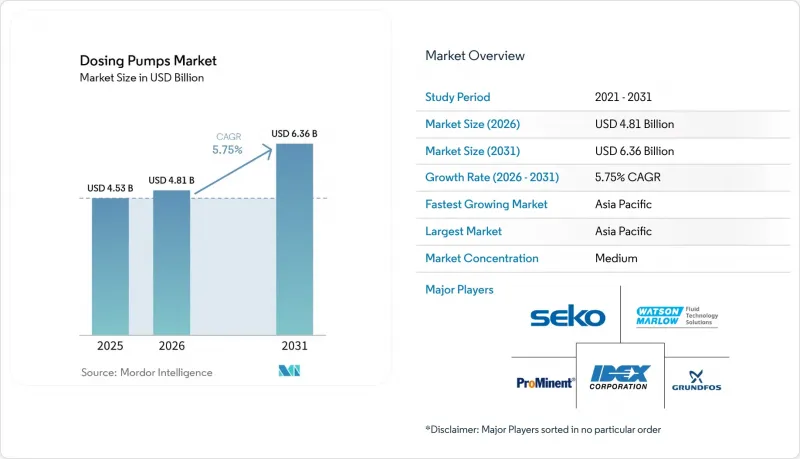
This report is Segmented by Product Type (Diaphragm Pumps, Piston/Plunger Pumps, and More), Application (Water and Wastewater Treatment, Oil and Gas, and More), End-User Facility (Industrial, Commercial, Residential and Municipal Utilities), and Geography (North America, Europe, Asia-Pacific, South America, and Middle East and Africa). The Market Forecasts are Provided in Terms of Value (USD).
Global Dosing Pumps Market Trends and Insights
Rising Water & Wastewater Infrastructure Spend
Capital funding is accelerating. The U.S. Environmental Protection Agency earmarked USD 2.6 billion for clean-water projects and a further USD 800 million for emerging contaminants in FY 2025, with California, Texas, and New York receiving the largest state allocations. India's Finance Commission recommended INR 56,100 crore (USD 6.7 billion) of wastewater grants for mid-sized cities during 2026-2031 to lift treatment rates above 37.5%. Yorkshire Water's USD 22.8 million Dewsbury upgrade exceeded 90% phosphorus-reduction targets and forms part of a USD 444 million program to retrofit 85 plants by 2030. These outlays drive procurement of coagulation, pH-control, and disinfection skids that embed smart dosing pumps.
Stringent Environmental Dosing Accuracy Norms
The recast EU Urban Wastewater Treatment Directive lowered coverage to 1,000 population equivalents and set phosphorus limits of 0.5 mg/L for large plants, with quaternary treatment mandating 80% micropollutant removal by 2045. Extended Producer Responsibility shifts up to 80% of quaternary-treatment costs to pharmaceuticals and cosmetics producers, shrinking municipal funding gaps. Utilities, therefore, specify metering pumps that deliver +-1% flow accuracy and provide tamper-proof electronic records. IEC 62443 compliance is emerging as a bid-score differentiator, especially in Europe and North America.
Raw-Material Price Volatility
Indian steel prices climbed more than 20% between late 2023 and Q1 2025 after safeguard tariffs of up to 15% on Chinese alloy imports, squeezing OEM margins and deferring tenders. Elastomer costs tied to petrochemical feedstocks remain elevated, and small manufacturers lack the scale to hedge, forcing specification downgrades or delivery deferrals in emerging-market projects.
Other drivers and restraints analyzed in the detailed report include:
- Oil & Gas Chemical Injection Demand Upswing
- AI-Enabled Remote-Monitoring Adoption
- Low-Cost Asian Maker Price Pressure
For complete list of drivers and restraints, kindly check the Table Of Contents.
Segment Analysis
Diaphragm models controlled 41.3% of 2025 revenue, anchored in high-pressure chemical injection where API 675 conformity and PTFE diaphragms assure long service life. Yet peristaltic units are expanding at 6.8% CAGR through 2031 as utilities seek dry-run capability and 10-minute hose swaps that minimize downtime. A U.K. water utility eliminated vapor-locking in sodium-hypochlorite dosing after switching to peristaltic technology, trimming maintenance call-outs by two-thirds. In high-purity biotech filling, single-wear-part designs also lower cross-contamination risk. Piston and plunger pumps keep their stronghold in reverse-osmosis antiscalant and refinery catalyst dosing above 16 bar, where ceramic plungers and packed heads withstand abrasive fluids at elevated pressure. Specialty rotary designs, such as gear and screw pumps, occupy niche adhesive and resin duties but lack the growth momentum seen in peristaltic offerings.
Geography Analysis
Asia-Pacific generated 40.8% of 2025 revenue, and the dosing pumps market size in the region is on track to expand at a 6.4% CAGR to 2031. India's INR 56,100 crore wastewater-upgrade plan and refinery build-outs across China and the Gulf underpin long-term demand. North America and Europe form a replacement-driven landscape. The U.S. FY 2025 funding round allocates USD 5.2 billion to state revolving funds, accelerating lead-service-line replacement and PFAS treatment that each rely on precise chemical feed. Europe's phosphorus-removal mandate stimulates multi-year dosing-skid orders, as seen in Yorkshire Water's 90% phosphorus-reduction retrofit that exceeded national effluent quotas. South America and the Middle East & Africa show smaller baselines but attractive upside. Brazil's deep-water projects and Oman's USD 1.82 billion water-expansion program translate into chemical-injection and desalination dosing requirements, respectively.
- Grundfos Holding A/S
- IDEX Corporation (Milton Roy, Pulsafeeder)
- Prominent GmbH
- SEKO S.p.A.
- Watson-Marlow Fluid Technology (Spirax-Sarco)
- Xylem Inc.
- Dover (Neptune, PSG)
- Ingersoll Rand (ARO)
- Blue-White Industries
- Wanner Engineering (Hydra-Cell)
- Graco Inc.
- SEEPEX GmbH
- Lutz-Jesco GmbH
- Etatron DS
- SEA Land srl
- North Ridge Pumps
- Lewa GmbH
- Verder Liquids
- CIRCOR (IMO)
- Cole-Parmer (Masterflex)
- Doseuro S.r.l.
Additional Benefits:
- The market estimate (ME) sheet in Excel format
- 3 months of analyst support
TABLE OF CONTENTS
1 Introduction
- 1.1 Study Assumptions & Market Definition
- 1.2 Scope of the Study
2 Research Methodology
3 Executive Summary
4 Market Landscape
- 4.1 Market Overview
- 4.2 Market Drivers
- 4.2.1 Rising water & wastewater infrastructure spend
- 4.2.2 Stringent environmental dosing accuracy norms
- 4.2.3 Oil & gas chemical injection demand upswing
- 4.2.4 AI-enabled remote monitoring adoption
- 4.2.5 Precision micro-dosing for continuous-flow biotech
- 4.2.6 EU phosphorus-removal retrofit mandates
- 4.3 Market Restraints
- 4.3.1 Raw-material price volatility
- 4.3.2 Low-cost Asian maker price pressure
- 4.3.3 Cyber-security risk in networked pumps
- 4.3.4 Skilled maintenance labor shortages
- 4.4 Supply-Chain Analysis
- 4.5 Regulatory Landscape
- 4.6 Technological Outlook
- 4.7 Porter's Five Forces
- 4.7.1 Competitive Rivalry
- 4.7.2 Threat of New Entrants
- 4.7.3 Bargaining Power of Suppliers
- 4.7.4 Bargaining Power of Buyers
- 4.7.5 Threat of Substitutes
5 Market Size & Growth Forecasts
- 5.1 By Product Type
- 5.1.1 Diaphragm Pumps
- 5.1.2 Piston/Plunger Pumps
- 5.1.3 Peristaltic (Hose and Tube) Pumps
- 5.1.4 Others (Gear, Screw, etc.)
- 5.2 By Application
- 5.2.1 Water and Wastewater Treatment
- 5.2.2 Oil and Gas
- 5.2.3 Chemical Processing
- 5.2.4 Pharmaceuticals and Biotech
- 5.2.5 Food and Beverages
- 5.2.6 Power Generation
- 5.2.7 Others (Pulp and Paper, Mining)
- 5.3 By End-User Facility
- 5.3.1 Industrial
- 5.3.2 Commercial
- 5.3.3 Residential and Municipal Utilities
- 5.4 By Geography
- 5.4.1 North America
- 5.4.1.1 United States
- 5.4.1.2 Canada
- 5.4.1.3 Mexico
- 5.4.2 Europe
- 5.4.2.1 United Kingdom
- 5.4.2.2 Germany
- 5.4.2.3 France
- 5.4.2.4 Spain
- 5.4.2.5 Nordic Countries
- 5.4.2.6 Russia
- 5.4.2.7 Rest of Europe
- 5.4.3 Asia-Pacific
- 5.4.3.1 China
- 5.4.3.2 India
- 5.4.3.3 Japan
- 5.4.3.4 South Korea
- 5.4.3.5 ASEAN Countries
- 5.4.3.6 Rest of Asia-Pacific
- 5.4.4 South America
- 5.4.4.1 Brazil
- 5.4.4.2 Argentina
- 5.4.4.3 Colombia
- 5.4.4.4 Rest of South America
- 5.4.5 Middle East and Africa
- 5.4.5.1 United Arab Emirates
- 5.4.5.2 Saudi Arabia
- 5.4.5.3 South Africa
- 5.4.5.4 Egypt
- 5.4.5.5 Rest of Middle East and Africa
- 5.4.1 North America
6 Competitive Landscape
- 6.1 Market Concentration Analysis
- 6.2 Strategic Moves (M&A, Partnerships, PPAs)
- 6.3 Market Share Analysis (Market Rank/Share for key companies)
- 6.4 Company Profiles (includes Global level Overview, Market level overview, Core Segments, Financials as available, Strategic Information, Products & Services, and Recent Developments)
- 6.4.1 Grundfos Holding A/S
- 6.4.2 IDEX Corporation (Milton Roy, Pulsafeeder)
- 6.4.3 Prominent GmbH
- 6.4.4 SEKO S.p.A.
- 6.4.5 Watson-Marlow Fluid Technology (Spirax-Sarco)
- 6.4.6 Xylem Inc.
- 6.4.7 Dover (Neptune, PSG)
- 6.4.8 Ingersoll Rand (ARO)
- 6.4.9 Blue-White Industries
- 6.4.10 Wanner Engineering (Hydra-Cell)
- 6.4.11 Graco Inc.
- 6.4.12 SEEPEX GmbH
- 6.4.13 Lutz-Jesco GmbH
- 6.4.14 Etatron DS
- 6.4.15 SEA Land srl
- 6.4.16 North Ridge Pumps
- 6.4.17 Lewa GmbH
- 6.4.18 Verder Liquids
- 6.4.19 CIRCOR (IMO)
- 6.4.20 Cole-Parmer (Masterflex)
- 6.4.21 Doseuro S.r.l.
7 Market Opportunities & Future Outlook
- 7.1 White-Space & Unmet-Need Assessment

