PUBLISHER: Mordor Intelligence | PRODUCT CODE: 2063267

PUBLISHER: Mordor Intelligence | PRODUCT CODE: 2063267
India Automotive Lighting - Market Share Analysis, Industry Trends & Statistics, Growth Forecasts (2026 - 2031)
According to Mordor Intelligence, the indian automotive lighting market size was valued at USD 1.73 billion in 2025 and is expected to increase from USD 1.83 billion in 2026 to reach USD 2.44 billion by 2031, growing at a CAGR of 5.87% over 2026-2031.
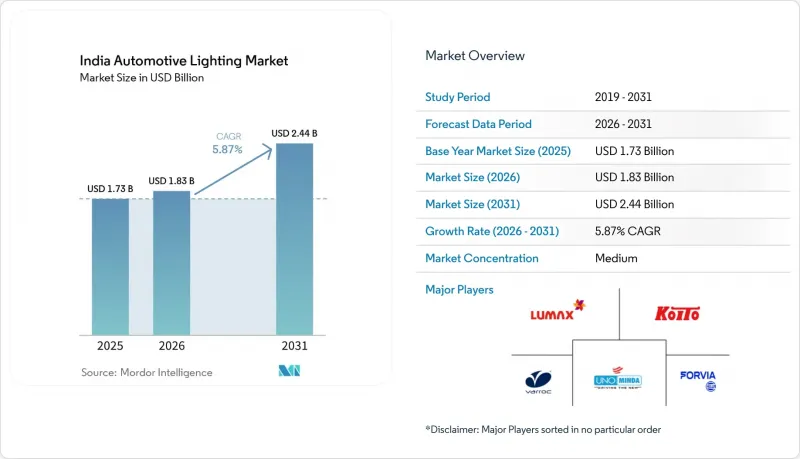
This report is Segmented by Vehicle Type (Passenger Cars, Light Commercial Vehicles, Medium & Heavy Commercial Vehicles, and Two-Wheelers), Application (Exterior and Interior), Technology (Halogen, Xenon/HID, LED, Laser, and OLED), and Sales Channel (OEM and Aftermarket). The Market Forecasts are Provided in Terms of Value (USD) and Volume (Units).
India Automotive Lighting Market Trends and Insights
LED Price Erosion and Energy-Efficiency Mandates
Declining component costs coupled with Bureau of Energy Efficiency thresholds have made LEDs the default fitment across price bands. OEM contracts now specify LEDs even for entry-level scooters to meet candela requirements without thermal penalties. Domestic suppliers that invested in automated surface-mount lines under the PLI scheme are capturing this shift, while halogen demand retreats to legacy replacement channels. The virtuous cost-volume cycle is compressing LED module prices toward parity with halogen assemblies, sealing the latter's obsolescence.
AIS-008 / AIS-012 Safety Regulations Enforcement
Type-approval audits for headlamps and signaling devices became more stringent in 2025. Tier-one suppliers with in-house photometric tunnels readily comply, whereas gray-market assemblers struggle to certify their products. Enforcement actions have already removed several non-conforming aftermarket lamps from urban retail shelves. Over time, sustained surveillance is expected to marginalize uncertified bulbs, improving lumen stability and color consistency on Indian roads.
High GST Slab and Import Duty on Advanced Lighting Modules
Combined levies exceeding 40% on imported complete units of laser and matrix-LED assemblies are dampening OEM enthusiasm for widespread adoption in the mass segment. While only luxury brands are shouldering the extra costs to provide long-range laser high beams, local joint ventures are hurrying to localize sub-assemblies. Their goal is to make premium features more affordable without the burden of duty inflation.
Other drivers and restraints analyzed in the detailed report include:
- Electrification Push Under FAME-LI Boosting 2-W and 4-W LED Fitment
- Tier-1 Localisation Incentives (PLI-Auto and Specs)
- LED-Driver Semiconductor Shortages
For complete list of drivers and restraints, kindly check the Table Of Contents.
Segment Analysis
Passenger cars constituted the largest 48.41% share of the Indian automotive lighting market in 2025, reflecting broad LED adoption across hatchbacks and sedans. In contrast, two-wheelers will grow the fastest, at a 6.01% CAGR, as newer scooters and motorcycles now feature automatic headlamp-on functions that mandate reliable solid-state lamps. Segment-specific regulations continue to elevate lighting content, making motorcycles a critical volume driver.
The regulatory tailwind encourages suppliers to customize compact LED modules for motorcycles that also meet splash-resistance norms for Indian monsoons. OEM design cycles have therefore shortened, as modular lamp housings allow brands to refresh aesthetics annually. While passenger cars continue to dominate value terms, accelerating scooter electrification firmly embeds two-wheelers in long-term growth narratives, balancing the market's segment mix without diluting unit profitability.
Exterior functions captured 63.21% of the Indian automotive lighting market in 2025, a lead cemented by daytime running lamps, adaptive front-lighting, and full-width tail bars that double as unmistakable brand signatures. OEM designers treat headlamps as "eyes" that must meet strict beam cutoff regulations while still packaging seamlessly into sculpted fascias. That dual imperative keeps exterior systems at the top of budget lists when engineering choices are made, ensuring incremental upgrades even in carry-over models. The 6.11% CAGR projected for exterior lamps also reflects planned rollouts of wider light bars whose continuous illumination improves conspicuity at dusk and during monsoon downpours.
Interior illumination, although smaller, now serves as a tactile differentiator in connected vehicles and electric cab-ins. Multi-zone RGB strips enable drivers to sync mood lighting with infotainment themes, turning the cabin ambiance into a software-defined experience. Vendors respond by shipping plug-and-play LED rails that integrate diffusers and CAN bus controllers into a single, slim form factor, reducing line assembly time. While exterior systems still dominate total value, expanding cabin-personalization menus ensure that interior orders rise in lockstep with higher trim penetrations. Suppliers see the two streams as complementary rather than competitive, since a single LIN-bus gateway can orchestrate both headlamp leveling and foot-well ambiance.
List of Companies Covered in this Report:
- Koito Manufacturing Co. Ltd.
- Lumax Industries Limited
- Varroc Group
- HELLA GmbH & Co. KGaA
- UNO Minda Ltd.
- Valeo Lighting Systems India
- Marelli Automotive Lighting India
- Hyundai Mobis Co. Ltd.
- Osram India
- Philips Automotive Lighting India
- SL Corporation
- Motherson Sumi Systems (Samvardhana)
- J.W. Speaker
- Magneti Marelli Parts & Services India
- Bosch Limited - Lighting ECUs
- Texas Instruments India
Additional Benefits:
- The market estimate (ME) sheet in Excel format
- 3 months of analyst support
TABLE OF CONTENTS
1 Introduction
- 1.1 Study Assumptions & Market Definition
- 1.2 Scope of the Study
2 Research Methodology
3 Executive Summary
4 Market Landscape
- 4.1 Market Overview
- 4.2 Market Drivers
- 4.2.1 LED-Price Erosion & Energy-Efficiency Mandates
- 4.2.2 AIS-008 / AIS-012 Safety Regulations Enforcement
- 4.2.3 Electrification Push Under Fame-LI Boosting 2-W & 4-W Led Fitment
- 4.2.4 Tier-1 Localization Incentives (PLI-Auto & Specs)
- 4.2.5 ADAS-Ready Adaptive Lighting Demand From Premium Oems
- 4.2.6 Smart-Corridor Pilots Enabling V2I-Linked Lighting
- 4.3 Market Restraints
- 4.3.1 High GST Slab & Import Duty On Advanced Lighting Modules
- 4.3.2 Prevalence Of Counterfeit Aftermarket Bulbs
- 4.3.3 LED-Driver Semiconductor Shortages
- 4.3.4 Low Consumer Awareness In Tier-2/3 Cities
- 4.4 Value / Supply-Chain Analysis
- 4.5 Regulatory Landscape
- 4.6 Technological Outlook
- 4.7 Porter's Five Forces
- 4.7.1 Threat of New Entrants
- 4.7.2 Bargaining Power of Suppliers
- 4.7.3 Bargaining Power of Buyers
- 4.7.4 Threat of Substitutes
- 4.7.5 Competitive Rivalry
5 Market Size & Growth Forecasts (Value (USD) and Volume (Units))
- 5.1 By Vehicle Type
- 5.1.1 Passenger Cars
- 5.1.2 Light Commercial Vehicles
- 5.1.3 Medium & Heavy Commercial Vehicles
- 5.1.4 Two-Wheelers
- 5.2 By Application
- 5.2.1 Exterior
- 5.2.1.1 Headlamps
- 5.2.1.2 Taillights
- 5.2.1.3 Daytime Running Lights (DRLs)
- 5.2.1.4 Fog Lamps
- 5.2.2 Interior
- 5.2.2.1 Ambient / Footwell
- 5.2.2.2 Roof / Dome
- 5.2.1 Exterior
- 5.3 By Technology
- 5.3.1 Halogen
- 5.3.2 Xenon / HID
- 5.3.3 LED
- 5.3.4 Laser
- 5.3.5 OLED
- 5.4 By Sales Channel
- 5.4.1 Original Equipment Manufacturer (OEM)
- 5.4.2 Aftermarket
6 Competitive Landscape
- 6.1 Market Concentration
- 6.2 Strategic Moves
- 6.3 Market Share Analysis
- 6.4 Company Profiles (Includes Global Level Overview, Market Level Overview, Core Segments, Financials as Available, Strategic Information, Market Rank/Share for Key Companies, Products and Services, SWOT Analysis, and Recent Developments)
- 6.4.1 Koito Manufacturing Co. Ltd.
- 6.4.2 Lumax Industries Limited
- 6.4.3 Varroc Group
- 6.4.4 HELLA GmbH & Co. KGaA
- 6.4.5 UNO Minda Ltd.
- 6.4.6 Valeo Lighting Systems India
- 6.4.7 Marelli Automotive Lighting India
- 6.4.8 Hyundai Mobis Co. Ltd.
- 6.4.9 Osram India
- 6.4.10 Philips Automotive Lighting India
- 6.4.11 SL Corporation
- 6.4.12 Motherson Sumi Systems (Samvardhana)
- 6.4.13 J.W. Speaker
- 6.4.14 Magneti Marelli Parts & Services India
- 6.4.15 Bosch Limited - Lighting ECUs
- 6.4.16 Texas Instruments India
7 Market Opportunities & Future Outlook
- 7.1 White-space & Unmet-Need Assessment

