PUBLISHER: Mordor Intelligence | PRODUCT CODE: 2063279

PUBLISHER: Mordor Intelligence | PRODUCT CODE: 2063279
Automotive Horn Systems - Market Share Analysis, Industry Trends & Statistics, Growth Forecasts (2026 - 2031)
According to Mordor Intelligence, the automotive horn systems market size is expected to grow from USD 0.73 billion in 2025 to USD 0.75 billion in 2026 and is forecast to reach USD 0.88 billion by 2031 at a 3.23% CAGR over 2026-2031.
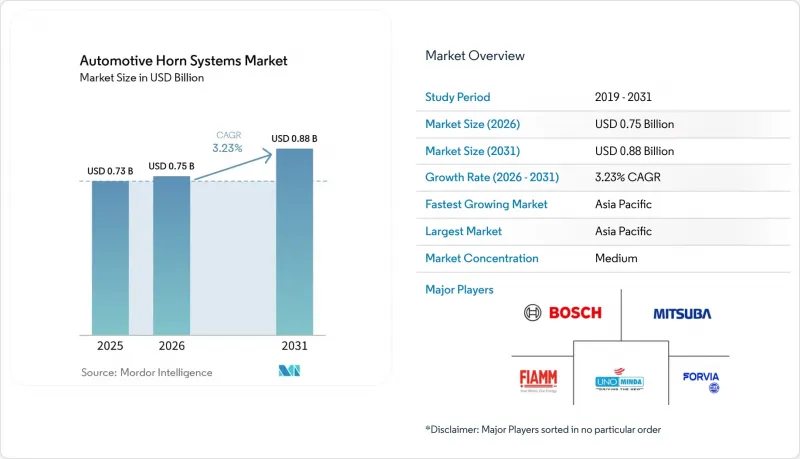
This report is Segmented by Product Type (Electric Horn and More), Horn Shape (Flat Horn and More), Vehicle Type (Passenger Vehicles, Light Commercial Vehicles, and More), Distribution Channel (OEM and Aftermarket), and Geography. The Market Forecasts are Provided in Terms of Value (USD).
Global Automotive Horn Systems Market Trends and Insights
Rising Vehicle Production in Asia-Pacific Spurring OEM Horn Demand
Factory output in China and India climbed in 2025, lifting first-fit orders for electromagnetic and electronic horns. Local content rules encourage suppliers to open plants near final-assembly hubs and shorten logistics chains. OEMs favor modular horn brackets that drop directly into mixed-powertrain lines. Regional standards now align more closely with UN R28, easing transnational homologation. Suppliers that pair acoustic hardware with digital validation services secure platform nominations faster than price-only rivals.
Increasing Adoption of Electric & Electromagnetic Horns for Energy-Efficient Safety
Electromagnetic disc units that draw 3-5 amperes match electric-vehicle power budgets and integrate with acoustic vehicle-alerting systems. KEPO's 3-in-1 module combines horn, pedestrian-alert, and welcome sounds in a single enclosure. Digital signal processing enables tone personalization without hardware swaps, appealing to ride-sharing fleets that value brand sound signatures. Over-the-air firmware allows compliance updates when jurisdictions tighten noise limits. Cost premiums continue to narrow as solenoid prices stabilize.
Noise-Pollution Caps Constraining Allowable Decibel Output
City ordinances in Delhi, Mumbai, and Westminster set maximum sound-pressure levels and impose on-the-spot fines. Campaigns that restart traffic lights when ambient noise rises discourage unnecessary honking. Retailers now highlight certified decibel ratings to avoid seizure of non-compliant stock. Designers balance audibility with acceptable volume by shifting toward dual-frequency envelopes that carry further at lower pressure. Stringent zones accelerate demand for spiral chambers tuned for low-frequency reach rather than peak dB.
Other drivers and restraints analyzed in the detailed report include:
- Stricter Global Horn-Audibility and Pedestrian-Safety Regulations
- Rapid Expansion of E-Commerce Channels for Aftermarket Parts
- Raw-Material Price Spikes & Supply-Chain Disruptions for Electronic Components
For complete list of drivers and restraints, kindly check the Table Of Contents.
Segment Analysis
Electronic horns commanded 45.61% of the automotive horn systems market share in 2025, reflecting automaker trust in solid-state reliability and seamless electronics integration. Software-defined tone profiles help brands differentiate cabin experiences while keeping compliance validation simple. Their sealed architecture also meets durability targets in humid or dusty climates. Suppliers bundle diagnostics that broadcast horn health across vehicle networks, enabling predictive maintenance without additional wiring. Growth in shared-mobility fleets further favors electronic designs because usage data can be captured and analyzed at scale.
Air horns, although a smaller slice, are on course for the quickest 3.29% CAGR through 2031 as freight operators insist on unmistakable low-frequency warnings in crowded corridors. The pneumatic format pairs naturally with existing truck air systems and maintains acoustic reach even when electric drivetrains replace diesel engines. Fleet managers value the recognizably deep timbre that cuts through construction-zone noise without electronic artifacts. Aftermarket installers continue to highlight bolt-on kits that require no software updates, expediting weekend retrofits. Regulatory bodies still allow air horns when tuned within legal decibel windows, ensuring the niche remains viable for years.
Flat horns led the segment with 50.93% of the automotive horn systems market share in 2025, benefiting from compact casings that slip behind fascias now crowded by cameras, sensors, and battery packs. Automakers appreciate the straightforward stamping and plating steps that keep supply chains lean. Engineers can position flat units close to structural rails, gaining natural amplification without extra brackets. A wide supplier base delivers interchangeable parts, reducing dual sourcing headaches when platforms stretch across regions.
Spiral horns exhibit the fastest 3.38% CAGR because their helical chambers amplify lower frequencies that remain audible under strict urban noise caps. Digital simulation accelerates chamber design, letting engineers validate sound envelopes before tooling. Automakers capitalize on the deeper pitch to project authority without exceeding limits, a balance welcomed by city regulators. Component suppliers also tout corrosion-resistant coatings that extend life when spirals sit near wheel wells and road spray.
Geography Analysis
Asia-Pacific remains the epicenter of demand, holding 39.81% of the automotive horn systems market share in 2025 and maintaining a leading 3.35% CAGR into the next decade. Local governments encourage in-region sourcing, so suppliers establish coil-winding and stamping lines near final assembly plants. Harmonization with UN R28 eases cross-border homologation, letting global brands ship common designs from China, India, or Thailand. Indigenous players partner with multinational tier-ones to access digital validation software that shortens launch cycles. Training programs supported by technical institutes help raise acoustic-engineering capabilities, feeding a talent pipeline attuned to next-generation sound systems.
Europe shows stable replacement activity even as some automakers move from dual to single horns in passenger models. Premium German manufacturers invest in virtual prototyping, so suppliers with strong simulation credentials win design contests. Noise-abatement zones in cities like Paris and Amsterdam push engineers toward lower-frequency tones that travel far without breaching limits, rewarding spiral-horn innovators. Aftermarket enthusiasts still personalize their sounds, but retailers highlight certified decibel levels to comply with municipal rules.
North America blends a storied culture of customization with rising connected-fleet adoption. Pickup and recreational-vehicle owners embrace brand-licensed kits that integrate seamlessly with factory wiring and steering-wheel controls. Telematics dashboards used by logistics operators now flag horn-health metrics, nudging preventive swaps at scheduled maintenance intervals. State noise ordinances influence product marketing more than engineering, so sellers display compliance badges prominently online. Suppliers opening regional logistics hubs aim to cut delivery times for both OEM and aftermarket clients, reflecting a customer base that values rapid fulfillment. South America and the Middle East & Africa, while smaller, court investment through incentives that localize final assembly and spark ancillary parts production, including audible-warning devices.
- Uno Minda
- Robert Bosch GmbH
- HELLA GmbH & Co. KGaA
- FIAMM Energy Technology S.p.A.
- Denso Corporation
- Mitsuba Corporation
- Clarton Horn S.A.U.
- Maruko Keihoki Co., Ltd.
- Imasen Electric Industrial Co., Ltd.
- Sun Automobile Co., Ltd.
- Kleinn Automotive Accessories
- Wolo Manufacturing Corp.
- Seger Horn
- SORL Auto Parts, Inc.
- Nikko Electric Industry Co., Ltd.
- Roots Industries India Ltd.
- Hamanakodenso Co., Ltd.
- Minda Stoneridge Instruments Ltd.
- Hainachuan Automotive Electronics
Additional Benefits:
- The market estimate (ME) sheet in Excel format
- 3 months of analyst support
TABLE OF CONTENTS
1 Introduction
- 1.1 Study Assumptions & Market Definition
- 1.2 Scope of the Study
2 Research Methodology
3 Executive Summary
4 Market Landscape
- 4.1 Market Overview
- 4.2 Market Drivers
- 4.2.1 Rising Vehicle Production In Asia-Pacific Spurring OEM Horn Demand
- 4.2.2 Increasing Adoption Of Electric & Electromagnetic Horns For Energy-Efficient Safety
- 4.2.3 Stricter Global Horn-Audibility And Pedestrian-Safety Regulations
- 4.2.4 Rapid Expansion Of E-Commerce Channels For Aftermarket Parts
- 4.2.5 Smart, Adas-Linked Customizable Horn Tones Enhancing Brand Identity
- 4.2.6 Predictive Maintenance Via Fleet-Telematics Driving Proactive Horn Replacement
- 4.3 Market Restraints
- 4.3.1 Noise-Pollution Caps Constraining Allowable Decibel Output
- 4.3.2 Raw-Material Price Spikes & Supply-Chain Disruptions For Electronic Components
- 4.3.3 EV Acoustic Vehicle Alerting Systems (AVAS) Reducing Reliance On Traditional Horns
- 4.3.4 Urban Anti-Honking Initiatives Dampening Replacement Demand In Key Cities
- 4.4 Value / Supply-Chain Analysis
- 4.5 Regulatory Landscape
- 4.6 Technological Outlook
- 4.7 Porter's Five Forces
- 4.7.1 Bargaining Power of Suppliers
- 4.7.2 Bargaining Power of Buyers
- 4.7.3 Threat of New Entrants
- 4.7.4 Threat of Substitutes
- 4.7.5 Competitive Rivalry
5 Market Size & Growth Forecasts (Value (USD))
- 5.1 By Product Type
- 5.1.1 Electric Horn
- 5.1.2 Air Horn
- 5.1.3 Electromagnetic Horn
- 5.2 By Horn Shape
- 5.2.1 Flat Horn
- 5.2.2 Spiral Horn
- 5.2.3 Trumpet Horn
- 5.3 By Vehicle Type
- 5.3.1 Passenger Vehicles
- 5.3.2 Light Commercial Vehicles
- 5.3.3 Medium & Heavy Commercial Vehicles
- 5.4 By Distribution Channel
- 5.4.1 Original Equipment Manufacturer (OEM)
- 5.4.2 Aftermarket
- 5.5 By Geography
- 5.5.1 North America
- 5.5.1.1 United States
- 5.5.1.2 Canada
- 5.5.1.3 Rest of North America
- 5.5.2 South America
- 5.5.2.1 Brazil
- 5.5.2.2 Argentina
- 5.5.2.3 Rest of South America
- 5.5.3 Europe
- 5.5.3.1 United Kingdom
- 5.5.3.2 Germany
- 5.5.3.3 Spain
- 5.5.3.4 Italy
- 5.5.3.5 France
- 5.5.3.6 Russia
- 5.5.3.7 Rest of Europe
- 5.5.4 Asia Pacific
- 5.5.4.1 India
- 5.5.4.2 China
- 5.5.4.3 Japan
- 5.5.4.4 South Korea
- 5.5.4.5 Rest of Asia Pacific
- 5.5.5 Middle East & Africa
- 5.5.5.1 United Arab Emirates
- 5.5.5.2 Saudi Arabia
- 5.5.5.3 Turkey
- 5.5.5.4 Egypt
- 5.5.5.5 South Africa
- 5.5.5.6 Rest of Middle East & Africa
- 5.5.1 North America
6 Competitive Landscape
- 6.1 Market Concentration
- 6.2 Strategic Moves
- 6.3 Market Share Analysis
- 6.4 Company Profiles (Includes Global Level Overview, Market Level Overview, Core Segments, Financials as Available, Strategic Information, Market Rank/Share for Key Companies, Products and Services, SWOT Analysis, and Recent Developments)
- 6.4.1 Uno Minda
- 6.4.2 Robert Bosch GmbH
- 6.4.3 HELLA GmbH & Co. KGaA
- 6.4.4 FIAMM Energy Technology S.p.A.
- 6.4.5 Denso Corporation
- 6.4.6 Mitsuba Corporation
- 6.4.7 Clarton Horn S.A.U.
- 6.4.8 Maruko Keihoki Co., Ltd.
- 6.4.9 Imasen Electric Industrial Co., Ltd.
- 6.4.10 Sun Automobile Co., Ltd.
- 6.4.11 Kleinn Automotive Accessories
- 6.4.12 Wolo Manufacturing Corp.
- 6.4.13 Seger Horn
- 6.4.14 SORL Auto Parts, Inc.
- 6.4.15 Nikko Electric Industry Co., Ltd.
- 6.4.16 Roots Industries India Ltd.
- 6.4.17 Hamanakodenso Co., Ltd.
- 6.4.18 Minda Stoneridge Instruments Ltd.
- 6.4.19 Hainachuan Automotive Electronics
7 Market Opportunities & Future Outlook
- 7.1 White-space & Unmet-need Assessment

