
PUBLISHER: Mordor Intelligence | PRODUCT CODE: 2063282

PUBLISHER: Mordor Intelligence | PRODUCT CODE: 2063282
Zero Trust Network Access - Market Share Analysis, Industry Trends & Statistics, Growth Forecasts (2026 - 2031)
According to Mordor Intelligence, the zero trust network access market size is projected to be USD 39.58 billion in 2025, USD 47.45 billion in 2026, and reach USD 109.48 billion by 2031, growing at an 18.20% CAGR from 2026 to 2031.
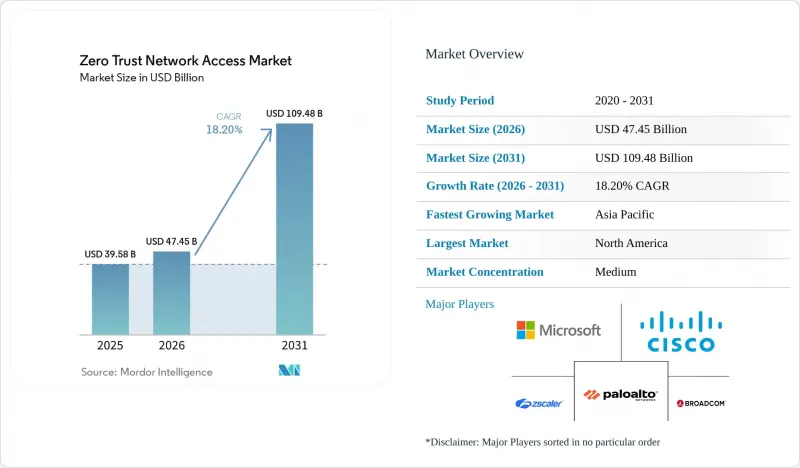
This report is Segmented by Component (Platform-Level ZTNA, Data-Centric Security Platforms, and More), Deployment Mode (Cloud-Based, Hybrid, and On-Premises), Organization Size (Large Enterprises, and More), Industry Vertical (BFSI, Healthcare, Government, and More), and Geography (North America, Asia-Pacific, South America, and More). The Market Forecasts are Provided in Terms of Value (USD).
Global Zero Trust Network Access Market Trends and Insights
Rapid Board-Level Cyber-Risk Accountability
The U.S. Securities and Exchange Commission rule that came into force in December 2023 forces listed companies to disclose material incidents within four business days, linking director liability to security controls. Boards now demand auditable zero-trust logs that prove least-privilege enforcement and shorten breach investigations. U.S. Department of Justice budget requests for fiscal 2027 earmark USD 110.3 million for zero-trust, signaling that public procurement will set the private-sector baseline. Legal counsel describes ZTNA as evidence of reasonable safeguards, a phrase that redefines cyber-risk as a governance metric. As a result, the Zero Trust Network Access market is moving from discretionary IT spending to compliance-driven obligations. Vendors able to map product features directly to disclosure requirements win faster board approval.
Mandates for Zero-Trust by U.S. and EU Public-Sector IT Spending
OMB memorandum M-22-09 sets a December 2026 deadline for U.S. civilian agencies to satisfy five zero-trust pillars, while CISA's directive on phishing-resistant MFA disqualifies SMS tokens. In parallel, the EU NIS2 Directive, transposed into national law by October 2024, expands obligations across 18 critical sectors and introduces personal liability for management. Vendors with FedRAMP High or EU certification gain preferred-bidder status, creating a procurement edge. These mandates establish a global compliance floor that private firms must match, driving sustained growth in the Zero Trust Network Access market. Spending accelerates first in North America and Europe, with Asia-Pacific governments quickly aligning to remain eligible for supply-chain contracts.
Fragmented Legacy IAM Stacks Slowing Policy Unification
Enterprises often juggle Active Directory, Okta, Ping Identity, and bespoke LDAP systems, each with different schemas and session lifetimes. CISA's Known Exploited Vulnerabilities list registered 1,143 identity-related flaws by March 2025, illustrating how attackers chain gaps across these silos. Running parallel authentication during consolidation dilutes zero-trust coverage. The October 2023 Okta breach, where support-portal tokens were stolen, showed that a single weak link undermines federated trust. Until identity harmonization accelerates, ZTNA projects face longer timelines and higher costs.
Other drivers and restraints analyzed in the detailed report include:
- Cloud-Native Data Fabrics Needing Identity-Aware Micro-Segmentation
- Generative-AI Threat Surface Expansion
- High Transition CAPEX for Brown-Field OT Networks
For complete list of drivers and restraints, kindly check the Table Of Contents.
Segment Analysis
Security Service Edge solutions are forecast to expand at an 18.96% CAGR, eclipsing traditional platform offerings that held a 38.18% share in 2025. The shift arises because converged stacks bundle secure web gateway, CASB, and ZTNA into a single cloud policy, cutting integration overhead. Dell'Oro projects combined SASE and SSE spending to approach USD 97 billion by 2030, reinforcing that convergence is now the mainstream buying pattern. Standalone platforms remain relevant for hybrid estates, but face price pressure as hyperscalers embed access control into larger deals. Data-centric security platforms address regulated data flows by wrapping tokenization around workloads in confidential-computing enclaves. IAM suites continue as the identity backbone, yet must synchronize attributes across multicloud deployments, a task that slows projects.
Platform-level ZTNA keeps strategic value where on-premises data centers persist. Cisco's Armorblox buy added natural-language analytics to detect phishing in collaboration tools. Niche providers target OT segmentation, offering protocol-aware controls that SSE vendors do not. Over the forecast horizon, the Zero Trust Network Access market size for component categories will hinge on how quickly buyers collapse point tools into unified clouds.
Cloud-based deployments accounted for 63.71% of spending in 2025 and are projected to grow at a 18.57% CAGR. SaaS consumption models priced per user remove the capital hurdle of appliance refresh cycles. Zscaler's cloud processes more than 500 billion daily transactions across 150 nodes, illustrating the scale advantage. Hybrid models appeal to sectors bound by data-residency laws because vendors can place policy nodes within national borders. On-premises deployments persist in air-gapped or classified networks but face staffing shortages; CISA counts a 500,000-person gap in zero-trust talent for secure enclaves.
Operational economics favor cloud because monthly fees of USD 5-15 per user are easier to approve than six-figure hardware buys. Hybrid solutions must constantly sync policies between cloud engines and local gateways, a complexity that vendors like Palo Alto Networks attempt to mask through automated replication. On industrial sites that require protocol translation, on-premises gateways remain relevant, though uptake is slower due to CAPEX constraints.
Geography Analysis
North America continues to lead with 41.24% share, supported by U.S. federal mandates, SEC disclosure rules, and a mature ecosystem of integrators. The U.S. justice budget seeks USD 110.3 million for zero-trust in fiscal 2027, signaling sustained demand. Canada's proposed Critical Cyber Systems Protection Act extends requirements to telecom and energy, boosting homegrown suppliers. Mexico lags on budgets, yet near-shoring of U.S. manufacturing drives cross-border ZTNA to secure data flows.
Asia-Pacific is forecast to have the fastest 18.91% CAGR as governments align cyber rules with digital-economy goals. Japan earmarked JPY 300 billion (USD 2 billion) of its USD 11.2 billion digital budget to cybersecurity in 2024. India's CERT-In directive mandates breach reporting within 6 hours and 180-day log retention. Singapore's Smart Nation program requires identity-aware access for citizen services, and South Korea mandates zero-trust for biometric data processors. China's security reviews favor domestic vendors, fragmenting the global market into separate policy domains.
Europe grows despite uneven NIS2 adoption, with Germany passing its law in 2024, while Italy and Spain delayed into 2025. The UK's NCSC principles recommend phased zero-trust rollouts starting with high-value assets. The Middle East invests in sovereign clouds: Saudi Arabia mandates in-country data storage, and the UAE published national standards aligned to UN e-government rankings. South America and Africa remain early-stage; compliance drivers exist under Brazil's LGPD and South Africa's POPIA, but budgets and skill shortages slow uptake.
- Microsoft Corporation
- Cisco Systems, Inc.
- Palo Alto Networks, Inc.
- Zscaler, Inc.
- Broadcom Inc.
- Okta, Inc.
- Fortinet, Inc.
- Check Point Software Technologies Ltd.
- CrowdStrike Holdings, Inc.
- IBM Corporation
- Google LLC
- Cloudflare, Inc.
- Akamai Technologies, Inc.
- Illumio, Inc.
- Forcepoint LLC
- Tenable Holdings, Inc.
- Trend Micro Incorporated
- Ping Identity Holding Corp.
- SailPoint Technologies Holdings, Inc.
- Cyxtera Technologies, Inc.
Additional Benefits:
- The market estimate (ME) sheet in Excel format
- 3 months of analyst support
TABLE OF CONTENTS
1 INTRODUCTION
- 1.1 Study Assumptions And Market Definition
- 1.2 Scope Of The Study
2 RESEARCH METHODOLOGY
3 EXECUTIVE SUMMARY
4 MARKET LANDSCAPE
- 4.1 Market Overview
- 4.2 Market Drivers
- 4.2.1 Rapid Board-Level Cyber-Risk Accountability (Post-SEC Rule)
- 4.2.2 Mandates For Zero-Trust By U.S. And EU Public-Sector IT Spending
- 4.2.3 Cloud-Native Data Fabrics Needing Identity-Aware Micro-Segmentation
- 4.2.4 Generative-AI Threat Surface Expansion
- 4.2.5 Tokenisation And Confidential-Computing Adoption
- 4.2.6 Quantum-Resistant Encryption Pilots
- 4.3 Market Restraints
- 4.3.1 Fragmented Legacy IAM Stacks Slowing Policy Unification
- 4.3.2 High Transition CAPEX For Brown-Field OT Networks
- 4.3.3 Shortage Of Zero-Trust Architects And ZTMM Skillsets
- 4.3.4 Vendor Lock-In Concerns Around Proprietary Policy Engines
- 4.4 Impact Of Macroeconomic Factors On The Market
- 4.5 Industry Value-Chain Analysis
- 4.6 Regulatory Landscape
- 4.7 Technological Outlook
- 4.8 Porter's Five Forces Analysis
- 4.8.1 Threat Of New Entrants
- 4.8.2 Bargaining Power Of Buyers
- 4.8.3 Bargaining Power Of Suppliers
- 4.8.4 Threat Of Substitutes
- 4.8.5 Competitive Rivalry
5 MARKET SIZE AND GROWTH FORECASTS (VALUE)
- 5.1 By Component
- 5.1.1 Platform-Level Zero Trust Network Access (ZTNA)
- 5.1.2 Data-Centric Security Platforms
- 5.1.3 Identity And Access Management (IAM) Suites
- 5.1.4 Security Service Edge (SSE) Solutions
- 5.2 By Deployment Mode
- 5.2.1 Cloud-Based
- 5.2.2 Hybrid
- 5.2.3 On-Premises
- 5.3 By Organization Size
- 5.3.1 Large Enterprises
- 5.3.2 Small And Mid-Sized Enterprises (SME)
- 5.4 By Industry Vertical
- 5.4.1 Banking, Financial Services And Insurance (BFSI)
- 5.4.2 Healthcare And Life Sciences
- 5.4.3 Government And Public Sector
- 5.4.4 IT And Telecom
- 5.4.5 Manufacturing And Critical Infrastructure
- 5.4.6 Retail And E-Commerce
- 5.5 By Geography
- 5.5.1 North America
- 5.5.1.1 United States
- 5.5.1.2 Canada
- 5.5.1.3 Mexico
- 5.5.2 Europe
- 5.5.2.1 United Kingdom
- 5.5.2.2 Germany
- 5.5.2.3 France
- 5.5.2.4 Italy
- 5.5.2.5 Rest of Europe
- 5.5.3 Asia-Pacific
- 5.5.3.1 China
- 5.5.3.2 Japan
- 5.5.3.3 India
- 5.5.3.4 South Korea
- 5.5.3.5 Rest of Asia-Pacific
- 5.5.4 South America
- 5.5.5 Middle East and Africa
- 5.5.1 North America
6 COMPETITIVE LANDSCAPE
- 6.1 Market Concentration
- 6.2 Strategic Moves
- 6.3 Market Share Analysis
- 6.4 Company Profiles (includes Global Level Overview, Market Level Overview, Core Segments, Financials As Available, Strategic Information, Market Rank/Share, Products And Services, Recent Developments)
- 6.4.1 Microsoft Corporation
- 6.4.2 Cisco Systems, Inc.
- 6.4.3 Palo Alto Networks, Inc.
- 6.4.4 Zscaler, Inc.
- 6.4.5 Broadcom Inc.
- 6.4.6 Okta, Inc.
- 6.4.7 Fortinet, Inc.
- 6.4.8 Check Point Software Technologies Ltd.
- 6.4.9 CrowdStrike Holdings, Inc.
- 6.4.10 IBM Corporation
- 6.4.11 Google LLC
- 6.4.12 Cloudflare, Inc.
- 6.4.13 Akamai Technologies, Inc.
- 6.4.14 Illumio, Inc.
- 6.4.15 Forcepoint LLC
- 6.4.16 Tenable Holdings, Inc.
- 6.4.17 Trend Micro Incorporated
- 6.4.18 Ping Identity Holding Corp.
- 6.4.19 SailPoint Technologies Holdings, Inc.
- 6.4.20 Cyxtera Technologies, Inc.
7 MARKET OPPORTUNITIES AND FUTURE OUTLOOK
- 7.1 White-Space And Unmet-Need Assessment

