PUBLISHER: Mordor Intelligence | PRODUCT CODE: 2063295

PUBLISHER: Mordor Intelligence | PRODUCT CODE: 2063295
Dimmer And Color Tunable - Market Share Analysis, Industry Trends & Statistics, Growth Forecasts (2026 - 2031)
According to Mordor Intelligence, the dimmer and color tunable market size is expected to be USD 17.68 billion in 2025, USD 19.25 billion in 2026, and reach USD 28.73 billion by 2031, growing at a CAGR of 8.34% from 2026 to 2031.
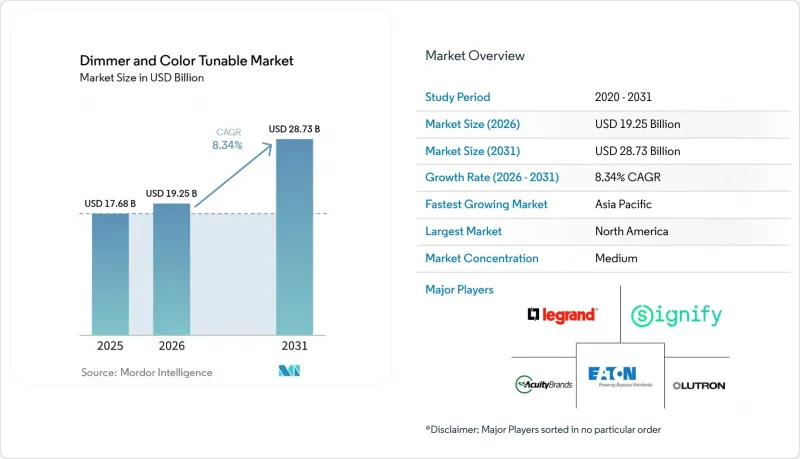
This report is Segmented by Product Type (Rotary, Slide, Touchless, and More), Communication Technology (Wired, and Wireless), Application (Residential, Commercial Offices, Hospitality, Retail, Outdoor and Architectural, and More), Sales Channel (New Construction OEM, Retrofit, Online Retail, and Professional Distribution), and Geography. The Market Forecasts are Provided in Terms of Value (USD).
Global Dimmer And Color Tunable Market Trends and Insights
Rapid LED Penetration in Residential Retrofit Projects
Residential LED socket penetration hit 90% across United States households in 2024, yet just 37% of homes had converted every fixture, leaving a large upgrade pool for smart dimmers that solve LED-to-TRIAC flicker issues. Homes with voice-assistant speakers adopt dimmers 2.3 times faster than non-connected households, confirming that ecosystem compatibility is a first-order purchase trigger. Warranty claims tied to incompatible dimmers declined 22% in 2025 after manufacturers added minimum-load disclosures, improving consumer confidence. Older housing stock built before 2000 concentrates retrofit demand because newer homes already contain neutral wires that support modern dimmers. The resulting upgrade cycle expands the dimmer and color-tunable market beyond early adopters and into mainstream do-it-yourself channels.
Stringent Building Energy-Code Updates Mandating Controllable Lighting
The 2024 International Energy Conservation Code mandates automatic lighting controls for commercial spaces larger than 5,000 square feet, effectively requiring continuous dimming in nearly four-fifths of new U.S. office construction. California Title 24 Part 6 enforces demand-responsive dimming statewide, while the European Union's latest Energy Performance of Buildings Directive sets daylight-harvesting baselines that steer projects toward DALI-2 or 0-10 V dimmers. Proposed 2028 amendments will extend demand response to multifamily properties, adding thousands of units per year to the dimmer and color tunable market. Code harmonization with ASHRAE 90.1 and IEC standards reduces friction in product development for global suppliers. Over the long term, regulatory pull is expected to outpace voluntary retrofits as continuous dimming becomes a construction default.
Legacy TRIAC Infrastructure Incompatibility with Tunable Drivers
Pre-2010 phase-cut dimmers generate audible hum and visible flicker when paired with tunable-white LED drivers, forcing homeowners to replace switches and luminaires in tandem and doubling the cost of room-level upgrades. Neutral-wire absences in older U.S. construction add USD 150-300 per fixture to rewiring costs, slowing retrofits. Battery-powered harvesters mitigate wiring gaps but cap dimming range and cannot support color-tunable standby loads. Compatibility databases show that fewer than 40% of legacy TRIAC models are suitable for tunable LEDs, which increases consumer confusion. The issue will fade as new housing stock grows, yet it remains a medium-term drag on the dimmer and color-tunable market.
Other drivers and restraints analyzed in the detailed report include:
- Declining ASPs of Smart Dimmer ICs and Modules
- Pro-Lumen-Tunable Guidelines from WELL and LEED v4 Standards
- Fragmentation of Wireless Protocols Delaying Interoperability
For complete list of drivers and restraints, kindly check the Table Of Contents.
Segment Analysis
Smart dimmer switches accounted for 33.11% of 2025 revenue, as homeowners favored retrofit-friendly devices that preserve wall-box footprints. Full-color RGB modules are forecast to grow at an 8.88% CAGR, supported by retail rollouts that link dynamic color shifts to shopper dwell times. Tunable-white modules accounted for 18.02% of the 2025 value in WELL-targeted hospitality and office projects, while rotary and slide dimmers remain prevalent in cost-sensitive residential construction. The dimmer and color-tunable market size for smart switches is poised to widen as battery-harvesting variants remove neutral-wire hurdles. Meanwhile, architectural landmarks such as Hudson Yards prove that RGB storytelling justifies premium budgets, expanding the dimmer-and-color-tunable market beyond functional lighting.
Cost declines for multi-channel LED drivers, down 25% since 2023, are compressing the price gap between tunable-white and RGB modules, democratizing full-color control for mid-tier commercial projects. Touchless dimmers gained traction in healthcare and food service under strict hygiene codes, although this niche remains below 5% of total value. Plug-in lamp dimmers and in-line cord units continue to serve specialty decor uses. As premium RGB systems migrate into mainstream budgets, vendors that offer seamless commissioning and pre-loaded color scenes will capture incremental market share in the dimmer- and color-tunable markets.
Wireless technologies accounted for 41.09% of the projected 2025 revenue, highlighting the growing consumer preference for hub-free installation solutions. This trend reflects the growing demand for seamless, user-friendly smart home systems. Thread and Matter solutions are forecast to achieve a compound annual growth rate (CAGR) of 8.91%, primarily driven by the advantages of native IPv6, which effectively eliminates the bottleneck caused by single-hub systems. Zigbee continues to dominate the installed base, largely driven by early adoption in ecosystems such as Philips Hue and SmartThings. However, its market share is gradually declining as platforms phase out support for legacy radios, signaling a shift toward more advanced technologies. Wired DALI-2 secured 22% of commercial revenue, benefiting from its compliance with IEC 62386-207 and -209 standards, which ensure interoperability and adherence to emergency-lighting codes.
Phase-cut dimmers remain prevalent in older homes; however, their market share is expected to decrease as neutral wires become a standard feature in U.S. housing constructed after 2011. Bluetooth Mesh technology has gained traction in boutique hotels, particularly after firmware updates enabled the support of 200-node networks without the need for gateways. This advancement has significantly reduced commissioning overhead, making it a more attractive option for commercial applications. Wi-Fi dimmers, while easy to install, face challenges such as higher standby power consumption and network congestion in densely populated apartment complexes. The market for dimmer and color-tunable wireless products is anticipated to grow further as certification costs decrease and smartphone ecosystems increasingly adopt Matter status indicators. These developments are expected to streamline the consumer purchase journey, enhancing the overall adoption of wireless lighting solutions.
Geography Analysis
North America controlled 39.02% of the 2025 global value, owing to California Title 24 and 90% LED penetration. The United States accounted for 78% of the region's revenue, aided by 14 million smart-speaker households adopting dimmers at 2.3 times the national rate. Canadian demand concentrates in Ontario and British Columbia, where incentives rebate up to half of smart-dimmer costs. Mexico's uptake remains nascent amid lower LED penetration and limited Spanish-language installation resources.
Asia-Pacific is projected to grow at an 8.73% CAGR through 2031, on the heels of China's GB 50034-2024 standard, which mandates dimming ratios in offices and schools. China dominates the regional revenue share, followed by Japan, where aging demographics are driving the adoption of voice-controlled lighting in a significant portion of senior households. India's Bureau of Energy Efficiency has extended star ratings to dimmable LEDs, expanding the addressable base across millions of households. South Korea and Australia collectively contribute a notable share of revenue, highlighted by public-housing retrofits that incorporate tunable-white modules.
Europe accounted for a significant share of the 2025 value, driven by a notable increase in DALI-2 certifications that guarantee multi-vendor interoperability. Germany leveraged subsidized loans that facilitated widespread residential dimmer upgrades during 2025. The United Kingdom's Future Homes Standard will mandate smart-ready wiring in the coming years, helping to offset Brexit-era tariff friction. Russia experienced a contraction due to component import curbs, while the Middle East and Africa contributed to global revenue, supported by smart-city blueprints like NEOM. South America, led by Brazil and Argentina, contributed a smaller share of the 2025 value, constrained by currency volatility.
- Lutron Electronics Co., Inc.
- Signify N.V.
- Legrand SA
- Leviton Manufacturing Co., Inc.
- Acuity Brands, Inc.
- Eaton Corporation plc
- Hubbell Incorporated
- Zumtobel Group AG
- ams-OSRAM AG
- Cree Lighting, A Company Of IDEAL INDUSTRIES, Inc.
- Savant Systems, Inc.
- Helvar Oy Ab
- Insteon Technologies LLC
- Jasco Products Company LLC
- Futronix Limited
- Casambi Technologies Oy
- RAB Lighting Inc.
- TCP International Holdings Ltd.
- MOSO Power Supply Technology Co., Ltd.
- LUTEC Lighting Co., Ltd.
Additional Benefits:
- The market estimate (ME) sheet in Excel format
- 3 months of analyst support
TABLE OF CONTENTS
1 INTRODUCTION
- 1.1 Study Assumptions and Market Definition
- 1.2 Scope Of The Study
2 RESEARCH METHODOLOGY
3 EXECUTIVE SUMMARY
4 MARKET LANDSCAPE
- 4.1 Market Overview
- 4.2 Market Drivers
- 4.2.1 Rapid LED Penetration in Residential Retrofit Projects
- 4.2.2 Stringent Building Energy-Code Updates Mandating Controllable Lighting
- 4.2.3 Declining ASPs of Smart Dimmer ICs and Modules
- 4.2.4 Pro-Lumen-Tunable Guidelines From WELL and LEED v4 Standards
- 4.2.5 Advances in Low-Voltage PoE Lighting Ecosystems
- 4.2.6 Hospitality Chains Pivot to Circadian-Lighting Guest Experiences
- 4.3 Market Restraints
- 4.3.1 Legacy TRIAC Infrastructure Incompatibility With Tunable Drivers
- 4.3.2 Fragmentation of Wireless Protocols Delaying Interoperability
- 4.3.3 Skilled-Installer Shortage in Emerging Economies
- 4.3.4 Supply-Chain Exposure to Silicon Carbide MOSFET Shortages
- 4.4 Industry Value-Chain Analysis
- 4.5 Regulatory Landscape
- 4.6 Technological Outlook
- 4.7 Impact of Macroeconomic Factors On The Market
- 4.8 Porter's Five Forces Analysis
- 4.8.1 Threat of New Entrants
- 4.8.2 Bargaining Power of Suppliers
- 4.8.3 Bargaining Power of Buyers
- 4.8.4 Threat of Substitutes
- 4.8.5 Intensity of Competitive Rivalry
5 MARKET SIZE AND GROWTH FORECASTS (VALUE)
- 5.1 By Product Type
- 5.1.1 Rotary Dimmer Switches
- 5.1.2 Slide Dimmer Switches
- 5.1.3 Touchless Dimmer Switches
- 5.1.4 Smart Dimmer Switches
- 5.1.5 Tunable White Modules
- 5.1.6 Full-Color RGB Tunable Modules
- 5.1.7 Other Product Type
- 5.2 By Communication Technology
- 5.2.1 Wired (0-10 V, DALI, Phase-Cut)
- 5.2.2 Wireless (Zigbee, Bluetooth Mesh, Wi-Fi, Thread And Matter)
- 5.3 By Application
- 5.3.1 Residential
- 5.3.2 Commercial Offices
- 5.3.3 Hospitality
- 5.3.4 Retail
- 5.3.5 Industrial
- 5.3.6 Outdoor And Architectural
- 5.3.7 Other Applications
- 5.4 By Sales Channel
- 5.4.1 New Construction OEM
- 5.4.2 Retrofit And Renovation
- 5.4.3 Online Retail
- 5.4.4 Professional Distribution / Wholesale
- 5.5 By Geography
- 5.5.1 North America
- 5.5.1.1 United States
- 5.5.1.2 Canada
- 5.5.1.3 Mexico
- 5.5.2 Europe
- 5.5.2.1 Germany
- 5.5.2.2 United Kingdom
- 5.5.2.3 France
- 5.5.2.4 Russia
- 5.5.2.5 Rest of Europe
- 5.5.3 Asia-Pacific
- 5.5.3.1 China
- 5.5.3.2 Japan
- 5.5.3.3 India
- 5.5.3.4 South Korea
- 5.5.3.5 Australia
- 5.5.3.6 Rest of Asia-Pacific
- 5.5.4 Middle East And Africa
- 5.5.4.1 Middle East
- 5.5.4.1.1 Saudi Arabia
- 5.5.4.1.2 United Arab Emirates
- 5.5.4.1.3 Rest of Middle East
- 5.5.4.2 Africa
- 5.5.4.2.1 South Africa
- 5.5.4.2.2 Egypt
- 5.5.4.2.3 Rest of Africa
- 5.5.4.1 Middle East
- 5.5.5 South America
- 5.5.5.1 Brazil
- 5.5.5.2 Argentina
- 5.5.5.3 Rest of South America
- 5.5.1 North America
6 COMPETITIVE LANDSCAPE
- 6.1 Market Concentration
- 6.2 Strategic Moves
- 6.3 Market Share Analysis
- 6.4 Company Profiles (includes Global Level Overview, Market Level Overview, Core Segments, Financials As Available, Strategic Information, Market Rank/Share, Products And Services, Recent Developments)
- 6.4.1 Lutron Electronics Co., Inc.
- 6.4.2 Signify N.V.
- 6.4.3 Legrand SA
- 6.4.4 Leviton Manufacturing Co., Inc.
- 6.4.5 Acuity Brands, Inc.
- 6.4.6 Eaton Corporation plc
- 6.4.7 Hubbell Incorporated
- 6.4.8 Zumtobel Group AG
- 6.4.9 ams-OSRAM AG
- 6.4.10 Cree Lighting, A Company Of IDEAL INDUSTRIES, Inc.
- 6.4.11 Savant Systems, Inc.
- 6.4.12 Helvar Oy Ab
- 6.4.13 Insteon Technologies LLC
- 6.4.14 Jasco Products Company LLC
- 6.4.15 Futronix Limited
- 6.4.16 Casambi Technologies Oy
- 6.4.17 RAB Lighting Inc.
- 6.4.18 TCP International Holdings Ltd.
- 6.4.19 MOSO Power Supply Technology Co., Ltd.
- 6.4.20 LUTEC Lighting Co., Ltd.
7 MARKET OPPORTUNITIES AND FUTURE OUTLOOK
- 7.1 White-Space and Unmet-Need Assessment

