PUBLISHER: Mordor Intelligence | PRODUCT CODE: 2063379

PUBLISHER: Mordor Intelligence | PRODUCT CODE: 2063379
Robo Taxi - Market Share Analysis, Industry Trends & Statistics, Growth Forecasts (2026 - 2031)
According to Mordor Intelligence, the robo taxi market size reached USD 0.80 billion in 2026 and is projected to touch USD 17.55 billion by 2031, advancing at an 85.45% CAGR over the forecast period.
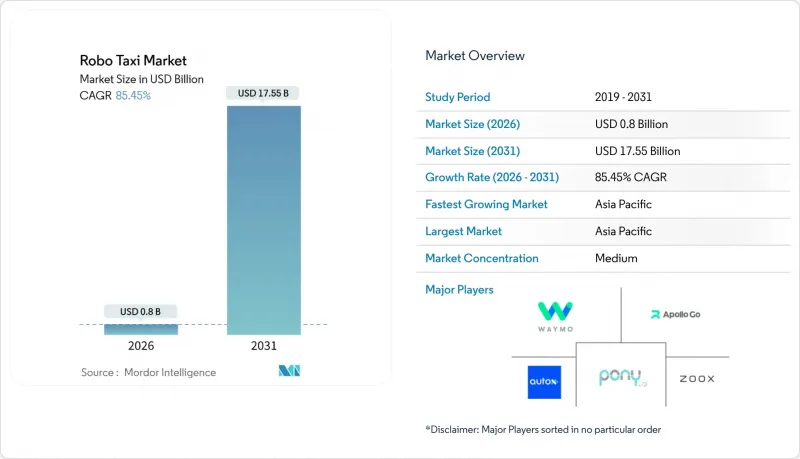
This report is Segmented by Level of Autonomy (Level 4 and Level 5), Propulsion (Battery-Electric, Hybrid-Electric, and More), Vehicle Type (Car and Van/Shuttle), Application (Passenger Transportation and Goods/Parcel Transportation), Service Type, Business Model, Fleet Ownership, Operating Environment, and Geography. The Market Forecasts are Provided in Terms of Value (USD) and Volume (Units).
Global Robo Taxi Market Trends and Insights
Government AV Pilots and Regulatory Sandboxes
Conditional exemptions enable the use of real-world data to substitute for theoretical models, thereby reducing validation timelines in the Robo Taxi Market. In August 2025, Zoox became the first recipient of a demonstration exemption from the National Highway Traffic Safety Administration under the Automated Vehicle Exemption Program (AVEP). This milestone enables Zoox's American-built, purpose-designed automated vehicle to operate without conventional manual controls, provided that certain specified conditions are met China's Ministry of Transport has permitted fully driverless public trials across multiple tier-1 cities since mid-2024, enabling millions of passenger-carrying miles. Abu Dhabi authorized commercial operations without safety drivers in November 2025, setting the stage for regional leapfrog adoption. Operators use early approvals to accrue safety records that ease expansion into more conservative markets.
On August 6, 2025, NHTSA granted Zoox the first-ever demonstration exemption under the Automated Vehicle Exemption Program (AVEP) for an American-built purpose-built automated vehicle, enabling operation without traditional manual controls under specified conditions."
Record Capital Inflows into Autonomous-Mobility Ventures
In October 2024, Waymo secured a USD 5.6 billion funding round, spearheaded by Alphabet and bolstered by external investors. This move highlighted the escalating investor confidence in the imminent commercialization of the Robo Taxi Market. Meanwhile, Waabi raised substantial capital to enhance its AI-driven simulation platform, significantly reducing the need for extensive on-road testing. As major IPOs and strategic spin-outs emerge, they're centralizing resources among a select few leaders, intensifying the prevailing scale advantages.
High Upfront CAPEX and Uncertain Payback
In most cities, breakeven periods for purpose-built vehicles and sensor suites are significantly long due to their high costs in the Robo Taxi Market. In December 2024, General Motors discontinued its autonomous ride-hailing venture after incurring substantial cumulative losses. Even with highly optimized designs, like Baidu's RT6, considerable upfront investment is required before these vehicles can enter service. A persistent challenge remains: off-peak hours experience significant underutilization, which dampens overall returns.
Other drivers and restraints analyzed in the detailed report include:
- Declining AD-Sensor and Computing Costs
- Maas Platform Integration Unlocking Fleet Utilization
- Persistent Public-Trust and Safety-Perception Gap
For complete list of drivers and restraints, kindly check the Table Of Contents.
Segment Analysis
Level 4 systems accounted for 62.05% of 2025 deployments; however, Level 5 is projected to outpace this with an 88.02% CAGR to 2031, as safety-driver wages are expected to disappear from operating ledgers. Waymo's expansion to freeway routes in late 2025 showed that on-ramp merging and high-speed lane changes are within current perception-and-planning capabilities.
Wider operational design domains will unlock airport runs, rural coverage, and inter-city corridors, raising revenue miles per vehicle. Zoox has obtained a steering-wheel-free exemption from the NHTSA, indicating that regulators will certify Level 5 once redundant braking, steering, and perception layers achieve safety equivalency. As remote operations centers supervise 50-plus vehicles per human, labor overhead falls below the cost of retaining in-car safety operators, tipping economics toward full autonomy.
Battery-electric platforms held a 72.13% share in 2025, reflecting the influence of zero-emission zone incentives and low per-mile energy costs. Hybrid alternatives carry dual-powertrain maintenance and fail to qualify for congestion-pricing exemptions in multiple capitals. The robo taxi market share for battery-electric vehicles is forecast to expand with a 87.14% CAGR through 2031 as pack prices decrease and city councils tighten emissions regulations.
Baidu's RT6, designed for a purpose, achieves an impressive range by optimizing energy efficiency through the removal of driver-centric hardware. This approach aligns its performance with hybrid sedans while reducing energy costs. Zoox claims that its purpose-built vehicle, equipped with a 133 kWh battery, can go over 16 hours on a single charge. This enables full-day service with designated charging intervals. However, fuel-cell prototypes face challenges due to the limited availability of hydrogen infrastructure and higher associated costs.
Passenger cars accounted for 68.22% of rides in 2025, driven by comfort benchmarks and existing sedan supply chains. Vans and shuttles, however, are forecast to grow at 86.03% CAGR, propelled by parcel contracts and fixed-route campus services. Nuro's third-generation cargo pod runs suburban grocery loops with notable daytime utilization, demonstrating higher asset productivity than peak-biased passenger use cases.
EasyMile's EZ10 and Navya's Autonom Shuttle log over 1 million commercial kilometers across airports and business parks, validating low-speed autonomy as a fast-track regulatory entry point. Reconfigurable interiors permit day-night mode switching, maximizing revenue per chassis.
Geography Analysis
The Asia-Pacific region led the robo taxi market with a 46.09% share in 2025 and is projected to grow at an 85.79% CAGR through 2031. China's Ministry of Transport has authorized fully driverless services in multiple tier-1 cities, accelerating cumulative ride counts beyond nine million for Apollo Go by January 2025 . Pony.ai's city-wide permit in Shenzhen covers a significant number of autonomous cars, demonstrating the region's regulatory momentum. Japan and South Korea leverage domestic manufacturing strength to push local pilots, while India attracts interest for congestion relief despite slower policy progress.
North America ranks second, led by Waymo's multi-city operations, which now include freeway segments. NHTSA's willingness to exempt purpose-built vehicles without steering wheels signals federal support, even as state-level insurance requirements remain uneven. Canadian pilots in Toronto and Vancouver concentrate on cold-weather validation to expand operational design domains.
Europe trails in volume due to conservative type-approval processes and fragmented liability norms. Nevertheless, Germany's Level 4 statute clarifies manufacturer responsibility, drawing pilot fleets from domestic OEMs. Autonomous campus shuttles from EasyMile and Navya have logged over 1 million kilometers, highlighting lower-speed niches as entry points. The Middle East emerges as a leapfrog region: Abu Dhabi hosts the first fully driverless commercial service, and Dubai plans to significantly expand its fleets, backed by government concessions that share revenue with operators.
- Waymo LLC
- Apollo Go
- AutoX Inc.
- Pony.ai
- Zoox, Inc.
- Tesla, Inc.
- DiDi Autonomous Driving
- Avride Inc. (Yandex Self-Driving Group)
- EasyMile SAS
- Navya Mobility SAS
- Nuro Inc.
- Motional, Inc.
Additional Benefits:
- The market estimate (ME) sheet in Excel format
- 3 months of analyst support
TABLE OF CONTENTS
1 Introduction
- 1.1 Study Assumptions & Market Definition
- 1.2 Scope of the Study
2 Research Methodology
3 Executive Summary
4 Market Landscape
- 4.1 Market Overview
- 4.2 Market Drivers
- 4.2.1 Government AV Pilots and Regulatory Sandboxes
- 4.2.2 Record Capital Inflows into Autonomous-Mobility Ventures
- 4.2.3 Declining AD-Sensor and Computing Costs
- 4.2.4 MaaS Platform Integration Unlocking Fleet Utilization
- 4.2.5 Purpose-Built Autonomous Van Architectures for Last-Mile Logistics
- 4.2.6 Urban Congestion Pricing Nudging Shared Autonomy
- 4.3 Market Restraints
- 4.3.1 High Upfront CAPEX and Uncertain Pay-Back
- 4.3.2 Persistent Public Trust and Safety-Perception Gap
- 4.3.3 Patchy Global Liability and Safety Certification Regimes
- 4.3.4 V2X Cybersecurity Vulnerabilities
- 4.4 Value/Supply-Chain Analysis
- 4.5 Regulatory Landscape
- 4.6 Technological Outlook
- 4.7 Porter's Five Forces
- 4.7.1 Threat of New Entrants
- 4.7.2 Bargaining Power of Buyers/Consumers
- 4.7.3 Bargaining Power of Suppliers
- 4.7.4 Threat of Substitute Products
- 4.7.5 Intensity of Competitive Rivalry
5 Market Size & Growth Forecasts (Value (USD) and Volume (Units))
- 5.1 By Level of Autonomy
- 5.1.1 Level 4
- 5.1.2 Level 5
- 5.2 By Propulsion
- 5.2.1 Battery-Electric Vehicles
- 5.2.2 Hybrid-Electric Vehicles
- 5.2.3 Fuel-Cell Electric Vehicles
- 5.3 By Vehicle Type
- 5.3.1 Car
- 5.3.2 Van / Shuttle
- 5.4 By Application
- 5.4.1 Passenger Transportation
- 5.4.2 Goods / Parcel Transportation
- 5.5 By Service Type
- 5.5.1 Rental-Based (free-floating)
- 5.5.2 Station-Based (hub-to-hub)
- 5.6 By Business Model
- 5.6.1 B2C (direct to riders)
- 5.6.2 B2B (corporate / logistics contracts)
- 5.6.3 Public-Transit Integration
- 5.7 By Fleet Ownership
- 5.7.1 OEM-Owned
- 5.7.2 Operator-Owned (TNCs and start-ups)
- 5.7.3 Public-Agency-Owned
- 5.8 By Operating Environment
- 5.8.1 Urban Core
- 5.8.2 Sub-Urban / Campus
- 5.8.3 Highway / Inter-city
- 5.8.4 Mixed-Use Zones
- 5.9 By Geography
- 5.9.1 North America
- 5.9.1.1 United States
- 5.9.1.2 Canada
- 5.9.1.3 Rest of North America
- 5.9.2 South America
- 5.9.2.1 Brazil
- 5.9.2.2 Argentina
- 5.9.2.3 Rest of South America
- 5.9.3 Europe
- 5.9.3.1 Germany
- 5.9.3.2 United Kingdom
- 5.9.3.3 France
- 5.9.3.4 Italy
- 5.9.3.5 Spain
- 5.9.3.6 Russia
- 5.9.3.7 Rest of Europe
- 5.9.4 Asia-Pacific
- 5.9.4.1 China
- 5.9.4.2 Japan
- 5.9.4.3 India
- 5.9.4.4 South Korea
- 5.9.4.5 Rest of Asia-Pacific
- 5.9.5 Middle East and Africa
- 5.9.5.1 Turkey
- 5.9.5.2 Saudi Arabia
- 5.9.5.3 United Arab Emirates
- 5.9.5.4 South Africa
- 5.9.5.5 Nigeria
- 5.9.5.6 Rest of the Middle East and Africa
- 5.9.1 North America
6 Competitive Landscape
- 6.1 Market Concentration
- 6.2 Strategic Moves
- 6.3 Market Share Analysis
- 6.4 Company Profiles (includes Global Level Overview, Market Level Overview, Core Segments, Financials as Available, Strategic Information, Market Rank/Share for Key Companies, Products and Services, SWOT Analysis, and Recent Developments)
- 6.4.1 Waymo LLC
- 6.4.2 Apollo Go
- 6.4.3 AutoX Inc.
- 6.4.4 Pony.ai
- 6.4.5 Zoox, Inc.
- 6.4.6 Tesla, Inc.
- 6.4.7 DiDi Autonomous Driving
- 6.4.8 Avride Inc. (Yandex Self-Driving Group)
- 6.4.9 EasyMile SAS
- 6.4.10 Navya Mobility SAS
- 6.4.11 Nuro Inc.
- 6.4.12 Motional, Inc.
7 Market Opportunities & Future Outlook
- 7.1 Autonomous Ride-Hailing Integration into City MaaS Platforms
- 7.2 Dedicated Robo-Van Networks for Last-Mile Parcel Delivery
- 7.3 Subscription-Based Robo-Taxi Services for Senior Mobility
- 7.4 Cross-Border Robo-Taxi Corridors (e.g., EU Schengen Pilot)
- 7.5 Carbon-Credit Monetization for Zero-Emission Robo-Taxi Fleets

