PUBLISHER: Mordor Intelligence | PRODUCT CODE: 2063385

PUBLISHER: Mordor Intelligence | PRODUCT CODE: 2063385
Swine Healthcare - Market Share Analysis, Industry Trends & Statistics, Growth Forecasts (2026 - 2031)
According to Mordor Intelligence, the swine healthcare market size is projected to be USD 3.52 billion in 2025, USD 3.74 billion in 2026, and reach USD 5.09 billion by 2031, growing at a CAGR of 6.34% from 2026 to 2031.
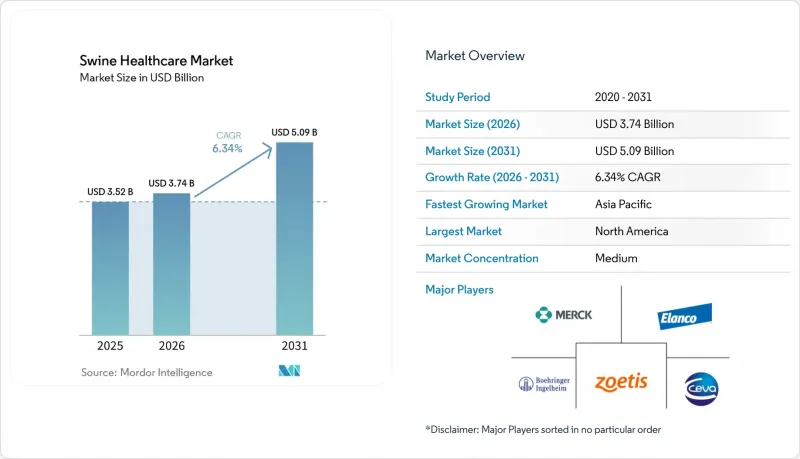
This report is Segmented by Product [Diagnostics (ELISA, Rapid Immune Migration (RIM) and More), Therapeutics (Vaccines and More)], Disease (Exudative Dermatitis, Coccidiosis, and More), End User (Large Integrated Swine Operations, and More), and Geography (North America, Europe, Asia-Pacific, Middle East & Africa, South America). The Market Forecasts are Provided in Terms of Value (USD).
Global Swine Healthcare Market Trends and Insights
Rising Incidence of Endemic & Trans-boundary Swine Diseases
African Swine Fever remains the chief catalyst for vaccine and diagnostic investment, generating trade restrictions that force weekly PCR surveillance in high-risk zones . Porcine reproductive and respiratory syndrome costs U.S. producers about USD 664 million annually through lower litter sizes and secondary infections. IDEXX and Thermo Fisher launched multiplex PCR panels in 2025 that differentiate ASF, Seneca Valley virus, and PCV-3 within hours, limiting needless movement bans and culling. Sustained disease pressure keeps the swine healthcare market's preventive segment resilient even as gene-editing projects progress. Integrated producers, therefore, prioritize vaccine coverage and rapid diagnostics to avoid the steep direct and opportunity costs of outbreaks.
Expanding Global Pork Demand & Intensifying Production Systems
Per-capita pork intake climbed 8% in Vietnam, 6% in the Philippines, and 12% in India between 2020 and 2025 . To capture demand, developers financed 10,000-head facilities that copy North American closed-herd biosecurity, elevating baseline spending on vaccines, probiotics, and real-time monitoring. Brazil's pork exports reached 1.2 million t in 2025 on the back of integrated giants BRF S.A. and JBS, both mandating autogenous vaccines to protect pathogen-free status. Concentrated buying power rewards suppliers that prove antibiotic-free performance, deepening adoption of diagnostics and feed additives. The structural shift to industrial production, therefore, entrenches multi-product purchasing contracts that enlarge the swine healthcare market.
Complex, Region-Specific Regulatory Approval Timelines & Costs
mRNA and viral-vector vaccines face 5-to-7-year U.S. pathways and even longer EU vetting that demands multi-country field trials. Zoetis disclosed cumulative ASF vaccine development spend above USD 150 million through 2025, with revenues contingent on approvals in at least three large markets. China requires separate domestic trials, and the approval queue averaged 42 months in 2024. Protracted timelines raise opportunity costs as pathogens mutate and integrators pivot to interim autogenous vaccines, shrinking the eventual addressable pool once full licenses arrive. Smaller biotech firms thus struggle to finance elongated campaigns, concentrating innovation among cash-rich multinationals.
Other drivers and restraints analyzed in the detailed report include:
- Surging R&D Spend on Novel Vaccines, Diagnostics & Feed Additives
- Stricter Food-Safety / Preventive-Health Regulations Worldwide
- High Treatment & Vaccination Costs for Smallholders in Emerging Markets
For complete list of drivers and restraints, kindly check the Table Of Contents.
Segment Analysis
Therapeutics captured 54.33% of the swine healthcare market share in 2025, reflecting steady demand for PRRS and Mycoplasma vaccines, parasiticides, and anti-infectives. Diagnostics contributed a smaller slice in 2025, yet their value is projected to outpace drugs at a 7.43% CAGR through 2031 as large integrators adopt weekly PCR surveillance and serology benchmarking. ELISA kits still dominate routine herd screening, but multiplex real-time PCR panels that detect ASF, Seneca Valley virus, and PCV-3 from one sample are winning orders from U.S., EU, and Chinese mega-farms. Feed additives, classified within therapeutics, posted a notable CAGR between 2020 and 2025 after the EU zinc-oxide ban steered demand toward organic acids and phytogenics. Rapid lateral-flow tests that deliver results in 15 minutes are popular among Southeast Asian veterinarians who lack lab infrastructure, expanding diagnostics penetration beyond premium markets.
The shift from curative drugs to preventive screening lifts the segment's revenue intensity and embeds subscription-style purchases of consumables. IDEXX reported North American swine PCR volume up significantly year-over-year in 2025, evidencing that higher testing frequency offsets lower per-test pricing. Portable ultrasound devices released in 2024 enable on-farm reproductive imaging, nudging diagnostics into previously under-served management tasks. Autogenous vaccines, once a niche service, now underpin long-tail revenue for custom manufacturers acquired by Boehringer Ingelheim and Ceva. As integrators use analytics to refine vaccine schedules, therapeutics growth moderates while diagnostics accelerate, preserving the overall swine healthcare market's 6.34% CAGR trajectory
Geography Analysis
North America generated 45.3% of global revenue in 2025, supported by a 74 million head inventory and strict USDA biosecurity enforcement that obliges certification for export partners Mexico, Japan, and South Korea. Canada's voluntary data-sharing framework, adopted in 2024, incentivizes producers to submit diagnostic results in exchange for benchmarking, creating a positive feedback loop for laboratory growth. Mexico's pork production rose in 2025, and the integrated supply chain with the United States means disease events in one nation quickly elevate vaccine and diagnostic purchasing in the other.
Asia-Pacific is forecast to register a 7.54% CAGR during 2026-2031, marking the fastest regional advance in the swine healthcare market. China's directive that all inter-provincial pig movements pass PCR testing structurally elevates diagnostic volume, while localized ASF flare-ups sustain vaccine demand despite gradual herd rebuild. Vietnam scaled pork output to 4.8 million tonnes in 2025 on the back of biosecurity subsidies and an emergency-use ASF vaccine, yet the lack of peer-reviewed efficacy data tempers neighboring import approvals. India's urban middle class is increasing pork intake, but fragmented smallholder supply chains restrict veterinary service access, presenting future upside for low-cost thermostable vaccines.
Europe contributed significantly to global sales in 2025, led by Germany, Spain, and France, where animal-welfare rules and the zinc-oxide ban funnel expenditure into vaccines and feed additives with antibiotic-free claims. Spain shipped notable portion of pork to China in 2025, underscoring the region's stake in pathogen-free certification. Integrated Brazilian producers copy North American herd-health models to protect 1.2 million t of exports, channeling spend toward multinational vaccine and diagnostic suppliers. Middle East and Africa remain small, but South Africa's commercial sector and Nigeria's rapid herd expansion could unlock latent demand if cold-chain and veterinary staffing improve.
- ADM Animal Nutrition
- Alltech
- Boehringer Ingelheim Pharma GmbH & Co. KG
- Cargill Animal Nutrition
- Ceva
- DSM-Firmenich
- Elanco
- HIPRA Laboratories
- Huvepharma
- IDEXX
- IDVet
- Jinyu Bio-Technology
- Kemin Industries
- KM Biologics
- Merck
- Phibro Animal Health
- Thermo Fisher Scientific (Vet)
- Vaxxinova
- Vetoquinol
- Virbac
- Zoetis
Additional Benefits:
- The market estimate (ME) sheet in Excel format
- 3 months of analyst support
TABLE OF CONTENTS
1 Introduction
- 1.1 Study Assumptions & Market Definition
- 1.2 Scope of the Study
2 Research Methodology
3 Executive Summary
4 Market Landscape
- 4.1 Market Overview
- 4.2 Market Drivers
- 4.2.1 Rising Incidence of Endemic & Transboundary Swine Diseases
- 4.2.2 Expanding Global Pork Demand & Intensifying Production Systems
- 4.2.3 Surging R&D Spend on Novel Vaccines, Diagnostics & Feed Additives
- 4.2.4 Stricter Food-Safety / Preventive-Health Regulations Worldwide
- 4.2.5 Rapid Adoption of Precision-Livestock-Farming (PLF) Analytics
- 4.2.6 Growth Of Autogenous & Custom Vaccines in Vertically Integrated Herds
- 4.3 Market Restraints
- 4.3.1 Complex, Region-Specific Regulatory Approval Timelines & Costs
- 4.3.2 High Treatment & Vaccination Costs for Smallholders in Emerging Markets
- 4.3.3 Cold-Chain & Vaccine-Handling Gaps in Backyard / Informal Sectors
- 4.3.4 Gene-Edited ASF-Resistant Pig Lines Could Curb Future Demand
- 4.4 Supply-Chain Analysis
- 4.5 Regulatory Landscape
- 4.6 Technological Outlook
- 4.7 Porter's Five Forces Analysis
- 4.7.1 Threat of New Entrants
- 4.7.2 Bargaining Power of Buyers
- 4.7.3 Bargaining Power of Suppliers
- 4.7.4 Threat of Substitutes
- 4.7.5 Competitive Rivalry
5 Market Size & Growth Forecasts (Value, USD)
- 5.1 By Product
- 5.1.1 Diagnostics
- 5.1.1.1 ELISA
- 5.1.1.2 Rapid Immuno Migration (RIM)
- 5.1.1.3 Polymerase Chain Reaction (PCR)
- 5.1.1.4 Diagnostic Imaging
- 5.1.1.5 Other Diagnostics
- 5.1.2 Therapeutics
- 5.1.2.1 Vaccines
- 5.1.2.1.1 Live Attenuated
- 5.1.2.1.2 Inactivated
- 5.1.2.1.3 Subunit / Recombinant
- 5.1.2.1.4 Autogenous / Custom
- 5.1.2.2 Parasiticides
- 5.1.2.3 Anti-infectives
- 5.1.2.4 Feed Additives
- 5.1.2.5 Other Therapeutics
- 5.1.2.1 Vaccines
- 5.1.1 Diagnostics
- 5.2 By Disease
- 5.2.1 Exudative Dermatitis (Greasy Pig)
- 5.2.2 Coccidiosis
- 5.2.3 Respiratory Diseases (incl. PRRS, MHyo)
- 5.2.4 Swine Dysentery
- 5.2.5 Porcine Parvovirus
- 5.2.6 Emerging Viral Diseases (ASF, Seneca Valley, PCV-3)
- 5.3 By End User
- 5.3.1 Large Integrated Swine Operations
- 5.3.2 Medium Commercial Farms
- 5.3.3 Smallholder / Backyard Farms
- 5.3.4 Veterinary Reference Laboratories
- 5.3.5 Government Animal-Health Agencies
- 5.4 By Geography
- 5.4.1 North America
- 5.4.1.1 United States
- 5.4.1.2 Canada
- 5.4.1.3 Mexico
- 5.4.2 Europe
- 5.4.2.1 Germany
- 5.4.2.2 United Kingdom
- 5.4.2.3 France
- 5.4.2.4 Italy
- 5.4.2.5 Spain
- 5.4.2.6 Rest of Europe
- 5.4.3 Asia-Pacific
- 5.4.3.1 China
- 5.4.3.2 India
- 5.4.3.3 Japan
- 5.4.3.4 South Korea
- 5.4.3.5 Australia
- 5.4.3.6 Rest of APAC
- 5.4.4 Middle East & Africa
- 5.4.4.1 GCC
- 5.4.4.2 South Africa
- 5.4.4.3 Rest of MEA
- 5.4.5 South America
- 5.4.5.1 Brazil
- 5.4.5.2 Argentina
- 5.4.5.3 Rest of South America
- 5.4.1 North America
6 Competitive Landscape
- 6.1 Market Concentration
- 6.2 Market Share Analysis
- 6.3 Company Profiles (includes Global level Overview, Market level Overview, Core Segments, Financials as available, Strategic Information, Market Rank/Share, Products & Services, Recent Developments)
- 6.3.1 ADM Animal Nutrition
- 6.3.2 Alltech
- 6.3.3 Boehringer Ingelheim Pharma GmbH & Co. KG
- 6.3.4 Cargill Animal Nutrition
- 6.3.5 Ceva Animal Health
- 6.3.6 DSM-Firmenich
- 6.3.7 Elanco Animal Health
- 6.3.8 HIPRA Laboratories
- 6.3.9 Huvepharma
- 6.3.10 IDEXX Laboratories
- 6.3.11 IDvet
- 6.3.12 Jinyu Bio-Technology
- 6.3.13 Kemin Industries
- 6.3.14 KM Biologics
- 6.3.15 Merck & Co., Inc.
- 6.3.16 Phibro Animal Health
- 6.3.17 Thermo Fisher Scientific (Vet)
- 6.3.18 Vaxxinova
- 6.3.19 Vetoquinol SA
- 6.3.20 Virbac
- 6.3.21 Zoetis Inc.
7 Market Opportunities & Future Outlook
- 7.1 White-space & Unmet-need Assessment

